
Stablecoins are no longer a single-category product. Most aim to trade near $1, but they serve different roles across trading liquidity, payments, collateral, settlement, yield strategies, and on-chain dollar movement.
There is no single “best” stablecoin for every market participant. Tether (USDT) leads on liquidity and exchange depth. USD Coin (USDC) stands out for regulatory alignment and reserve transparency. Dai (DAI) keeps a decentralized collateral angle alive. World Liberty Financial USD (USD1) brings a newer fiat-backed reserve model into the market. Ethena USDe (USDe) represents the synthetic-dollar category.
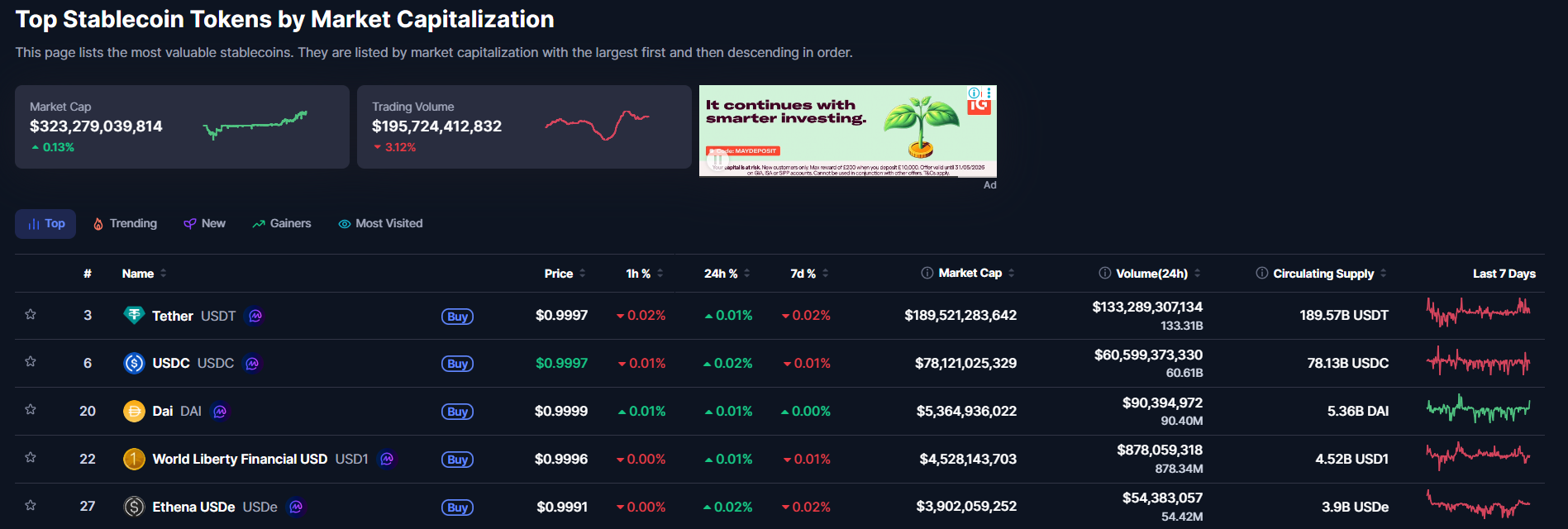
Top stablecoin tokens by market capitalization from CoinMarketCap, as of May 2026.
The stablecoin sector now sits around $323 billion in market capitalization, with daily trading volume near $196 billion. That scale makes stablecoins more than trading tools. They support exchange liquidity, cross-border settlement, decentralized finance (DeFi), payment flows, and tokenized asset activity.
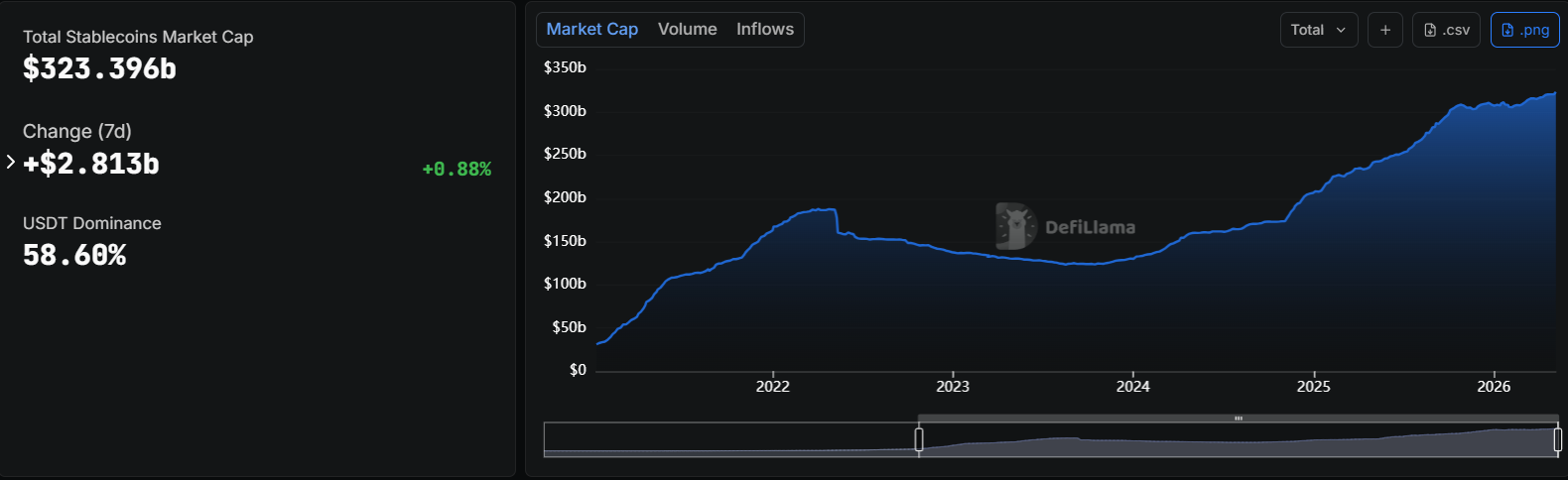
Total stablecoin market capitalization from DeFiLlama, as of May 2026.
The useful question is not which stablecoin is universally better. It is what each stablecoin is built for, how its backing or mechanism works, where it is used, and what risk comes with that design.
Why stablecoins are not interchangeable
Stablecoins look similar at the price level because most target the same dollar peg. Under the surface, their structures can be very different.
A fiat-backed stablecoin depends on reserves, custody, banking relationships, attestations, and redemption confidence. A decentralized stablecoin depends more on collateral design, protocol governance, and on-chain risk management. A synthetic dollar depends on hedging, funding markets, custodians, exchanges, and execution quality.
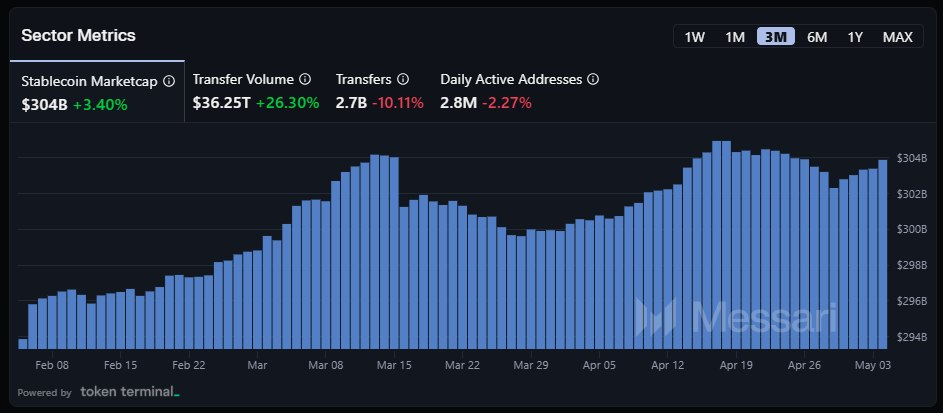
Stablecoin sector metrics from Messari, as of May 2026.
That difference shapes how each token should be evaluated:
-
Liquidity use case: Built for traders who need deep exchange markets and fast settlement
-
Regulatory use case: More relevant for institutions, payment firms, and protocols that prioritize reserve clarity and compliance
-
DeFi use case: Useful for collateral, lending, liquidity pools, and decentralized settlement
-
New-issuer use case: Worth tracking when a stablecoin gains exchange access, reserve support, and market-cap growth
-
Synthetic-dollar use case: Relevant for crypto-native dollar exposure and yield-linked structures, with higher mechanism risk
How these tokens were chosen
These 5 tokens were selected using 3 filters:
-
Market leadership: Each token has visible scale in the stablecoin category
-
Reserve design: The list includes fiat-backed, decentralized, and synthetic-dollar structures
-
Catalyst strength: Each token has a live adoption, regulatory, product, reserve, or market-access reason to stay on watchlists
This is not a ranking of the “best” stablecoins. It is a watchlist of the most relevant stablecoins by market cap, based on how each token fits a different role in the market.

Stablecoin leaders and movers from Messari, as of May 2026.
1. Tether (USDT)
The catalyst: Liquidity dominance and Treasury-heavy reserve scale
USDT remains the stablecoin liquidity anchor. It holds a market cap of about $189.54 billion, with 24-hour trading volume above $133 billion and circulating supply near 189.57 billion USDT.
Tether positions USDT as a fiat-pegged stablecoin backed by reserve assets. Its Q1 2026 update pointed to about $141 billion in direct and indirect U.S. Treasury bill exposure as of March 31, 2026, reinforcing the scale of its reserve base.
Here is what Tether does at a product level:
-
Trading liquidity: USDT supports deep trading pairs across centralized exchanges and crypto venues
-
Dollar settlement: USDT is used for dollar-denominated transfers, settlement, and liquidity movement
-
Multi-network access: USDT circulates across multiple blockchains, giving traders and protocols broad transfer options
-
Reserve-backed model: Tether positions USDT as a fiat-pegged stablecoin supported by reserve assets
-
Cross-border utility: USDT remains widely used for fast dollar-linked transfers outside traditional banking rails
Why it matters / What to watch
USDT belongs at the top of this list because stablecoin liquidity still runs through it. Its scale gives it a direct role in exchange depth, cross-market settlement, and crypto-native dollar flows.
The main risk is reserve confidence. USDT’s market role is unmatched, but reserve transparency, asset composition, and regulatory scrutiny remain key watch points. The stronger USDT gets, the more important those questions become for institutions, exchanges, and market participants.
2. USD Coin (USDC)
The catalyst: Regulatory alignment and institutional reserve structure
USDC is the main regulated-stablecoin counterweight to USDT. It holds a market cap of about $78.10 billion, with 24-hour trading volume above $60 billion and circulating supply near 78.13 billion USDC.
Circle positions USDC as a dollar stablecoin backed by equivalent-value reserve assets, including cash and the Circle Reserve Fund. Circle also states that USDC and EURC are compliant with the Markets in Crypto-Assets (MiCA) regulation in the European Union, giving USDC one of the clearest regulatory-alignment narratives among major stablecoins.
Here is what USDC does at a product level:
-
Regulated dollar access: USDC gives exchanges, protocols, and institutions a reserve-backed digital dollar
-
Payments and settlement: USDC is used for transfers, merchant flows, and crypto-native settlement
-
DeFi collateral: USDC remains a major collateral and liquidity asset across DeFi
-
Reserve transparency: Circle’s model emphasizes cash, short-dated U.S. Treasuries, and reserve reporting
-
Tokenized finance: USDC has a direct role in tokenized asset activity and institutional on-chain settlement
Why it matters / What to watch
USDC belongs on this list because it gives the stablecoin sector a regulated-infrastructure angle. It is not as large as USDT, but it is widely used by protocols, exchanges, payment providers, and institutions that prioritize compliance and reserve clarity.
The main risk is business-model pressure. Circle’s growth depends on circulation, distribution, reserve yield, and regulated market access. If reserve-yield economics weaken or distribution costs rise, USDC can still grow while Circle faces tighter margins.
3. Dai (DAI)
The catalyst: Sky ecosystem transition and decentralized stablecoin relevance
DAI remains one of the most visible decentralized stablecoins by market cap. It holds a market cap of about $5.36 billion, with 24-hour trading volume near $90 million and circulating supply around 5.36 billion DAI.
DAI’s current story is closely tied to the Sky Protocol transition. MakerDAO rebranded to Sky in 2024, while DAI and USDS now coexist inside the broader ecosystem. Sky’s newer products, including the Sky Savings Rate and staked USDS (sUSDS), have become central to the current growth narrative.
Here is what DAI does at a product level:
-
Decentralized dollar liquidity: DAI gives DeFi protocols a crypto-native stablecoin option
-
Collateral-backed design: DAI is tied to collateral systems rather than a simple bank-deposit reserve model
-
Borrowing and lending: DAI remains useful across lending markets, collateral positions, and liquidity pools
-
Sky ecosystem role: DAI now sits beside USDS as Sky shifts toward newer stablecoin products
-
On-chain settlement: DAI still functions as a settlement asset across decentralized applications and protocols
Why it matters / What to watch
DAI belongs on this list because it prevents the stablecoin discussion from becoming only a fiat-reserve story. Its role is tied to DeFi liquidity, collateral design, and decentralized stablecoin infrastructure.
The main risk is narrative dilution. DAI remains important, but Sky’s newer USDS and sUSDS products now carry much of the ecosystem’s current growth story. The key question is whether DAI can keep meaningful DeFi relevance as Sky’s product focus shifts.
4. World Liberty Financial USD (USD1)
The catalyst: BitGo-backed reserve model and rapid market growth
USD1 is one of the most visible new entrants in the stablecoin category. It holds a market cap of about $4.53 billion, with 24-hour trading volume near $874 million and circulating supply around 4.53 billion USD1.
USD1 is connected to World Liberty Financial and uses BitGo-linked reserve infrastructure. BitGo states that USD1 is 100% backed by short-term U.S. government Treasuries, U.S. dollar deposits, and other cash equivalents, with monthly attestation reporting by third-party accounting firms.
Here is what USD1 does at a product level:
-
Fiat-backed settlement: USD1 is designed for dollar-denominated transfers and market settlement
-
Reserve structure: USD1 is positioned around Treasuries, dollar deposits, and cash-equivalent backing
-
Custody infrastructure: BitGo provides a key custody and reserve-support role
-
Exchange access: Binance listed USD1 spot trading, improving visibility and market access
-
New-entrant growth: USD1 gives the stablecoin sector a fresh issuer and distribution story
Why it matters / What to watch
USD1 belongs on this list because it has grown quickly into a large visible stablecoin. Its reserve structure, custody setup, exchange access, and institutional transaction visibility make it more relevant than a typical new stablecoin launch.
The main risk is operating history. USD1 still needs a longer track record across redemptions, attestations, exchange liquidity, and real settlement demand. Issuer concentration and political-brand risk also make careful wording important.
5. Ethena USDe (USDe)
The catalyst: Synthetic-dollar demand and sUSDe yield
USDe is the strongest synthetic-dollar candidate in the visible list. It holds a market cap of about $3.9 billion, with 24-hour trading volume around $58 million and circulating supply near 3.9 billion USDe.
Ethena’s design is different from traditional fiat-backed stablecoins. Its documentation states that USDe uses delta-neutral hedges against backing assets through perpetual and deliverable futures contracts, while also holding liquid stablecoins such as USDC and USDT.
Here is what Ethena USDe does at a product level:
-
Synthetic dollar exposure: USDe gives crypto-native dollar exposure without using the same fiat-reserve model as USDT or USDC
-
Delta-neutral design: The protocol uses hedging to support relative peg stability
-
Staking layer: sUSDe allows holders to receive rewards through Ethena’s staking system
-
Crypto-native yield: USDe connects stablecoin demand with funding markets and protocol-level yield design
-
Market structure exposure: USDe’s model depends on execution across exchanges, custodians, and hedging venues
Why it matters / What to watch
USDe belongs on this list because it represents the synthetic-dollar category. It is useful for understanding how stablecoins are expanding beyond fiat reserves and decentralized collateral alone.
The main risk is complexity. USDe depends on hedging execution, funding-rate conditions, custody controls, exchange exposure, and peg management. It can grow quickly when market conditions support the model, but it requires more risk awareness than simple fiat-backed stablecoins.
Stablecoin outlook
The stablecoin sector is no longer a single market with 1 design. USDT and USDC still dominate liquidity, but DAI, USD1, and USDe show how the category is splitting into different models.
The main divide is clear. Some stablecoins compete on scale and trading depth. Some compete on regulatory alignment. Others compete on decentralization, yield design, or new distribution channels.
That segmentation makes the sector more useful, but also more complex. Stablecoins can look similar at the price level, but their risks are not the same.
The bottom line
The stablecoin market is expanding beyond simple dollar liquidity. USDT and USDC remain the core anchors, while DAI, USD1, and USDe show how the sector is moving across decentralized, new fiat-backed, and synthetic-dollar models.
The main opportunity is stablecoin growth across trading, payments, settlement, and on-chain finance. The main risk is mechanism design: Reserve quality, regulation, issuer trust, and hedging execution can separate stronger stablecoins from weaker ones quickly.
This article is for informational purposes only and does not constitute financial advice. Always do your own research (DYOR) before making any decisions.
How to buy crypto on Toobit
To buy crypto on Toobit, create an account, complete verification, and go to Buy Crypto. Choose a token, select a payment method, and confirm the purchase. Your assets will appear in Spot Account once the transaction settles.
Congratulations, you now know how to purchase crypto on Toobit!


