
Lowering the barrier to entry
Optimism (OP) allows you to launch your own blockchain and capture the upside of every transaction. Its Superchain handles operations and scaling so you can focus on shipping products, not running blockchains.
This Ethereum-secured token is viewed as a masterclass in ecosystem growth. On the other hand, its price is held back by an aggressive unlock schedule which retail chooses to ignore.
Regardless, this project allows you to spend more time growing your business instead of blockchain technicalities.
What is Optimism (OP)?
Optimism (OP) is among the leading Ethereum Layer 2 (L2) scaling solutions available today, especially when it comes to ecosystem growth. It processes transactions off-chain while benefiting from the decentralized security of Ethereum.
The network is designed to function as a high-speed blockchain express lane while providing ultra-fast speeds. It accomplishes this by using optimistic rollup technology, which assumes transactions are valid by default.
This results in near-instant processing, while a seven-day challenge period ensures integrity by allowing participants to submit Fault Proofs to reverse any fraudulent activity. The technology balances speed and security, positioning it as a solution for decentralized finance (DeFi) and consumer applications.
Optimism has also evolved beyond a single blockchain into the OP Stack, a modular framework that serves as the blueprint for the Superchain. It is a massive ecosystem of interoperable networks, which includes industry giants like Coinbase’s Base and World Chain.
Their shared technical architecture allows these chains to form a unified web that handles a significant portion of global Layer 2 activity.
The deployment of recent technical milestones has further enhanced its utility, such as Flashblocks, which slashes confirmation times to just 250 milliseconds. It also implemented a revenue-buyback model using 50% of sequencer revenue generated across the entire Superchain to buy back OP.
Such enterprise guarantees, combined with a solid infrastructure for businesses to launch their own blockchains make Optimism a top L2 choice.
Optimism price history and performance overview
Optimism price history
OP reached its all-time high (ATH) of $4.85 on March 6, 2024, and is currently down about 97.48%. This was driven by U.S. approval of spot Bitcoin exchange-traded funds (ETFs) and Layer 2 (L2) network growth.
It recently printed its all-time low (ATL) of $0.0999 on March 30, 2026, and is now up 22.11%. This was due to significant token unlocks, competition from other L2 solutions, and a risk-off sentiment.
Optimism's latest performance
Price action for OP from April 27 to May 3, 2026, was between $0.1175 and $0.1279. It is slowly regaining upward momentum since coming down from $0.1324 on April 25, 2026.
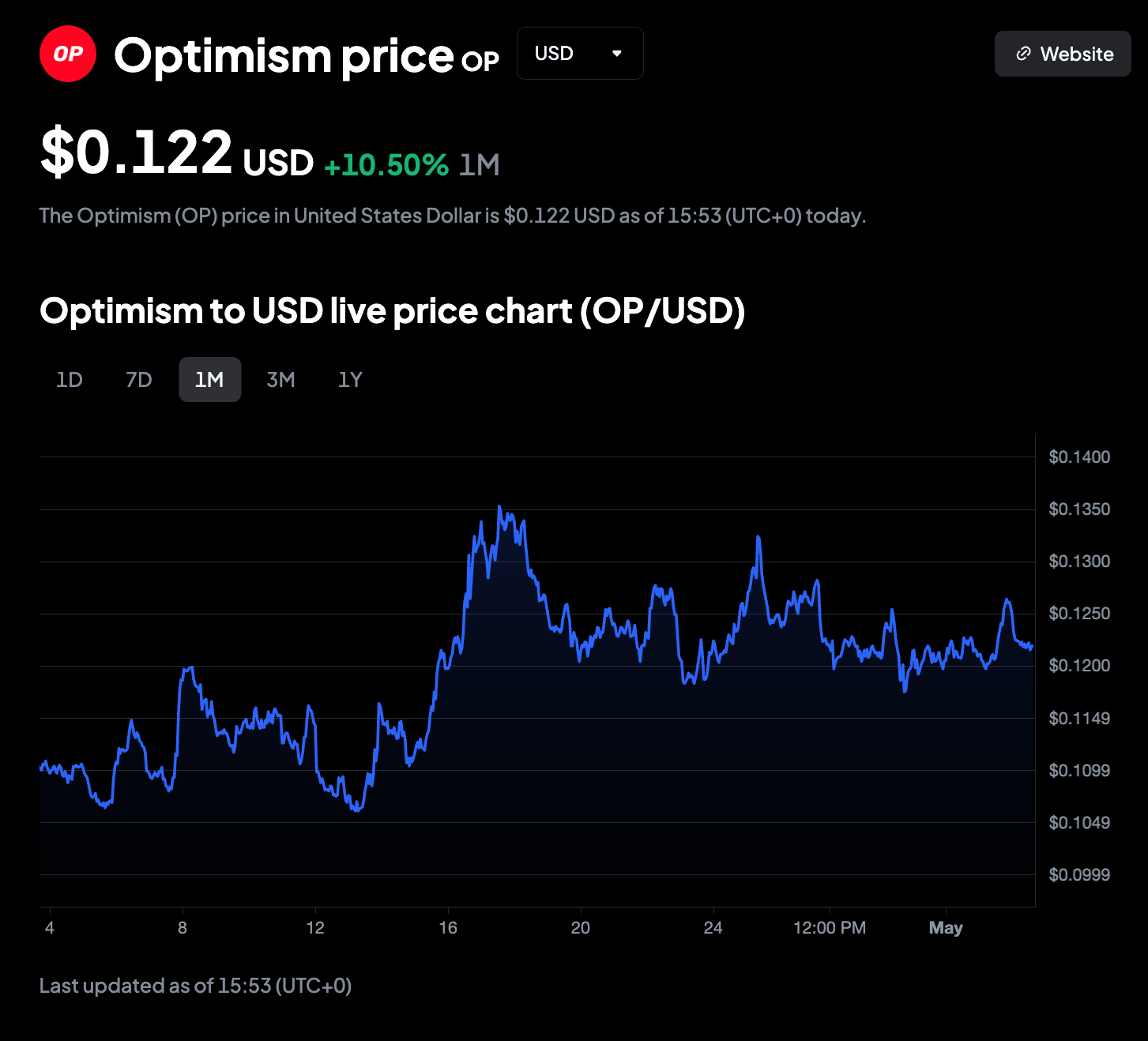
OP to USD live price chart on May 4, 2026, 15:53 UTC from Toobit
OP’s market cap ranged between $252.18 million and $276.61 million within this same period. It has 2.15 billion OP in circulation with a total supply of 4.29 billion OP.
Current market snapshot (May 3, 2026, 23:57 UTC+8)
OP is down just 0.89% in the last 24 hours. It is currently trading at $0.1220 on the OP/USDT spot chart.
About 49.11% of the total supply of 4.29 billion OP has yet to enter into circulation. It has a market cap of $262.51 million, which is only down 0.78% from yesterday.
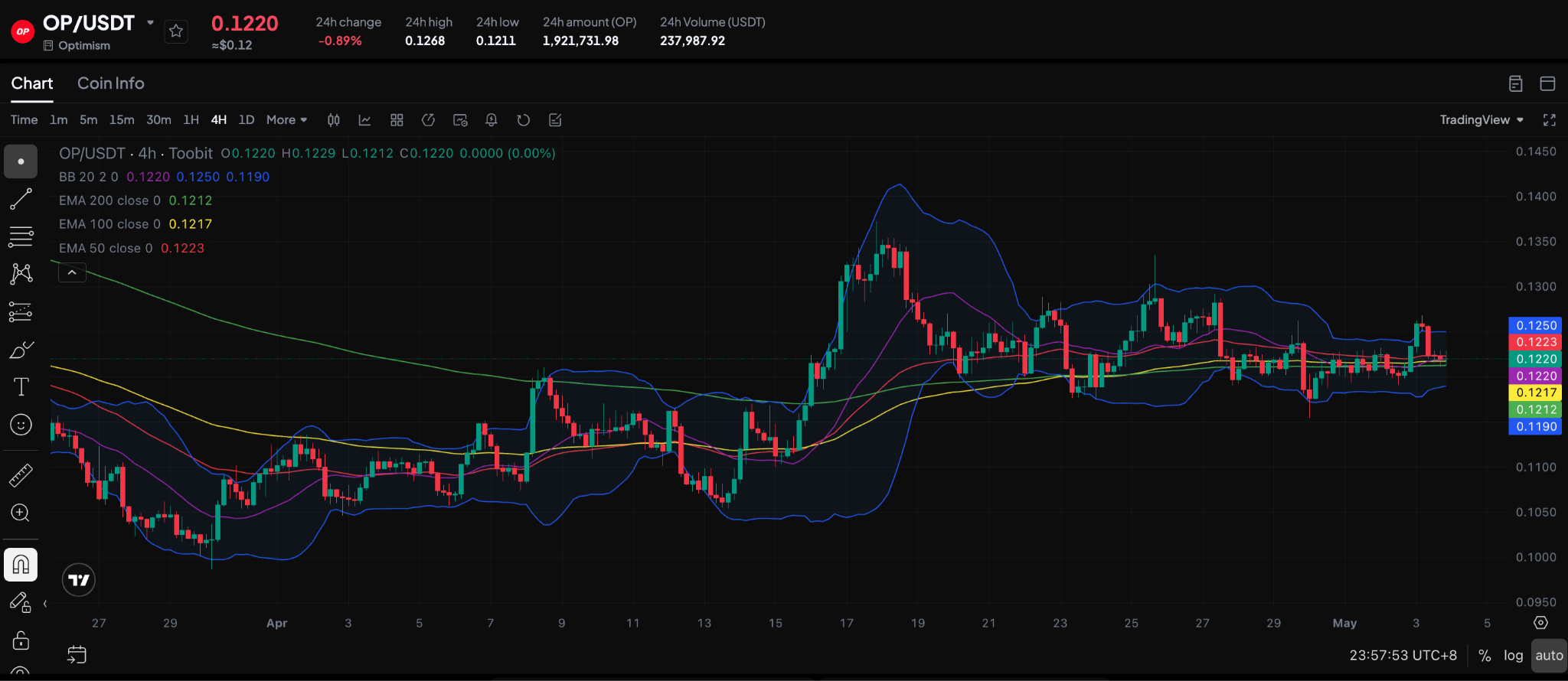
OP/USDT 4-hour spot trading chart from Toobit
Price has been trading between $0.1191 and $0.1268 in the last 24 hours. It has been steadily building support after dropping to its ATL on March 30, 2026.
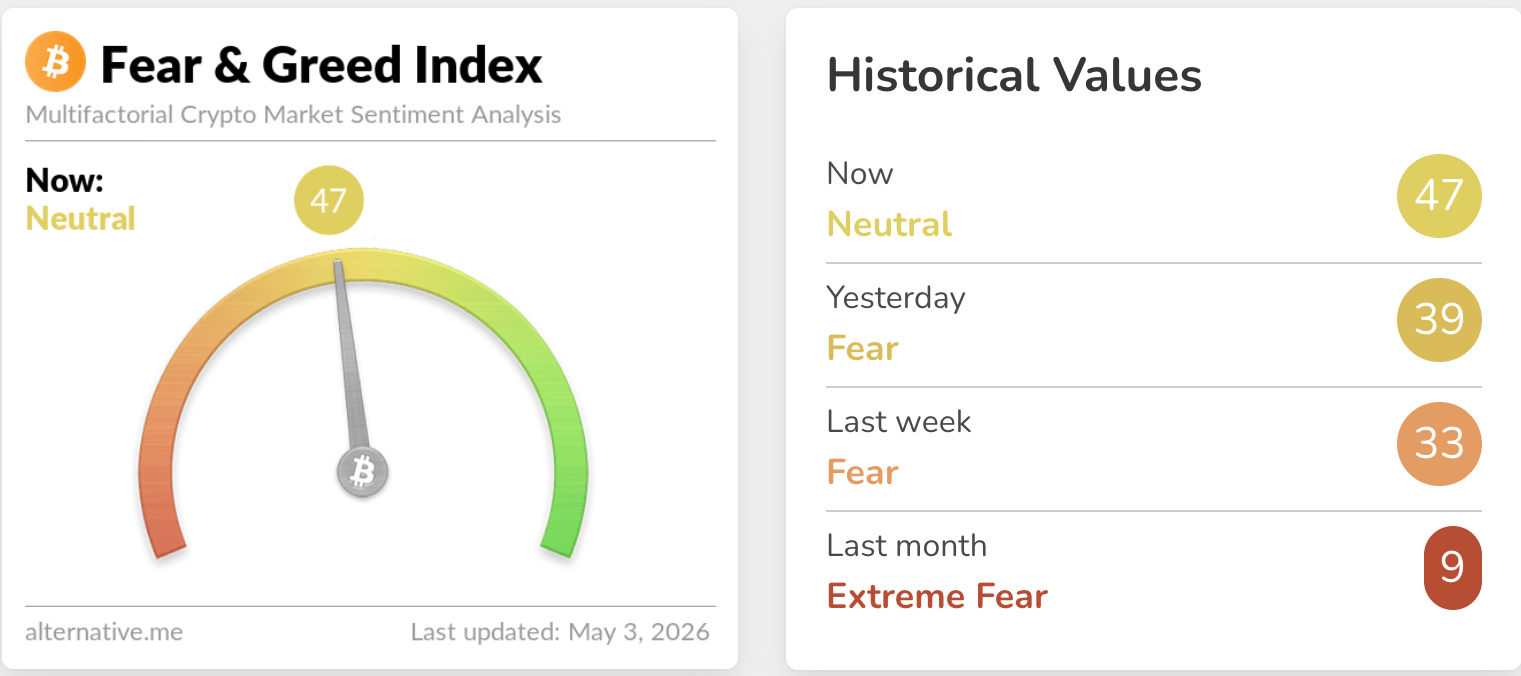
Crypto Fear and Greed Index on May 3, 2026, from Alternative.me
The overall Fear and Greed Index for Bitcoin and other large cryptocurrencies currently stands at a 47 (Neutral) reading. It has shown recent improvement after ranging from Extreme Fear to Fear territory since January 19, 2026.
On-chain and technical analysis
Support and resistance
OP has been consolidating since registering its ATL on March 30, 2026, and is building support at the $0.1150 level. It has been trying to hold the $0.3280 region since dropping to that area in October 2025.
Price continued to drop, however, due to a combination of various factors. Among the most notable was the sell-the-news event surrounding approval of the revenue-buyback program of the Optimism Collective.
It pledged 50% of Superchain sequencer revenue to open-market OP purchases. The news was positive, but the market had already priced in the approval, leading to a run-up in price in mid-January.
News of a 31.3 million OP token unlock on January 31, 2026, also contributed to the drop. Retail traders tried to pre-empt token dumping by early investors.
Short-term resistance is at the $0.1658 level. It is necessary to reclaim this area or risk a further drop with no clear support.
Momentum indicators
OP’s 4-hour Relative Strength Index (RSI) is slowly trending upwards as buyers are entering the market. Its RSI is now at 49.70, which appears to be making another attempt at a higher high.
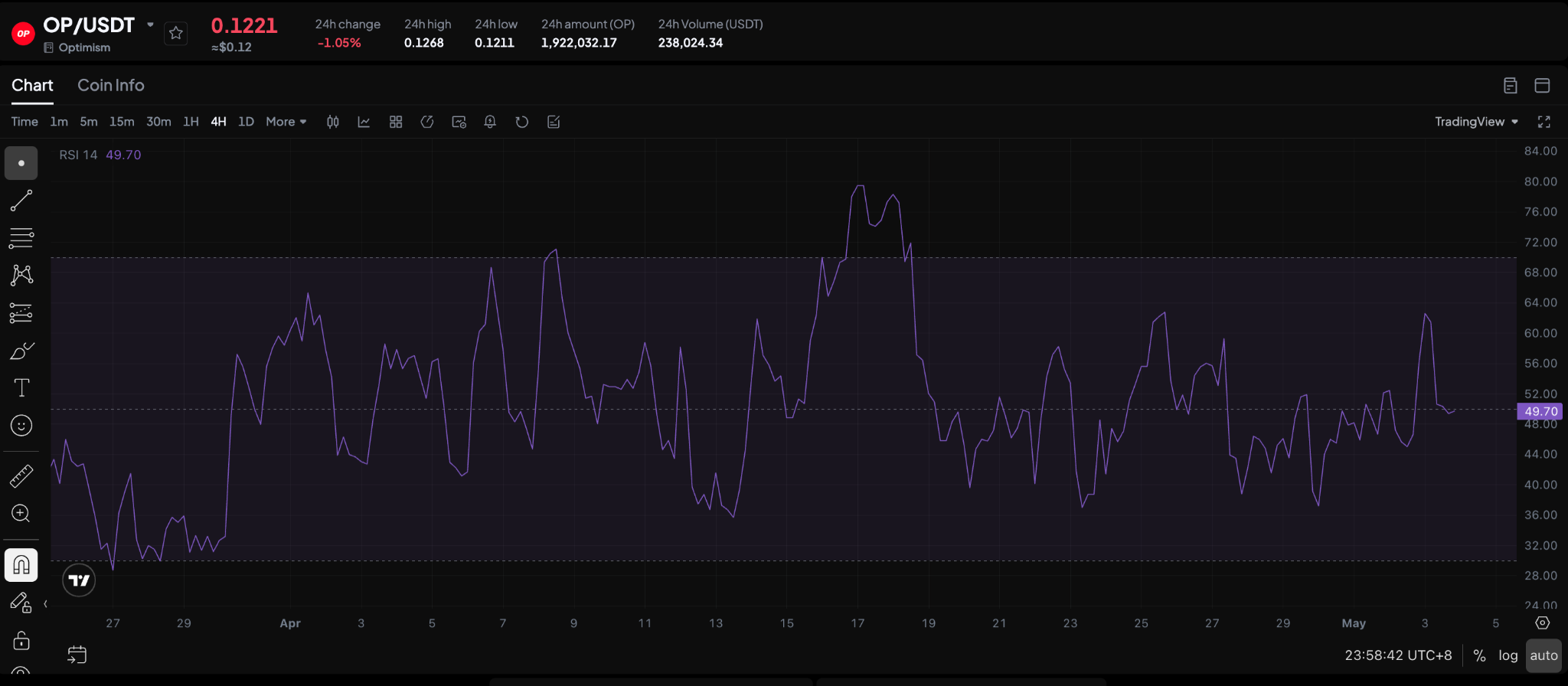
OP/USDT 4-hour RSI chart from Toobit
Its 4-hour Moving Average Convergence/Divergence (MACD) histogram is green at 0.0001 with a similar signal reading. The blue MACD indicator is 0.0002, which indicates ranging price action.
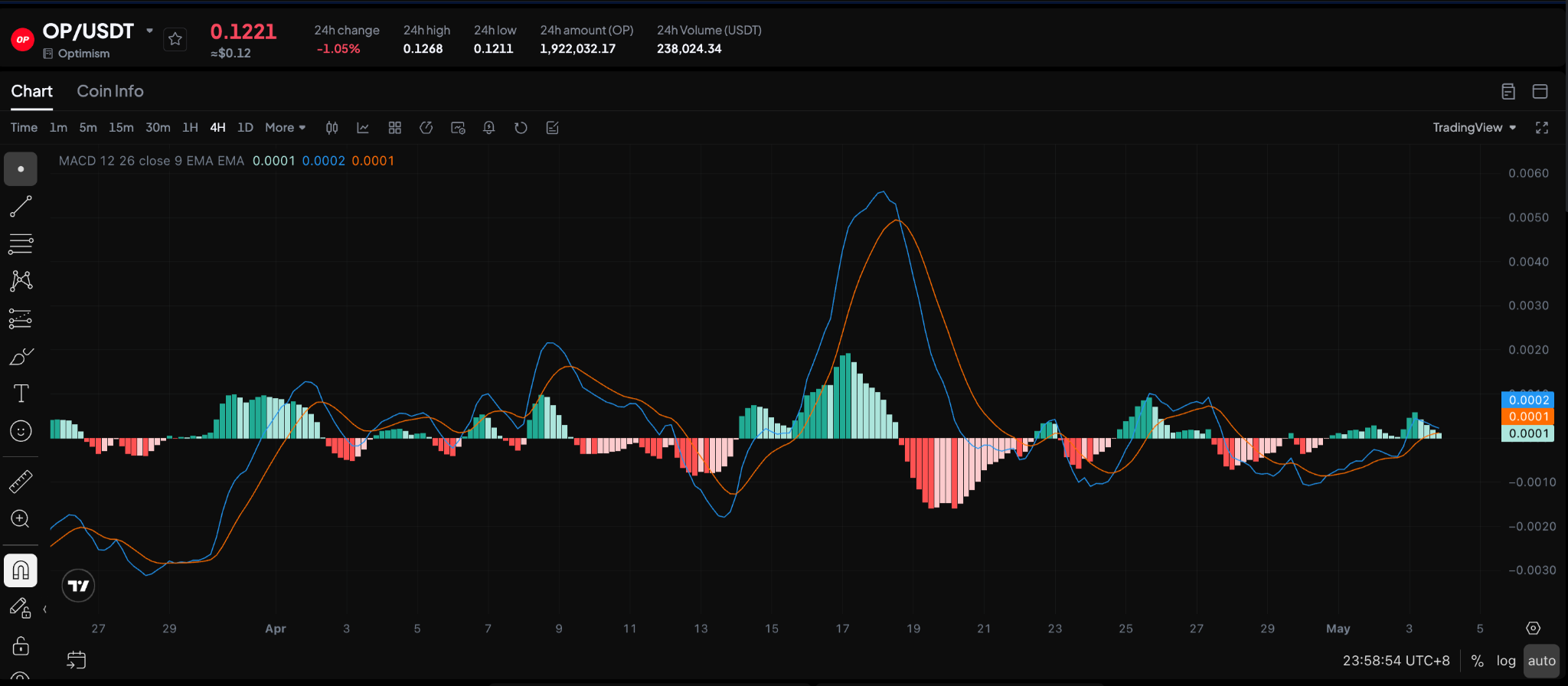
OP/USDT 4-hour MACD chart from Toobit
A more powerful move to the upside may be brewing as momentum switches to green on its daily timeframe.
Moving averages and volume
Price has compressed within its 4-hour timeframe’s 50-day, 100-day and 200-day moving averages (MA) at the start of May. It currently sits at $0.1212, $0.1217, and $0.1223 respectively, and are separated by mere fractions of a cent.
OP’s 24-hour trading volume is currently up by 18.22% at $57.06 million across all exchanges. It reached a high of $67.69 million earlier in the week and a low of $47.67 million.
On-chain cues
Over 30 OP Stack chains contribute revenue to Optimism. Its March 2026 daily transactions reached 16.6 million, with Base accounting for 9.2 million.
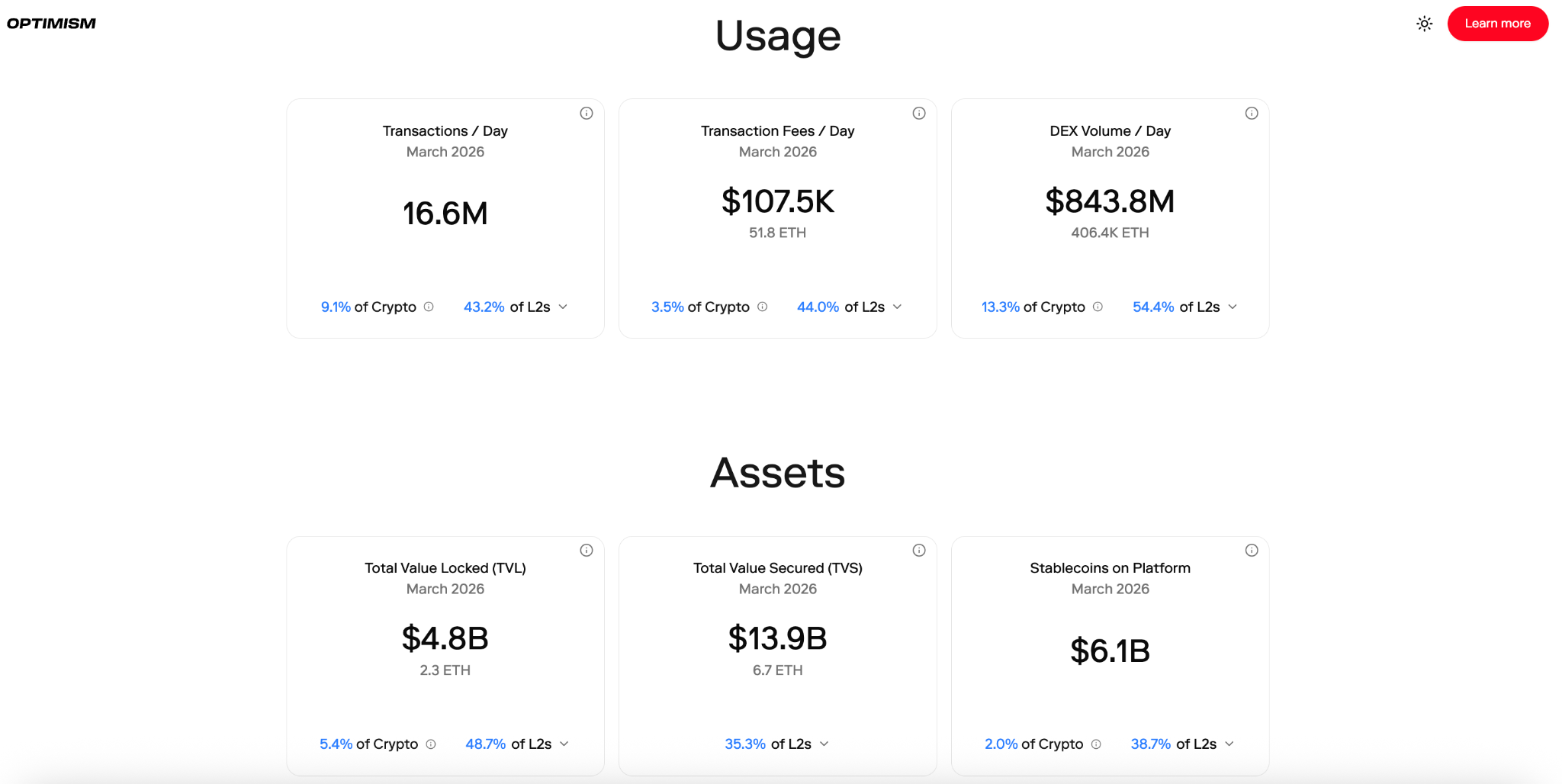
OP Stack statistics on May 3, 2026 from Optimism
These transactions generated $107,500 in fees per day, with daily decentralized exchange (DEX) volume at $843.8 million. Its Total Value Locked (TVL) was $4.8 billion with $6.1 billion stablecoins on the platform in March 2026.
Optimism claims the largest multi-chain ecosystem in crypto with a March 2025 to March 2026 L2 market share of 44%. Its total crypto market share in transaction fees for March 2026 was 3.5%.
Optimism price prediction and outlook
Optimism has grown into an architectural backbone of the decentralized web, with the OP Stack powering a massive, interoperable Superchain. Network activity remains dominant, boasting over 16 million daily transactions and a 44% Layer 2 market share.
Price is currently consolidating near $0.1220 with the 2026 outlook depending on the performance of technical milestones. Upgrades like Flashblocks and the revenue-buyback program must be able to successfully absorb pressure from upcoming token unlocks.
Bull Case: $0.85 to $1.15
The revenue-buyback model could finally outpace scheduled unlocks as migrations like Ronin and GIWA Chain flood the ecosystem with fees. This scenario assumes a broader Ethereum rally following the Pectra upgrade maturity, fully restoring institutional confidence in Superchain infrastructure.
Base Case: $0.45 to $0.65
The price likely stabilizes as the Superchain narrative moves past the Base-exit trauma and consolidates around the $0.50 level. Steady growth from 30-plus interoperable chains provides a firm floor against supply inflation, maintaining OP’s top-tier utility asset status.
Bear Case: $0.05 – $0.08
A prolonged risk-off macro sentiment or additional high-profile partner exits could force the price toward new all-time lows. Under this extreme pressure, the constant stream of unlocked tokens would likely overwhelm the buyback program’s current capacity.
Ultimately, OP remains a high-stakes play on the modular future of Ethereum. It is trading way below its $4.85 high but its decentralized architectural blueprint role is more established than ever.
This article is for informational purposes only and does not constitute financial advice. Always do your own research (DYOR) before making any decisions.
Key milestones for Optimism
-
Founded by Jinglan Wang, Karl Floersch, and Ben Jones (Early 2019): The Plasma Group sought to develop the first production-ready Optimistic Rollup for scaling Ethereum.
-
Public mainnet launch (December 16, 2021): Transitioned from a testing environment to a fully functional, public Ethereum Virtual Machine (EVM) equivalent scaling solution.
-
OP token launch (May 31, 2022): Its native token was introduced and distributed through an airdrop.
-
Bedrock upgrade (June 6, 2023): This major architectural overhaul transitioned the network into the OP Stack architecture, reducing fees and increasing system efficiency.
-
Base and Superchain launch (August 9, 2023): Coinbase’s adoption of the OP Stack officially initiated the Superchain vision of a unified network of interoperable, shared-security blockchains.
-
Ecotone upgrade (March 14, 2024): The Ethereum blobs integration through Ethereum Improvement Proposal (EIP) 4844 brought transaction costs to near-zero for ecosystem users.
-
Flashblocks deployment (September 30, 2025): Block times were reduced to 250 milliseconds, providing near-instant responsiveness required for mass consumer applications.
-
Revenue-buyback era (February 2026): Directly linked ecosystem success to token demand by using 50% of Superchain sequencer profits to buy back OP tokens.
Community sentiment and OP news
As of May 3, 2026, Messari shows OP with a Sentiment Score of 0.0235. Sentiment Scores range from -1.0, being extremely negative, to 1.0, being extremely positive.
OP sentiment score and Tweet volume charts from Messari
Its year-to-date (YTD) peak was a positive score of 0.536, which took place on May 11, 2025. The Ethereum Pectra upgrade and the Superchain interoperability announcements by OP Labs materially contributed to this outcome.
Sentiment of OP however plunged to -0.479 on February 20, 2026. This was triggered by Coinbase’s Base Network announcement that it was shifting away from relying on the OP Stack.
OP’s YTD Tweet volume reached its ATH at 74 on February 19, 2026, due to talk surrounding Base’s exit. Its Tweet volume has since gone down to 4 on May 3, 2026.
OP news
-
(May 4, 2026): Dunamu, the South Korean operator of Upbit, partnered with the Optimism Foundation to build the GIWA Chain using the OP Stack. This enterprise-grade L2 will focus on real-world use cases, including tokenized payments and won-backed stablecoin services.
-
(May 3, 2026): The Ronin gaming network officially migrated to an OP Stack-powered Ethereum L2 to integrate with the Superchain's shared security. It is expected to bring over 1.2 million daily active users and new sequencer revenue to the Optimism ecosystem.
-
(April 30, 2026): MegaETH successfully launched its native token after building on a high-performance, customized version of the OP Stack architecture. The public sale attracted over $1.3 billion in commitments, signaling strong institutional and developer confidence in Optimism's modular technology.
FAQs
What exactly is the Superchain?
It is a growing web of interoperable blockchains sharing the same security and technology. Assets between different chains can move seamlessly, as if they were all part of one single network.
How does the sequencer work?
The sequencer orders and bundles transactions before posting them to Ethereum in bulk. It acts as the network's traffic controller while generating transaction revenue for doing so.
Why do withdrawals to Ethereum take seven days?
It is a security feature, which provides a seven-day challenge period to give the network time to detect and stop potential fraud. The feature is a necessary trade-off for the massive speed and low costs provided by Optimistic Rollup technology.
How does the OP token actually capture value?
The token’s value is driven by a revenue-sharing model, where 50% of sequencer profits from the entire ecosystem are used for token buybacks, along with DAO governance. It links the growth of every chain in the OP Stack directly to the OP token.
What are Flashblocks and why do they matter?
Flashblocks is a technical upgrade that makes using apps on Optimism feel as fast and responsive as a centralized website.
What is the OP Stack?
The OP Stack is the open-source blueprint used to build a blockchain on Optimism. Anyone can use this blueprint to launch their own customized blockchain, compatible with the rest of its ecosystem.
The bottom line
Optimism has successfully pivoted from being just another Ethereum scaler to providing an architectural blueprint for the decentralized web. The OP Stack is both a technical achievement and a massive economic engine.
Its transition to a revenue-buyback model marks a fundamental shift toward institutional-grade sustainability. In spite of such positive features, OP has yet to fully take off in terms of price.
Ultimately, OP is a long-game asset driven by the adoption of the OP Stack across global on-chain activity.
Stay alert and track OP price charts on Toobit for real-time insights.
How to start trading OP on Toobit
Optimism allows you to launch your own blockchain and generate revenue, secured by Ethereum. It is among one of the most used blockchain infrastructures.
Ready to trade OP?
Toobit delivers seamless access through Spot and Futures markets. It features competitive fees, robust liquidity pools, and advanced charting for strategic execution.
Start trading OP/USDT today.


