
Preheader: Track the latest Filecoin price, key FIL USD levels, key technical indicators, and the network milestones that could shape Filecoin’s market outlook in 2026.
When decentralized storage becomes cloud infrastructure
Filecoin enters 2026 with a broader product story than a simple decentralized storage network. Its base layer still focuses on storage and retrieval, but the network is also expanding into a verifiable cloud stack built around storage, data delivery, and on-chain payments.
That story is being shaped by 3 core forces: the rollout of Filecoin Onchain Cloud, the programmability enabled by the Filecoin Virtual Machine (FVM), and governance modernization through the Constellation Program.
The next sections explain how Filecoin works at the infrastructure level, what role FIL plays in that system, and which recent milestones matter most for the project’s longer-term direction.
What is Filecoin (FIL)?
Filecoin storage network overview from Filecoin

Filecoin is a decentralized storage network and open storage marketplace. It supports paid storage, proof-based verification that data remains stored, and retrieval through an open network instead of a single platform.
Here is how the system works at a product level:
-
Storage and retrieval: Filecoin supports storage and retrieval deals with providers. Those deals set the terms for price, duration, and collateral, while retrieval providers return data when needed.
-
Proof-based reliability: Filecoin uses Proof of Replication (PoRep) to show that a provider created a unique copy of data, and Proof of Spacetime (PoST) to show that the provider is still storing that data over time.
-
Programmable infrastructure: Filecoin is also expanding beyond storage through Filecoin Onchain Cloud and the FVM, which position the network around storage, data delivery, and programmable services.
FIL is the network’s native token and sits at the center of Filecoin’s economic model. It is used to pay for storage and retrieval. Storage providers earn FIL through network activity and block rewards. Storage providers must also lock FIL as collateral, and part of that collateral can be slashed and burned if proving requirements are not met.
Additionally, FIL has a governance role, but a simple one-token-one-vote model is not used. Network changes are typically introduced through the Filecoin Improvement Proposal (FIP) process, then discussed and refined through community consensus.
In that process, FIL holders can participate in proposing, deliberating, and shaping changes alongside implementers, Core Devs, storage providers, and other ecosystem stakeholders.
FIL price history and performance overview
FIL price history
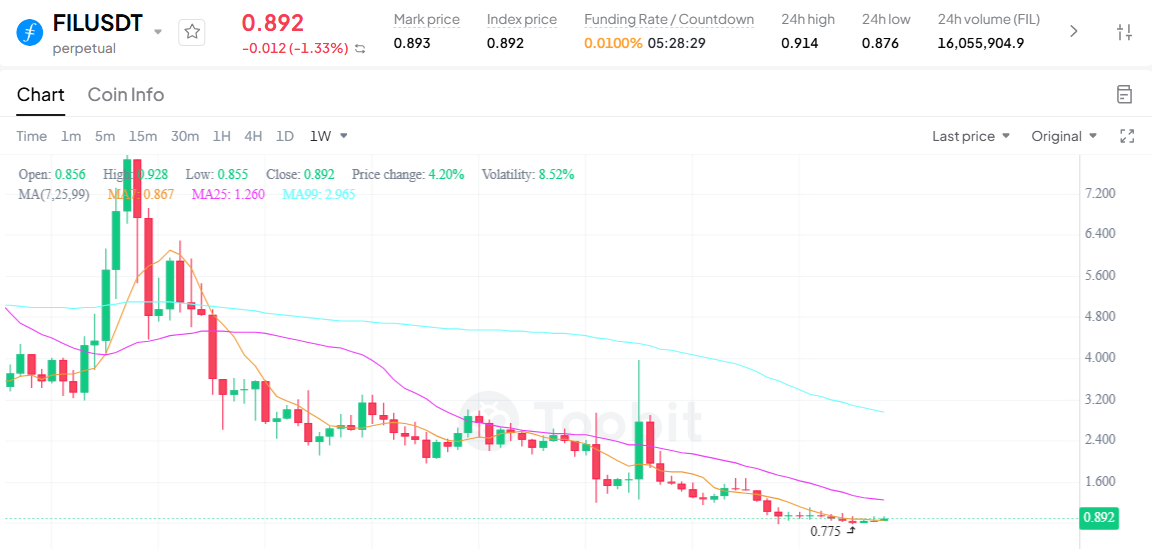
FIL’s long-term chart has traded through a steep reset since its 2021 peak, with price still sitting near the lower end of its broader historical range.
-
All-time high (ATH): around $237.24 (April 1, 2021)
-
All-time low (ATL): around $0.6336 (October 11, 2025)
FIL price (perpetual) from Toobit, as of April 15, 2026, 03:19 UTC
FIL’s latest performance
-
FIL price: around $0.892
-
24h high: around $0.914
-
24h low: around $0.876
-
24h volume: around 16,055,904.9 FIL (around $14.32 million in USDT)
At the time of writing, FIL is trading near the middle of its latest 24-hour range, showing some short-term stabilization after rebounding from recent lows, but the move is still sitting within a weak broader structure rather than a clearly repaired trend.
Current market snapshot (April 15, 2026)
Filecoin Fear and Greed Index from CFGI.io, as of April 15, 2026
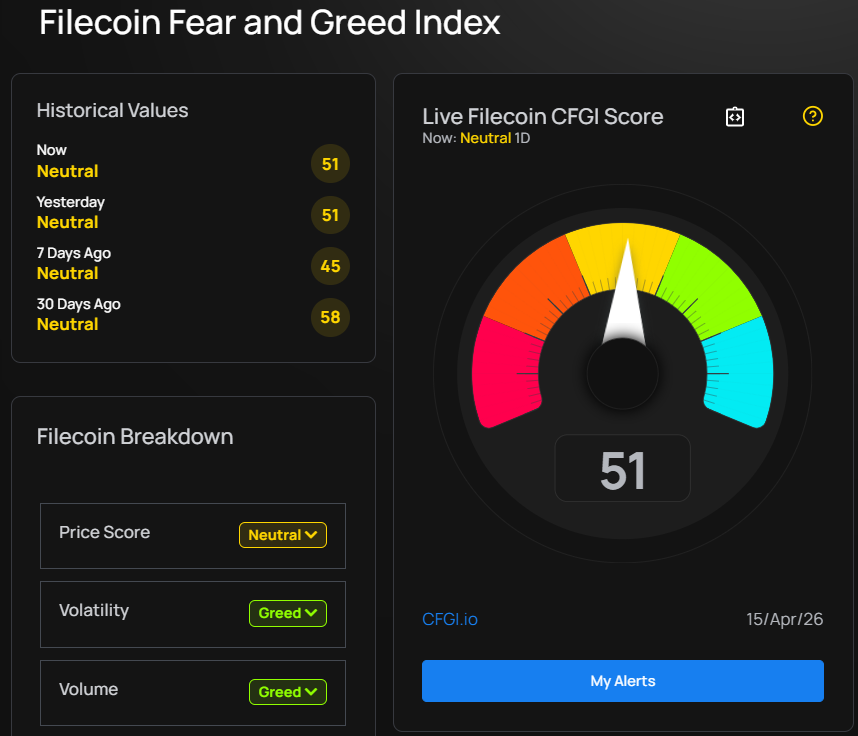
The Filecoin Fear and Greed Index score is 51 (Neutral), unchanged from yesterday (51). A week ago it was 45 (Neutral), while 30 days ago it stood at 58 (Neutral).
That keeps the market mood in neutral territory, which fits the current chart setup: FIL has stabilized after rebounding from recent lows, but price is still trading below heavier overhead resistance, so the sentiment read looks steadier rather than fully risk-on.
The index breakdown points in the same direction. The price score is Neutral, while volatility and volume both read Greed. That suggests participation has improved, but not enough on its own to confirm a broader structure repair.
On-chain and technical analysis
Support and resistance
FIL is trading near the lower end of its broader range after a short-term rebound, with the latest 24-hour range sitting between $0.876 and $0.914. The current structure looks steadier than the recent low area, but price is still sitting below the first overhead zone that would need to break for the chart to look more constructive.
Near-term support sits at $0.855 to $0.867.
Near-term resistance remains $0.914 to $0.928. Below support, the recent low near $0.775 remains the more important downside reference.
Momentum indicators
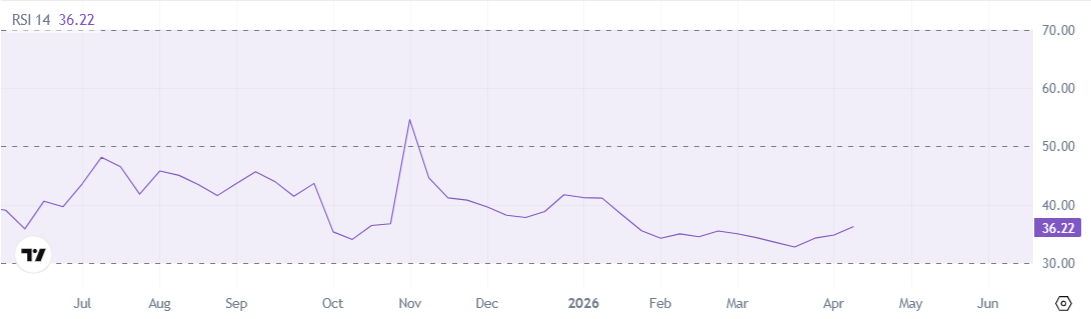
FIL’s 14-period Relative Strength Index (RSI) is around 36.22, which keeps it in weak-natural territory. That usually reflects a market that has cooled from earlier downside pressure, but has not yet shifted into stronger upside momentum.
FIL RSI from TradingView, as of April 15, 2026, around 03:20 UTC.
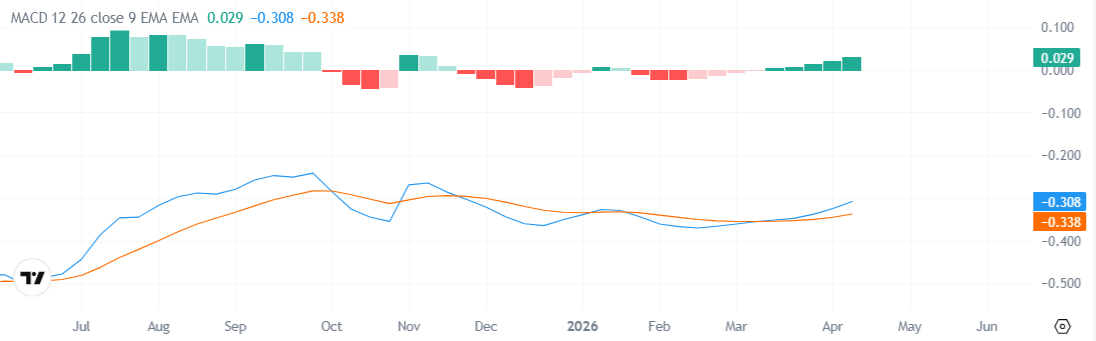
Moving average convergence divergence (MACD) is still below zero, with MACD around -0.308, the signal line around -0.338, and the histogram around 0.029. That suggests momentum is improving from depressed levels, but FIL is still recovering inside a weak broader structure rather than pushing into a clean trend change.
FIL MACD from TradingView, as of April 15, 2026, around 03:20 UTC.
Moving averages and volume
FIL is back above its short-term moving average near $0.866 to $0.867, but it still sits well below the higher MA references near $1.260 and $2.965. That matters because the latest bounce has improved the short-term picture, but the broader structure still looks reactive rather than fully repaired.
FIL volume from Toobit, as of April 15, 2026, 03:19 UTC

Volume also looks more consistent with stabilization than confirmation. The latest reading is around 28.453 million, while the 20-day volume average is around 117.948 million. That gap suggests participation has improved from recent lows, but not enough to confirm a stronger accumulation phase.
On-chain cues
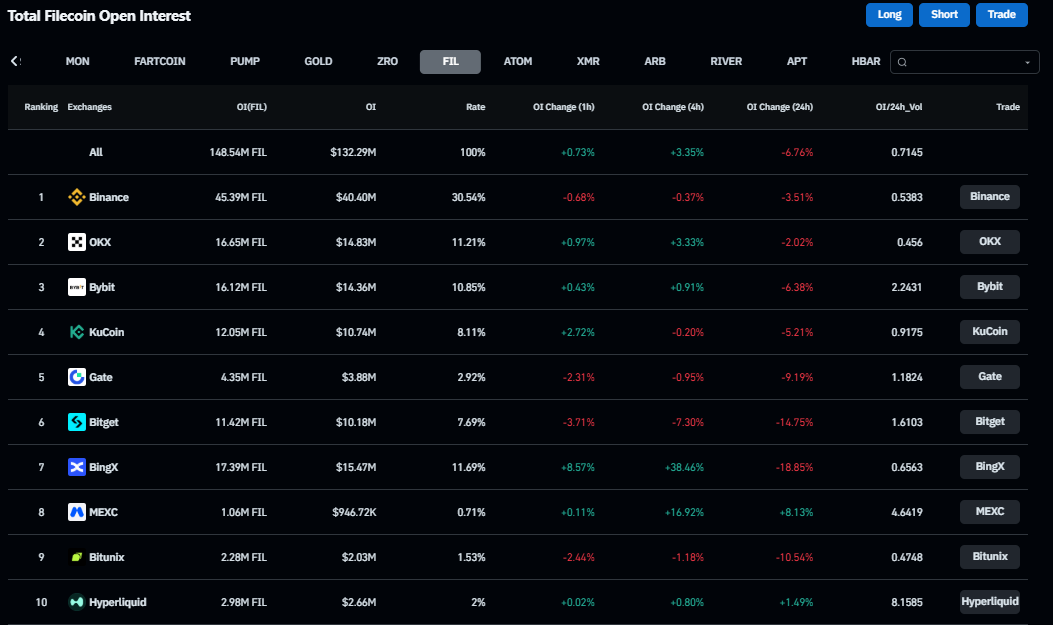
Derivatives positioning still looks active, but it is not one-way.
Total open interest (OI) is around 148.54 million FIL (around $132.29 million). Short-term changes are mixed: up around 0.73% (1-hour), up around 3.35% (4-hour), and down around 6.76% (24-hour).
FIL OI from Coinglass, as of April 15, 2026, around 03:20 UTC.
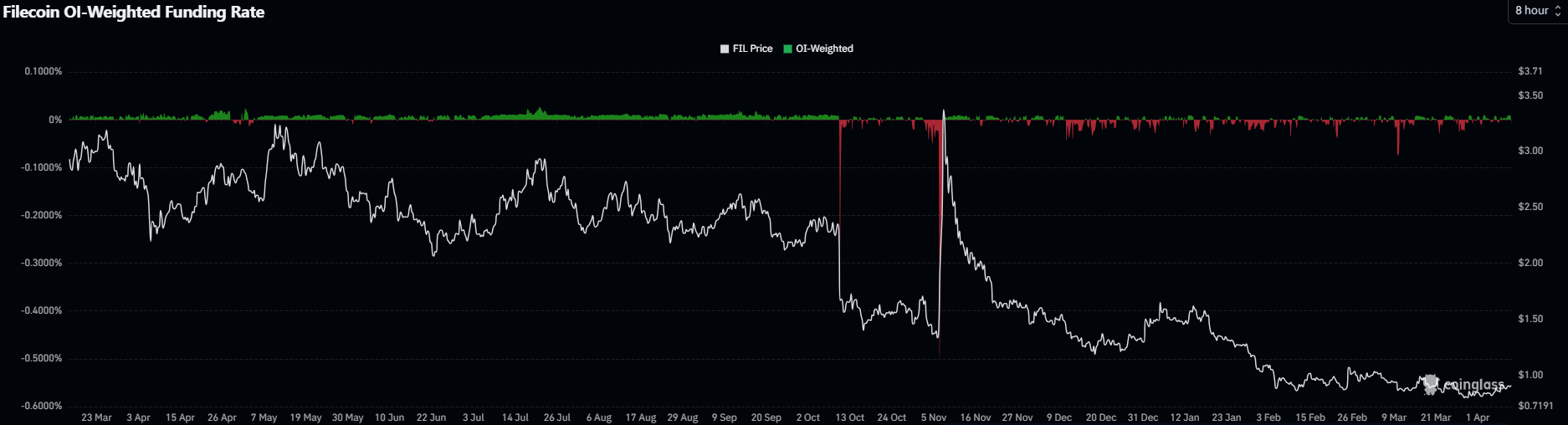
The OI-weighted funding rate (FR) looks close to neutral overall, with a slight positive tilt in the most recent prints. For FIL, that matters because price is rebounding from a weak base, but the market is not yet showing the kind of crowded long positioning that usually confirms a stronger breakout.
FIL OI-weighted funding rate from Coinglass, as of April 15, 2026, around 03:20 UTC.
What to watch next
-
FIL holds $0.855 to $0.867 and avoids slipping back toward $0.775
-
FIL reclaims $0.914 to $0.928 and starts holding above that band
-
OI keeps building on the short-term view instead of extending the 24-hour decline
-
Funding stays controlled while volume starts improving from current levels
FIL price prediction and outlook
Base case
-
FIL keeps stabilizing while holding the $0.855 to $0.867 band.
-
Price stays capped below $0.914 to $0.928, which keeps the rebound constructive in the short term but still incomplete on the broader chart.
-
The setup remains steady as long as short-term OI keeps rebuilding, funding stays controlled, and volume does not fade further.
Bull case
-
FIL reclaims $0.914 to $0.928 and starts holding above that zone.
-
That would improve the short-term structure and open room toward the $1.00 area first, with the broader test sitting higher near the $1.260 moving-average ceiling.
-
The move looks cleaner if OI rises with price, FR stays near neutral, and volume starts building from current depressed levels.
Bear case
-
FIL loses $0.855 to $0.867 and fails to reclaim it quickly.
-
That would weaken the current repair attempt and put the recent low near $0.775 back in focus.
-
The downside read gets more vulnerable if the 24-hour OI decline extends and rebounds continue to come on light participation.
A controversial viewpoint
FIL may remain structurally important, but that does not guarantee momentum leadership in the near term.
In that setup, Filecoin Onchain Cloud, broader infrastructure relevance, and the push toward on-chain services can keep the narrative active while price still struggles to break cleanly into a stronger trend.
The more realistic risk is not a sharp breakdown. It is a broad repair range where rebounds keep attracting attention but still fail to turn into sustained upside unless participation, OI, and volume start improving together.
The key twist
-
The infrastructure lane is tied to Filecoin Onchain Cloud, which expands Filecoin beyond decentralized storage into a broader verifiable cloud stack. That matters because it can change how the market frames FIL over time.
-
The economics lane is tied to whether stronger usage turns into paid demand and steadier participation. If that starts showing up in price, OI, and volume, FIL has a stronger case for moving beyond a local rebound.
Key milestones for Filecoin
-
July 15, 2014: The first version of the Filecoin protocol was published, setting the project’s original design around proof-based storage and retrieval.
-
September 2017: Filecoin completed its token sale, raising around $205 million from around 2,100 participants. That fundraising mattered because it helped finance early network development and became part of the network’s early token history.
-
October 15, 2020: Filecoin mainnet launched, moving the project from research and fundraising into live storage infrastructure.
-
March 14, 2023: The FVM went live on mainnet, adding smart contract programmability to the network and opening a broader application layer on top of Filecoin’s storage base.
-
April 29, 2025: Fast Finality for Filecoin (F3) went live on mainnet, cutting finality time from hours to minutes and improving the network’s usability for faster applications.
-
May 6, 2025: Proof of Data Possession (PDP) went live on mainnet, adding verifiable hot-storage capability on top of Filecoin’s archival storage base.
-
September 30, 2025: Filecoin Foundation said the network had preserved more than 1 million cultural and scientific artifacts, marking a major public-data and digital-preservation milestone.
-
November 18, 2025: Filecoin Onchain Cloud launched, expanding Filecoin from decentralized storage into a broader verifiable, programmable cloud stack.
-
December 18, 2025: The Constellation Program launched as a phased effort to modernize governance, decision-making, and resource allocation across the network.
-
January 20, 2026: Filecoin Foundation and the Government of Bermuda announced a public-datasets initiative through Democracy’s Library, adding a public-sector use case for resilient data preservation.
Community sentiment and FIL news
FIL chatter has stayed active lately as Filecoin’s 2026 narrative tightens around Filecoin Onchain Cloud, infrastructure relevance, and the network’s push beyond decentralized storage into broader data services.
A community post discussing FIL from X
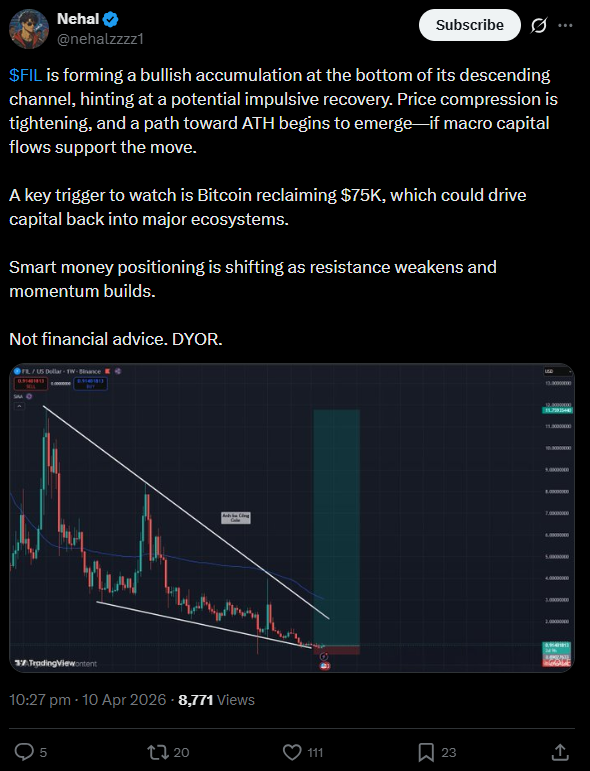
Recent updates also helped sustain attention around the network. The Constellation Program kept governance modernization in focus, while the Bermuda public-data initiative added a public-sector example for resilient data preservation through Democracy’s Library. Those developments gave FIL a broader infrastructure angle beyond pure token discussion.
Filecoin Onchain Cloud overview from Filecoin
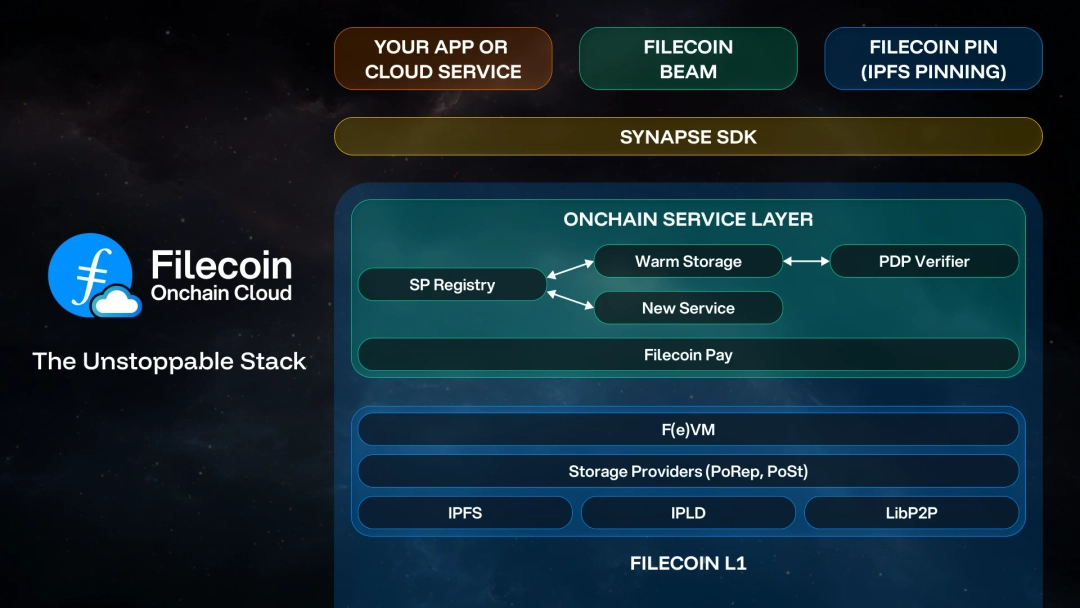
On social media, the tone is broadly constructive but still selective. That tone is also supported by the provided Grayscale holdings snapshot, which shows FIL at 17.22% of a 4-asset portfolio as of April 13, 2026. That kind of positioning adds to the view that FIL is still being tracked as part of the infrastructure and data-services trade.
Grayscale holdings snapshot from Grayscale, as of April 13, 2026
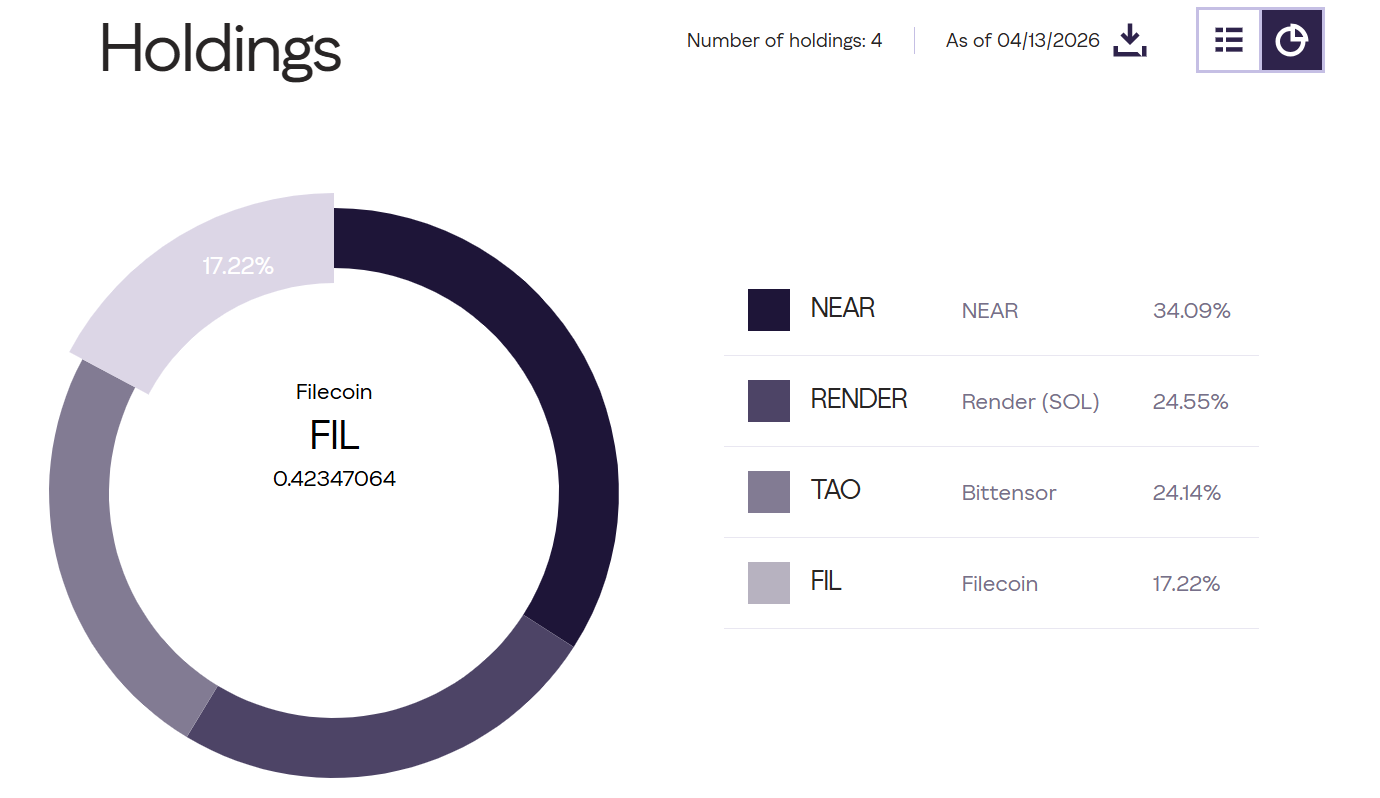
Even so, the market still wants cleaner follow-through before treating that constructive tone as stronger conviction.
Community sentiment for FIL from CoinMarketCap, as of April 14, 2026, 07:25 UTC
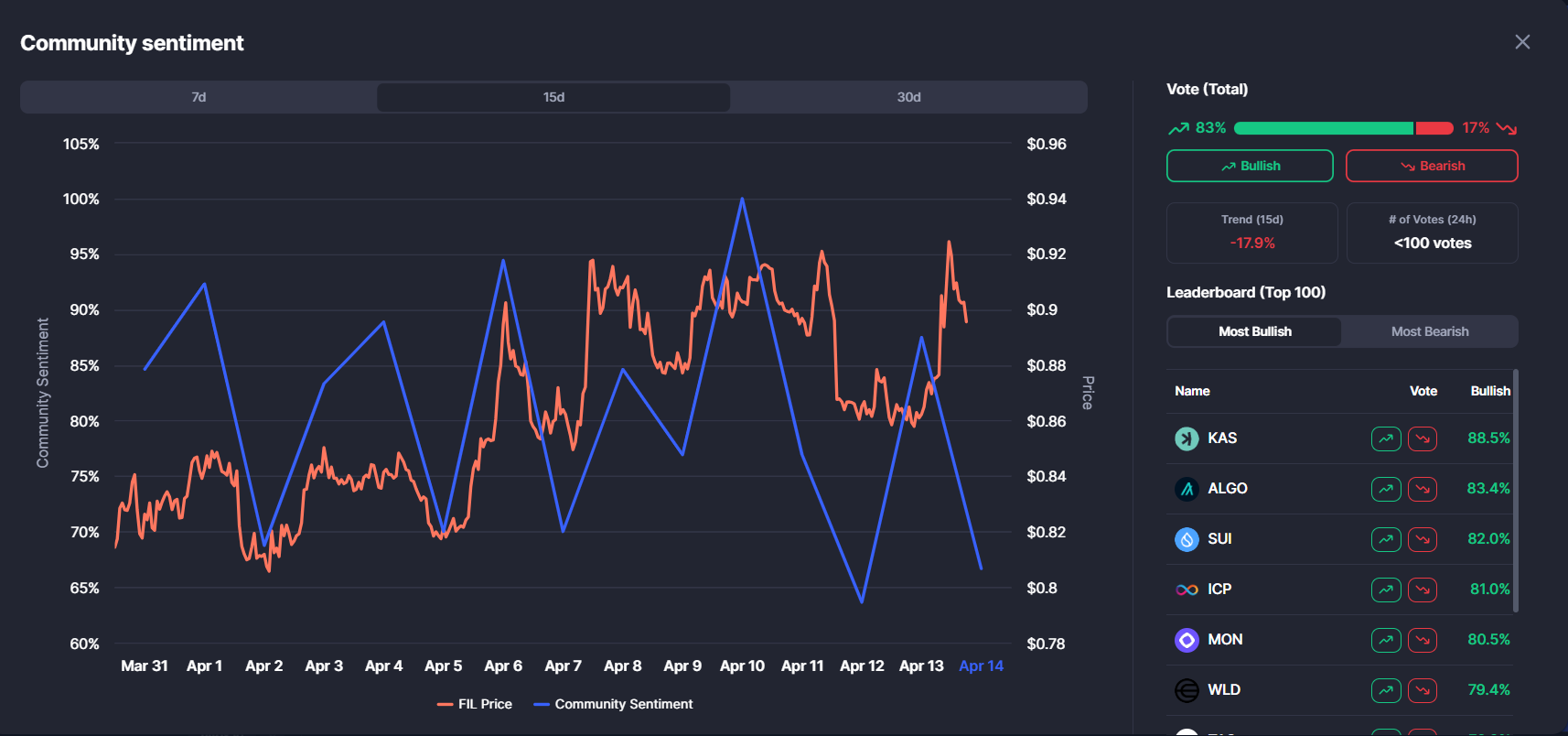
Community sentiment from CoinMarketCap, shows 83% bullish versus 17% bearish, with a -17.9% 15-day trend and <100 votes in the last 24 hours. That keeps the signal directionally supportive, but the vote count is still small and the sample remains limited.
FAQs
How does Filecoin prove that data is actually being stored?
Filecoin uses 2 core proof systems: Proof of Replication (PoRep) shows that a storage provider created a unique copy of the data, while Proof of Spacetime (PoST) shows that the provider continues storing that data over time. That is what makes Filecoin a verifiable storage network, not just a storage marketplace.
What is FIL used for?
FIL is the network’s native token and sits at the center of Filecoin’s economic model. It is used for storage and retrieval payments, while storage providers earn FIL through network activity and block rewards. Storage providers must also lock FIL as collateral, and part of that collateral can be slashed and burned if proving requirements are not met.
What is the difference between storage and retrieval on Filecoin?
Storage and retrieval are related but not the same. Storage deals are about keeping data on the network over a defined period under agreed terms, while retrieval is about getting that data back when needed. In practice, one side is tied to long-term data persistence, while the other is tied to data delivery.
What is the Filecoin Virtual Machine (FVM)?
The Filecoin Virtual Machine (FVM) adds smart contract programmability to Filecoin. That matters because it moves the network beyond storage alone and allows developers to build applications, automate on-chain logic, and connect storage with broader infrastructure and payment flows.
Should I buy FIL now?
This is not financial advice. That depends on your risk tolerance, time horizon, and what you think about Filecoin’s broader infrastructure story. FIL is tied to a network that is trying to expand beyond decentralized storage into a wider cloud and data-services role, but the token still needs stronger usage, participation, and follow-through to support a more durable market re-rating.
The bottom line
Filecoin is entering 2026 with a broader infrastructure story, led by Filecoin Onchain Cloud, a clearer verifiable cloud stack narrative, and a growing push toward on-chain services beyond storage alone. The key question is whether those product moves can translate into sustained usage and paid demand across the network’s economic model, not just stronger attention around the infrastructure narrative.
If that demand starts compounding, Filecoin looks more like durable data infrastructure than a narrow storage story.
This article is for informational purposes only and does not constitute financial advice. Always do your own research (DYOR) before making any decisions.
How to start trading Filecoin (FIL) on Toobit
Filecoin is one of the clearest infrastructure-focused tokens in the market, with FIL tied to decentralized storage, data delivery, and the network’s broader push into verifiable cloud services. That makes it worth watching when attention shifts toward real utility, protocol upgrades, and adoption across data infrastructure.
Ready to trade FIL? Toobit offers spot and futures trading with low fees, deep liquidity, and clean charting tools to help you plan entries and manage risk.
Start trading FIL/USDT today.


