
Privacy as a rebellious necessity
Zcash (ZEC) is a vital shield in a world that watches every digital footprint you leave. John McAfee, a famous computer expert, warned that transparent blockchains would eventually become tools for global surveillance.
He argued that your financial activity is your business and no one else has the right to see it. Privacy is not a crime, despite lazy claims that it only serves illicit actors.
Zcash gives you total control over your data so your money stays strictly your business.
What is Zcash (ZEC)?
Launched in October 2016 by the Electric Coin Company (ECC) and Zooko Wilcox-O’Hearn, ZEC is a decentralized fork of Bitcoin. It also has a 21-million coin cap but is faster, has lower fees, and a focus on optional financial privacy.
The core of Zcash is its Zero-Knowledge (zK) Succinct Non-Interactive Argument of Knowledge (zk-SNARK) technology. It is the first real-world application of zK-proofs in blockchain.
This provides cryptographic proof that a transaction is valid without revealing the sender, receiver, or amount involved.
Zcash offers 2 distinct address types which are transparent t-addresses and shielded (optional privacy) z-addresses. This Privacy by Choice model is more nuanced than competitors like Monero, which is private by default.
Allowing users to toggle between transparency and anonymity allows users to balance individual discretion with regulatory compatibility.
The network is secured by the Equihash Proof-of-Work (PoW) algorithm. This memory-hard system was designed to reduce Application-Specific Integrated Circuit (ASIC) dominance and keep mining decentralized.
It still faces occasional pressure from large mining pools, however. Funding the project's academic research is its 20% Founder’s Reward, whose distribution was previously a controversial subject among stakeholders.
The recent introduction of its Ztarknet Layer-2 (L2) upgrade added a programmable layer for privacy-preserving smart contracts. It expanded its utility beyond simple value transfers by creating a shielded decentralized finance (DeFi) ecosystem providing private interactions.
Zcash price history and performance overview
Zcash price history
ZEC was launched October 28, 2016 and spiked to an all-time high (ATH) of $5,941.80 soon after. It then dropped to about $30 in a few months before achieving a peak of around $700 in 2018.
This would be its highest price up until November 7, 2025 when it reached the area of $750. Its lowest point however came on July 5, 2024 at $15.97 caused by delisting concerns on major centralized exchanges.
At the time, it had a dead-project narrative since its PoW mechanism was viewed as unable to keep up with DeFi and L2 innovations on other projects.
Zcash's latest performance
Price action for ZEC was between $211.04 to $243.72 from February 25 to March 31, 2026. Its market cap for the week ranged from $3.51 billion to $4.04 billion.
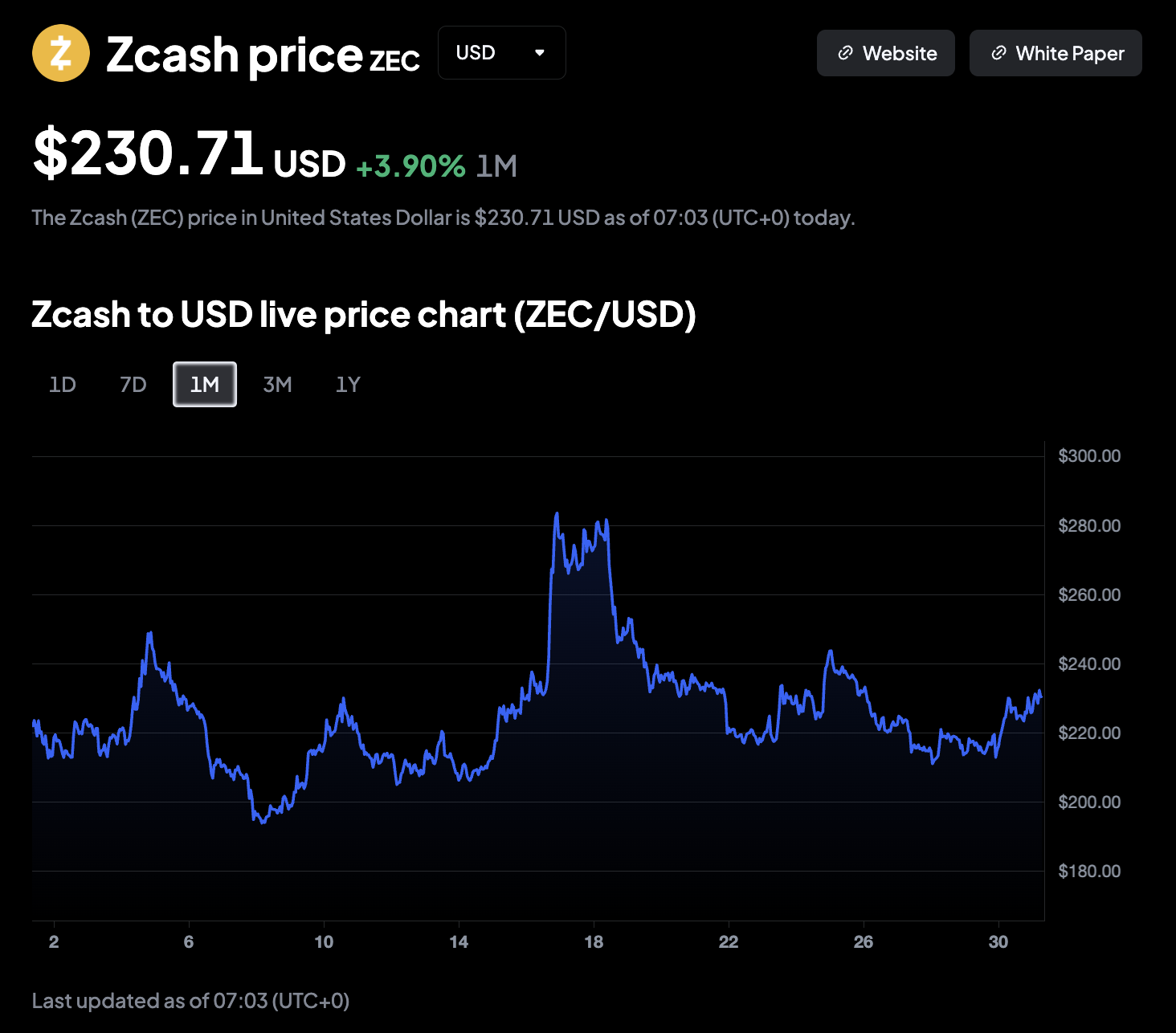
Zcash to USD live price chart on March 31, 2026, 15:05 UTC+8 from Toobit
Its recent notable top was at $284.31 last March 17, 2026. This is an 18.85% drop from ZEC’s current price valuation.
Current market snapshot (March 31, 2026, 15:05 UTC+8)
ZEC’s price currently sits at $230.71, up 1.55% in the last 24 hours. Its market cap is currently at $3.83 billion with a circulating supply of 16.6 million ZEC.
Trading volume is up 35.71% within the last 24 hours at $374.87 million.
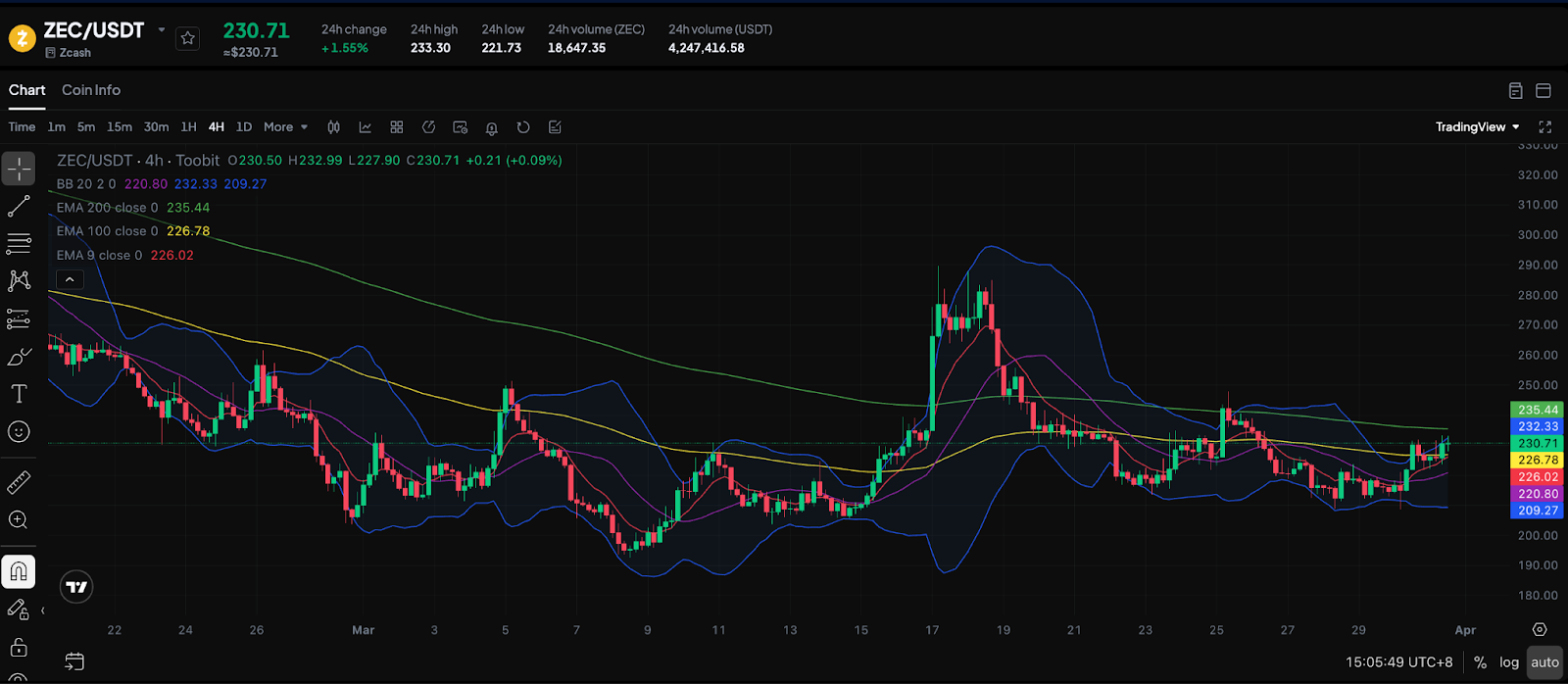
ZEC/USDT 4-hour spot trading chart from Toobit
ZEC’s intraday price movements have currently printed a low of $222.03 and high of $232.99.
A relief rally in the short-term is possible though further downside in the medium-term is likely.
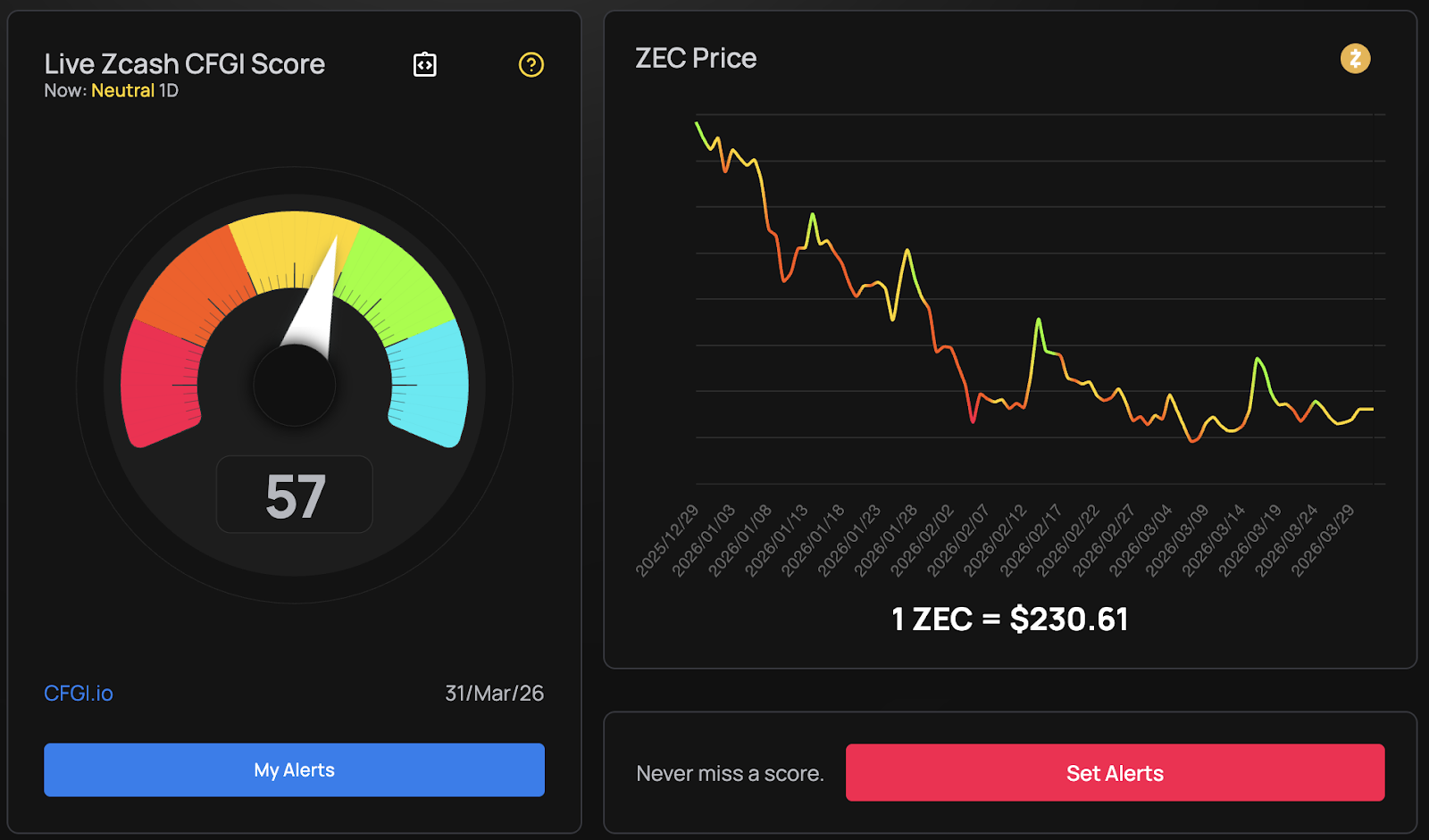
Crypto Fear and Greed Index (CFGI) on March 31, 2026 for ZEC
The Crypto Fear and Greed Index (CFGI) for ZEC currently has a 57 (Neutral) reading. It reflects significant confidence in the privacy based project compared to 11 (Extreme Fear) prevailing among popular cryptocurrencies.
On-chain and technical analysis
Support and resistance
ZEC may have found local support at around the $220 level. This is the area it keeps returning to since the sell-off last February 6, 2026.
It is the $185 level however which is shaping up as longer term support after price punched through it last October 9, 2025. ZEC retraced to this level on October 17, 2025 before skyrocketing to around $750 in about 3 weeks.
-
Near-term support: $185, breaking below this could have $128 as the next support zone.
-
Near-term resistance: $310, followed by the next significant resistance level of $398.
Momentum indicators
The Relative Strength Index (RSI) on ZEC’s 4-hour chart is showing a rising 59.84 level. Its Moving Average Convergence/Divergence (MACD) is signalling -0.06, with a histogram of 1.67 on the same time frame.
A short-term pump could be on the way as RSI tries to break through the 70 level. Its 4-hour MACD likewise is still showing signs that buyers are in control.
Moving averages and volume
ZEC’s price is currently above its 50-day and 200-day moving averages (MA) on its 4-hour chart. It is now seeking to break through its 100-day MA.
Preceding candles have been showing compression below the 100-day MA but buyers have not lost momentum. With enough volume, price may close above it and continue with short-term upside.
The overall trend however is still bearish.
On-chain cues
Out of the 16.6 million ZEC currently in circulation, 31.1% is shielded (private) while the remaining 68.9% is transparent. It has been yielding around 1,580 ZEC in daily emissions at an inflation rate of about 3.5%.
This reflects growing adoption of Zcash’s core privacy utility with nearly a third of its current supply now shielded. It is underpinned by a stable 3.5% annual inflation rate balancing liquidity with long-term scarcity.
Zcash price prediction and outlook
ZEC’s mainstream utility hinges on its necessity, especially if financial privacy rights become limited in the future. The programmable privacy features of its Ztarknet L2 upgrade, which enable shielded DeFi transactions, further boost its potential.
The Security and Exchange Commission’s (SEC) investigation into Zcash has recently ceased with no penalties, lifting years of regulatory concerns. ZEC’s original developer team, the ECC, left the project earlier this year due to internal governance conflicts.
Bullish Case ($850 – $1,100)
ZEC could surpass previous highs if Ztarknet achieves mass DeFi adoption, and if financial privacy rights come under fire. Favorable privacy regulations and the emergence of a strong developer team could further boost interest.
Base Case ($350 to $500)
A measured recovery toward mid-range resistance is possible with steady growth in shielded address usage and regulatory clarity.
Bearish Case ($120 to $160)
Development stagnation due to ECC’s recent exit made worse by low demand for privacy-centric assets could cause a dip to long-term support levels.
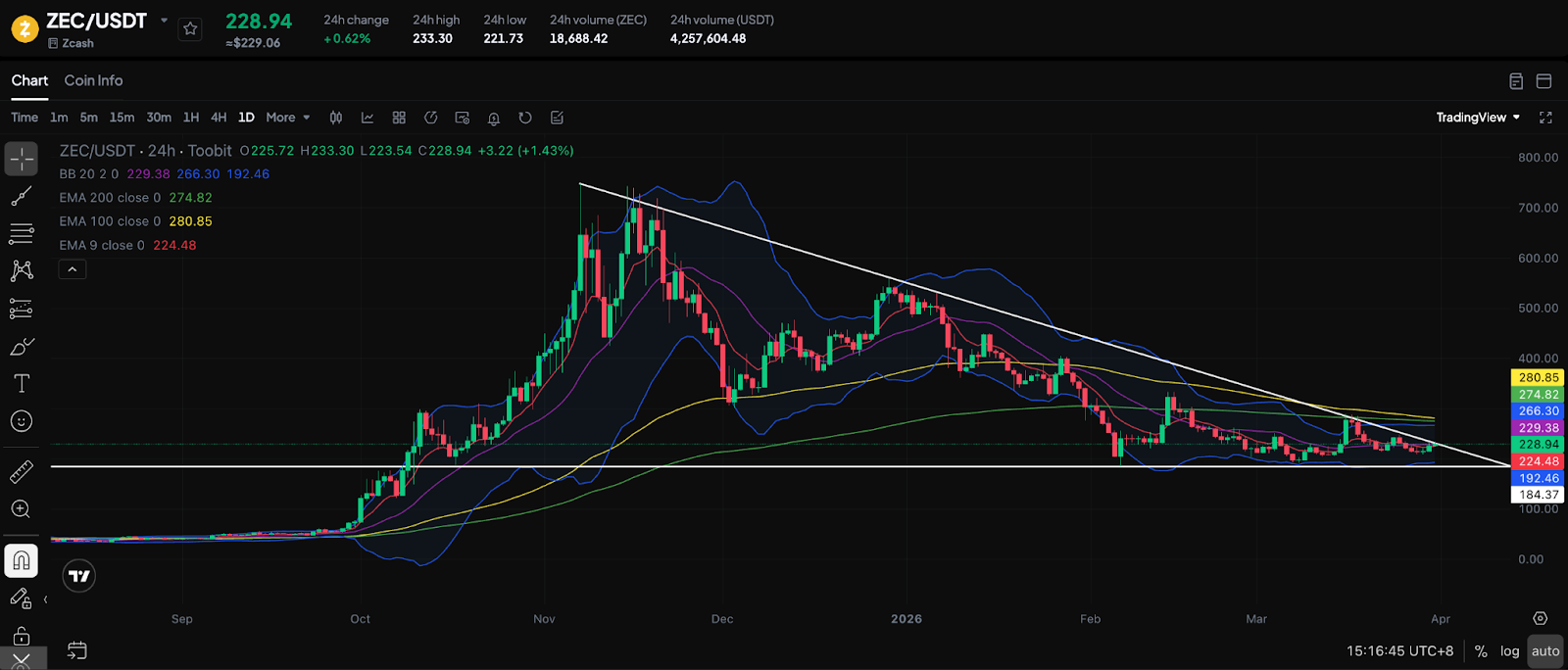
ZEC/USDT daily spot trading chart from Toobit
Note the descending triangle pattern on ZEC’s daily time frame, which is squeezing price to its $185 support level. This often bearish pattern could signal a breakdown below support in the near future.
Conservative traders should remain sidelined until ZEC secures a daily close above the descending trendline. This should be followed by a successful retest of that level as new support.
Key milestones for Zcash
-
October 2016: Founded by Wilcox-O'Hearn and ECC initially as Zerocash.
-
June 2018: Hard fork with first network upgrade to Overwinter, allowing future upgrades while improving performance.
-
November 2020: First halving, miner rewards go from 6.25 to 3.125 ZEC. The original Founder’s Reward has ended.
-
May 2022: NU5 upgrade and introduced Orchard Pool which replaced the need for a trusted setup with the Halo 2 recursive proof system. It also added Unified Addresses (UA) for better usability.
-
November 2024: Second halving, reduced block rewards to 1.5625 ZEC. NU6 upgrade lowered inflation to about 3.5% and instituted in-protocol lockboxes which helped reduce sell pressure.
-
November 2025: Ztarknet L2 introduced a programmable layer for privacy-preserving smart contracts that was previously challenging to build directly onto the blockchain.
Community sentiment and Zcash news
Community sentiment
ZEC has a Sentiment Score of 0.02 for March 31, 2026 on Messari, with -1.0 being the lowest and 1.0 the highest. Curiously, sentiment appears the highest for 2026 at 0.248 on January 28 around the time Gemini launched its Zcash credit card.
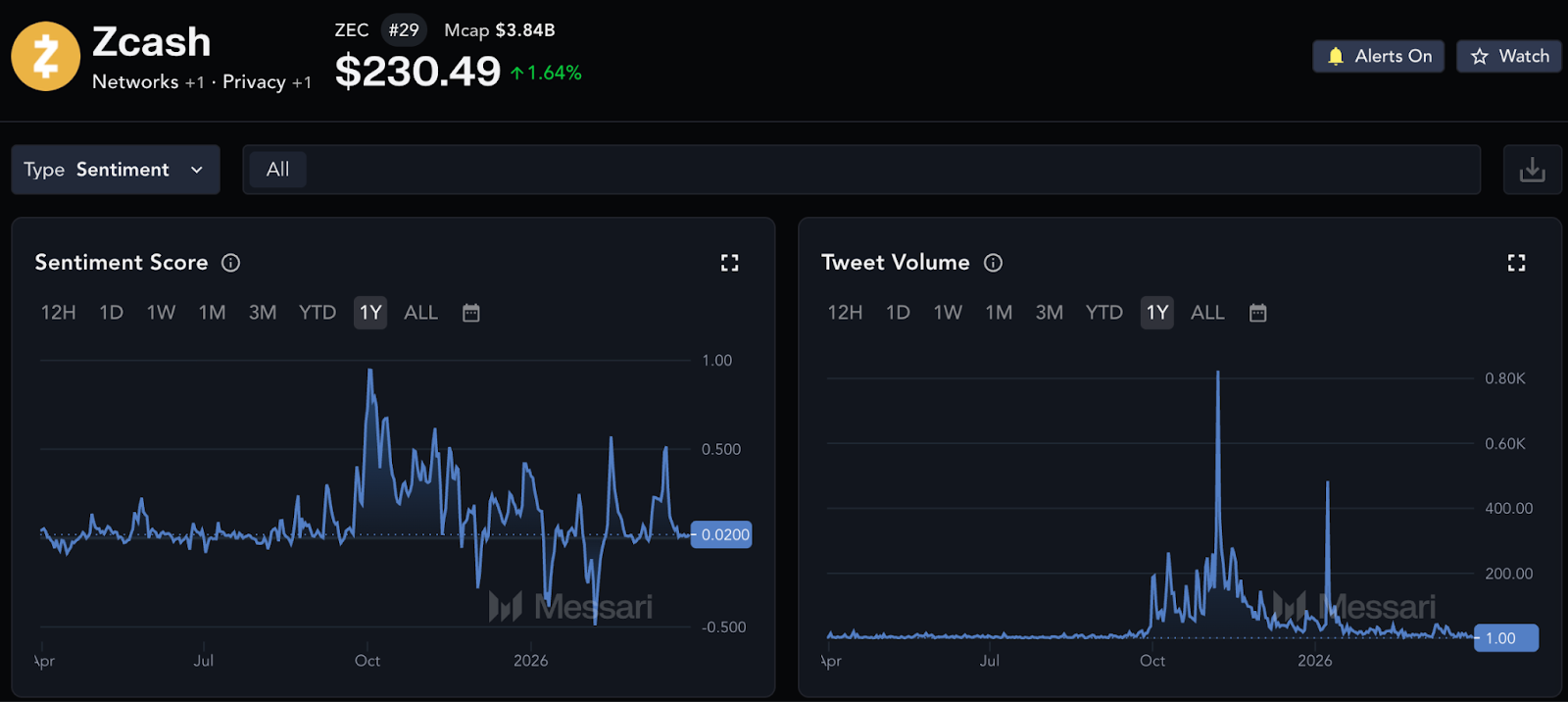
ZEC sentiment score and Tweet volume charts from Messari
Tweet volume on the other hand has been bouncing between the 1 to 36 Tweets per day for March. Its last significant spike of 484 Tweets occurred January 8, 2026, around the core development team’s mass resignation announcement.
Zcash news
-
(March 26, 2026) Grayscale sees Zcash as a mispriced asset poised for growth as AI-driven surveillance transforms financial privacy into a core financial necessity. ZEC stands to gain significantly if the market begins to prioritize and reprice digital confidentiality, despite its high-risk profile.
-
(January 15, 2026) SEC concludes multi-year Zcash investigation with no sanctions or orders to change the Zcash Foundation, eliminating regulatory uncertainty.
-
(January 8, 2026) ECC, the developer team behind ZCash resigns en masse due to irreconcilable differences with Bootstrap. The latter is a 501(c)(3) non-profit nonprofit organization serving as ECC’s parent entity within the ZEC network.
FAQs
Is Zcash truly private?
Yes, shielded z-addresses use zk-SNARKs to hide details fully. Transparent t-addresses are optional.
Can I convert between transparent and shielded ZEC?
Yes, shielding moves t-ZEC to private z-addresses or deshield back to t-addresses through wallet commands. This pools funds anonymously but repeated actions can statistically weaken privacy sets.
It is best to shield once and stay private.
Could you explain the difference between the former and current Founder’s Reward?
The former Founder's Reward (2016 to 2020) allocated 20% of each block's rewards directly to ECC and partners. It totaled about 10% of ZEC supply and sparked premine debates.
The current system (post-2020 Bootstrap) ended this. It redirects 20% to a community treasury governed by decentralized Zcash Improvement Proposals (ZIPs) for development and ecosystem grants.
What is the usual rate of its shielded transaction use?
Only 1 to 5% historically due to wallet complexity and higher fees. Upgrades like UAs simplify this, but critics say it proves optional privacy fails against set it and forget it chains.
ZEC vs. Monero?
Zcash offers selective privacy and faster transactions while Monero provides full anonymity as a default but with higher fees.
Is Zcash quantum-resistant?
Partially. Halo upgrades aim for it by ditching Elliptic Curve Digital Signature Algorithm (ECDSA) keys vulnerable to quantum attacks.
ECDSA is a cryptographic method used to generate digital signatures for verifying data authenticity, integrity, and non-repudiation. Current zk-SNARKs rely on non-quantum assumptions, but full migration is ongoing.
What’s the Zcash supply schedule?
ZEC has halvings every 4 years like Bitcoin, with the next one coming sometime in 2028. It will have mined 16.5 million ZEC by early 2026, with forever slow tail emissions.
This slow tail emission design is to ensure the security of the network by continuing to pay miners in perpetuity.
The bottom line
Zcash is a research-led project that balances transparency and anonymity through its optional privacy features.
The project’s upcoming upgrades offer strong drivers for growth though tempered by development team uncertainty. Its upwards trajectory is clear especially if masses prioritize personal financial privacy.
It remains to be seen however if McAfee’s warning will come to pass.
Stay alert and track Zcash price charts on Toobit for real-time insights.
How to start trading ZEC on Toobit
ZEC gives you the option to choose privacy and was the first to implement zk proof technology.
If you are ready to trade ZEC, Toobit offers excellent Spot and Futures trading access. It has competitive fees, deep liquidity, and charting tools for strategic trading execution.
Start trading ZEC/USDT today.


