
Flying under the radar
Stellar Lumens (XLM) prioritizes institutional infrastructure over market hype. Its Soroban smart contracts deliver high throughput for real-world assets (RWAs) and hybrid payments.
Successful central bank digital currencies (CBDC) pilot programs have demonstrated its clear utility. It remains an undervalued project despite this, as it awaits institutions to flip the switch.
What is Stellar Lumens (XLM)?
Stellar is a decentralized, open source blockchain network with Lumens (XLM) as its native currency. This is how Stellar works.
It acts as a bridge asset while also preventing malicious activity on the network. Cross border payments among individuals (retail) as opposed to institutions are its target users.
Currencies can be sent worldwide, enjoying near instant settlements with low fees. XLM is used as a bridge, acting as token representations of assets like USD, EUR or crypto.
It is based on the anchor model, where regulated entities issue fiat-backed tokens on Stellar. This is central to its adoption as XLM connects RWAs to the blockchain ecosystem.
As of 2026, Stellar has anchors in more than 180 countries.
Its Stellar Consensus Protocol (SCP) design is faster and more environmentally friendly as opposed to Bitcoin’s energy intensive Proof-of-Work (PoW) process. This allows nodes to come to agreement quicker and more efficiently.
Soroban is Stellar's smart contract platform, built with Rust and WebAssembly (WASM). It delivers secure, high-speed decentralized applications (dApps) that integrate seamlessly with XLM's payment rails.
With low-cost transactions, XLM is positioned to evolve beyond a simple payments network into the primary backbone for bridging CBDCs.
Stellar price history and performance overview
Stellar price history
On January 4, 2018 XLM hit its all-time high (ATH) of $0.9381 at the peak of that cycle’s bull run. It was mainly attributed to its partnership with IBM and high interest in cross-border payments.
Conversely, its all-time low (ATL) was $0.000476 on March 5, 2015. It offers evidence that XLM's chart moves through cycles due to waves in adoption rather than pure speculation.
It sits about 73% away from its ATH however, it is steadily building a reputation as crypto’s enterprise plumber.
Time will soon reveal how much value XLM provides delivering remittances and CBDC rails as opposed to memecoin hype.
Stellar's latest performance
From March 3 to 9, 2026, XLM traded between $0.1480 and $0.1656. Market cap fluctuated around the $4.92 billion mark, with 32.99 billion XLM in circulation.
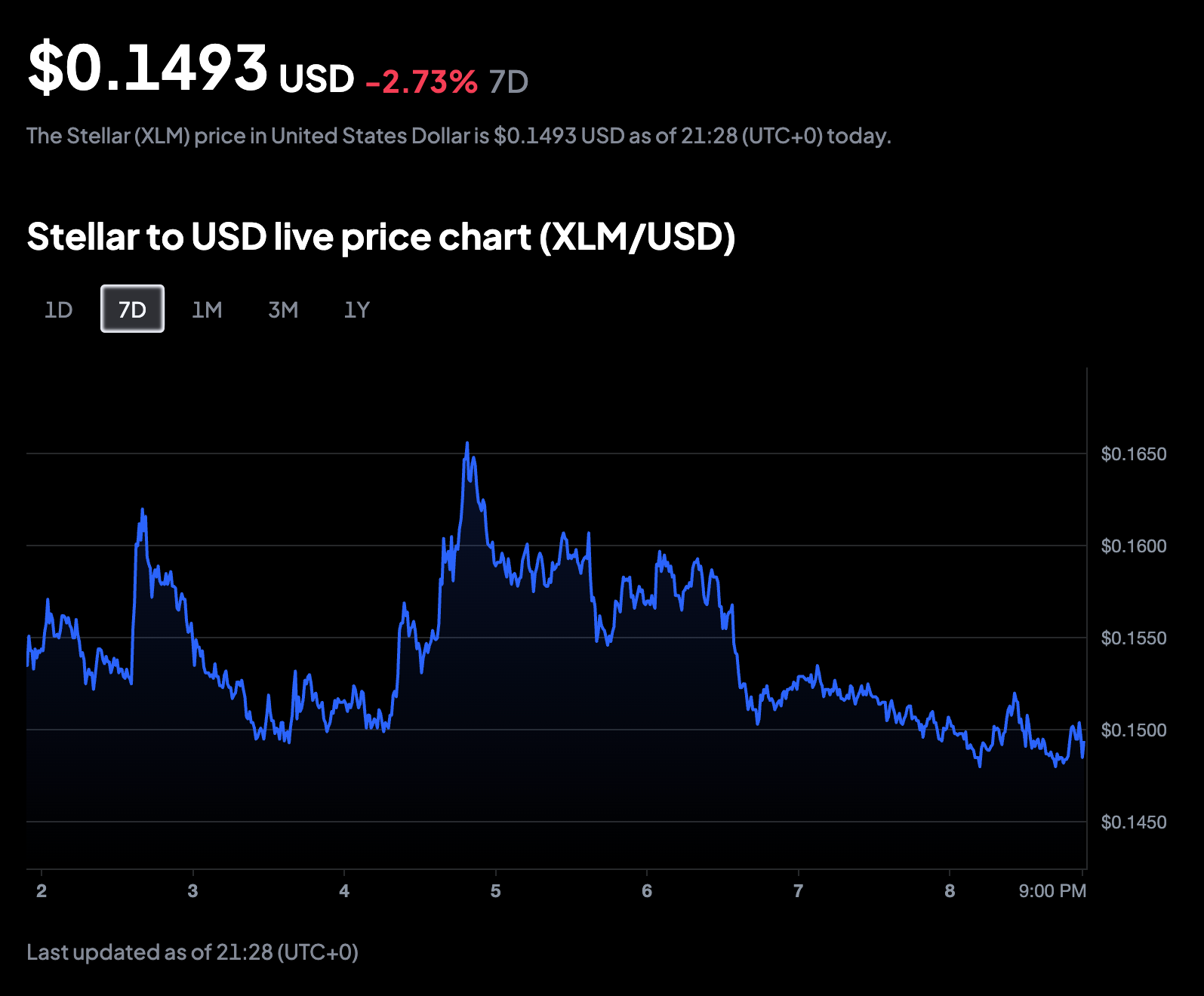
Stellar to USD live price chart from Toobit
Recent XLM price charts reveal the price has been moving sideways at around the $0.1550 level for about a month now. An exception was a noticeable pop to $0.1835 last February 15, 2026.
The pivot?
This month-long consolidation appears to be an accumulation stage with a potential move to the upside soon.
Current market snapshot (March 9, 2026, 05:31 UTC+8)
XLM currently trades at $0.1493, down 0.86% within 24 hours with around $75.6 million in trading volume.
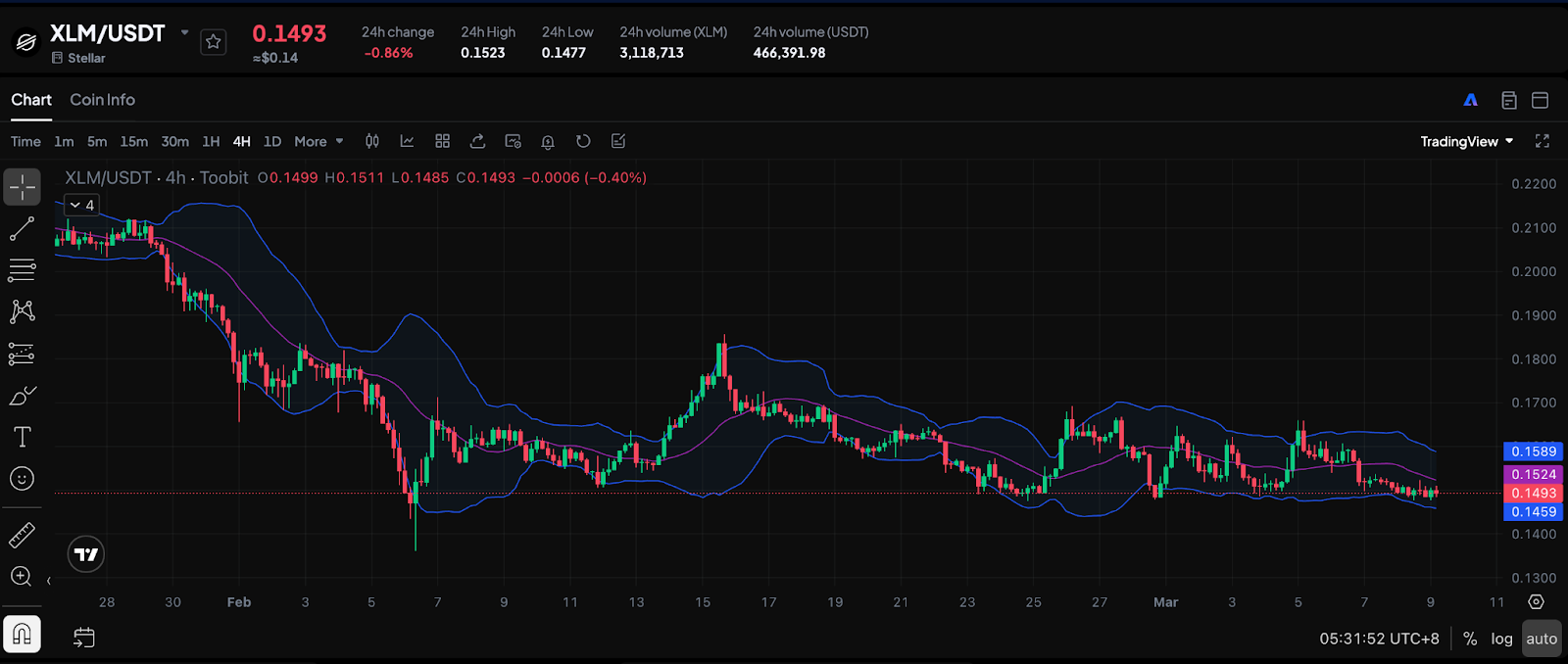
It reached a high of $0.1523 within the last 24 hours and is currently trying to stay above $0.1480. XLM is still trying to gain upside momentum after printing this year’s low at $0.1362 a month ago.
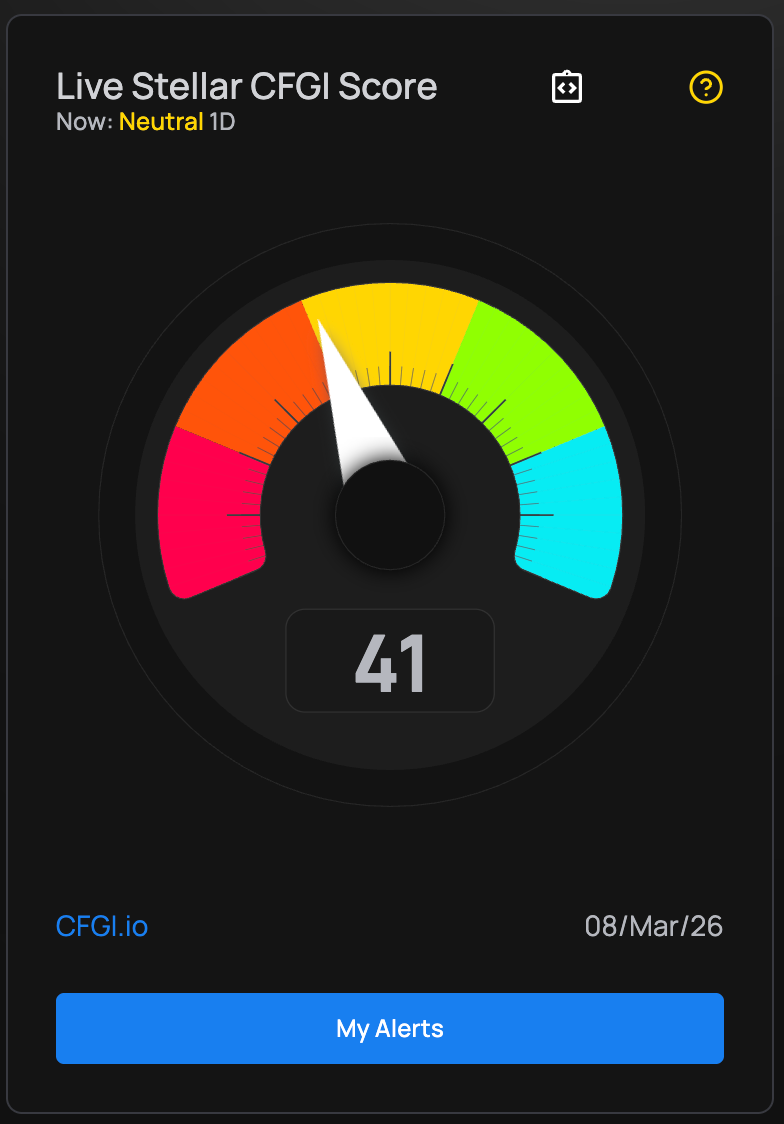
Stellar Fear and Greed Index from CFGI.io
The Stellar Fear and Greed Index reads 41 (Neutral). It is steadily coming out of Fear territory from last week’s 38 (Fear) and the 32 (Fear) levels from 30 days ago.
On-chain and technical analysis
Support and resistance
XLM continues to defend the critical support level of $0.1480. Price has settled in this zone since early February while occasionally trying to break resistance at $0.1650.
The next major support level is at $0.1070 should there be another major sell-off due to prevailing macro conditions. If it can blast through $0.1650 however, then resistance at $0.2035 is next.
Momentum indicators
Its 4-hour time frame shows a neutral-to-oversold stance without extremes. XLM's Relative Strength Index (RSI) is steadily climbing out of oversold territory at 42.33.
On the other hand, its Moving Average Convergence/Divergence (MACD) is nearing its zero crossover point at -0.0002.
Bear momentum is fading.
Moving averages and volume
On the 4-hour time frame, XLM price has continuously touched its 50-day Moving Average (MA) at $0.1500. It has yet to close decidedly above it.
XLM must reclaim this first before it tests its 100-day MA currently at $0.1566.
March 5, 2025 saw significant volume at $161.03 million where buyers took the field. Activity for the month of March however has generally been dominated by sellers.
In spite of this, normal seller exhaustion has already set in with no recorded surges in volume. A strong boost in buyer volume is still necessary if it is to punch through the $0.1650 resistance level.
On-chain cues
XLM is currently experiencing a network load of 34% at a rate of 65 TPS and 55.44 billion XLM burned. This evidence shows the network is not overloaded while providing a clear deflationary mechanism.
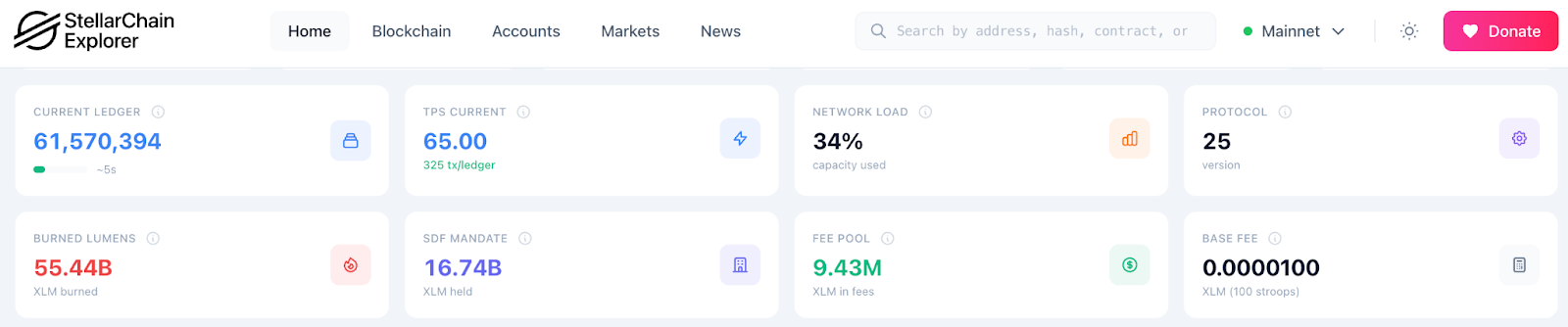
Active addresses increased to 10,235,699 million but there has been a marked drop in processed operations since February 2026. It was in the tens of millions before a sharp drop to about 4.3 million on February 2, 2026.
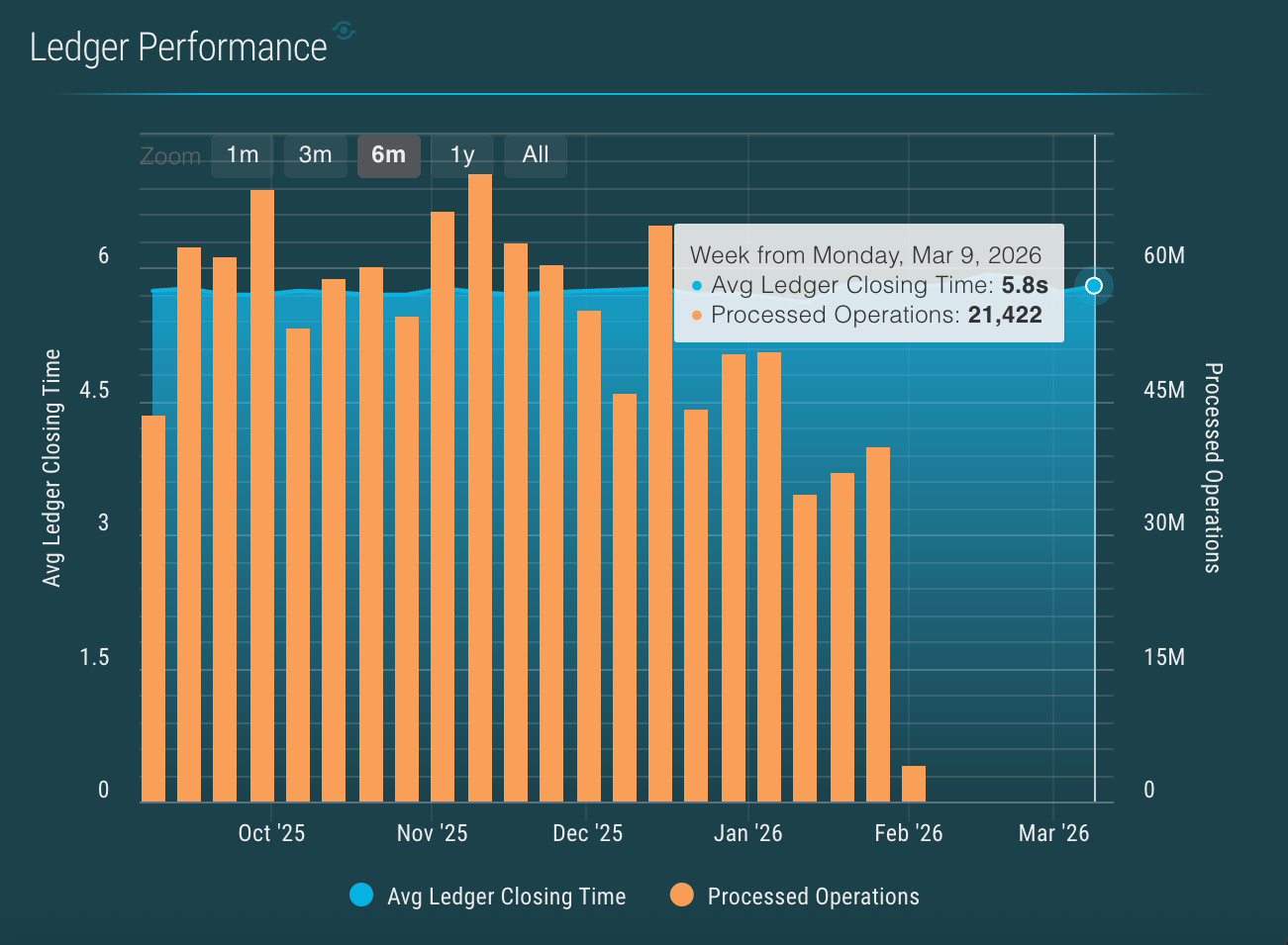
Only a mere 21,422 operations have been processed between March 3 to 9, 2026. The network maintained an average ledger closing time of 5.8 seconds regardless of the volume of processed operations.
Stellar price prediction and outlook
Stellar is currently at a crossroads. Despite reaching a record 10.23 million active addresses, on-chain operations plummeted from 40 million to just 21,422.
While the pipes are clear with a 5.8-second ledger time, the network is currently awaiting a fresh surge of utility.
Bull Case ($0.32 to $0.45)
This surge depends on the successful adoption of Protocol 25 propelled by its new ZK-proof capabilities combined with Soroban smart contracts. It could trigger a mass migration of national CBDC and Universal Basic Income (UBI) programs.
XLM could reclaim the $0.2035 resistance on high volume. This fundamental shift from testing to actual use would likely boost the price toward the $0.45 mark.
Base Case ($0.18 to $0.24)
A more measured recovery assumes XLM maintains its critical $0.1480 support. The recent deployment of RedStone oracles is vital here, restoring developer trust following February’s $10 million oracle exploit.
The most probable outcome is a steady climb toward the $0.24 range as security stabilizes and on-chain activity gradually returns to early-year levels.
Bear Case ($0.09 to $0.11)
If the recent activity cliff persists and macro-economic tensions stall institutional onboarding, XLM risks a breakdown.
Failing to hold the $0.1480 floor would likely trigger a sell-off toward the $0.1070 macro support. In this scenario, the network remains technically sound but lacks the active utility needed to sustain higher valuations, leading to a bottom between $0.09 and $0.11.
This article is for informational purposes only and does not constitute financial advice. Always do your own research (DYOR) before making any decisions.
Key milestones for XLM
-
July 31, 2014: Stellar was launched by Ripple co-founder Jed McCaleb and Joyce Kim as a non-profit alternative to what McCaleb envisioned for XRP.
-
August 2014: XLM started with a supply of 100 billion tokens which was later reduced to 50 billion tokens.
-
January 2015: Tokens were initially known as "stellars" then changed to Lumens (XLM). It hit around 3 million user accounts and a $15 million market cap during this time.
-
January 4, 2018: Its ATH was $0.9381 driven by the bull market peak and partnerships such as IBM.
-
Early 2024: DeFi and non-fungible tokens (NFTs) were enabled through the Soroban smart contracts launch on Protocol 20.
-
October 2024: Mastercard and Paxos partnerships for payments.
-
January 22, 2026: Protocol 25 upgrade goes live, allowing developers to verify zero-knowledge (zk) proofs on-chain.
-
Early 2026: TVL around $100 million in DeFi through Soroban
Community sentiment and XLM news
XLM’s March 8, 2026 Sentiment Score on Messari currently sits at a positive 0.0434. Sentiment Scores range from -1.0 being extremely negative and 1.0 as extremely positive.
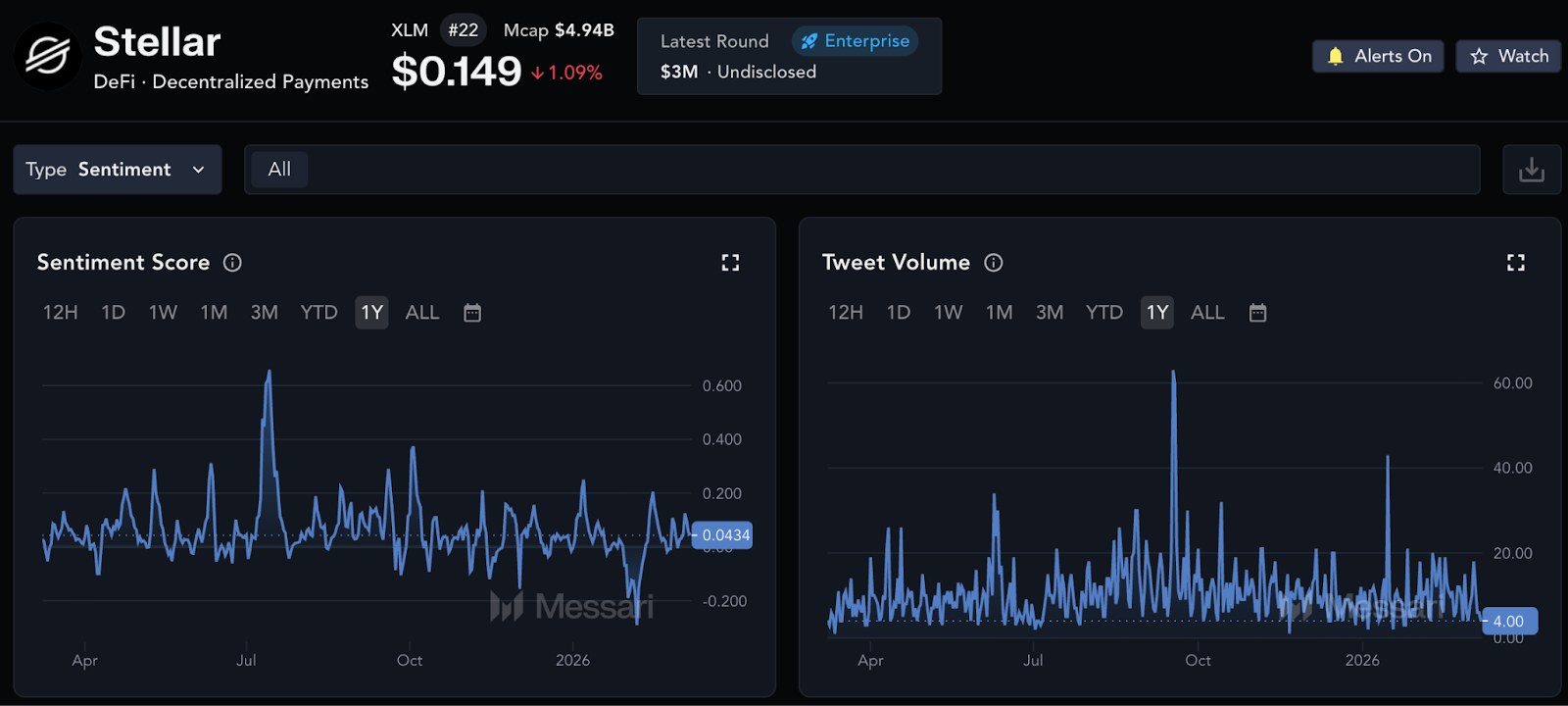
Stellar Sentiment Score and Tweet Volume charts from Messari
It was able to recover from the -0.291 sentiment score that hit it early last February. An overall drop in sentiment was experienced by the crypto industry caused by record liquidations and escalating geopolitical tensions.
XLM news
-
(March 5, 2026) RedStone deploys price oracle to improve Stellar’s security after a recent $10 million exploit due to oracle vulnerabilities.
-
(February 11, 2026) Next-generation web3 wallet TopNod to integrate with the Stellar ecosystem.
-
(December 17, 2025) Marshall Islands program leads to Stellar becoming the world’s first blockchain project to facilitate UBI on-chain distribution.
FAQ
What sets Stellar's consensus apart?
There is no wasteful energy expended mining for XLM or centralized staking involved. Its SCP can achieve consensus within 3 to 5 seconds through trusted nodes.
How does XLM bridge assets?
It does this by providing liquidity for path payments by auto-routing forex trades for example, from USD to XLM to EUR.
Why Stellar for RWAs over Ethereum?
It utilizes native issuance with compliance tools for freezing/clawback while skipping complex smart contracts and cutting costs.
What is Soroban’s throughput?
Soroban's Rust/WASM contracts enable high throughput, with recent upgrades like Whisk targeting 5,000 plus TPS potential at near-zero fees of around 0.00001 XLM.
In practice, Stellar's network handles about 136 TPS and is scaling toward the thousands through optimizations.
Is Stellar truly nonprofit?
Yes, the Stellar Development Foundation acts as a 501(c)(3) non-profit organization. It distributes around 95% XLM through grants for financial inclusion instead of venture capitalism.
What is XLM's CBDC edge?
Its anchor system allows banks to issue tokenized fiat/CBDCs interoperably. Tests in Ukraine and Marshall Islands have provided proof that XLM can provide CBDC plumbing.
These countries retained sovereign oversight without loss in blockchain decentralization.
The bottom line
XLM is on the other side of the trading spectrum of quick pump meme coins. Instead, it is a stealth utility play that institutions can turn to without all the marketing noise.
Its global anchors can tokenize trillions in RWAs/CBDCs and Soroban's near-free smart contracts outpace established gas hungry blockchains. Expect a slow rise toward $0.30 plus per XLM should bullish forecasts play out.
Stellar’s price appreciation largely depends on its utility and increased adoption. This however is more preferable over the empty promises of boom or bust hype projects.
Stay alert and track XLM price charts on Toobit for real-time insights.
How to start trading XLM on Toobit
XLM powers near instant cross-border payments and CBDC infrastructure for real-world financial inclusion at close to zero fees.
Ready to trade XLM? Toobit offers Spot, Futures, and Grid Bot trading options coupled with deep liquidity at competitive rates.
Start trading XLM/USDT today.


