
Starknet is entering 2026 with a clearer product narrative than its price chart suggests. Infrastructure work is building around decentralization, staking mechanics, prover efficiency, privacy upgrades, and Bitcoin integration through strkBTC, while STRK still trades near the lower end of its broader historical range.
The setup has 2 lanes. The first is technical: Starknet is trying to turn its zero-knowledge (ZK) rollup stack, Cairo developer base, and Bitcoin-facing roadmap into more visible network activity. The second is economic: STRK still needs clearer demand tied to governance, staking, and future sequencer decentralization before infrastructure progress becomes stronger token conviction.
The next sections break down how Starknet works, where STRK fits, and what the current price structure needs to confirm.
What is Starknet (STRK)?
Starknet is a ZK rollup built on Ethereum using STARK cryptography and the Cairo programming language. It scales Ethereum by processing transactions off-chain, verifying their integrity with validity proofs, and settling back to the mainnet for security.
ZK-STARK explainer diagram from Extrimian
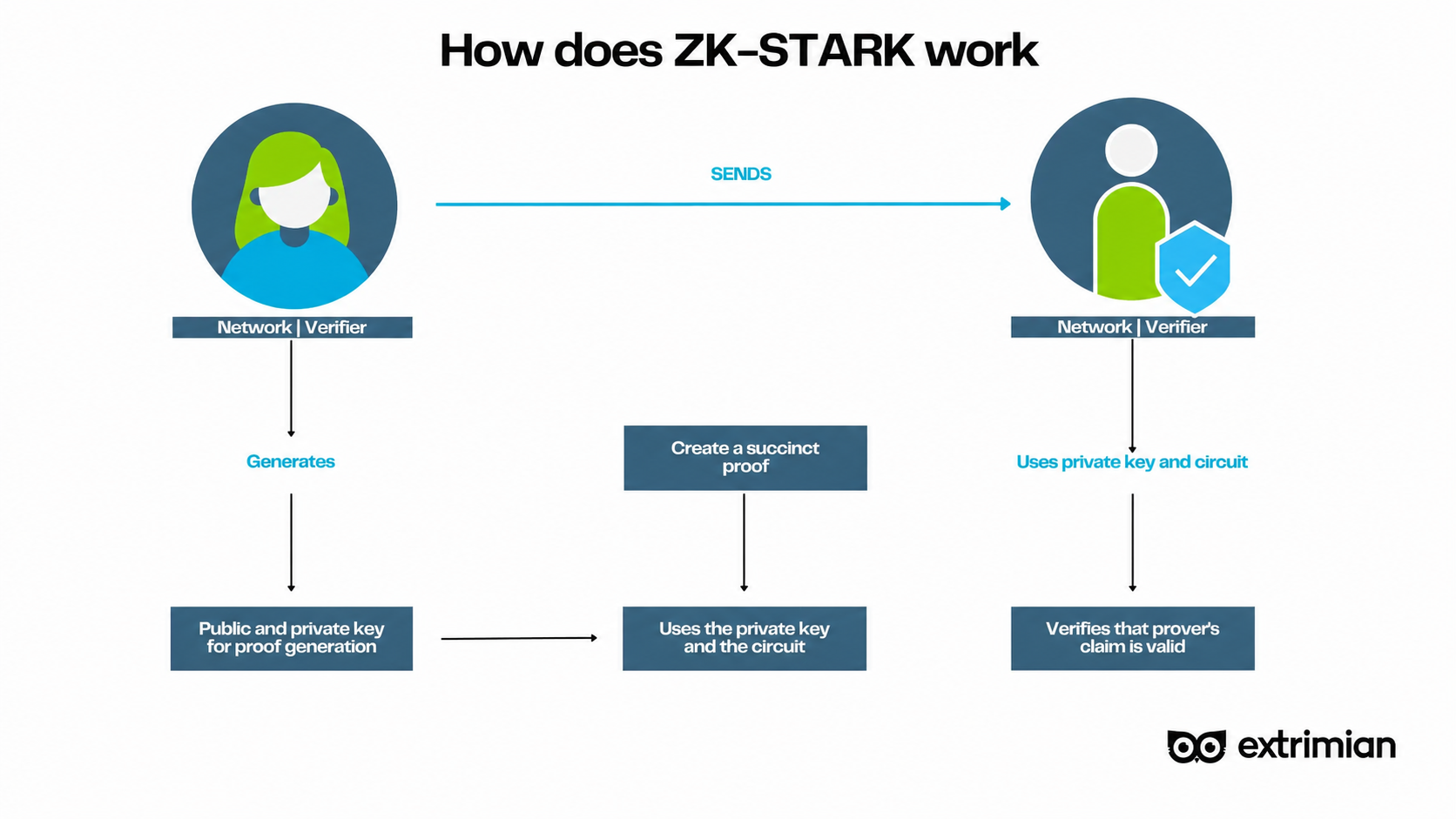
STRK is the network’s native token. It is tied to governance, staking mechanics, and Starknet’s longer-term path toward decentralized sequencing. That makes the token part of the network’s control and security model, not only a market asset.
The project’s current infrastructure story has several active lanes:
-
Scalable throughput: Starknet processes activity through validity proofs, giving apps more transaction capacity while keeping Ethereum settlement.
-
Cairo development: Cairo gives developers a Starknet-specific environment for building apps that use the network’s proof system.
-
Decentralization path: Staking and sequencer decentralization are central to the network’s long-term control model.
-
Bitcoin integration: strkBTC expands Starknet’s focus beyond Ethereum scaling by connecting BTC liquidity to Starknet-based activity.
Governance is also part of STRK’s role. The token is tied to protocol governance, staking mechanics, and Starknet’s longer-term path toward decentralized sequencing, establishing a clear place for STRK inside the network’s control and security model.
This positioning offers STRK a more distinct angle than a standard Ethereum Layer 2 (L2) story. The stronger case depends on whether Starknet can turn ZK-scaling performance, Bitcoin integration, and privacy-focused infrastructure into sustained app activity, liquidity, and token demand.
STRK price history and performance overview
STRK price history
STRK traded through a major expansion cycle that resulted in a new peak in 2024. Since then, price has reset sharply and is still sitting far below its all-time high, even though it remains well above its early historical low.
-
All-time high (ATH): around $0.207 on August 1, 2024
-
All-time low (ATL): around $0.000169 on June 1, 2022
STRK price from Toobit, as of May 25, 2026, around 14:00 UTC
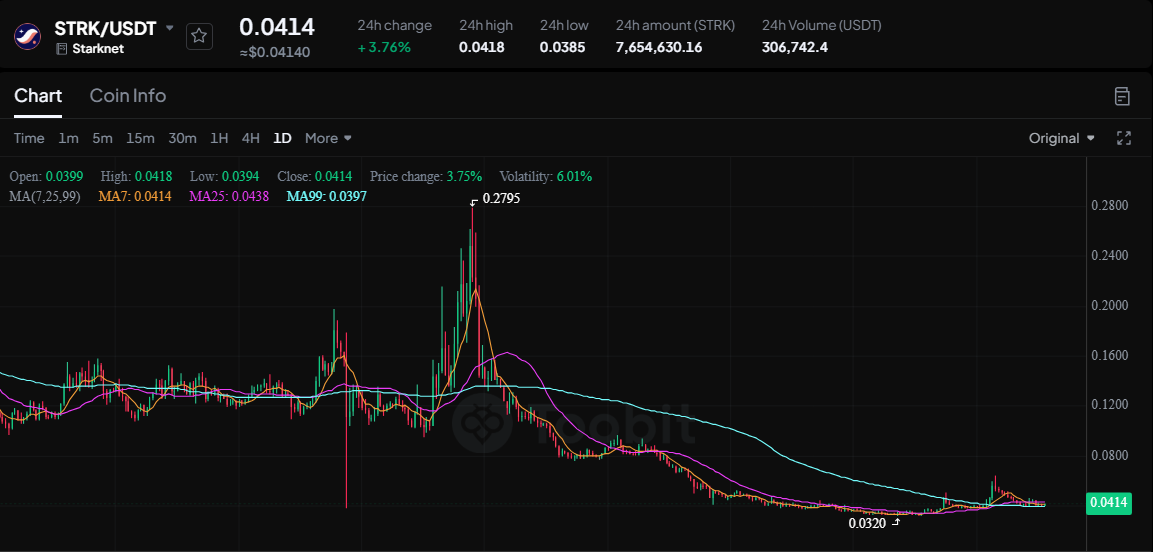
STRK’s latest performance
-
STRK price: around $0.0414
-
24h high: around $0.0418
-
24h low: around $0.0385
-
24h volume: around 7,654,630.16 STRK (around 306,742.4 USDT)
At the time of writing, STRK is trading about 98.87% below its ATH and about 28.72% above its ATL. The implication is that price remains near the lower end of its broader historical range, while any stronger recovery still needs clearer follow-through.
Current market snapshot (May 25, 2026)
The Bitcoin Crypto Fear and Greed Index (CFGI) score is 55 (Neutral), unchanged from yesterday. A week ago it was 41 (Neutral), while 30 days ago it stood at 60 (Greed).
Bitcoin CFGI from CFGI.io, as of May 25, 2026, around 14:00 UTC
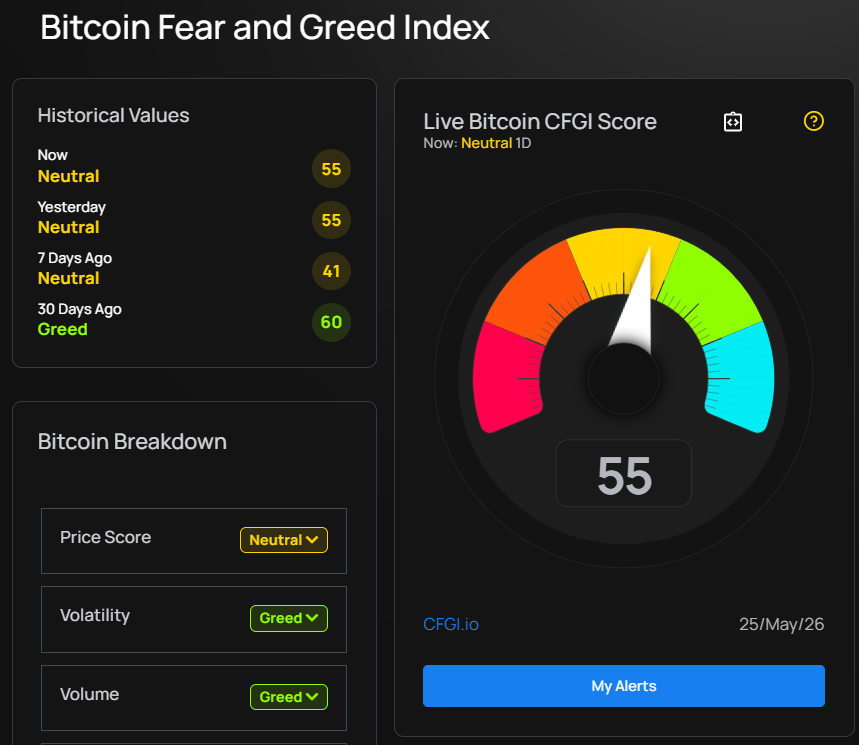
The market mood has improved from last week but remains below last month’s greed reading. For STRK, this creates a balanced backdrop: a rebound can still develop, but the setup is not fully risk-on.
The CFGI breakdown is more active under the headline score. The price score is neutral, while volatility and volume both read greed. This suggests broader participation has improved, but STRK still needs stronger token-specific follow-through before the market backdrop becomes a reliable confirmation signal.
On-chain and technical analysis
Support and resistance
STRK is trading around $0.04145 on the perpetual view, close to the upper side of its latest 24-hour range. The first level to hold sits around $0.03851, with a deeper local reference near $0.03197 if the current range breaks lower.
Near-term resistance sits around $0.04157. A cleaner push above that area would bring the wider chart reference near $0.08820 back into focus, but that remains a larger-range level rather than an immediate confirmation point.
Momentum indicators
The Relative Strength Index (RSI) is around 46.91, which keeps momentum below neutral but no longer deeply weak. The reading supports a short-term recovery attempt, but it still needs stronger price follow-through before momentum looks firmer.
STRK RSI from TradingView, as of May 25, 2026, around 14:00 UTC

The Moving Average Convergence Divergence (MACD) remains negative, with the MACD line near -0.00005, the signal line near -0.00105, and the histogram near -0.00101. Downside pressure appears to be easing because the MACD line is above the signal line, but the setup still looks closer to stabilization than a clean trend change.
STRK MACD from TradingView, as of May 25, 2026, around 14:00 UTC

Spot and futures flows
STRK flows are supportive on shorter windows, but the multi-day read is still weaker. Futures flows are positive from 4 hours to 24 hours, including a 12-hour net inflow of around $218.34K, while spot flows are also positive from 4 hours to 12 hours.
STRK spot and futures flows from CoinGlass, as of May 25, 2026, around 14:00 UTC
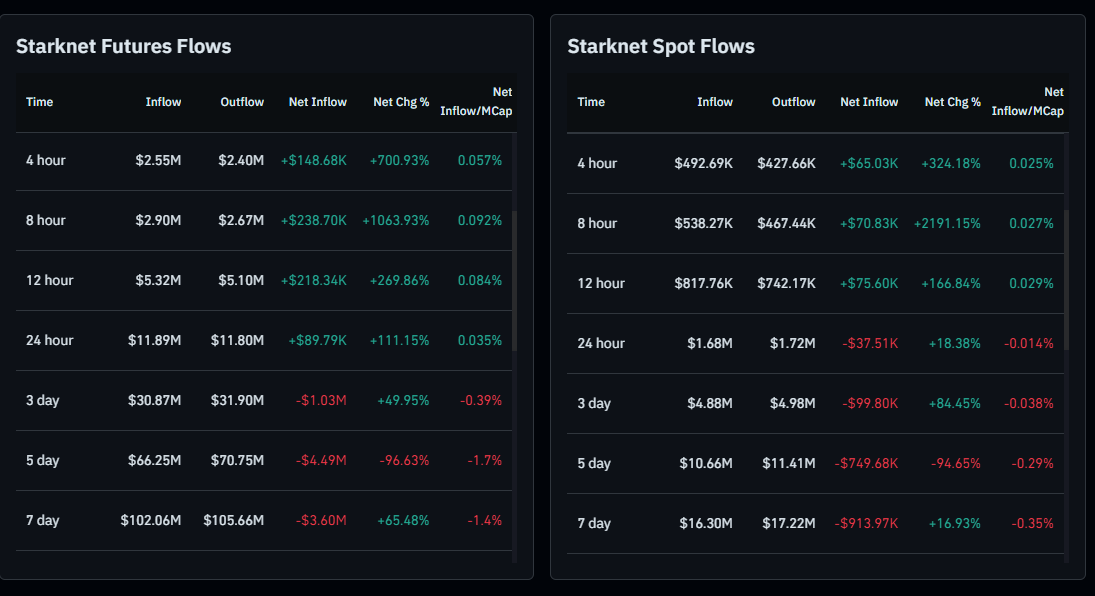
The longer-window read is less supportive. Futures flows are negative from 3 days to 7 days, while spot flows also show net outflows across the same longer windows. That keeps the rebound from looking fully confirmed, even though short-window participation has improved.
Moving averages and volume
STRK is trading near the 7-day moving average (MA7) around $0.0414 and above MA25 near $0.0380, which points to firmer short-term momentum. The 99-day moving average (MA99) sits near $0.0397, so price holding above that level keeps the latest recovery attempt intact.
STRK volume from Toobit, as of May 25, 2026, around 14:00 UTC

Volume still needs stronger confirmation. The current visible reading is around 3.4 million STRK, but the 20-day volume average is not clearly visible in the provided chart. Without that average reference, the safer read is that volume supports short-term activity but does not yet confirm a stronger recovery phase.
On-chain cues
Derivatives positioning is improving, but it still needs price confirmation. For STRK, rising participation supports the rebound attempt, while the funding read shows positioning is not yet clean enough to confirm a stronger move by itself.
STRK Open Interest from CoinGlass, as of May 25, 2026, around 14:00 UTC
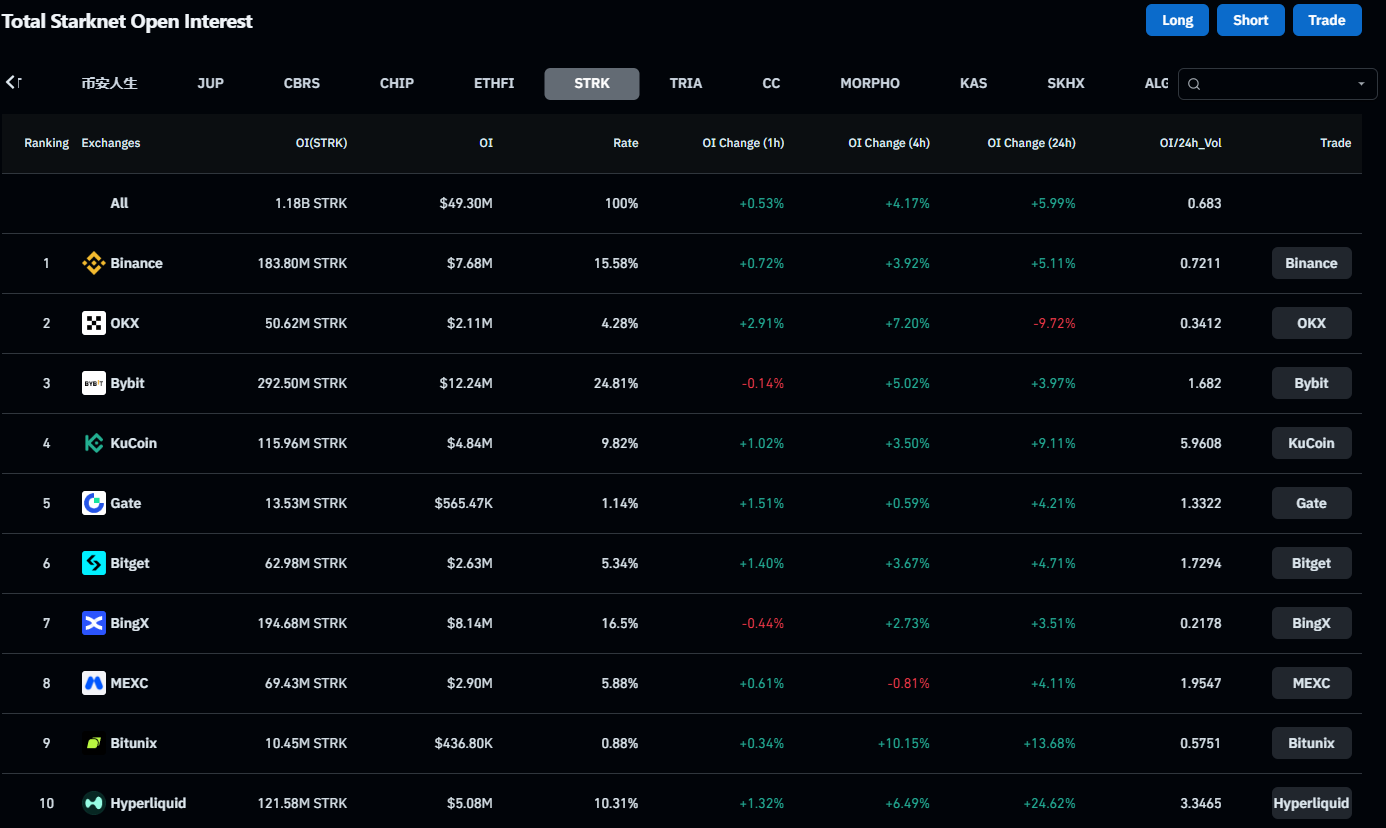
The Open Interest (OI) is around 1.18 billion STRK, or roughly $49.30 million. OI is up around 0.53% over 1 hour, 4.17% over 4 hours, and 5.99% over 24 hours. That points to rising participation, but it still needs price follow-through to avoid becoming unstable leverage.
STRK OI-weighted FR from CoinGlass, as of May 25, 2026, around 14:00 UTC
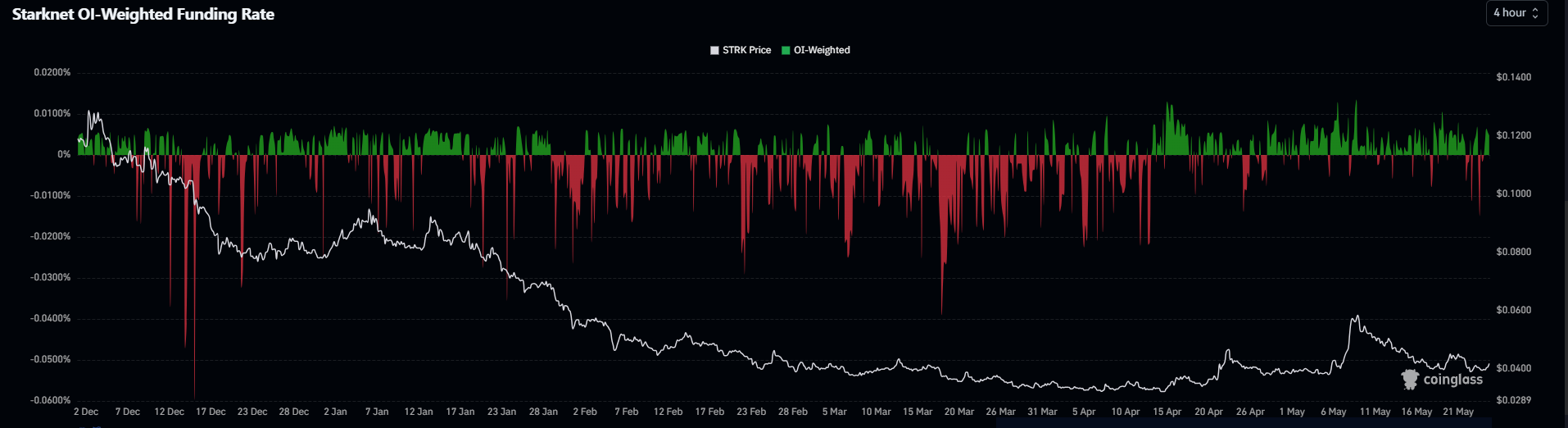
The Funding Rate (FR) from Toobit is around -0.0052%, while the OI-weighted FR from CoinGlass looks mixed and close to neutral on the visible 4-hour view. Negative FR means short-side positioning is still present, so a stronger recovery would need price strength to force cleaner confirmation.
What to watch next
-
$0.04157 reclaim: Confirms short-term follow-through on the perpetual chart.
-
$0.0418 spot reclaim: Confirms the spot-led breakout trigger for the outlook.
-
$0.03851 hold: Keeps the technical range intact.
-
$0.0385 spot hold: Protects the spot base for later scenarios.
-
MA7 at $0.0414: Needs cleaner separation to show stronger short-term momentum.
-
OI rises with improving FR: Supports participation without leaving the move too one-sided.
-
3-day to 7-day flows improve: Confirms longer-window selling pressure is easing.
STRK price prediction and outlook
Base case
STRK can stay in a short-term stabilization range if spot price holds above $0.0385. The immediate cap remains $0.0418, where price needs a cleaner reclaim before the move can look stronger.
The current setup is supported by price holding near the 7-day MA at $0.0414 and above the 25-day MA at $0.0380. Volume still needs to improve, while rising OI and negative FR should be treated as supporting context rather than the main signal.
Bull case
A spot reclaim above $0.0418 would improve the short-term setup first. Holding above that level would make the move look less like a range bounce and more like an attempt to rebuild momentum above the latest high.
The next confirmation would come from price holding above the MA cluster with stronger spot volume. OI can support the move if participation keeps rising, but FR needs to normalize so the rebound does not rely too heavily on one-sided derivatives positioning.
Bear case
A loss of $0.0385 would weaken the current spot range and put STRK back near the lower side of its recent structure. If price fails to recover that level quickly, the $0.0309 ATL becomes the broader downside reference again.
The bear read becomes stronger if volume stays thin while multi-day flows remain negative. Rising OI would not help much if spot price loses support and FR stays negative, because that would point to unstable participation rather than durable demand.
A controversial viewpoint
STRK can remain relevant as Ethereum scaling infrastructure without leading on price. Starknet may still attract developers through its L2 design and Cairo-based stack, but the token needs clearer spot demand before market participants treat the recovery as more than a low-range rebound.
The key twist
-
Ethereum scaling: STRK’s stronger narrative is tied to whether Starknet can turn technical development into more visible app activity, liquidity, and transaction demand. If usage becomes easier to measure, the market may frame STRK through network activity rather than only post-drawdown recovery.
-
Token demand: The price case still depends on whether that activity creates clearer demand for STRK. Stronger spot volume, cleaner MA support, and controlled derivatives positioning would give the token a firmer path than infrastructure relevance alone.
Key milestones for Starknet
-
May 2018: StarkWare completed a $6 million Seed Round, funding early STARK proof research and infrastructure development. This early funding anchored Starknet’s later rollup architecture in years of cryptography-focused development long before STRK existed.
-
June 2020: StarkEx went live on Ethereum mainnet, marking an early production deployment of STARK-based validity rollup infrastructure. This gave StarkWare a live scaling track before Starknet became a general-purpose rollup.
-
August 2020: StarkWare introduced Cairo, a Turing-complete programming language designed for writing provable programs under STARK constraints. Cairo remains central to Starknet because it gives developers a native environment for building apps around the network’s proof system.
-
November 2021: Starknet Alpha launched on Ethereum mainnet, enabling live ZK-rollup transaction processing using Cairo-based smart contracts. This shifted the project from application-specific scaling toward a broader environment for decentralized apps.
-
May 2022: StarkWare raised $100 million in a Series D at a reported $8 billion
valuation. This funding secured one of the most substantial ZK scaling roadmaps, expanding the team's runway for prover development, tooling, and network growth.. -
February 20, 2024: The STRK claim window opened, anchoring early liquidity and
token price discovery. STRK also reached its reported $5.30 ATH on the same date, making the launch period a key reference point for the token’s long-term price history. -
June 2025: Staking v2 was activated, expanding validator participation and refining Starknet’s economic security model. This foundational upgrade anchors STRK's expanding utility within Starknet's long-term transition to decentralized sequencing.
-
July 2025: The v0.14.0 upgrade improved sequencing efficiency, transaction inclusion, and block confirmation stability. This helped strengthen Starknet’s infrastructure case by reducing transaction latency and improving block production stability.
-
November 2025: The S-two prover was deployed, improving proof generation efficiency and reducing operational overhead. Prover performance remains central to Starknet’s scaling model because it determines the cost and speed of verifying state transitions.
-
February 2026: Starknet introduced strkBTC and released the Starkzap SDK, expanding its 2026 narrative around Bitcoin integration, stablecoin access, and decentralized finance (DeFi) primitives. This keeps the current focus on whether Starknet can turn technical progress into clearer app activity, liquidity, and STRK demand.
Community sentiment and STRK news
STRK chatter has stayed active as the token’s recent narrative tightened around Starknet’s Shinobi mainnet privacy upgrade. A community post from BSCN framed the update as a direct catalyst for STRK’s short-term move, with the token rising 19% in 24 hours to around $0.04318 and gaining 25% on the week.
STRK community post from BSCN, as of April 23, 2026
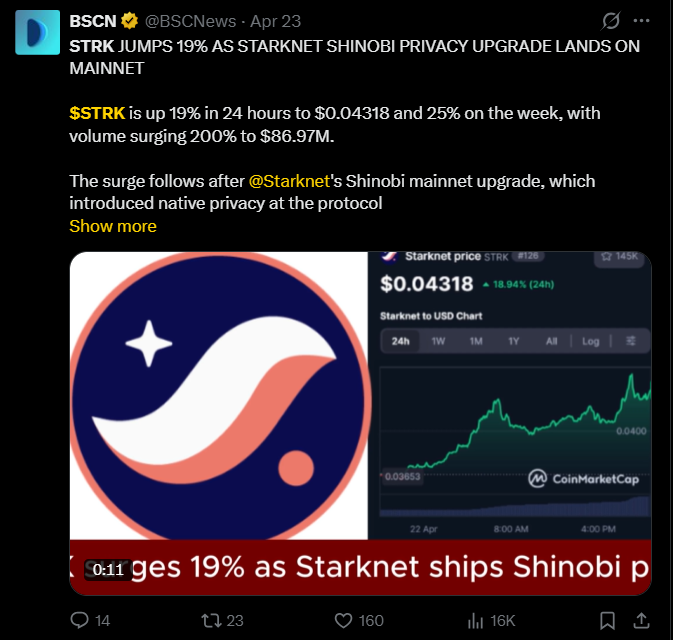
The same post said volume surged 200% to around $86.97 million after Shinobi landed on mainnet. That gives the market a product-specific news driver, but it should still be separated from longer-term adoption because the post does not confirm sustained app activity, liquidity depth, or recurring transaction demand.
Community sentiment from CoinMarketCap also leans supportive. The latest read shows 67% bullish versus 33% bearish, with the 15-day trend up 10.0%. The signal remains limited because fewer than 100 votes were recorded in the last 24 hours.
STRK community sentiment from CoinMarketCap, as of May 25, 2026, around 14:00 UTC
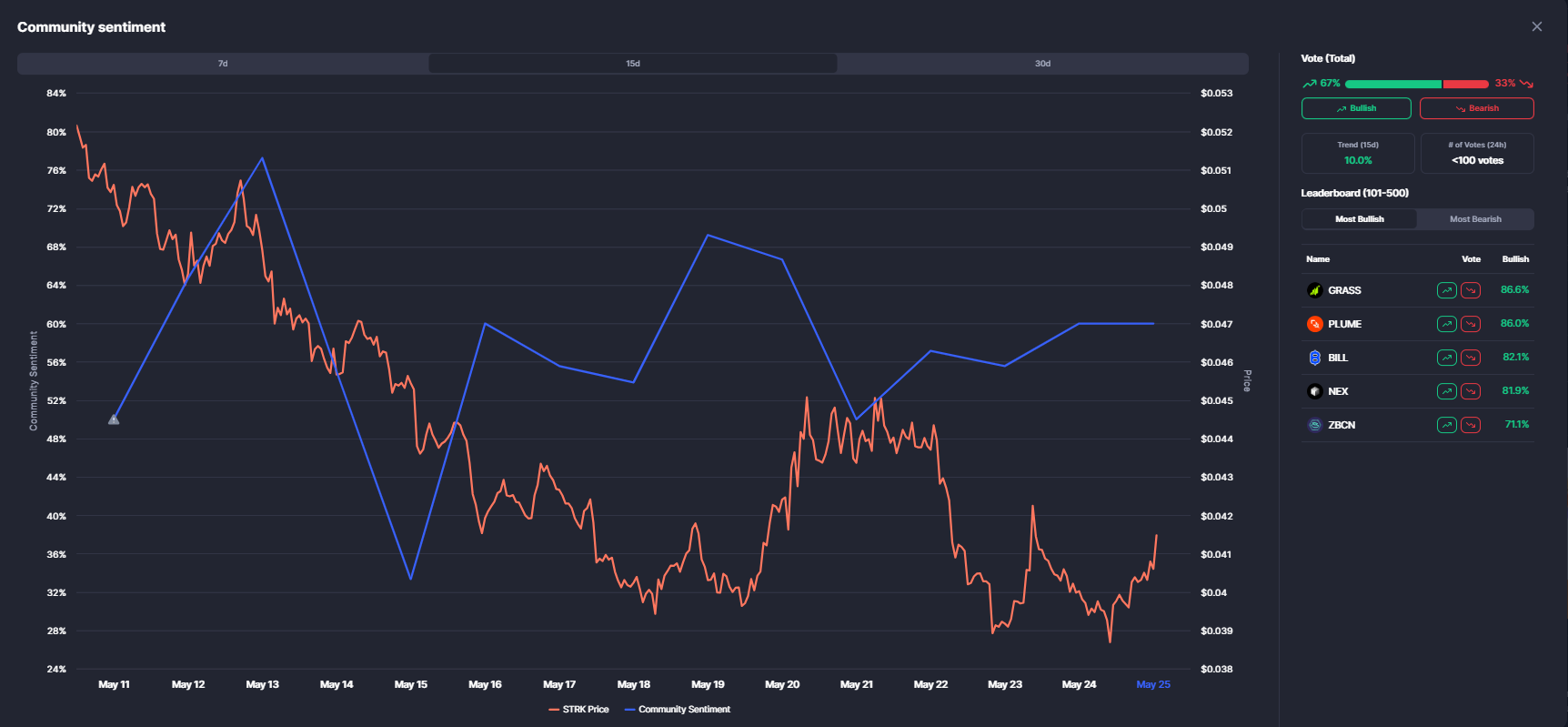
The broader takeaway is that the market still recognizes Starknet as an active Ethereum scaling project with a privacy-upgrade narrative. Even so, STRK still needs stronger participation, cleaner flows, and visible network activity before that constructive tone becomes stronger token conviction.
FAQs
How does Starknet scale Ethereum activity?
Starknet scales Ethereum by moving transaction processing off the mainnet and using validity proofs to verify that transactions were processed correctly. This lets apps handle more activity while still settling back to Ethereum for security.
The practical value is that Starknet can support higher-throughput apps without requiring every transaction to be processed directly on Ethereum mainnet.
What is STRK used for?
STRK is the native token of Starknet. It is tied to governance, staking mechanics, and the network’s longer-term move toward decentralized sequencing.
The token also serves as the platform’s native currency for transaction fees, aligning ongoing network usage directly with token utility. Its structural importance grows as network activity expands and broader staking validation goes live across the ecosystem.
Why does Cairo matter for Starknet?
Cairo is Starknet’s native programming language for writing provable programs. It gives developers a purpose-built environment for apps that rely on Starknet’s proof system.
This makes Cairo part of Starknet’s product edge, but the market still needs to see whether developer activity turns into sustained app usage and liquidity.
Why is Starknet adding Bitcoin integration?
Starknet’s Bitcoin-facing roadmap, including strkBTC, expands the network beyond a standard Ethereum scaling story. The aim is to bring BTC liquidity into Starknet-based activity, including DeFi primitives and private transaction use cases.
This gives Starknet a broader infrastructure lane, but the key test is whether BTC-related activity becomes measurable through liquidity, transactions, and app demand.
Should I buy STRK now?
STRK is worth studying if you are tracking Ethereum scaling, ZK infrastructure, staking mechanics, and Bitcoin-linked DeFi expansion. The project has a deeper technology base than many short-term token narratives.
That does not make STRK a guaranteed buy. The token still needs stronger evidence that Starknet’s infrastructure progress can translate into sustained network activity, liquidity, and token demand.
The takeaway
Starknet holds a stronger 2026 infrastructure narrative than its price chart reflects. The network is building around ZK scaling, staking, decentralization, privacy, and Bitcoin integration, but the token still needs clearer demand signals.
Growth relies heavily on a surge in app activity and liquidity following recent upgrades. However, if technical progress continues to outpace token demand, STRK faces the risk of becoming a back-end infrastructure utility rather than a market leader. Whether Starknet can successfully bridge this gap and turn its roadmap into sustained network usage remains the definitive question.
This article is for informational purposes only and does not constitute financial advice. Always do your own research (DYOR) before making any decisions.
How to start trading Starknet (STRK)
Starknet is worth watching because it sits at the intersection of ZK-scaling, Ethereum settlement, staking, privacy infrastructure, and Bitcoin-linked DeFi. Sustaining long-term token demand depends on whether ecosystem milestones, including Cairo developer adoption, sequencer decentralization, strkBTC integrations, and privacy upgrades, can successfully translate into consistent on-chain utility.
Ready to trade? Toobit gives you a straightforward way to track STRK price moves, compare market conditions, and trade with spot and futures tools in one place.
Start trading STRK/USDT on Toobit today.


