
Resolv (RESOLV) creates a financial future where money no longer depends on traditional banks to maintain its value. However, this experiment exposes a tough reality for everyone in crypto.
In escaping Wall Street, blockchain technology might simply trade traditional banking risks for devastating technical flaws. Some view Resolv’s brand of advanced financial engineering as a complex house of cards, claiming true stability in crypto is an illusion.
Beyond the skepticism, this protocol fought its way back to life after a near-fatal collapse. Its next steps will decide whether independent digital dollars can actually work or remain an expensive dream.
What is Resolv (RESOLV)?
The protocol serves as the core utility and governance pillar of a pioneering decentralized stablecoin ecosystem. Its network provides the infrastructure to run a fiat-independent money market using crypto-native asset reserves.
Resolv is built directly on Ethereum (ETH) to tap into the network's Proof-of-Stake (PoS) security. The protocol maintains a strict 1 billion token limit and uses buybacks to steadily shrink the circulating supply.
As the platform developed, it introduced a unique delta-neutral strategy using two distinct token tranches. A delta-neutral strategy balances opposing trades to shield portfolios from price swings, allowing profitability without guessing market direction.
Users mint pegged Resolve USD (USR) stablecoins against ETH or Bitcoin (BTC) collateral. Meanwhile, Resolv hedges price volatility by opening short futures positions on venues like Deribit
This framework routes yields from staking rewards and futures funding fees directly to users. At the same time, a secondary Resolv Liquidity Pool (RLP) token acts as an insurance backstop.
In March 2026 however, a devastating hack shook the project and exposed flaws in its off-chain design. An attacker used a compromised private key to bypass on-chain minting limits.
This was accomplished by breaching Resolv’s Amazon Web Services Key Management Service (AWS KMS) environment. The hacker printed 80 million unbacked USR, causing a depeg and resulting in millions in decentralized finance (DeFi) bad debt.
To restore investor confidence, the team launched a full recovery framework in May 2026. This pivotal Vault Street upgrade introduces institutional real-world asset (RWA) vaults, positioning the RESOLV token for a major structural transformation.
How RESOLV works
The protocol orchestrates capital through a multi-tiered smart contract engine. When users deposit crypto, the system automatically routes assets into two distinct functional channels.
-
Delta-neutral Loop: The protocol pairs every dollar of spot collateral with an equal short position on external derivatives exchanges. This offsets directional price exposure and harvests continuous funding rate fees.
-
Tranched risk architecture: Capital flows into either senior stability (USR) or junior risk (RLP). The junior tranche absorbs any negative funding periods, protecting the stablecoin's core backing.
-
Governance and parameter control: Staking RESOLV into stRESOLV grants active voting power over the ecosystem's risk variables. Holders directly calibrate target yields, choose white-listed hedging venues, and dictate RWA vault allocations.
The underlying infrastructure relies heavily on automated rebalancing scripts to manage margin requirements across centralized and decentralized platforms. Following recent overhauls, the system now implements strict on-chain oracle checks to prevent arbitrary minting actions.
Resolv price history and performance overview
RESOLV price history
RESOLV reached its all-time high (ATH) of $0.4108 on June 11, 2025, just a day after its launch. Massive hype surrounding centralized exchange (CEX) listings and a restricted initial token supply sparked this rush.
Its price would slowly decline from there however. After a little over a year, RESOLV hit its all-time low (ATH) of $0.01427 on June 20, 2026.
On the other hand, the project’s market cap showed resilience despite the downward price trajectory. It generally stayed in the tens of millions, reaching its ATH of $61.38 million on July 28, 2025.
Resolv’s market cap only dipped below the $10 million mark in late May 2026. Investor optimism around recovery plans temporarily cushioned the token before post-hack sell-offs finally dragged its market cap down.
RESOLV's latest performance
Tracking the price chart from July 28 to August 3, 2026 would show RESOLV trading between $0.01522 to highs of $0.01644. The week has its price moving into a consolidation phase and is only about 10.11% from its ATL.
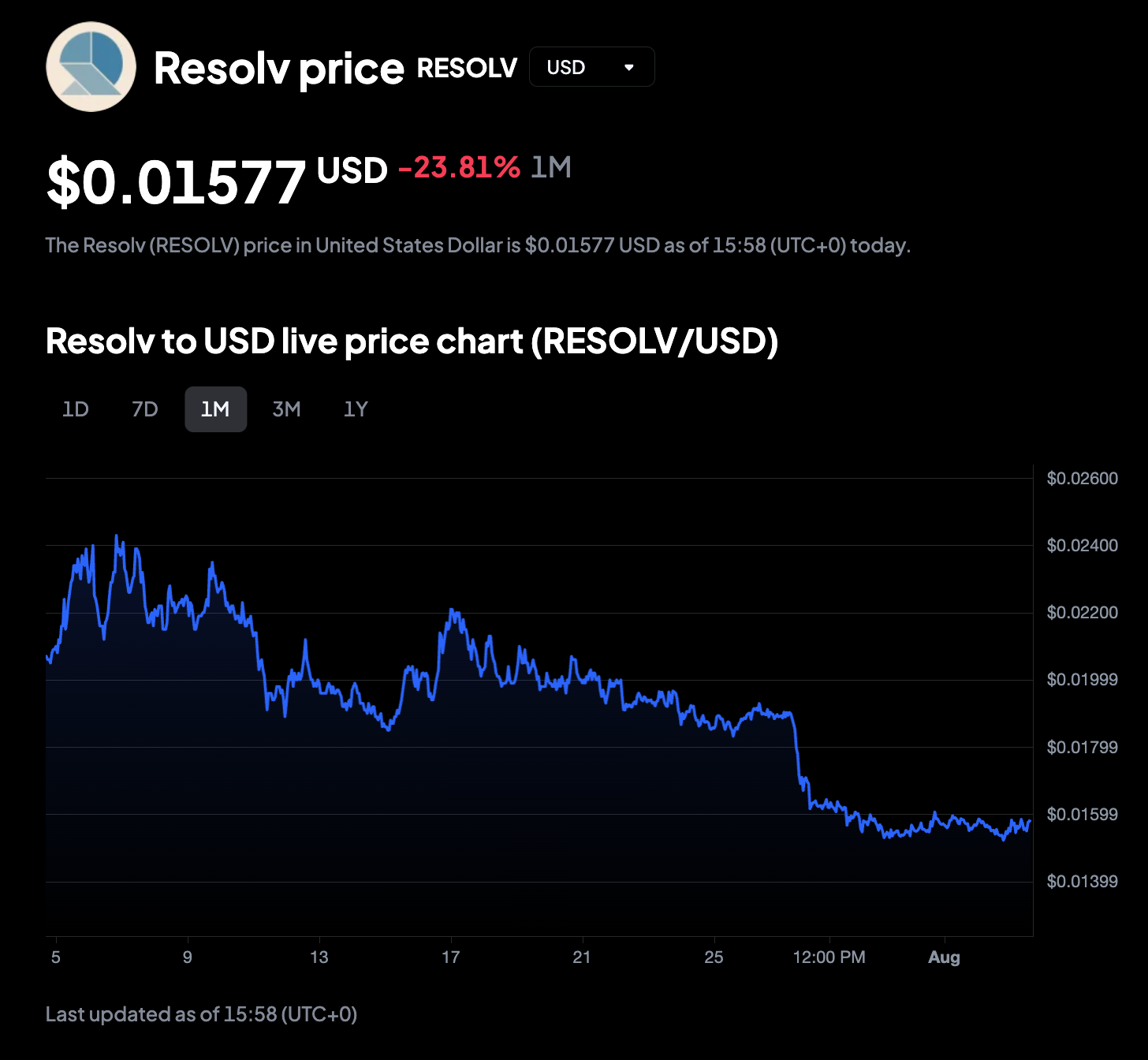
Resolv to USD live price chart on August 3, 2026, 15:26 UTC+0 from Toobit
Its market cap performance for this same week did not fluctuate much. The lowest it reached was $6.73 million while its highest was at $7.18 million.
Current market snapshot (August 3, 2026 23:59 UTC+8)
RESOLV is up 2.54% at $0.01577, ranging between $0.01520 and $0.01596 within the last 24 hours. It is keeping steady though is still 96.18% away from its ATH.
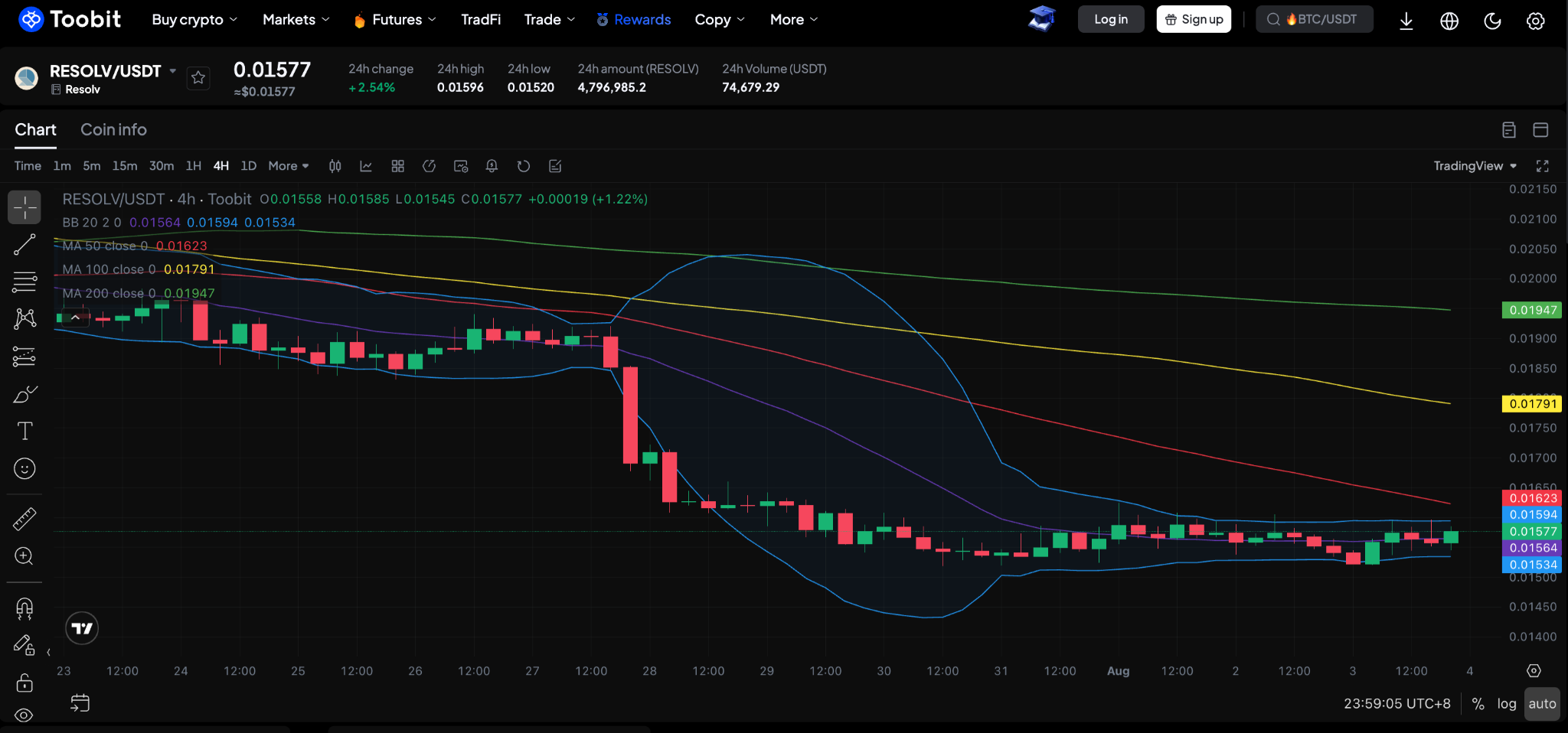
RESOLV/USDT 4-hour spot trading chart from Toobit
Similarly in the green is its market cap, up 2.32% at $6.92 million from yesterday. It has a circulating supply of 440.4 million RESOLV coming from a 1 billion total supply.
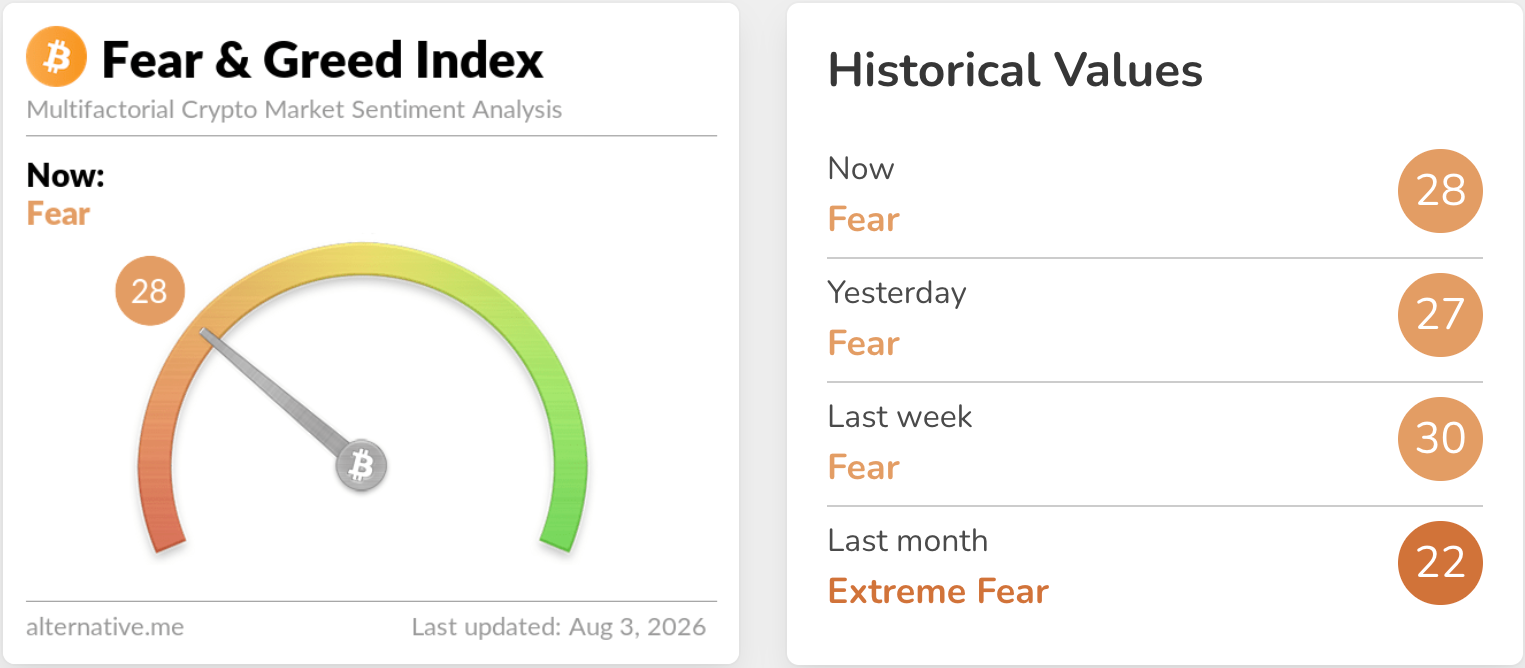
Crypto Fear and Greed Index on August 3, 2026 from Alternative.me
The Crypto Fear and Greed Index slightly improved to a 28 (Fear) from yesterday’s 27 (Fear) rating. Bitcoin and other large cryptocurrencies have stayed in fear to extreme fear territory for the majority of 2026’s 2nd quarter.
On-chain and technical analysis
Support and resistance
RESOLV on the 4-hour chart is keeping steady for this week of July 28 to August 3, 2026. It had just lost its support level of about $0.01890 on July 27 but was able to stabilize by July 29.
Again, price is about 10.11% away from its ATL where its near-term support of $0.01545 hovers dangerously close. Losing this level could drop RESOLV into a new ATL but might be unlikely in the short term.
Its near-term resistance however is a short distance away at $0.01605, after trading in a tight range this week. Breaking past this could allow it to challenge its previous support of $0.01890, now acting as resistance.
Momentum indicators
The 4-hour Relative Strength Indicator (RSI) shows RESOLV spending almost four days in oversold territory. It cleared it on July 31, 2026 and is now at 49.52 to possibly go beyond its neutral zone.
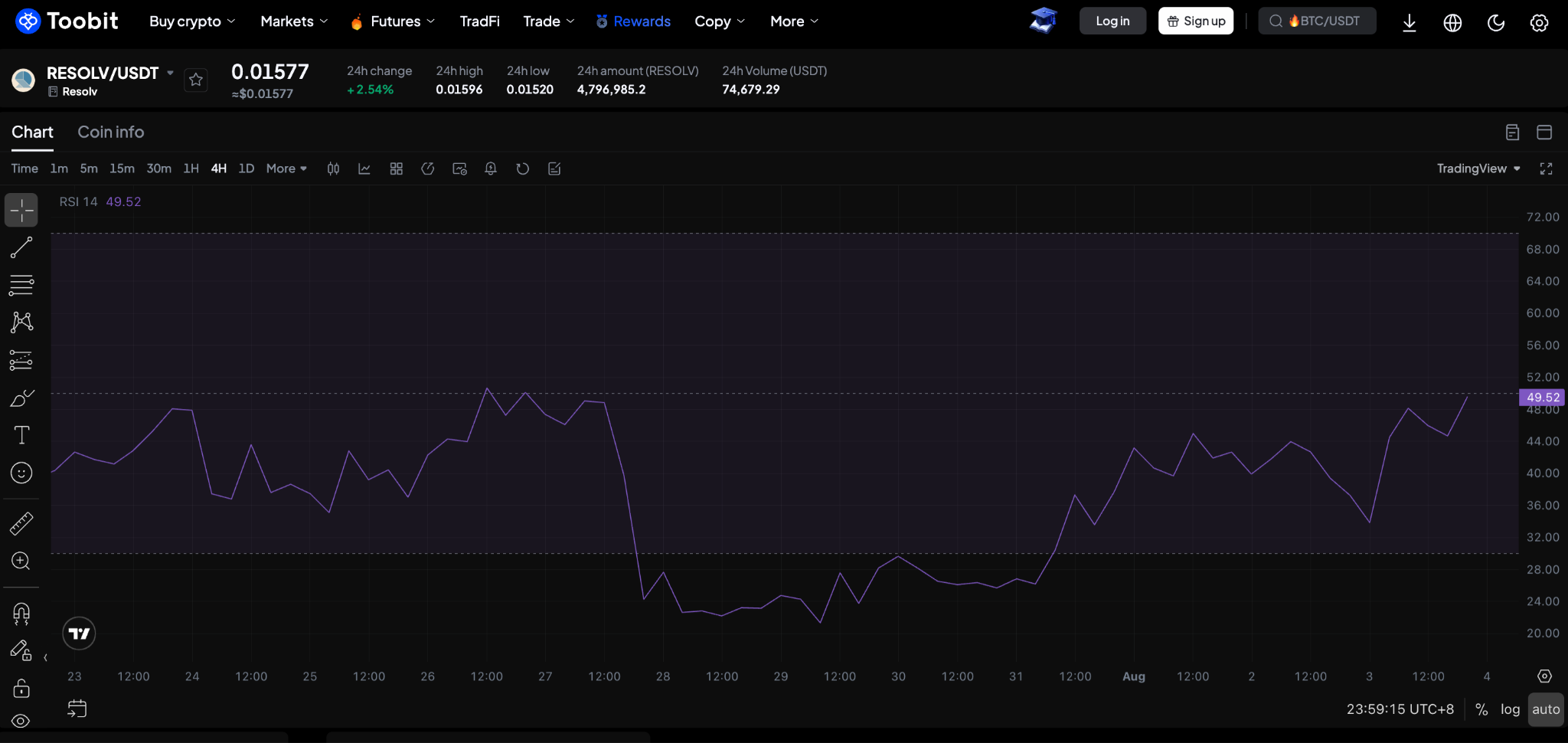
RESOLV/USDT 4-hour RSI chart from Toobit
RESOLV’s Moving Average Convergence Divergence (MACD) is also showing strength on the 4-hour timeframe. Its blue MACD line appeared to intersect its orange signal lines but price bounced off its lower Bollinger band.
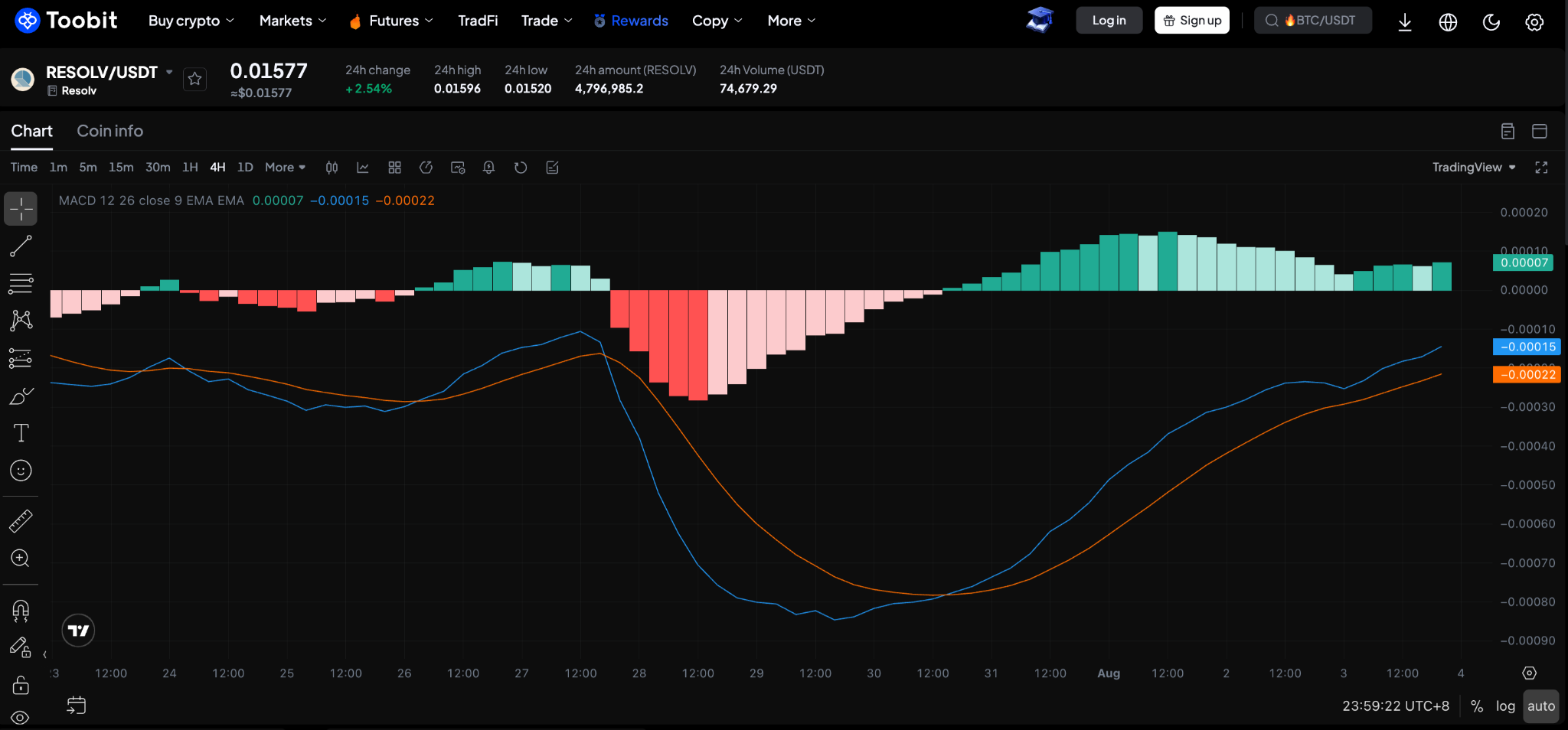
RESOLV/USDT 4-hour MACD chart from Toobit
The reaction reflected a renewed upwards MACD trajectory now at -0.00015 with the signal line following at -0.00022. It has a positive histogram of 0.00007, measuring the distance between these lines.
Moving averages and volume
Should it continue with its positive momentum, RESOLV could hit its 50-day moving average (MA) now at $0.01623. It could pierce its 100-day (MA) at $0.01791 should buying extend to overbought levels on its 4-hour RSI.
Hitting its 200-day MA at $0.01941 would mean that it has blasted past the next level resistance of $0.01890.
Volume rose by 3.88% to $2.48 million across all exchanges within the last 24 hours. It went as low as $2.51 million and as high as $5.83 million during the past week.
On-chain cues
Protocol metrics on DefiLlama show a Total Value Locked (TVL) of $12.14 million. This is supported by $17.76 million in annualized fee generation and $2.02 million in annualized protocol earnings.
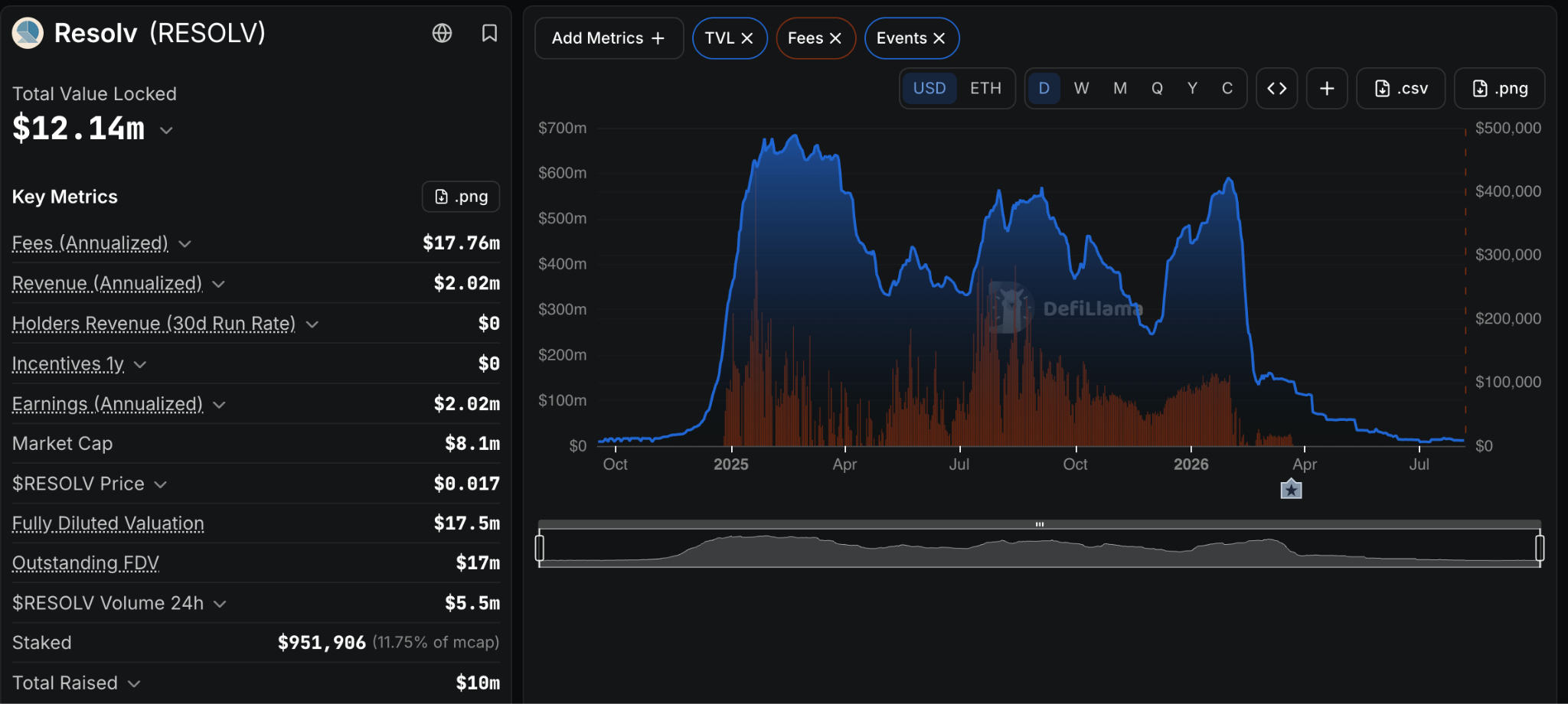
RESOLVE on-chain analytics on August 5, 2026 from DeFiLlama
On-chain staking activity reflects steady participation, with $951,906 worth of tokens currently locked to support yield operations. Multi-signature timelocks continue to secure non-circulating allocations off secondary markets to prevent supply dilution.
Token distribution data on Etherscan reveals a community base of 12,865 holders maintaining active positions. Meanwhile, Vault Street pool depositors keep collateralization levels steady to maintain balanced delta-neutral hedging mechanics across smart contracts.
Resolv price prediction and outlook
Staging a comeback after a major security flaw is not easy, but Resolv is actively working to rebuild its reputation. Its price path in 2026 depends on the crypto community’s renewed trust as it rolls out stronger security and RWA options.
Bull case ($0.0350 to $0.0550)
Institutional adoption of the newly launched Vault Street yield pools drives renewed platform demand. Combined with programmatic supply buybacks, this momentum could spark a strong rally well beyond key moving averages.
Base case ($0.0180 to $0.0250)
Steady protocol TVL and successful implementation of strict oracle checks help the asset gradually regain user trust. This scenario allows the token to push past resistance near $0.01890 and stabilize in a higher trading channel.
Bear case ($0.0080 to $0.0130)
Persistent investor fatigue and low social engagement could prevent price recovery from current consolidation levels. Failing to hold the $0.01545 support floor would likely force a breakdown into fresh historical lows.
Resolv has the technical tools in place to survive, but turning those upgrades into sustained upward momentum takes time. Watching how effectively these yield vaults attract fresh capital will give traders the clearest signal of what lies ahead.
This article is for informational purposes only and does not constitute financial advice. Always do your own research (DYOR) before making any decisions.
Key milestones for RESOLV
-
Protocol founding (2023): Its founders launched Resolv Labs in the UAE to build smarter, volatility-proof investment tools for the DeFi community.
-
Mainnet architecture deployment (September 2024): Went live on Ethereum, officially establishing the foundational delta-neutral minting engine for the USR stablecoin.
-
Seed capital infusion (April 16, 2025): Secured a $10 million seed funding round co-led by Cyber.Fund and Maven 11 to expand institutional digital asset integrations.
-
Token generation event (TGE) (June 10, 2025): Launched the RESOLV ecosystem utility token, paving the way for immediate spot trading support across tier-one exchanges.
-
Governance fee-switch activation (July 24, 2025): The community voted to activate the protocol’s core fee-switch mechanism, routing a portion of trading revenues directly to RESOLV stakers.
-
Programmatic deflationary buyback (August 27, 2025): The foundation executed its first major buyback of 1 million RESOLV tokens to initialize its automated token supply reduction strategy.
-
Emergency security intervention (April 6, 2026): Following the March 2026 off-chain cloud exploit, developers executed a contract upgrade to permanently destroy 36.73 million hacker-held stablecoins.
-
Vault Street upgrade (May 26, 2026): Initiated its post-exploit recovery framework and launched Vault Street, a major new business branch dedicated to distributing institutional tokenized RWAs.
Community sentiment and RESOLV news
Community sentiment
April 11, 2026 was the last reading Resolv had on Messari, with a neutral sentiment score of 0. Sentiment Scores range from -1.0 being extremely negative and 1.0 as extremely positive.
Dedicated stakers still support Resolv’s shift into real-world assets, but most everyday investors remain cautious after the March hack. Platforms like Messari dropping coverage shows falling market interest, meaning the token must now win back trust through solid security.
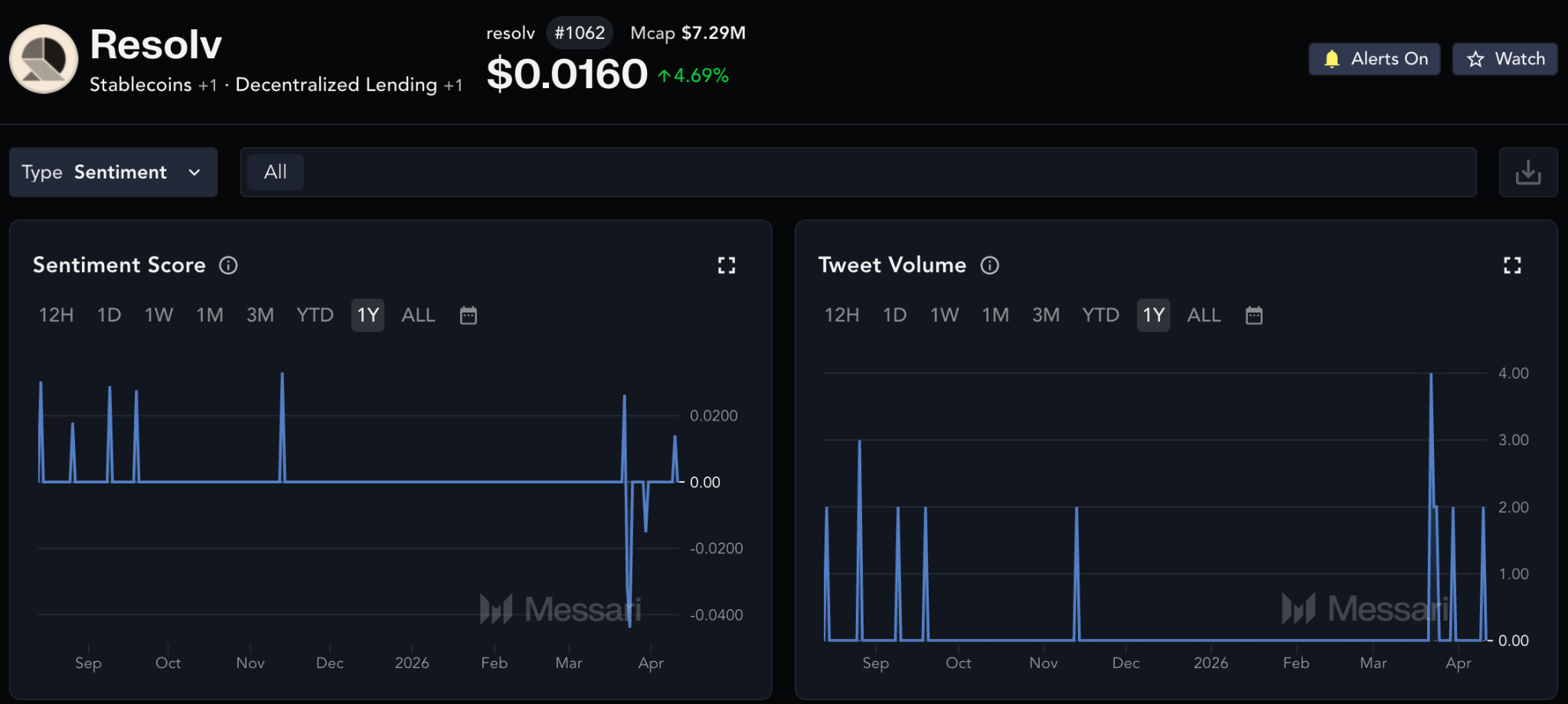
Resolv Sentiment Score and Tweet Volume charts from Messari
Sentiment plummeted to its lowest at -0.049, recorded a few days after the hack. Its Tweet volume was highest at 4, on the very day of the attack.
RESOLV News
-
(July 16, 2026) Resolv officially launched its Vault Street product line to expand institutional real-world asset integrations. The upgrade completed user compensation frameworks while extending token governance across new yield-generating vaults.
-
(April 6, 2026) Protocol developers implemented an emergency contract upgrade to permanently destroy over 36 million unauthorized tokens. The patch had strict on-chain oracle verification to prevent future exploit attempts through compromised validator keys.
-
(March 22, 2026) Resolv temporarily suspended protocol operations following a critical breach of its cloud key management system. Attackers exploited compromised private keys to bypass minting permissions before developers froze affected smart contracts.
FAQs
How does Resolv protect user assets if a partner derivatives exchange fails?
The protocol uses off-exchange custody networks to secure collateral in independent vaults instead of depositing funds directly onto trading platforms. This protects assets from exchange insolvency while keeping the delta-neutral short positions active.
What motivates investors to buy the high-risk RLP token instead of holding USR?
RLP holders take on the burden of negative funding rates to capture leveraged crypto market yields during bull cycles. When market funding rates surge, this junior tranche receives outsized reward payouts compared to standard stablecoin stakers.
How exactly do the new Vault Street RWA vaults help support the USR stablecoin?
The RWA vaults diversify the reserve pool by integrating tokenized RWAs like short-term U.S. Treasuries. This baseline institutional yield cushions the protocol when crypto derivatives funding rates dry up or turn negative.
How do the newly implemented on-chain oracle checks prevent another minting exploit?
The upgraded smart contracts now automatically verify the exact market value of incoming collateral before minting any new USR. This step strips off-chain validator keys of the power to unilaterally print unbacked tokens.
What was the outcome of the May 2026 recovery framework for affected users?
The foundation offered pre-attack USR holders a 1:1 reimbursement to USDC, while post-attack holders received a 1:0.5 rate. RLP holders recovered over 60% of their assets alongside partial compensation in RESOLV tokens.
Can market crashes cause liquidations for users who deposit collateral into Resolv?
Market drops will not liquidate deposited assets because the protocol's matching short positions perfectly offset spot market losses. This balance keeps the total value of the reserve pool entirely stable regardless of price direction.
What lies ahead
Resolv fought its way back from a devastating breach by completely overhauling its entire network. The protocol now offers a much smarter blueprint for independent money by mixing RWAs with its original delta-neutral strategy.
It now backs its RESOLV token with a deeply upgraded and proven security system. To succeed long-term, Resolv must turn these tough infrastructure lessons into lasting market trust.
Stay alert and track RESOLV price charts on Toobit for real-time insights.
How to start trading RESOLV on Toobit
Protect your portfolio from market swings and lock in reliable crypto yields. Stake RESOLV today to pocket direct revenue and shape the future of stable finance.
Ready to trade RESOLV?
Toobit offers excellent Spot and Futures trading access. It has competitive fees, deep liquidity, and charting tools for trading implementation.
Start trading Resolv today.


