
Trillions in transaction value
Polygon (POL) is finally fixing the frustration of money being stuck in line at the bank while the rest of the internet moves at light speed. Founded in 2017 by Jaynti Kanani, Sandeep Nailwal, and Anurag Arjun, to supplement Ethereum’s efficiency and accessibility.
Branded as the Value Layer of the Internet whose high-occupancy toll-like digital infrastructure has moved over $2 trillion in assets. Polygon enables users to bypass slow, expensive legacy systems and settle payments instantly for less than a cent.
Trusted by global giants, Polygon provides the enterprise-grade speed and reliability that the modern economy demands.
What is Polygon (POL) and how does it work?
By 2026, Polygon (POL) has evolved from a simple sidechain into the Value Layer of the Internet. This decentralized infrastructure unifies fragmented blockchains into a single, high-performance network allowing assets to move as seamlessly as information.
The architecture uses a dual-layer Proof-of-Stake (PoS) system anchored to Ethereum for maximum security. The Heimdall Layer acts as the consensus command center while the Bor Layer serves as a high-speed execution rail.
Integrated zero-knowledge (zk)-proofs allow Polygon to inherit Ethereum’s security at a fraction of the cost. Its Aggregation Layer (AggLayer) is the decentralized network protocol at the center of it all.
This unified settlement layer at the center connects thousands of chains to share liquidity and users. Its shared state eliminates the risks and delays of traditional bridging.
Polygon currently has processing speeds of around 2,100 to 2,400 transactions per second (TPS).
The Polygon network already powers global commerce for brands like Starbucks, Nike, and Stripe. Its GigaGas standard is targeting Visa-level speeds of 100,00 TPS.
The POL token is the hyper-productive successor to MATIC which was a passive, single-chain asset. POL on the other hand, secures and powers an entire web of interconnected blockchains.
Below is a table which presents Polygon’s shift from a helper for Ethereum users (MATIC) to the Value Layer of the Internet (POL):
|
Feature |
MATIC (Legacy) |
POL (The Current Standard) |
|
Primary Goal |
Single-chain Ethereum scaling |
Unifying the Value Layer of the Internet |
|
Utility Scope |
Limited to the Polygon PoS chain |
Powers the AggLayer or all connected chains |
|
Staking Model |
Single-chain validation |
Multi-chain staking or securing many chains at once |
|
Tokenomics |
A mostly fixed supply |
2% annual emission which is 1% for staking and 1% for treasury |
|
Performance |
Standard L2 speeds or around 1,000 TPS |
GigaGas scaling targeting over 100,000 TPS |
|
User Experience |
Fragmented which required bridges |
Seamless or unified liquidity across all chains |
Polygon price history and performance overview
Polygon price history
POL reached its all-time high (ATH) of $1.29 on March 14, 2024 and is currently down about 93.10%. It did however reach an ATH of $2.92 when it was still MATIC on January 12, 2021.
Migration from MATIC to POL and the Value Layer promise caused the March 2024 peak. This Polygon 2.0 narrative was further supported by key partnerships with Stripe and Franklin Templeton evidencing real-world use.
The recent crash on February 6, 2026 brought POL’s price to its all-time low (ATL) of $0.085. It has since been up by 4.71% though POL’s price briefly touched $0.084 on some trading platforms.
Polygon's latest performance
Price action for POL from April 2 to 8, 2026 was between $0.0890 to $0.0938. This has been its relative range since coming down from $0.1000 on March 25.
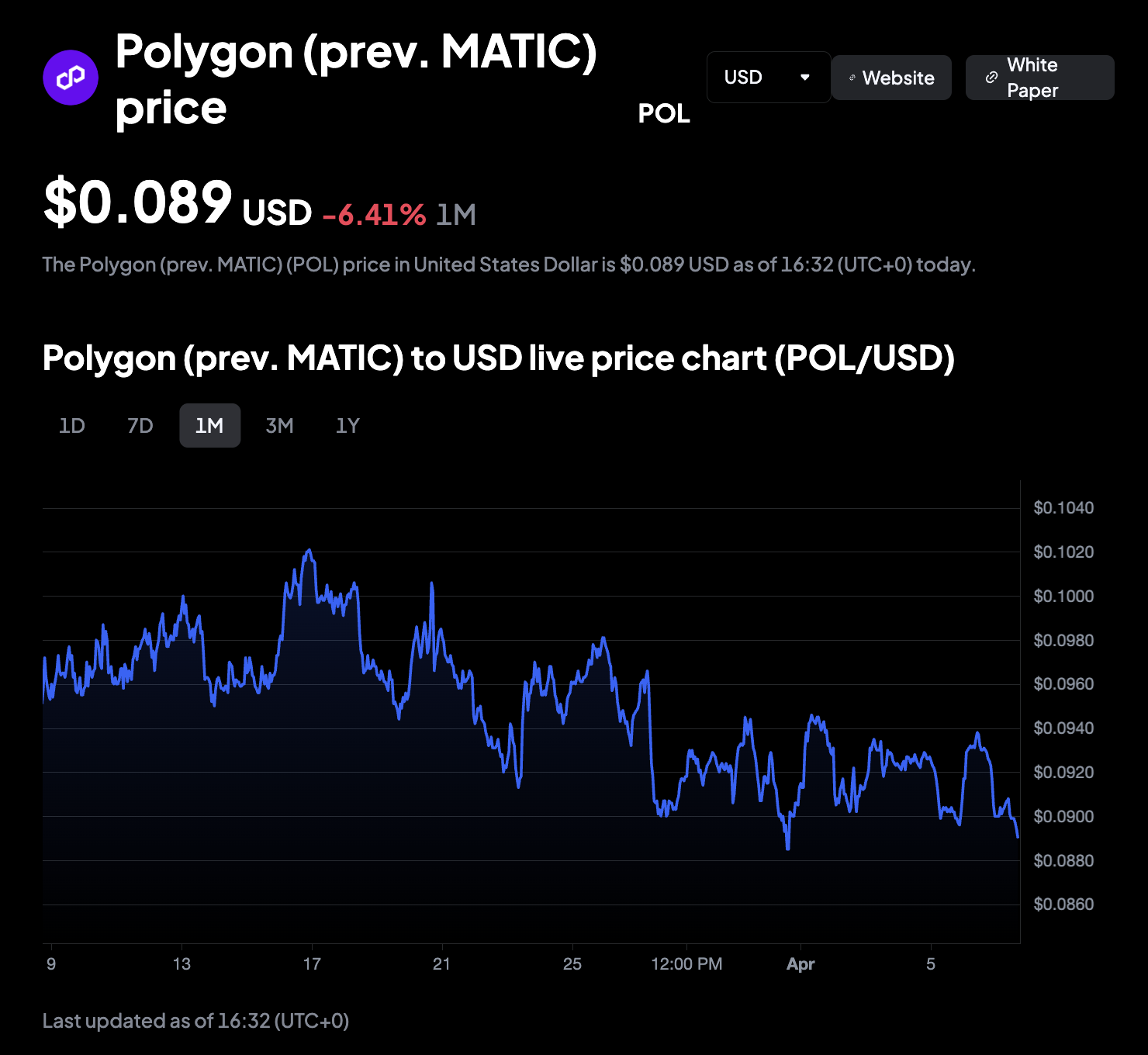
POL to USD live price chart on April 8, 2026, 16:32 UTC from Toobit
POL’s market cap ranged between $943.62 million to $1.002 billion within this same period. It has 10.62 billion POL in circulation with the same number as its total supply.
Current market snapshot (April 8, 2026, 00:42 UTC+8)
POL is down 4.40% in the last 24 hours. It is currently trading at $0.0890 on the POL/USDT spot chart.
The max supply of POL is currently undetermined though it has a 2% annual emission rate. It has a market cap of $944.66 million, which is only 0.11% above the week’s low.
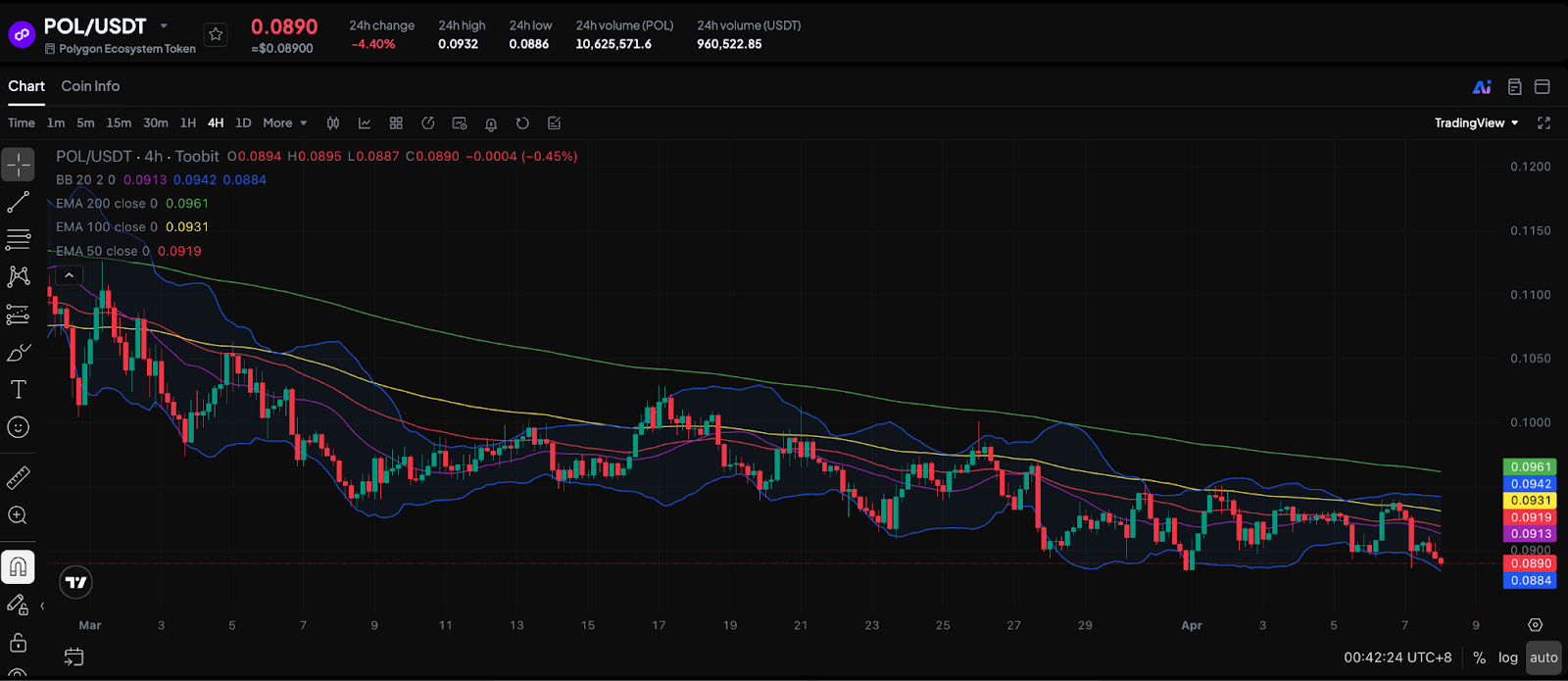
POL/USDT 4-hour spot trading chart from Toobit
Price has been trading between $0.0886 and $0.0931 in the last 24 hours. It is still struggling to maintain support after experiencing its ATL two months ago.
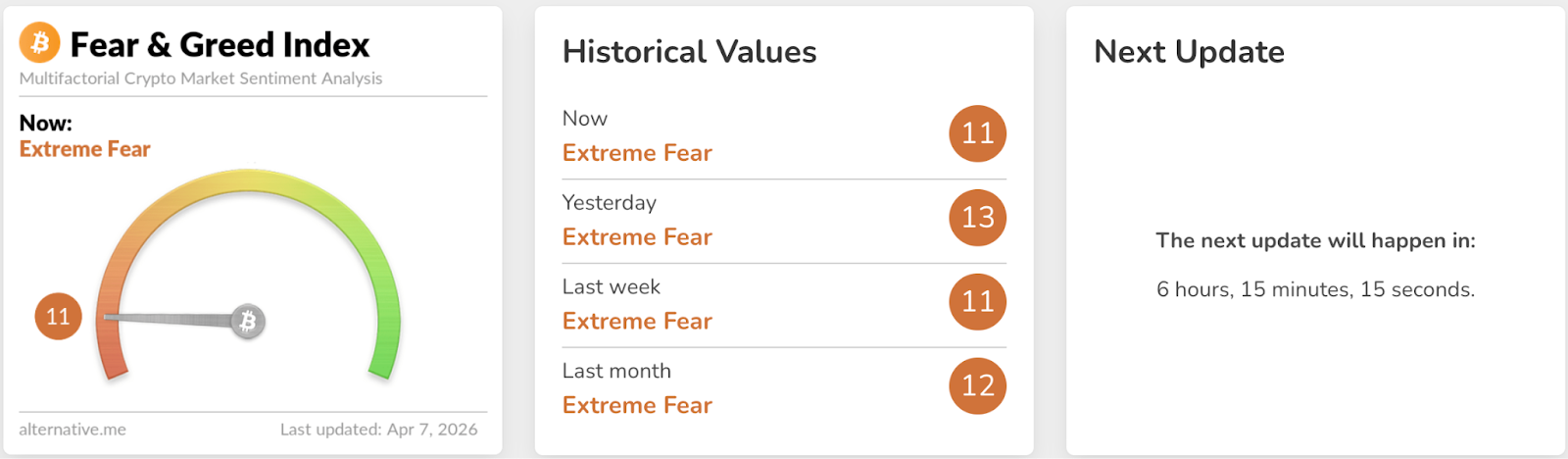
Crypto Fear and Greed Index on April 7, 2026, from Alternative.me
The overall Fear and Greed Index for Bitcoin and other large cryptocurrencies currently stands at an 11 (Extreme Fear) reading. It has been within the Extreme Fear range since March 19, 2026.
On-chain and technical analysis
Support and resistance
POL has been on a steady decline since its AggLayer went live during the first quarter of 2024. It formed major support around the $0.21 level, though October 6, 2025’s massive 50% single-day crash punched through it.
This eventually gave way just about a month after, becoming resistance. It is still establishing near-term support at the $0.0895 level after registering its ATL.
Price challenged resistance at $0.11 throughout the latter half of February 2026 but failed. It has since dropped to a resistance level of $0.093 on the 4-hour time frame.
Momentum indicators
POL’s 4-hour Relative Strength Index (RSI) has not gone below 30 nor above 70 since February 23, 2026. RSI is now at 37.69, with bulls and bears still undecided on the prevailing trend.
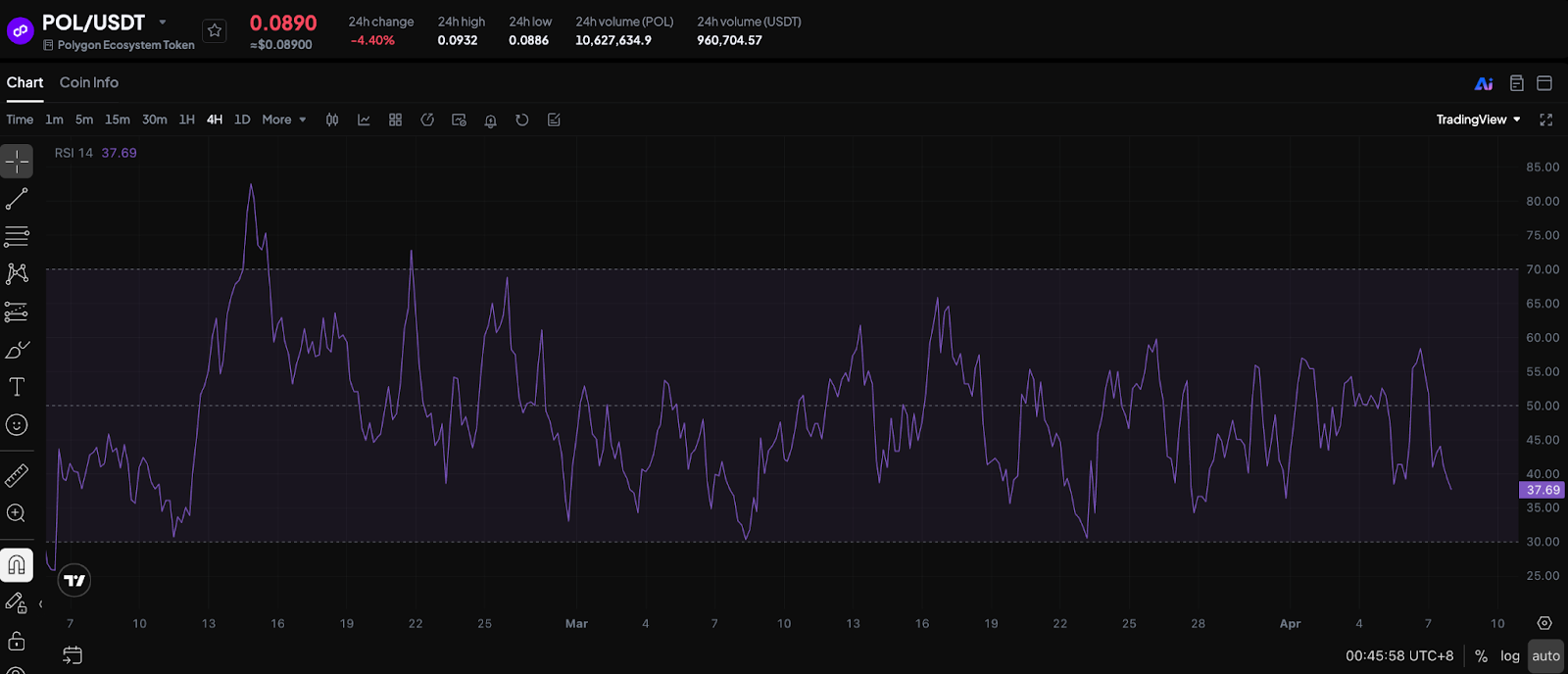
POL/USDT 4-hour RSI chart from Toobit
Its 4-hour Moving Average Convergence/Divergence (MACD) daily histogram is red at -0.0003 with an identical signal reading. The blue MACD indicator is -0.0006 which could indicate a short term upward reversal.
Moving averages and volume
Price has moved under its daily time frame’s 50-day, 100-day and 200-day moving averages (MA) since January 27, 2026. Its immediate target is its 50-day MA currently at $0.9865.
POL had a 24-hour trading volume high of $70.85 million across all exchanges earlier in the week. It has since declined by 19.22% to $57.23 million coinciding with its lowest price point.
Perhaps some good news in the geopolitical arena can boost prices of crypto tokens in the short term.
On-chain cues
According to Dune, POL’s transactions are nearing the 6.72 billion mark and rapidly rising. It has over 164.3 million unique wallets and $1.225 billion in total value locked (TVL).
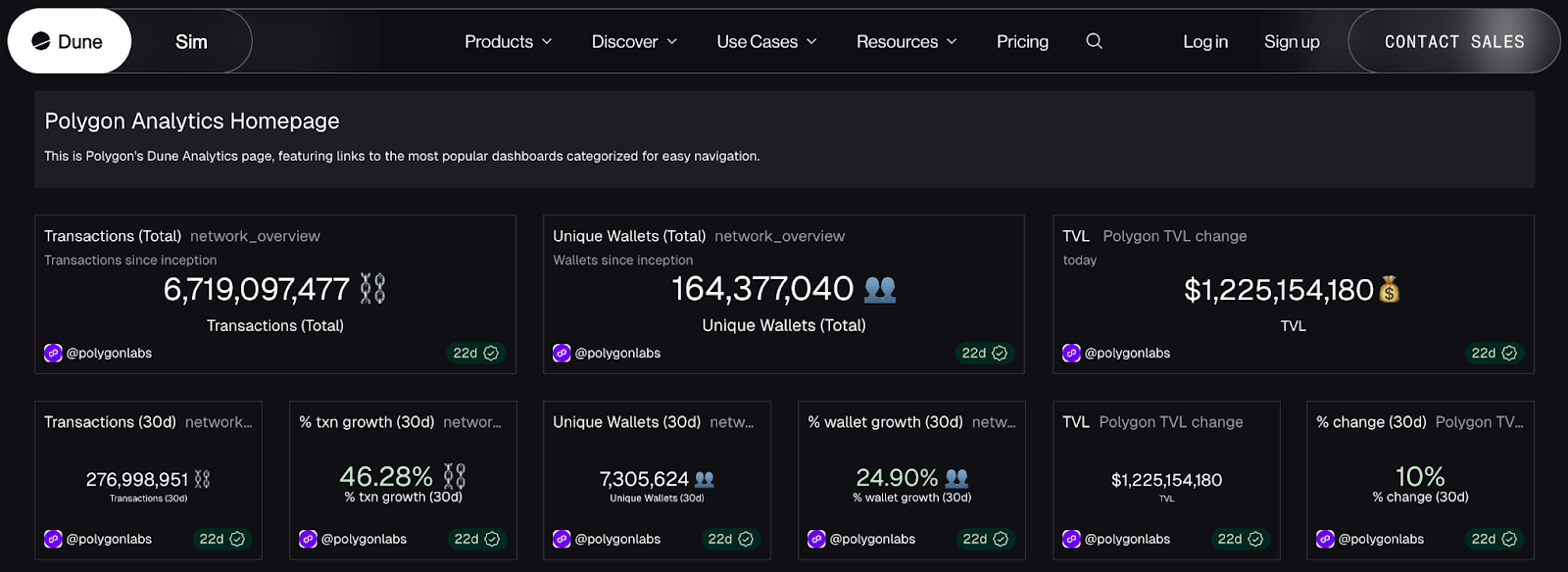
POL on-chain analytics on April 8, 2026 from Dune
Transaction growth over the past 30 days has spiked by 46.28% and wallet growth by 24.90%. Its TVL also increased by 10% over the same time frame, supporting POL’s real world use case.
POL has a massive $3.192 billion stablecoin market cap according to DeFiLlama. This is complemented by a 49.40% USDC dominance rating.
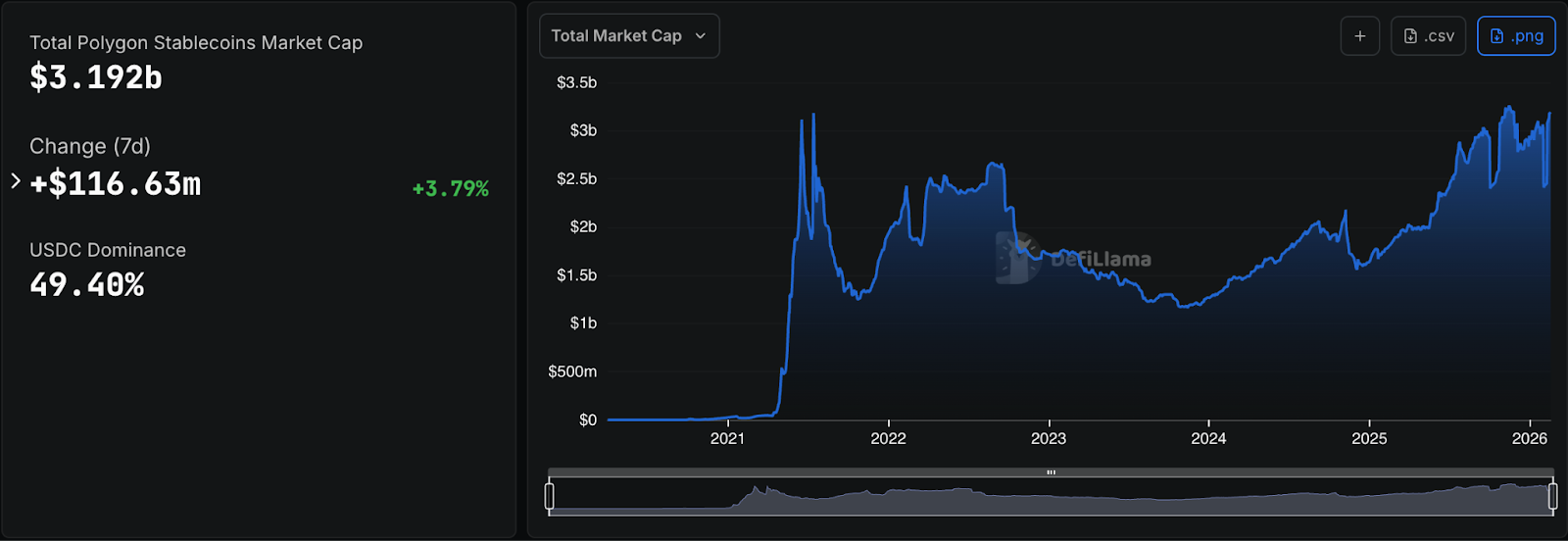
POL stablecoins market cap on April 8, 2026 from DeFiLlama
The past 30 days also saw Polygon decentralized exchange (DEX) transactions reaching more than $5.1 billion worth in stablecoin volume. It has cleared over $281 billion since October 2020, however.
Polygon (POL) 2026 price prediction and outlook
POL has an obvious disconnect between its well-built infrastructure and its valuation. It has facilitated over $2 trillion in total transactions but remains near its February 2026 ATL of $0.085.
A recovery depends on market sentiment shifting from Extreme Fear to recognizing Polygon's strong deflationary fundamentals. It has 2% annual emissions offset by a daily burn rate of around 1 million POL.
This currently results in an estimated 1.5% net-supply reduction annually. Transaction volume is up 46% over the last 30 days, increasing scarcity and could possibly establish a firm price floor.
Giugliano hard fork slashes transaction finality on April 8, 2026, moving the network closer to its 100,000 TPS GigaGas goal. The network is fundamentally stronger than it was during its 2024 peak due to its growing list of partnerships and upgrades.
Bull Case ($0.45 to $0.75)
A GigaGas supply shock combined with surging institutional volume from partners like Franklin Templeton could trigger a major breakout.
Base Case ($0.20 to $0.35)
Normalizing market sentiment and steady retail adoption may push POL to reclaim historical resistance levels.
Bear Case ($0.07 to $0.12)
Persistent global economic fear and Extreme Fear readings could keep the price suppressed near its $0.085 all-time low.
Polygon’s technology has matured faster than its market perception. The current price-vs-value gap suggests that any positive shift in macroeconomic sentiment could rapidly favor POL.
This article is for informational purposes only and does not constitute financial advice. Always do your own research (DYOR) before making any decisions.
Key milestones for Polygon
-
The Matic network (October 2017): Founded in Mumbai by Kanani, Nailwal, and Arjun to solve Ethereum’s congestion issues using a high-speed sidechain approach.
-
Mainnet launch (2020): MATIC Mainnet officially went live and quickly became the go-to destination for low Ethereum transaction fees.
-
Polygon strategic rebrand (February 2021): Single-chain Matic transitioned to the Polygon network of blockchains and became the first merger of two blockchain networks with Hermez.
-
Polygon 2.0 vision (2023): Value Layer of the Internet unveiled on 2.0 roadmap, introducing zK-powered scaling and technical transition from MATIC to POL.
-
AggLayer and POL migration (2024): AggLayer goes live granting various blockchains shared liquidity. It also officially migrated to POL allowing multi-chain staking and governance.
-
Institutional tipping point (2025): Became the primary rail for real-world assets (RWAs), with major financial entities like Franklin Templeton and Mastercard moving billions on-chain.
-
Rio and Madhugiri upgrades (Late 2025): Eliminated chain reorganizations and boosted network speeds to over 5,000 TPS, making Polygon’s reliability indistinguishable from traditional banking systems.
-
GigaGas era and net deflation (2026): A multi-phase upgrade targeting 100,000 TPS is underway with high network activity pushing it into a net-deflationary state.
Community sentiment and POL news
Community sentiment
As of April 7, 2026, Messari shows POL with a Sentiment Score of 0.177. Sentiment Scores range from -1.0 being extremely negative and 1.0 as extremely positive.
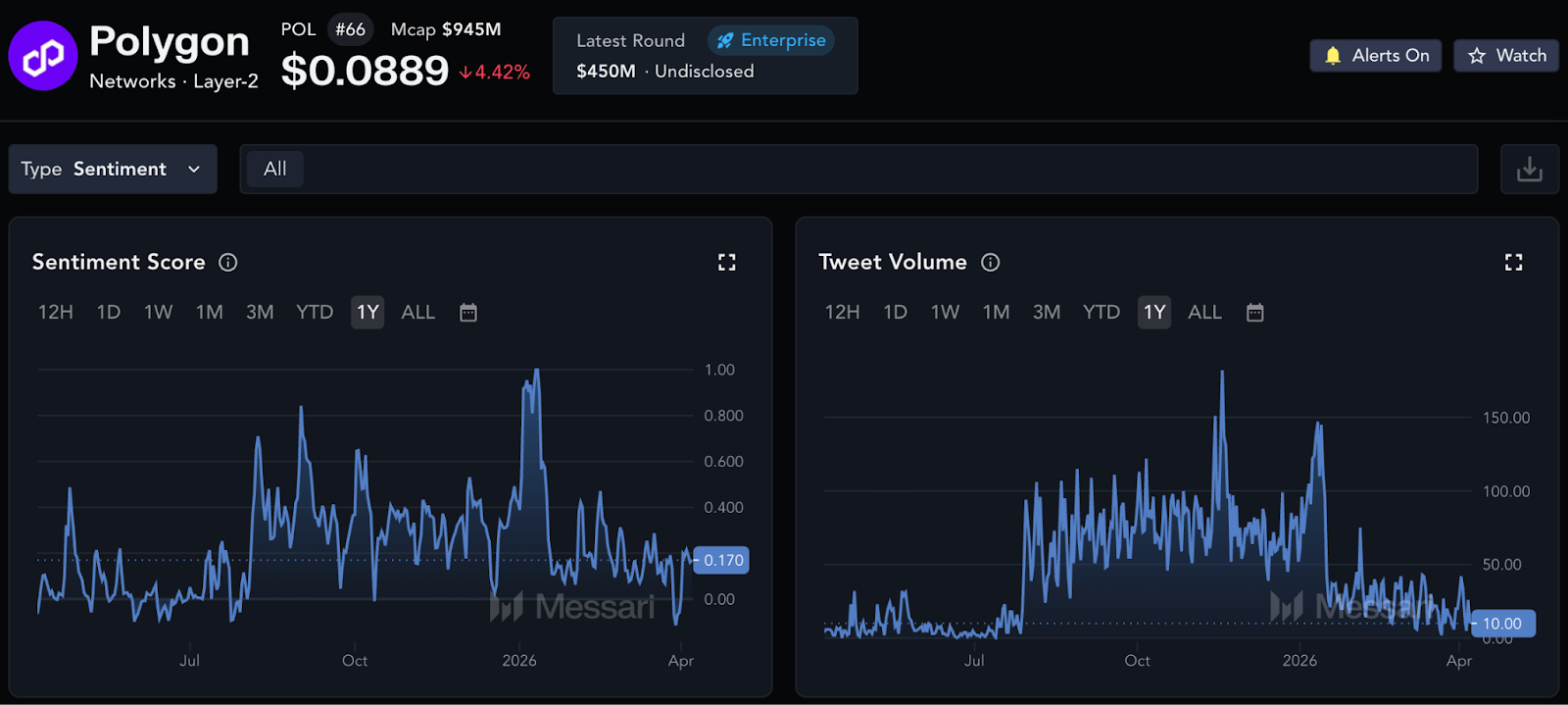
POL sentiment score and Tweet volume charts from Messari
Its most recent peak was a perfect positive score of 1.0 which took place on January 10, 2026. This was due to steady on-chain usage all throughout early January.
POL’s Tweet volume likewise peaked at 147 for the year on January 11, 2026. Its highest year-to-date point however was on November 18, 2025 at 182.
This was around the time it was announced that Mastercard selected Polygon to power verified username transfers for self-custody wallets. Tweet volume has since dropped to 10 for April 7, 2026.
POL news
-
(April 8, 2026) Today’s Guigliano hard fork slashes transaction finality by 2 seconds to bring the network closer to near-instant GigaGas speeds.
-
(April 1, 2026) TokenPocket integrated a feature allowing users to send USDC on Polygon without needing to hold any POL for gas fees.
-
(March 30, 2026) Walmart-backed OnePay now allows millions of retail users to utilize POL for everyday digital payments within its ecosystem.
FAQs
How does Polygon reduce its supply over time?
Its EIP-1559 standard usage-linked deflationary model requires a transaction gas fee consisting of a priority fee and a base fee. Base fees are automatically and permanently burned while the remaining priority fee is given as a tip to the validator.
Is POL currently inflationary or deflationary?
Deflationary, it is currently burning around 1 million POL in base fees daily with a fixed 2% annual emission. This destroys about 3.5% of the supply annually, translating into a yearly net supply reduction of about 1.5%.
What is the Heimdall Layer?
Heimdall is a PoS layer monitoring Ethereum staking contracts and manages bridging events. It commits snapshots of the Polygon network to the Ethereum mainnet ensuring Polygon’s security is anchored to Ethereum’s massive power.
What is the Bor layer?
The Bor layer is the network’s high-speed execution engine, responsible for block production and transaction execution. It is fully Ethereum Virtual Machine (EVM)-compatible, allowing it to run any Ethereum smart contract but at much higher speeds and lower costs.
The Heimdall layer periodically shuffles the block-producing nodes in Bor to maintain decentralization.
How do I migrate my MATIC to POL?
It depends on where your MATIC are held:
-
On Polygon PoS: Migration was automatic, your wallet should already show POL.
-
On Centralized exchanges: Most exchanges such as Binance or Coinbase handled the swap for their users automatically.
-
On Ethereum mainnet: You must visit the Polygon Portal and perform a manual 1:1 swap.
The bottom line
Polygon provides the underlying framework for scaling digital assets and instant payments. It is designed to make blockchain technology invisible and more accessible for worldwide transactions.
POL acts as the technical backbone for this vision. It strips away high fees and slow speeds to make transactions as simple as sending an email.
Stay alert and track POL price charts on Toobit for real-time insights.
How to start trading POL on Toobit
Polygon is currently growing into a multi-chain framework, beyond its beginnings as an Ethereum sidechain.
Looking to get on board?
Toobit is a great place to get started. It offers competitive fees for its Spot and Futures pairs with excellent charting tools.
Start trading POL/USDT today.


