
You are the product, not the customer
Polkadot challenges the surveillance-driven Web2, which trades freedom for convenience.
Free platforms harvest data based on searches and clicks, manipulating algorithmic feeds to profit from online behavior. For content creators, one policy change can get them deplatformed or even erased, along with their livelihood.
With Polkadot, identity and data can exist without corporate gatekeepers, where rules are enforced by code instead of executives. This makes censorship and data exploitation structurally harder.
The original Internet promised openness. Polkadot turns that promise into infrastructure, not a marketing slogan.
What is Polkadot (DOT)?
Imagine Polkadot as a two-part machine. It uses a dual or hybrid consensus model, which splits work in two separate roles, allowing the network to run more efficiently.
The Blind Assignment for Blockchain Extension (BABE) mechanism is for block production. Complementing it is the GHOST-based Recursive ANcestor Deriving Prefix Agreement (GRANDPA), which focuses on security.
BABE builds blocks every 6 seconds, and GRANDPA is responsible for finality on the network. This is what makes up its Nominated Proof-of-Stake (NPoS) consensus mechanism.
Polkadot is not a blockchain merely for running decentralized applications (dApps). Instead, it provides the foundational infrastructure for other blockchains (or data structures) called parachains to launch and share security.
This shared security is more specifically Shared Finality, meaning that finality on a parachain is finality on the Polkadot network.
Attackers would face an impossible task if they want to revert a transaction on a tiny parachain. They would have to take on the entire Polkadot Relay Chain to do so.
Parachains communicate through Cross-Consensus Message Passing (XCMP), avoiding risky third-party bridges and connecting to the central Relay Chain. These independent and customizable parachains run parallel within the Polkadot and Kusama ecosystems with shared scalability and interoperability.
With the Polkadot 2.0 upgrade, however, parachains can now rent Cores for Elastic Scaling if they need more processing power.
Polkadot is a Layer 0 blockchain that acts as a central motherboard for a global computer. Its Cores give dApps instant access to a shared network of validators instead of requiring them to build their own security and hardware from scratch.
Its base network can handle thousands of transactions per second (TPS). Its true power, however, comes from Parallel Processing, allowing it to run dozens of parachains simultaneously.
Along with this increased scalability comes its asynchronous backing upgrade. It can theoretically reach 1 million TPS using its 100 Cores but can comfortably handle 100,000 TPS.
Polkadot is evolving
This blockchain is not built on hype or speculation. It is helping create the foundational layer of the new internet (Web3) as a layer 0 blockchain.
Polkadot 2.0 now functions like a high-performance computer with multiple cores instead of a single-lane road like most blockchains. This architecture allows it to provide decentralized power to hundreds of applications simultaneously without congestion.
Such scalability is why it can handle Web2-level traffic like a viral game or a global social app, for example. It can simply add more Cores.
|
Component |
Technical Role |
Analogy |
|
Relay Chain |
The central motherboard that provides security and coordinates all connected chains. |
The PC Motherboard |
|
Coretime |
The actual processing power (CPU time) that apps buy to run their transactions. |
Renting a CPU core |
|
Asynchronous backing |
A speed upgrade that lets chains prepare new blocks while old ones are being finalized. |
Hyper-threading |
|
Elastic scaling |
The ability for one app to use multiple cores at once during high traffic. |
Multi-core processing |
|
WebAssembly (Wasm) runtime |
The code-on-chain that allows the network to upgrade without splitting. |
A software auto-update |
Presenting its components this way provides a quick snapshot of what is behind Polkadot’s efficiency. There are more aspects for sure, but this shows that Polkadot 2.0 powers chains.
It has grown from just connecting them back when it was Polkadot 1.0.
Polkadot also recently completed its Pi Day update, slashing annual issuance by over 50% and enforcing a 2.1 billion DOT hard cap. This transition from perpetual inflation to Bitcoin-like scarcity provides a fundamental supply shock.
The network is now advancing toward Polkadot 3.0 through the Join-Accumulate Machine (JAM) protocol, with Polkadot 2.0 virtually complete. It will transform the multi-core motherboard into a true decentralized global supercomputer.
Polkadot price history and performance overview
Polkadot price history
DOT achieved its $55 all-time high (ATH) on November 4, 2021, over a year after its launch. It is down about 97.72% since then.
Nonetheless, DOT is up by 11.03% from its all-time low (ATL) of $1.13. It hit this level recently on February 6, 2026.
Note that the price wicked below the $1.00 mark on some exchanges last October 10, 2025.
Polkadot's latest performance
Weekly price action for DOT from April 20 to 26, 2026 was between $1.219 and $1.322. Its market cap for the week was between $2.05 billion and $2.22 billion.
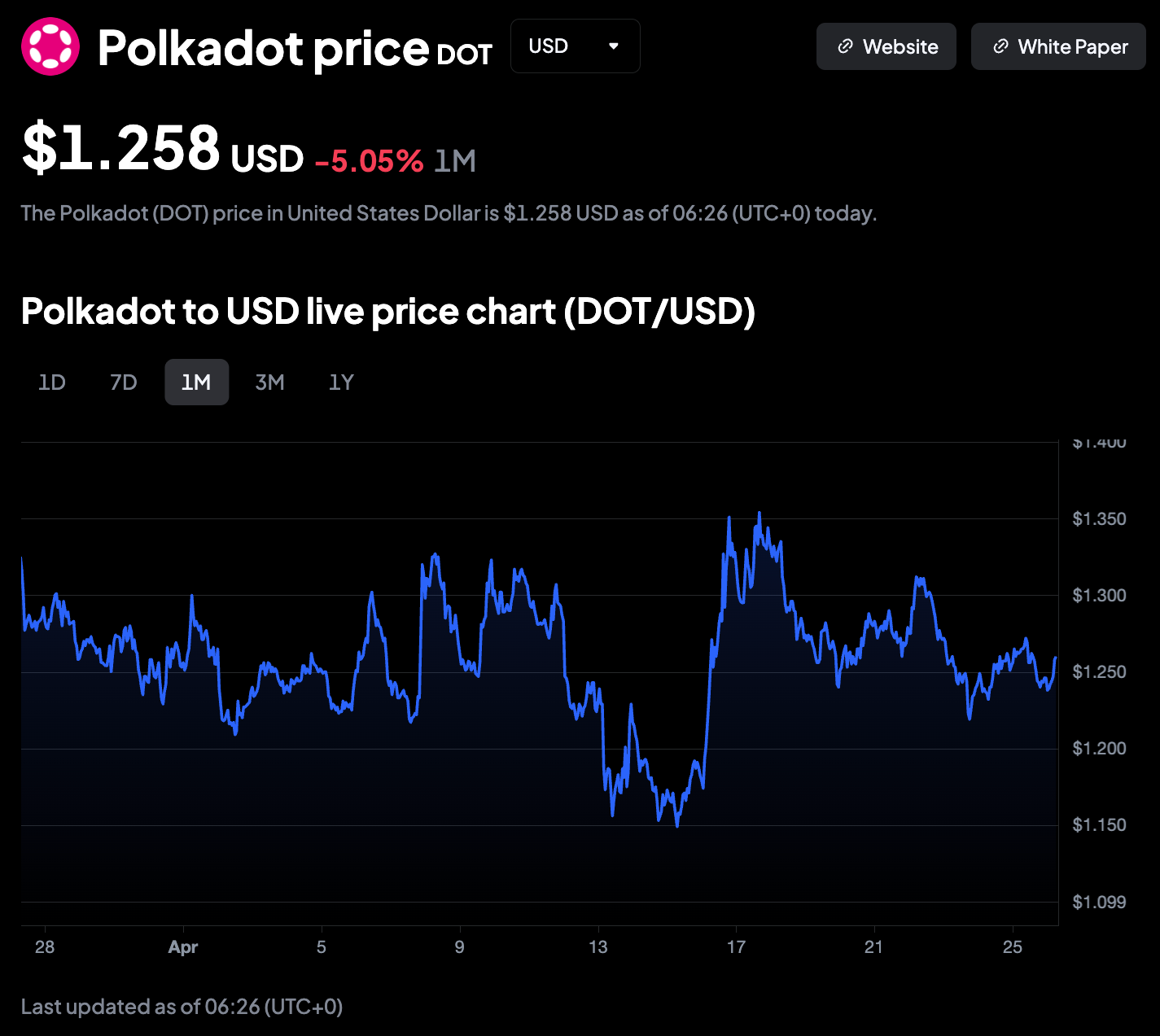
Polkadot to USD live price chart on April 26, 2026, 06:26 UTC+8 from Toobit
Like most cryptocurrencies, its price fell during February 6, 2026’s dump. DOT crashed 50.81% from its most recent uptrend peak of $2.342 on January 14, 2026.
It has yet to recapture this price level since the February crash.
Current market snapshot (April 26, 2026, 14:33 UTC+8)
DOT is currently trading at $1.258 on the DOT/USDT price chart. It is down 0.87% in the last 24 hours.
There are 1.68 billion DOT in circulation, or about 80% of the 2.1 billion DOT maximum supply. Its market cap is down 0.61% to $2.11 billion.
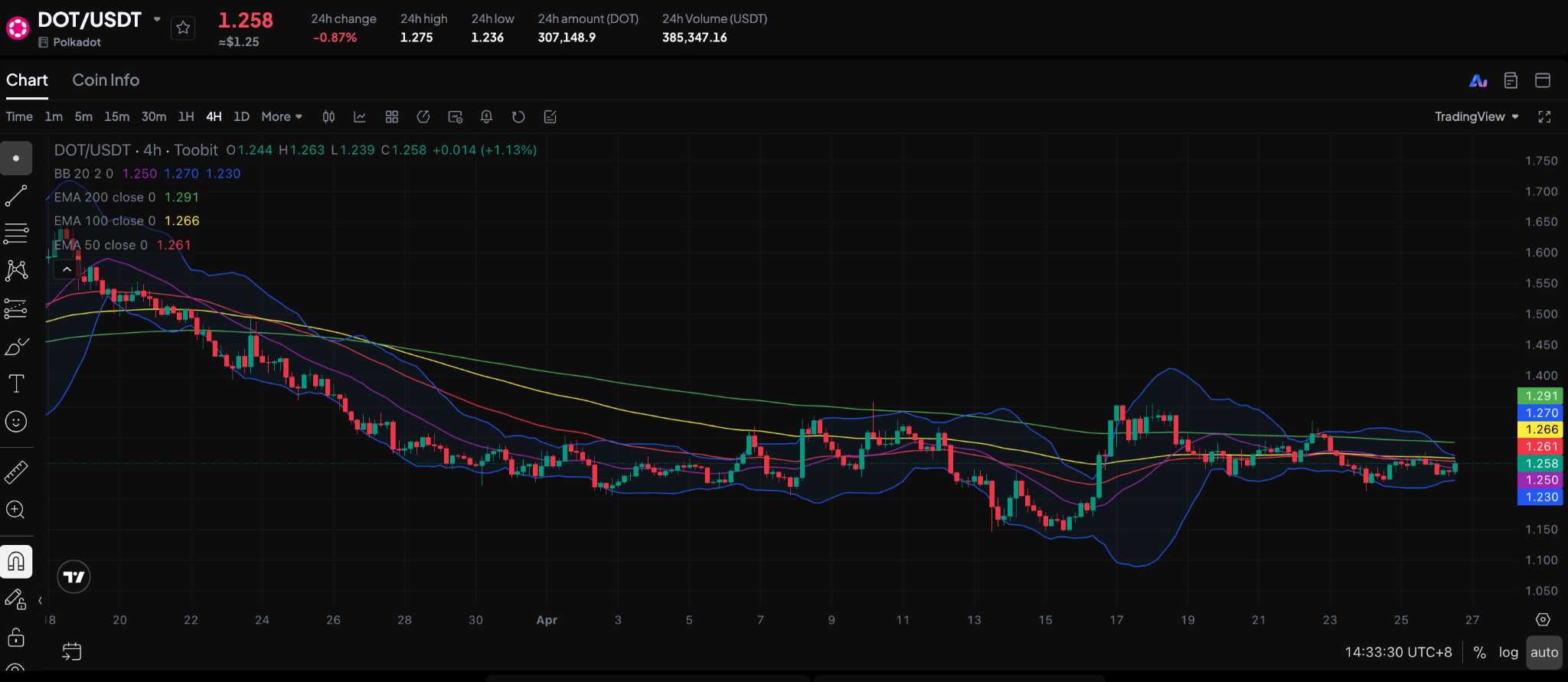
DOT/USDT 4-hour spot trading chart from Toobit
DOT’s intraday trading period had a low of $1.236 and went as high as $1.275. It appears that DOT has formed a local bottom around $1.225 since its peak of $2.342 on January 13, 2026.
A short-term bounce to the upside seems likely within a prevailing bearish trend.
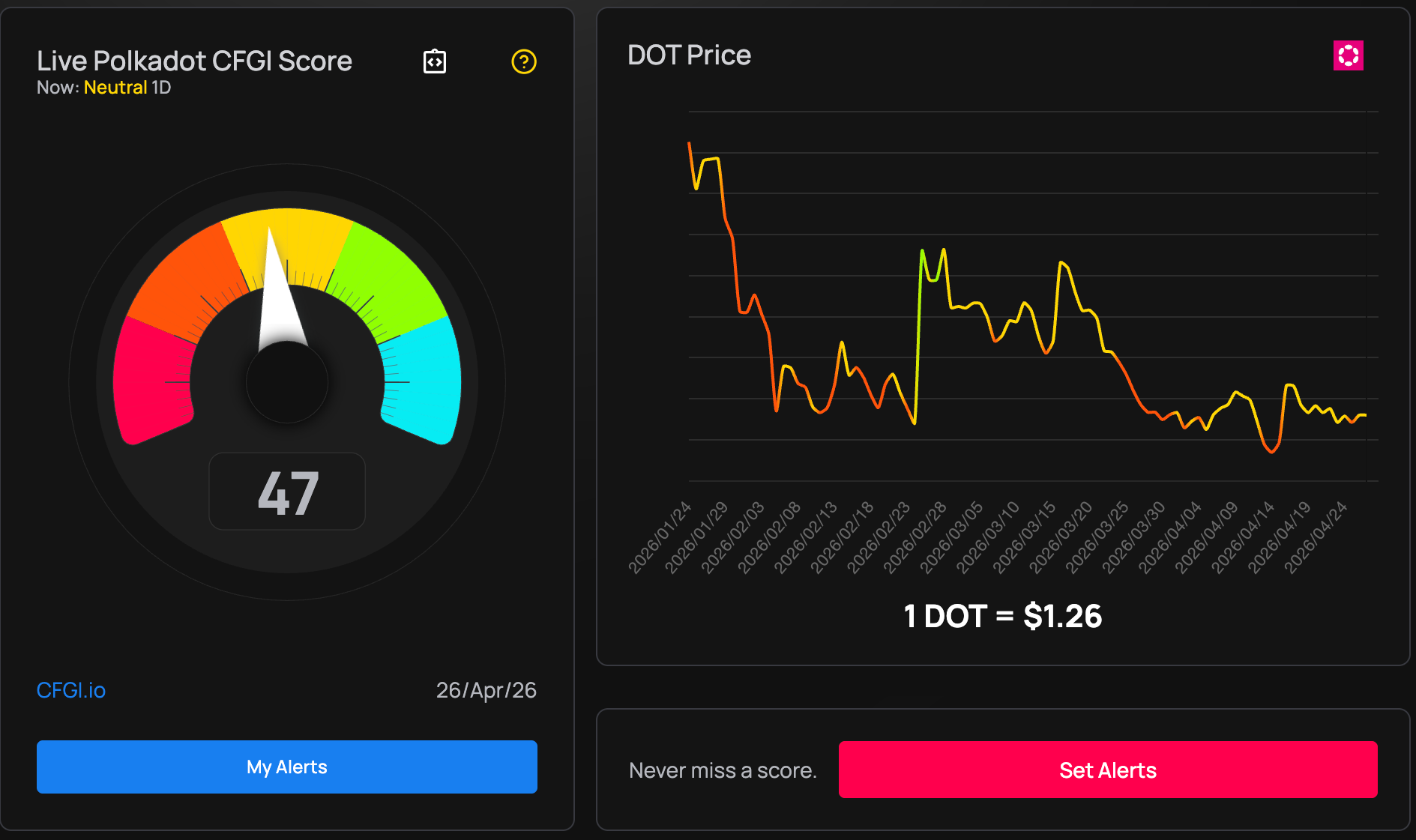
Polkadot Fear and Greed Index from CFGI.io
The DOT Crypto Fear and Greed Index (CFGI) currently has a 47 (Neutral) rating. DOT is faring better against the Fear & Greed Index for Bitcoin and other large cryptocurrencies, which currently reads 33 (Fear).
On-chain and technical analysis
Support and resistance
Now is not the time to execute any bullish trades. DOT could still go further down while the entire crypto industry navigates ongoing geopolitical uncertainties.
Long-term support was at $4.22 starting December 2022. It has been battling to decidedly flip long-term resistance at $6.80.
Instead, DOT closed below this support on its weekly chart last November 2025. Its price has been on a steady decline since then, despite positive news surrounding DOT.
Near-term support has formed around $1.23 on the 4-hour chart starting February 2026. DOT appears to be consolidating and may likely print new lows in the short term.
DOT’s near term resistance is at the $1.35 level while its next significant resistance level is at $1.43.
Momentum indicators
It has been awhile since DOT was above 70 on its daily Relative Strength Index (RSI). The last time it was above this level was 74.95 on July 22, 2025, indicating high buyer demand.
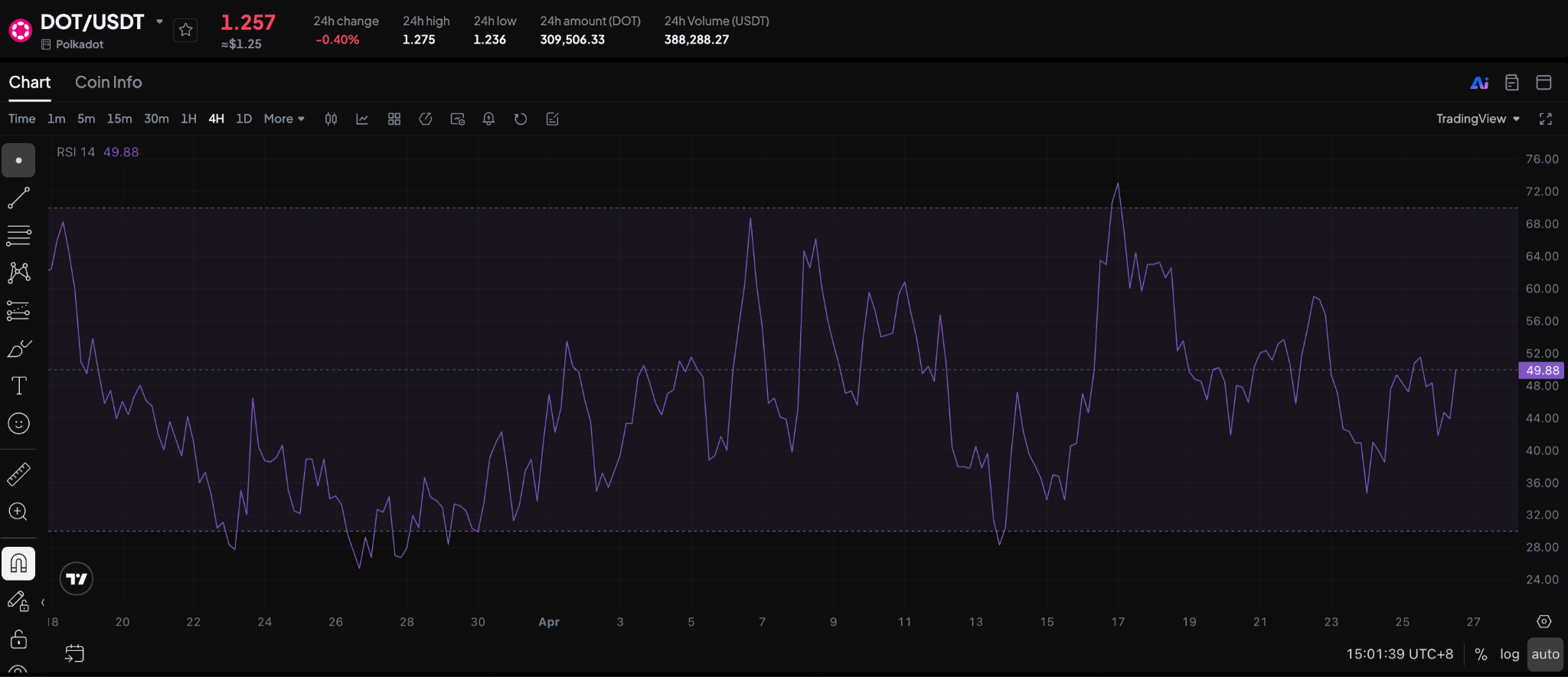
DOT/USDT 4-hour RSI chart from Toobit
On its 4-hour chart, the reading is currently at 49.88 with a higher likelihood of revisiting the 30 range. Buyers are displaying caution while the price is approaching resistance at the upper Bollinger band.
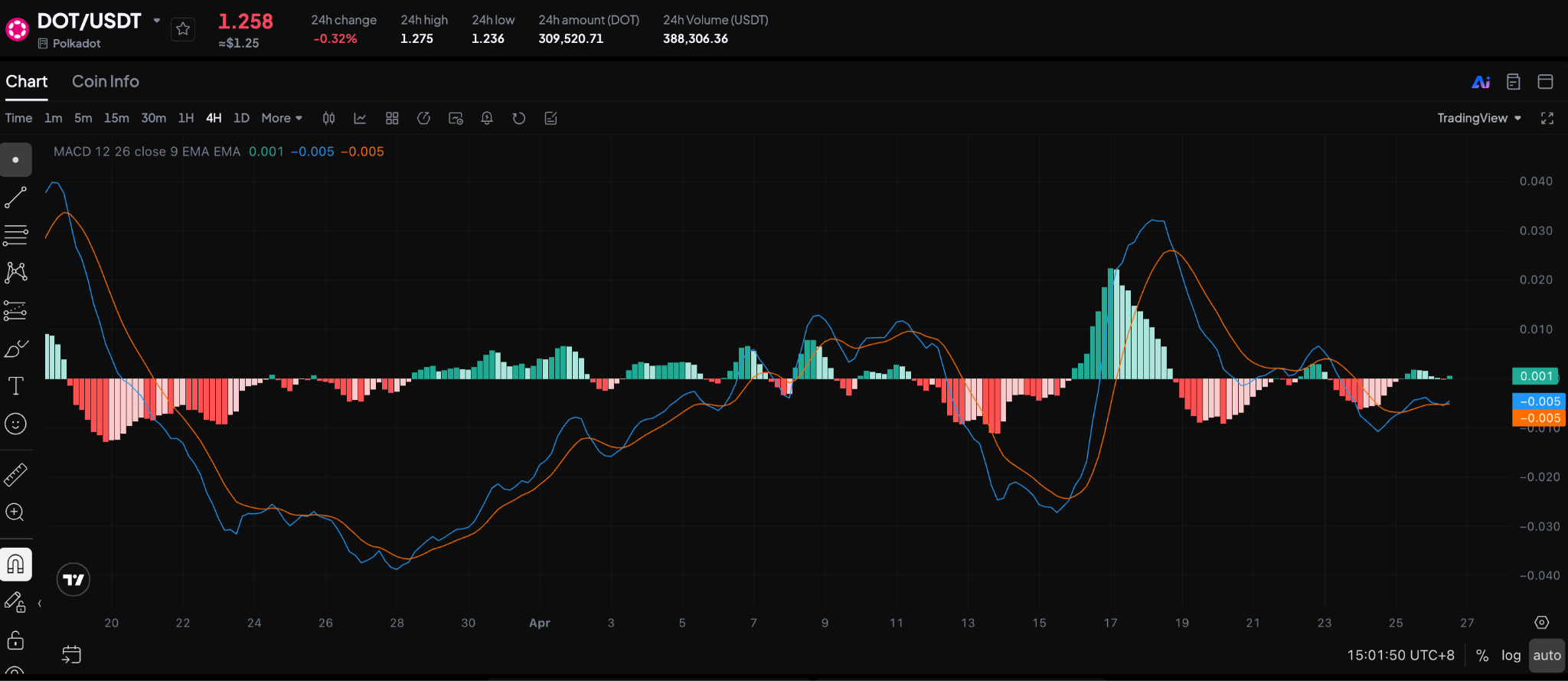
DOT/USDT 4-hour MACD chart from Toobit
Its 4-hour Moving Average Convergence/Divergence (MACD) histogram is green at 0.001. The blue MACD, as well as its signal, are both exhibiting -0.005, indicating weak upwards momentum.
Moving averages and volume
DOT’s price has been battling to rise above its 50-day, 100-day, and 200-day moving averages (MAs) since April 16, 2026. This has been its story on its 4-hour chart as it now tests the $1.266 of the 100-day MA.
Price, however, has failed to close at least 2 days above the daily 50-day MA since October 9, 2025. This freefall is not isolated to DOT but is being experienced by most major cryptocurrencies as well.
The February 6 crash only accelerated something that was already in motion for weeks. It may even be said that crypto’s overall downward trajectory started after Bitcoin’s cycle peak around October 2025.
Its 24-hour trading volume is down by only 0.06% to $106.16 million across exchanges for April 26, 2026. DOT’s 24-hour trading volume ranged between $101.24 million and 189.07 million for the week.
On-chain cues
DOT has 600 active validators with a maximum of 22,500 Polkadot and 12,500 Kusama nominators securing its NPoS system. Staked DOT is over 887 million or about 52.79% of the current total supply of 1.68 billion DOT.

Polkadot total staked from Subscan
Polkadot’s Treasury assets currently have a market value of $46.09 million. This gives them a healthy war chest for development.
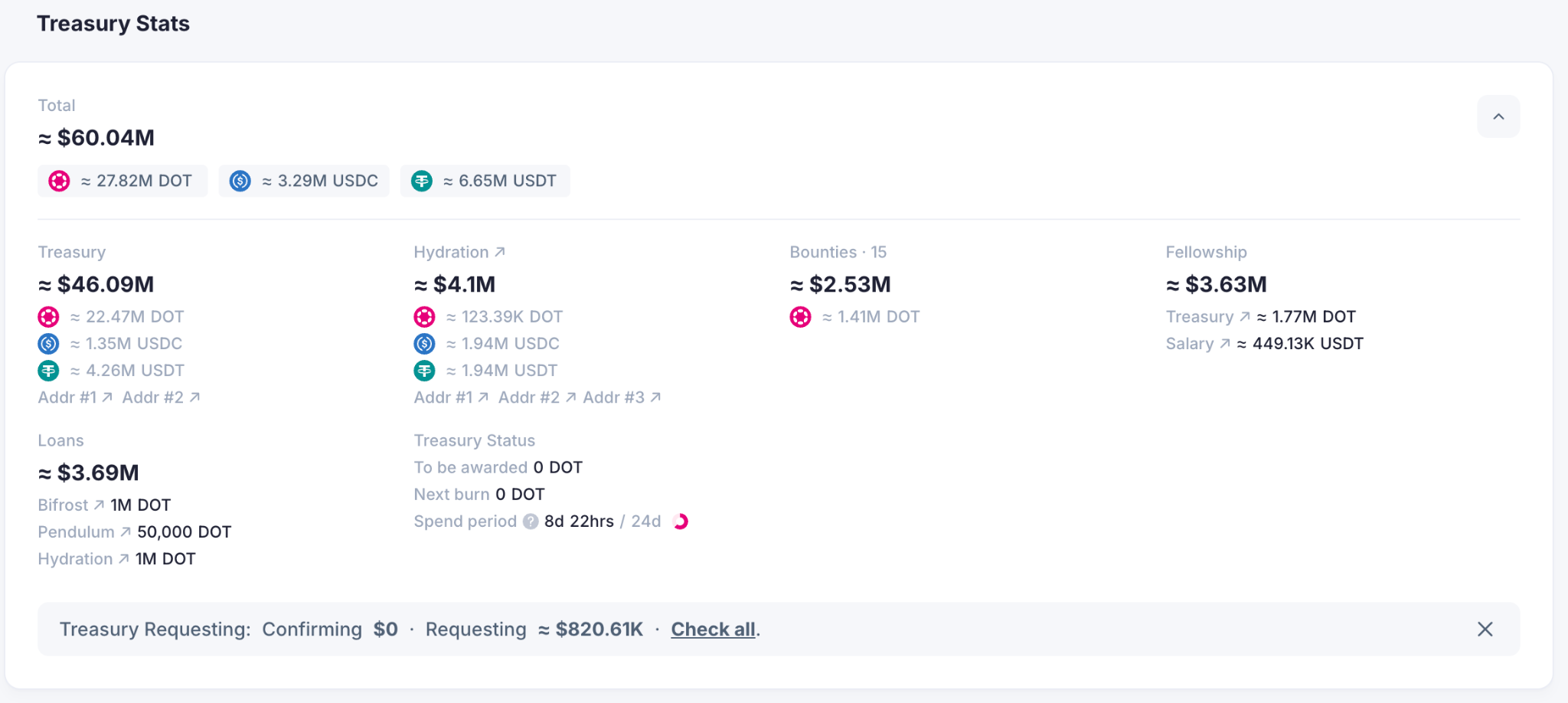
Polkadot treasury stats from SubSquare
As of April 26, 2026, DOT has over 1.77 million DOT holders performing more than 8 million on-chain transactions. This is evidence of trust in the network despite the ongoing industry-wide bearish trend.
Polkadot price prediction and outlook
DOT’s Pi Day was a fundamental pivot, ending perpetual inflation in favor of a 2.1 billion DOT hard cap. Note that its medium-term trend is to the downside possibly until around September or October of 2026.
Bull Case ($5.50 to $10.50)
A massive rally triggered by the JAM (Polkadot 3.0) mainnet launch and sustained institutional inflows. If developers aggressively adopt DOT’s utility features, it could serve as additional fuel to propel it toward double digits.
Base Case ($1.75 to $3.15)
Steady recovery as the market absorbs the reduction in token issuance. In this scenario, DOT stabilizes as a scarce asset, slowly climbing as any prevailing fear-uncertainty-doubt (FUD) fades.
Bear Case ($1.00 to $1.20)
If broader crypto winter conditions persist or high-profile exploits occur, DOT may continue to test its recent ATL of $1.13. The 2.1 billion DOT cap provides a strong floor, but a lack of retail hype could keep price action range-bound.
Caution is advised before executing an entry point. Wait for a more impulsive wave, though any upward movement will likely be a relief rally.
DOT is near the oversold region on its weekly timeframe. It is still exhibiting potential for further downward price action.
This article is for informational purposes only and does not constitute financial advice. Always do your own research (DYOR) before making any decisions.
Key milestones for Polkadot
-
Whitepaper (October 2016): Ethereum co-founder Dr. Gavin Wood introduces the concept of a sharded multichain through the release of the Polkadot Whitepaper.
-
Genesis block (May 2020): DOT starts out as a Proof of Authority consensus mechanism upon its Polkadot Genesis block launch. It then moves to Proof of Stake (PoS) in July 2020 for decentralized community governance.
-
First parachain (December 2021): Polkadot auctioned its first parachains to Acala and Moonbeam. This created the initial link between multiple independent blockchains through the Polkadot Relay Chain.
-
Cross-consensus messaging (XCM) (May 2022) : Allowed parachains to talk to each other. Polkadot becomes a truly interoperable ecosystem, transferring tokens and data between parachains easily.
-
OpenGov (June 2023): Polkadot gives power directly to token holders by replacing the Council, its initial governance system with OpenGov. It allowed simultaneous voting and execution of multiple community proposals, providing one of the best governance systems in crypto.
-
Asynchronous backing (May 2024): Increased DOT’s efficiency by 8 times. Decoupled how blocks are created and verified, allowing parachains to produce blocks in 6 seconds instead of 12.
-
Agile Coretime and Elastic Scaling (late 2024 to 2025): Developers can now buy processing power on demand through Agile Coretime. Elastic Scaling lets a single application handle millions of users simultaneously through multiple cores while maintaining high speeds. These upgrades, along with asynchronous backing, completed the Polkadot 2.0 upgrade.
-
JAM (2025): The next step in DOT’s evolution releases its M1 testnet. JAM seeks to turn Polkadot into a decentralized cloud supercomputer instead of its current Relay Chain motherboard version.
Community sentiment and DOT news
Community sentiment
As of April 26, 2026, Messari shows DOT with a close to neutral Sentiment Score of -0.0675. Sentiment Scores range from -1.0 being extremely negative to 1.0 as extremely positive.
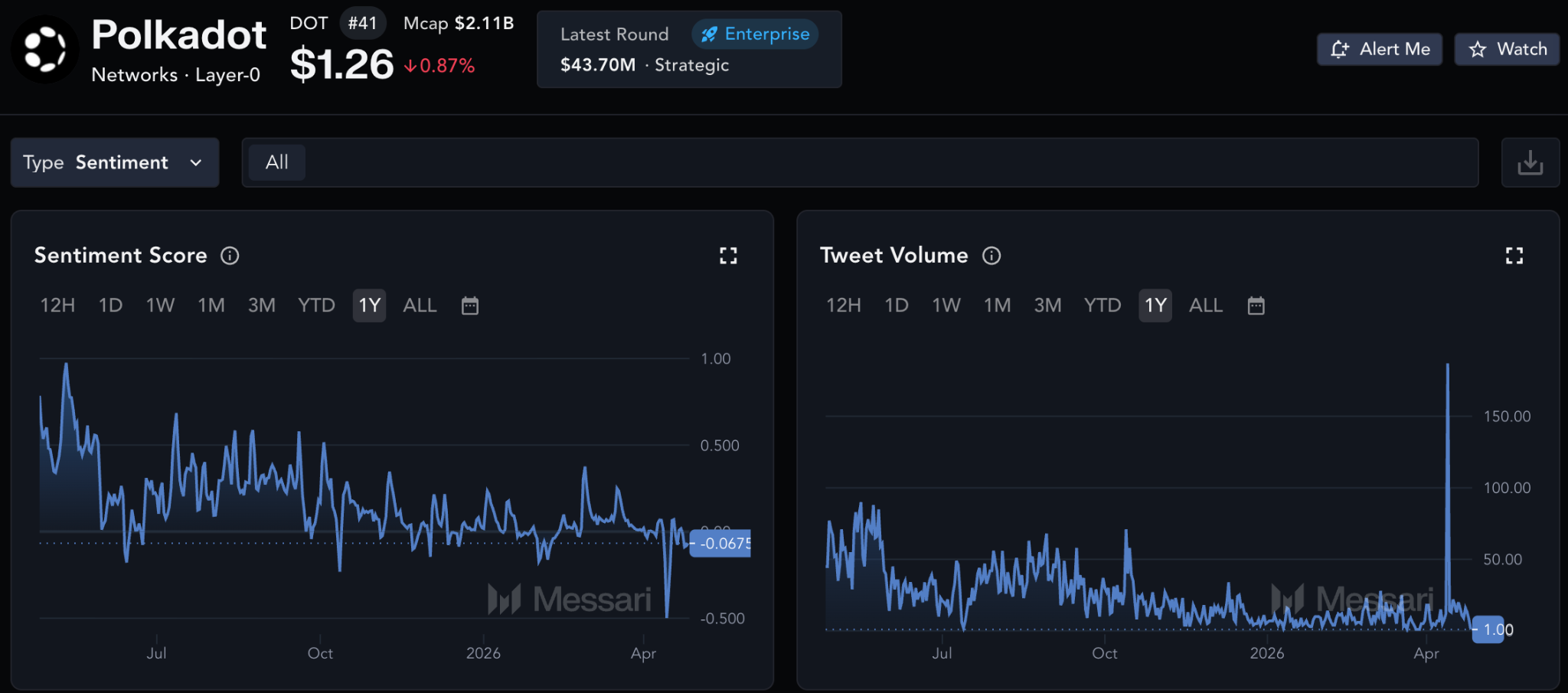
Polkadot Sentiment Score and Tweet Volume charts from Messari
Its highest year-to-date peak, an extremely positive score of 0.975, occurred on May 11, 2025. This was around the time its developers achieved the Elastic Scaling upgrade on the Kusama blockchain.
Kusama is essentially a canary network for Polkadot, which tests experimental features in a live blockchain environment before mainnet release. The upgrade was a significant milestone toward the completion of Polkadot 2.0.
Sentiment dipped to -0.499 on April 14, 2026, however, due to news of an exploit in the Hyperbridge protocol. Hyperbridge is a key infrastructure that connects Polkadot to Ethereum.
The dip in sentiment was preceded by a 187 in Tweet volume on April 13, 2026. Netizens discussed the 1 billion wrapped DOT that the attacker minted and dumped on the market.
In truth, the exploit occurred on the Ethereum-side of the bridge, and the attacker walked away with about $237,000 in ETH. The Polkadot Relay Chain was untouched, though some questioned the safety of cross-chain bridges.
DOT news
-
(April 16, 2026) Polkadot hit a top 10 developer milestone as Agile Coretime onboarded 150 new dApps in Q1 2026 alone. Major chains like Moonbeam are already reporting 5-times throughput gains thanks to Elastic Scaling.
-
(March 14, 2026) The Pi Day Reset slashed annual issuance by 53.6% and implemented a permanent 2.1 billion DOT supply cap. The new Dynamic Allocation Pool now funds ecosystem growth using network fees and minted tokens.
-
(March 6, 2026) The 21Shares TDOT exchange-traded fund (ETF) officially debuted on the Nasdaq, opening a regulated channel for institutional investors. This launch triggered a 22% price rally as the market prepared for the massive supply reduction.
FAQs
What is asynchronous backing?
It allows parachains to submit new blocks before the previous ones are finalized. By pipelining this process, block times drop from 12 seconds to 6 seconds. It increases network throughput by 8 times.
Why use two consensus engines (BABE and GRANDPA)?
It separates making blocks from finalizing them. If the network lags, BABE keeps producing blocks so the chain does not stop. GRANDPA can wait for a stable connection before locking them in permanently across multiple parachains simultaneously.
How does Agile Coretime work?
Polkadot now sells processing power like a cloud provider instead of 2-year leases. Projects can buy coretime in bulk for a month or pay-as-you-go for single blocks. This makes it cheaper for small apps to start.
How are upgrades forkless?
Polkadot stores its operating rules (the Runtime) directly on the blockchain as a Wasm file. When a vote passes, the network replaces that file. All nodes update their behavior automatically without splitting the chain.
What is nomadic validator security?
DOT uses nomadic rotation to protect its Cores. Validators are randomly shuffled between different parachains every few hours. This moving target strategy prevents attackers from having enough time to bribe or coordinate with validators on any single chain.
What is erasure coding?
This is Polkadot’s Data Availability system that breaks block data into hundreds of small shards and spreads them across the entire network. Erasure coding means you only need about a third of those shards to reconstruct the original block. It ensures data cannot be hidden or lost if nodes go offline.
The bottom line
Polkadot is often described as the Internet of blockchains, focusing on foundational technology that enables a decentralized, interconnected web. Understanding the intricacies of its security, scalability, and interoperability can be challenging, even for those interested to do so.
There is just something very fascinating about DOT’s promise and the progress it has made to bring it to reality. Gaining a better appreciation could be beneficial, despite its apparent complexity.
Over 50 million blockchain projects have been created as of 2026, but only a small number of them can make you feel that they have the potential to change the world.
Polkadot is one of them.
Stay alert and track DOT price charts on Toobit for real-time insights.
How to start trading DOT on Toobit
Own the motherboard of the global computer. Secure your DOT today and power the multi-core revolution.
Ready to trade DOT?
Toobit offers excellent Spot and Futures trading access. It has competitive fees, deep liquidity, and charting tools for strategic trading execution.
Start trading Polkadot today.


