
Lido decentralized asset organization (DAO) solved Ethereum’s biggest capital efficiency problem: how to earn staking rewards without locking up liquidity. By issuing tradable tokens in exchange for deposited ETH, the protocol ensures capital remains productive instead of sitting idle in a validator node.
But this efficiency came with a trade-off. Lido’s overwhelming dominance has effectively turned the DAO into a shadow regulator for Ethereum network security. While the protocol solves a liquidity bottleneck for users, it creates a governance bottleneck for the wider ecosystem.
As a masterclass in capital utility, Lido faces a permanent structural question: is the convenience of institutional yield worth the risk of systemic influence?
What is Lido DAO (LDO)?
Lido DAO provides a liquid staking solution for Ethereum. Staking traditionally requires locking assets with a 32 ETH minimum, which renders capital illiquid.
These barriers are eliminated by issuing a liquid staking token (LST) representing staked ETH plus rewards called stETH. It allows utilization of capital in decentralized finance (DeFi) while simultaneously earning network yield.
The protocol’s technical architecture has transitioned from a simple staking pool to a modular infrastructure. Its V2 upgrade introduced the Staking Router to diversify node operators via Distributed Validator Technology (DVT).
More recently, the 2026 V3 launch introduced stVaults. It enables institutional users to create isolated, compliant staking environments with customizable risk profiles without sacrificing core liquidity.
Governance is managed by LDO token holders. The protocol recently implemented a Dual Governance mechanism to resolve the agency problem between stakers and governance.
This system grants stETH holders veto power over LDO-led proposals, ensuring that those who provide the capital have a final check on protocol changes.
Under the GOOSE-3 roadmap, Lido is shifting from a single-service protocol to a diversified DeFi hub. The strategy retires underperforming multi-chain experiments to focus capital on the Ethereum scaling ecosystem and specialized, revenue-generating vaults like EarnUSD.
Lido DAO price history and performance overview
LDO price history
LDO’s all-time high (ATH) of $18.62 was achieved on November 16, 2021. This was backed by ETH’s own ATH of around $4,800 and a surge in Lido’s total value locked (TVL).
Its price has come down by 98.13% since then, however.
Conversely, its all-time low (ATL) of $0.2711 just came in a few months ago on March 8, 2026. It was mainly driven by whale holder sell-offs starting around October 2025, amounting to about 80 million tokens.
LDO has bounced back by about 28.25% from its ATL, though any strong short-term upward trajectory awaits clear indicators.
LDO's latest performance
Checking the monthly time frame price chart of Lido DAO reveals that it has been on a downtrend. It peaked at $0.4699 on April 26, 2026, with the bears slowly gaining the upper hand this May.
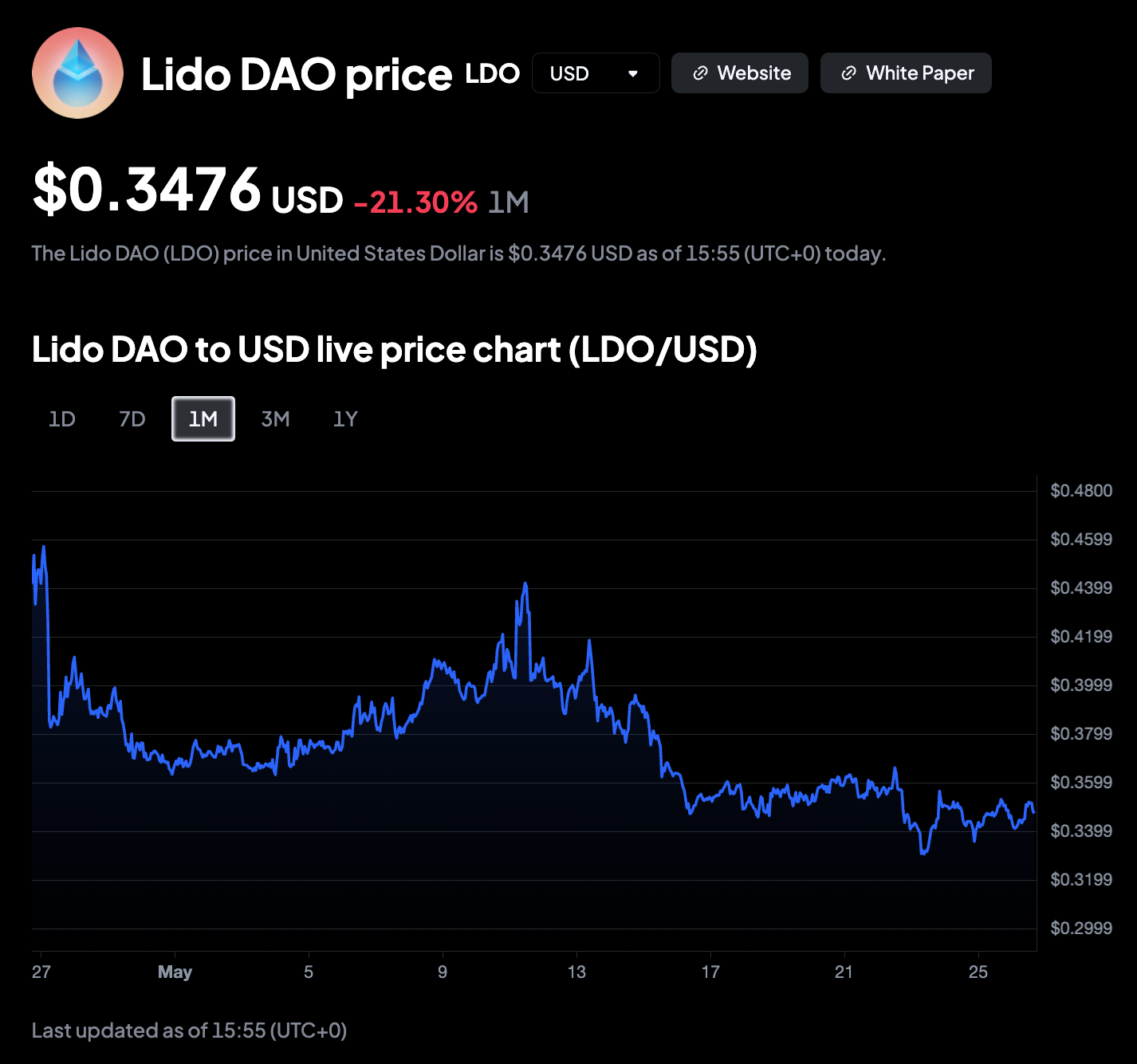
Lido DAO to USD live price chart on May 26, 2026, 15:55 UTC+0 from Toobit
More recently, LDO’s price action ranged between $0.3305 and $0.3661 from May 20 to 26, 2026. It now appears to be slowly building short-term support.
LDO’s market cap dipped to $280.34 million and reached as high as $309.51 million within this same period.
Current market snapshot (May 26, 2026 23:57 UTC+8)
LDO is trading at $0.3470 and is just slightly down by 0.94% in the last 24 hours. Its market cap on the other hand is at $293.77 million, down by 0.99%.
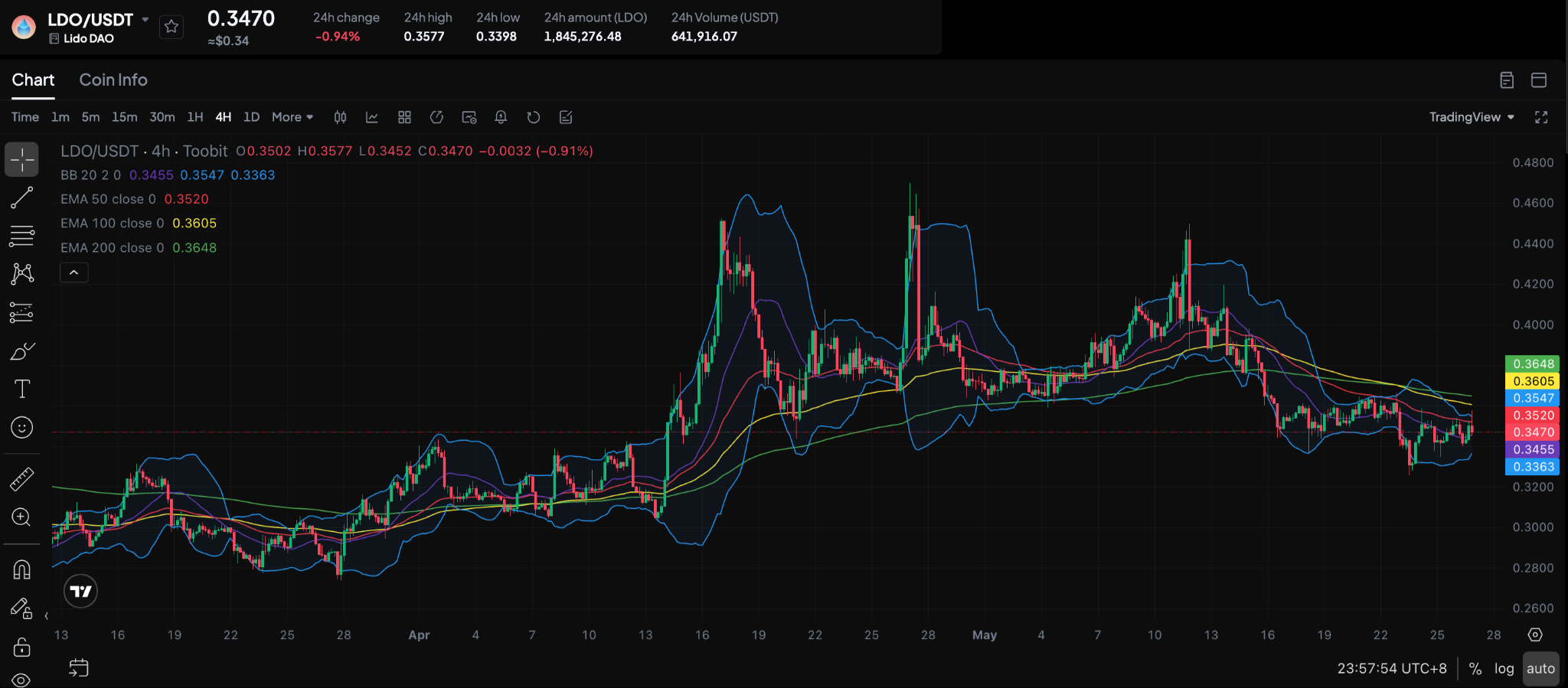
LDO/USDT 4-hour spot trading chart from Toobit
Price has been trading between $0.3398 and $0.3577 in the last 24 hours. It has wicked to the upside on the 4-hour chart, but is likely to continue moving in a tight range.
There is a total supply of 1 billion LDO with about 15.09% that have yet to enter into circulation. This leaves 849.05 million LDO as its circulating supply.
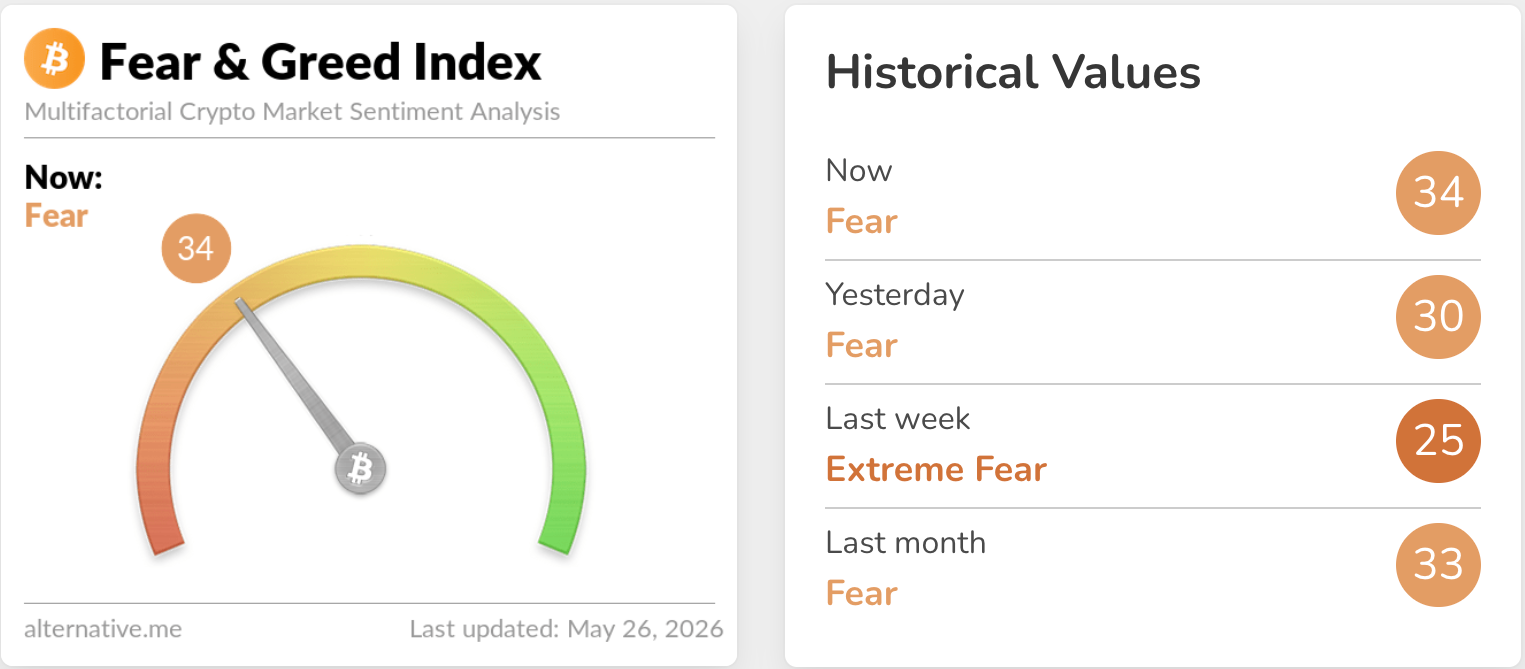
Crypto Fear and Greed Index on May 23, 2026, from Alternative.me
The overall Fear and Greed Index for Bitcoin and other large cryptocurrencies now has a 34 (Fear) value. It is slowly moving the dial toward Greed territory since crashing to last week’s 25 (Extreme Fear) rating.
On-chain and technical analysis
Support and resistance
LDO’s price action on the 4-hour chart is on a downtrend after its aforementioned April 26, 2025 peak. It is now consolidating at its near-term support level of $0.3390.
Crypto traders as a whole appear to be taking on a wait-and-see approach. The ongoing U.S.–Iran peace deal negotiations can still go either way.
Should it turn out to be favorable, expect LDO’s price to shoot past its $0.3575 near-term resistance. It could likely challenge the $0.4250 resistance level after that.
Failure to achieve favorable geopolitical conditions however could break price down below near-term support and touch the $0.3045 level. If compounded with further negative macroeconomic conditions, LDO’s price could likely pierce past its ATL.
Momentum indicators
Closely observing LDO’s 4-hour Relative Strength Index (RSI) will show that it is on a slight down trend. Its RSI now sits at 49.65 RSI, with gradually descending lower highs coming before it.
Revisiting the 30 oversold level is likely before it starts to make another rotation back up.
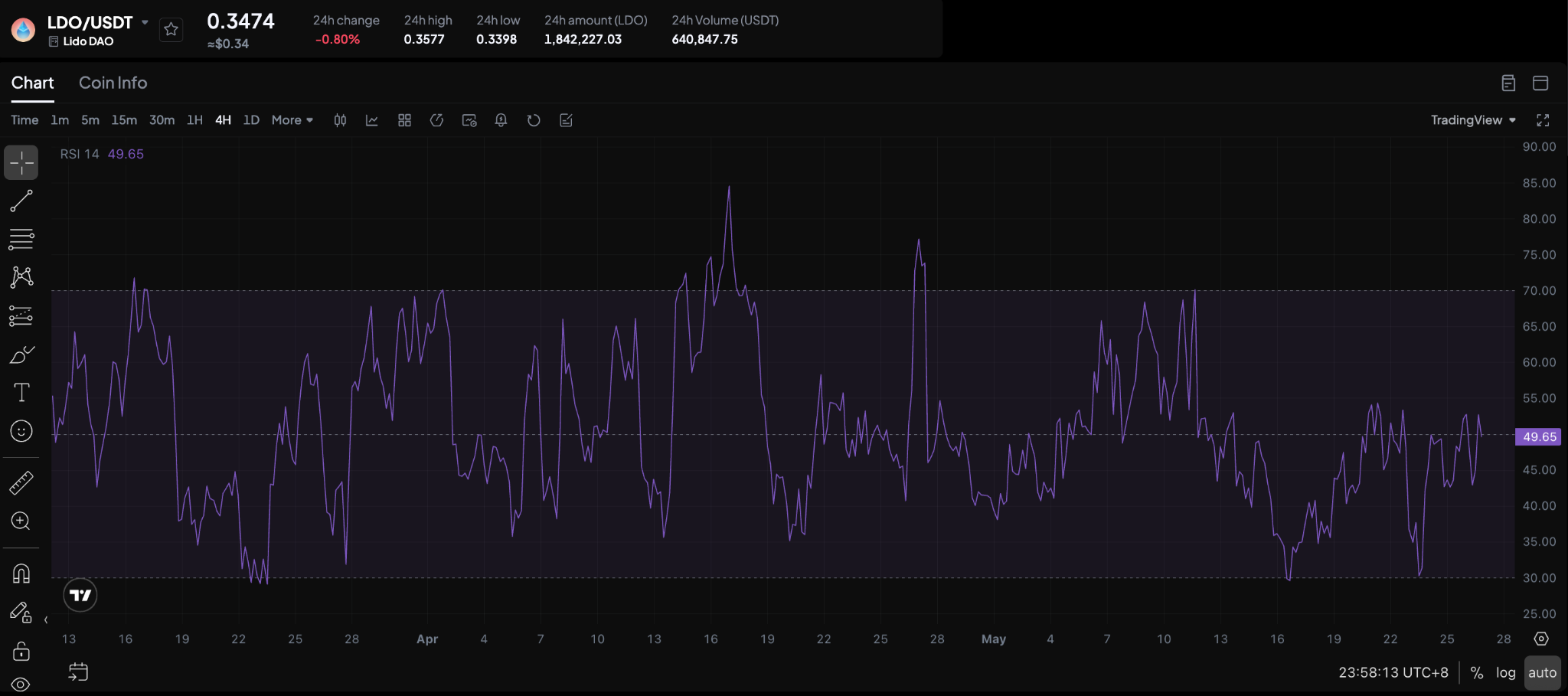
LDO/USDT 4-hour RSI chart from Toobit
This means that its 4-hour Moving Average Convergence/Divergence (MACD) is likely to follow the same trajectory. Its histogram, while currently green at 0.0007, will likely flash red soon.
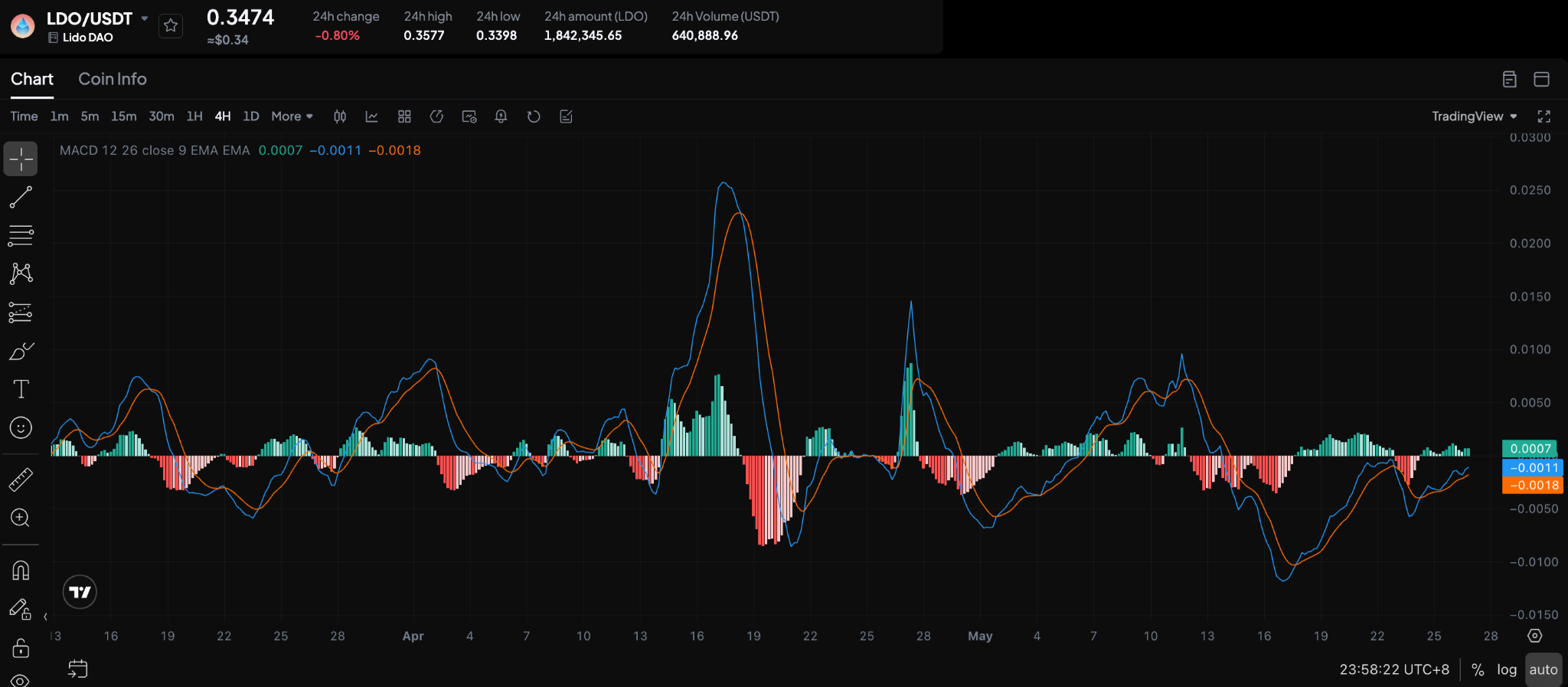
LDO/USDT 4-hour MACD chart from Toobit
At the moment, its blue MACD indicator is at -0.0011 with the orange signal line at -0.0018. This indicates short-term bearish action, hinting at an impending drawdown.
Moving averages and volume
The last candlestick’s wick to the upper Bollinger Band indicates strong selling pressure at that level. It touched the 50-day moving average (MA) at $0.3520, but a continuation to the upside appears unlikely.
Both the 100-day MA and 200-day MA are floating above LDO’s current price at $0.3605 and $0.3648, respectively.
LDO’s 24-hour trading volume is currently up by 22.16% at $49.98 million across all exchanges. It dipped to $31.47 million and reached as high as $51 million between May 20 and 26, 2026.
On-chain cues
With over 100 DeFi integrations, 900 node operators, and $2 billion in weekly trading volume, Lido Institutional has already secured deeply entrenched utility across the ecosystem.
It has over $18.5 billion TVL in stETH staked at 2.4% annual percentage rate (APR). Lido also has other well-performing products at good annual percentage yields (APYs).
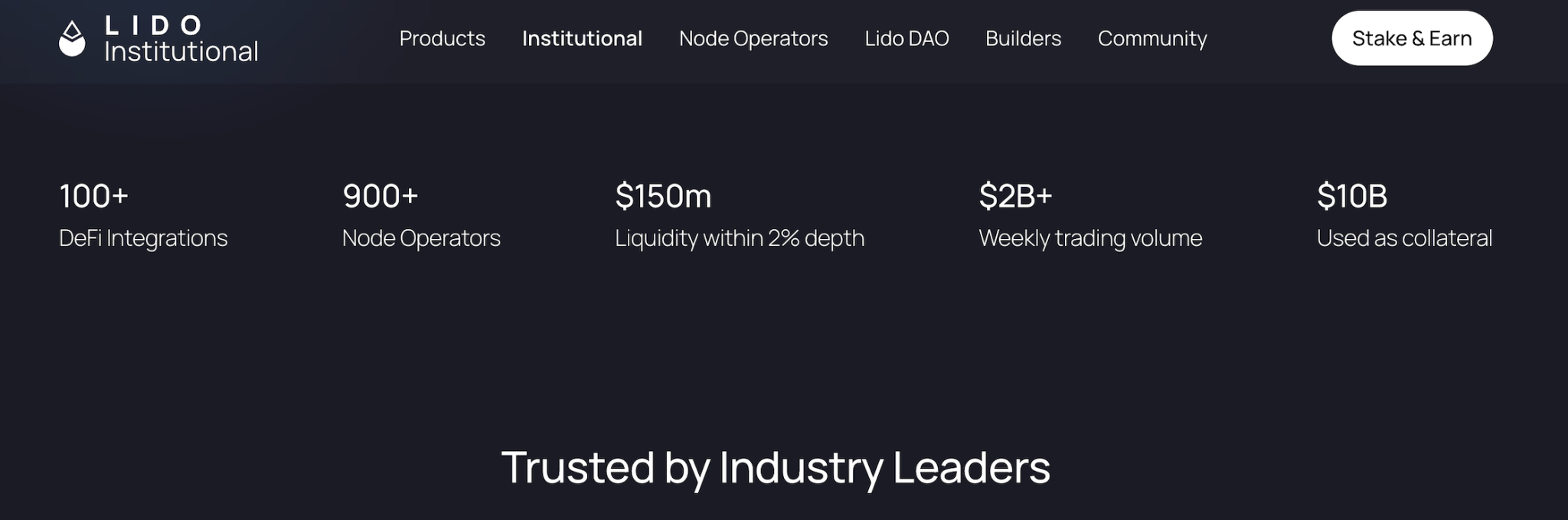
Lido Institutional statistics on May 26, 2026 from lido.fi
EarnETH is at $98.1 million TVL on 3.0% APY while EarnUSD is at $6.8 million TVL on 3.9% APY. This is complemented by a validator set performance of 99.03% and a network performance of 98.82%.
These metrics prove that Lido acts as a trusted DeFi platform with over $18.6 billion yield earning crypto assets. The heavy weekly trading activity and near-perfect technical performance show that the system is exceptionally reliable and widely used.
Lido DAO price prediction and outlook
LDO’s consolidation near the $0.34 support indicates calculating macro risks alongside the liquid staking narrative. Its performance through the remainder of 2026 will heavily depend on enterprise adoption and the implementation of its structural roadmap.
Bullish target ($0.75–$0.90)
This scenario requires rapid enterprise onboarding onto the new stVaults architecture coupled with a broader crypto market reversal. It would be fueled by capital inflows from specialized GOOSE-3 yield ecosystems and programmatic token buybacks through the NEST framework.
Base case target ($0.40–$0.50)
In this baseline outcome, overhead MAs are recaptured as geopolitical tensions resolve and user confidence climbs out of fear territory. The recent Chainlink CCIP integration will likely stabilize the token within a sustainable consolidation channel linked directly to Ethereum's performance.
Bearish target ($0.20–$0.25)
A downward breakdown remains probable if widespread macro headwinds persist and Lido's staking market share continues below historical levels. Failure to attract commercial-scale corporate volume would likely trigger further whale distribution, driving the price past its recent ATL.
This article is for informational purposes only and does not constitute financial advice. Always do your own research (DYOR) before making any decisions.
Key milestones for LDO
-
Protocol launch (December 2020): The first viable liquid staking solution for Ethereum, allowing users to bypass the 32 ETH requirement while maintaining liquidity.
-
Paradigm-led treasury diversification (May 2021): Finalized a $73 million Paradigm-led funding round, diversifying the treasury and solidifying Lido’s position as the liquid staking industry standard.
-
Investment by a16z (March 2022): Institutional support by a16z investing $70 million directly into the DAO as a decentralized alternative to custodial exchange staking.
-
Lido V2 and Ethereum withdrawals (May 2023): The V2 upgrade marked a major technical overhaul to its architecture by introducing the Staking Router and enabled withdrawals.
-
Multi-chain contraction and Ethereum-first pivot (2023 to 2024): This Ethereum-first model sunsetted multi-chain operations (Solana, Polygon, and Polkadot) to focus exclusively on securing and scaling the Ethereum network.
-
Implementation of Dual Governance (June 2025): An on-chain veto mechanism for stETH holders ensures LDO holders cannot unilaterally pass proposals that compromise staker security.
-
Lido V3 and stVaults launch (January 2026): Modular stVaults allows institutional users to create customized, compliant staking setups with specific risk profiles.
-
The GOOSE-3 strategy and buyback proposal (March 2026): DAO approves GOOSE-3 roadmap and 10,000 stETH buyback, shifting the protocol toward becoming a comprehensive real-business DeFi hub.
Community sentiment and LDO news
Community sentiment
As of May 26, 2026, Messari shows LDO with a positive Sentiment Score of 0.0110. Sentiment Scores range from -1.0 being extremely negative, to 1.0 being extremely positive.
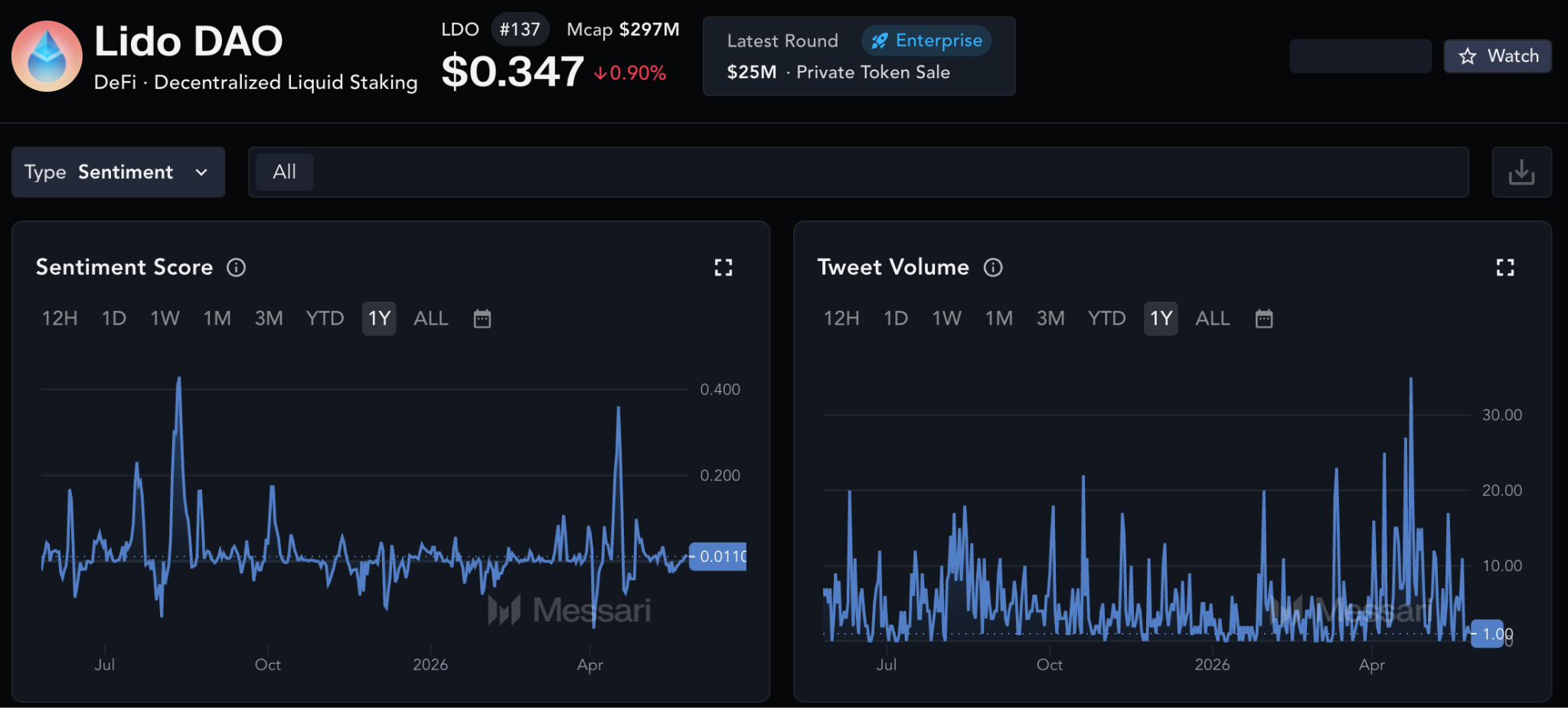
Lido DAO Sentiment Score and Tweet Volume charts from Messari
Its highest positive year-to-date (YTD) score was 0.43 posted on August 12, 2025. This was mainly backed by favorable bullish indicators supported by positive analyst projections.
On the flip side, its lowest YTD sentiment score came on April 3, 2026 at -0.157. The dive was accelerated by short-term sell signals and a rotation away of capital from the DeFi narrative.
LDO’s current Tweet volume is at a low 1 but achieved a 35 YTD peak on April 23, 2026. It was driven by discussions around the KelpDAO rsETH $292 million exploit.
LDO news
-
(May 21, 2026) Lido Labs core Ethereum (TVL) grew to 8.86 million ETH despite a 20.8% total staking market share reduction. The DAO also successfully absorbed all user losses resulting from a recent security vulnerability within its EarnETH ecosystem product.
-
(May 18, 2026) Lido DAO finalized two major governance votes to automate the protocol's operational risk management and financial strategies. The community approved the CircuitBreaker smart contract for emergency protocol pauses alongside the NEST framework to automate treasury buybacks.
-
(May 15, 2026) Lido Finance officially integrated Chainlink’s Cross-Chain Interoperability Protocol (CCIP) to secure cross-chain transfers of wrapped staked ETH (wstETH). This partnership establishes an institutional-grade security standard for moving the protocol's liquid staking tokens safely across diverse blockchain networks.
FAQs
What are stVaults in Lido V3?
They are non-custodial smart contracts allowing stakers to select specific node operators and customize parameters like fees or risk-reward profiles. Its modular architecture provides institutional-grade control that can optionally mint stETH against their staked collateral for liquidity.
How does the dual governance system function?
It introduces a check-and-balance system where stETH holders can veto LDO-led proposals to prevent governance capture or malicious changes. A successful veto gives stakers a window to negotiate or exit the protocol before the proposal takes effect.
What is the purpose of the Staking Router?
This controller contract manages various staking modules such as solo stakers, DVT clusters, and permissioned operators. It allows the DAO to increase network decentralization by easily integrating new validation technologies without disrupting the core protocol.
How is stETH fungibility maintained across different vaults?
An overcollateralized minting mechanism is utilized by stVaults that keeps a portion of deposited ETH as a buffer against potential slashing losses. It ensures that every stETH token remains backed by an equal or greater value of assets across the entire ecosystem.
What is the GOOSE-3 roadmap?
GOOSE-3 is a three-year plan to transition Lido from a liquid staking provider into a real-business DeFi hub. The strategy focuses on institutional infrastructure, real-world asset integration, and specialized yield products like EarnETH and EarnUSD.
Can institutional users customize their validator selection?
Yes, by utilizing stVaults establishing direct, auditable relationships with specific System and Organization Controls (SOC) 2-compliant or regulated node operators. This allows segregated accounting and customizable custody arrangements while still benefiting from Lido’s native liquidity and rewards infrastructure.
The liquidity backbone of Ethereum
Lido DAO has successfully bridged the gap between passive network participation and active capital utility through its pioneering liquid staking model. The protocol protects both institutional and retail interests by integrating modular infrastructure like stVaults and robust Dual Governance.
Today, Lido represents the primary liquidity layer for the Ethereum network, balancing capital efficiency with rigorous security frameworks. Its DAO continues to strengthen its position concerning Ethereum-based yield and sustainable decentralization through its GOOSE-3 roadmap.
Stay alert and track LDO price charts on Toobit for real-time insights.
How to start trading LDO on Toobit
Lido DAO provides greater flexibility for your ETH aside from price appreciation and staking revenue. Minting its transferable utility tokens could earn additional rewards and have other usages for on-chain activities.
Ready to trade LDO?
Toobit offers excellent Spot and Futures trading access. It has competitive fees, deep liquidity, and charting tools to build your strategy.
Start trading Lido DAO today.


