
Decentralized cloud seeking clear skies ahead
Internet Computer (ICP) is an ambitious but polarizing world computer play.
It aims to host decentralized applications (dApps) and data on-chain without Big Tech cloud servers. Others, however, are still wary of its suspected but unproven venture capitalist exit that caused its spectacular price crash in 2021.
Nonetheless, its technology and what it purports to achieve remains solid.
Can it regain its former glory as a decentralized internet sensation as it slowly rebuilds its reputation? Possibly, if more people believe in its vision and trust that insider trading is no longer present in its inner circle.
What is Internet Computer (ICP)?
The vision of ICP is huge. It is to become a decentralized world computer that expands our ever growing public Internet.
Think about that for a minute.
This means that centralized platforms like Amazon Web Services can be shifted to a decentralized, open-sourced and on-chain environment, with the help of ICP.
DFINITY, a non-profit Swiss-based developer powering ICP led by Dominic Williams, envisioned a self-writing Internet. It is where artificial intelligence (AI) can exist as smart contracts (canisters) on-chain while independently operating dApps.
ICP is not just another Layer 1 (L1) protocol. It scales through its chain-key technology and subnets. This turns its compute cycles into burned fees while its decentralized autonomous organization (DAO) guides it through its growth.
This sovereign cloud infrastructure will replace servers run by Big Tech with its own independent data center fully on-chain. Its Chain Fusion Technology will enable bridgeless interoperability to other blockchains with ICP being the central hub.
How ICP works
The core components implementing this vision are:
-
Canister smart contracts: These upgraded smart contracts can hold more data and do heavier computations. Canisters can even serve web content directly to users at fast web speeds on the blockchain, eliminating middleman servers.
-
Reverse gas model: Instead of users needing crypto to interact with dApps, it is the developers who pay for computational resources (cycles). Developers earn from the value they create which pave the way for revenue generators like subscriptions, premium features and ads.
-
Network Nervous System (NNS): A DAO that manages the entire network. It ensures that upgrades and security are implemented without the need for a central administrator.
It sounds exciting to say the least but critics have pointed out conflicts in ICP’s design. Its fantastic computational platform is built for decentralized finance (DeFi) as well as social and enterprise scale applications without servers.
At the same time, ICP is locked in its NNS as neurons. It acts as the DAO’s governance token for votes while being staked for yields, enriching early stakers.
Such a combination is viewed by some as being more prone to pump-and-dump schemes when adoption or venture capitalist narratives fade. The bet is no longer centered around its infrastructure being high-risk. Alternatively, sharing the risk by staking into the project while benefitting could also be seen as fair.
Recently, Internet Computer introduced its MISSION70 tokenomics upgrade. This aims to reduce annual token inflation by 70% from its current rate of 9.72%.
The target range is between 2.92 and 5.42%. It combines 44% in reward supply cuts with 26% from demand-side cycle burns through AI and dApps.
Internet Computer price history and performance overview
ICP price history
Shortly after its launch, ICP hit an all-time high (ATH) of $750.73. This was followed however by a wild 95% crash.
It was sparked by token unlock controversies though events concerning the crypto industry also influenced an overall market decline.
The blockchain’s lowest point was $1.98 registered on October 11, 2025 but reached around $1.60 on other exchanges. It is now up 22.75% from this all-time low (ATL) but down 99.68% from its (ATH).
ICP’s long-term chart displays bursts of hype followed by dumps. It is currently undergoing a slow rebuild to reclaim higher price points which is tied to its protocol upgrades.
ICP's latest performance
Over the past week, ICP experienced lows of $2.404 to highs of $2.683 between April 14 to 20, 2026. It is down by about 9.5% from its most recent peak of $2.683 last April 17, 2026.
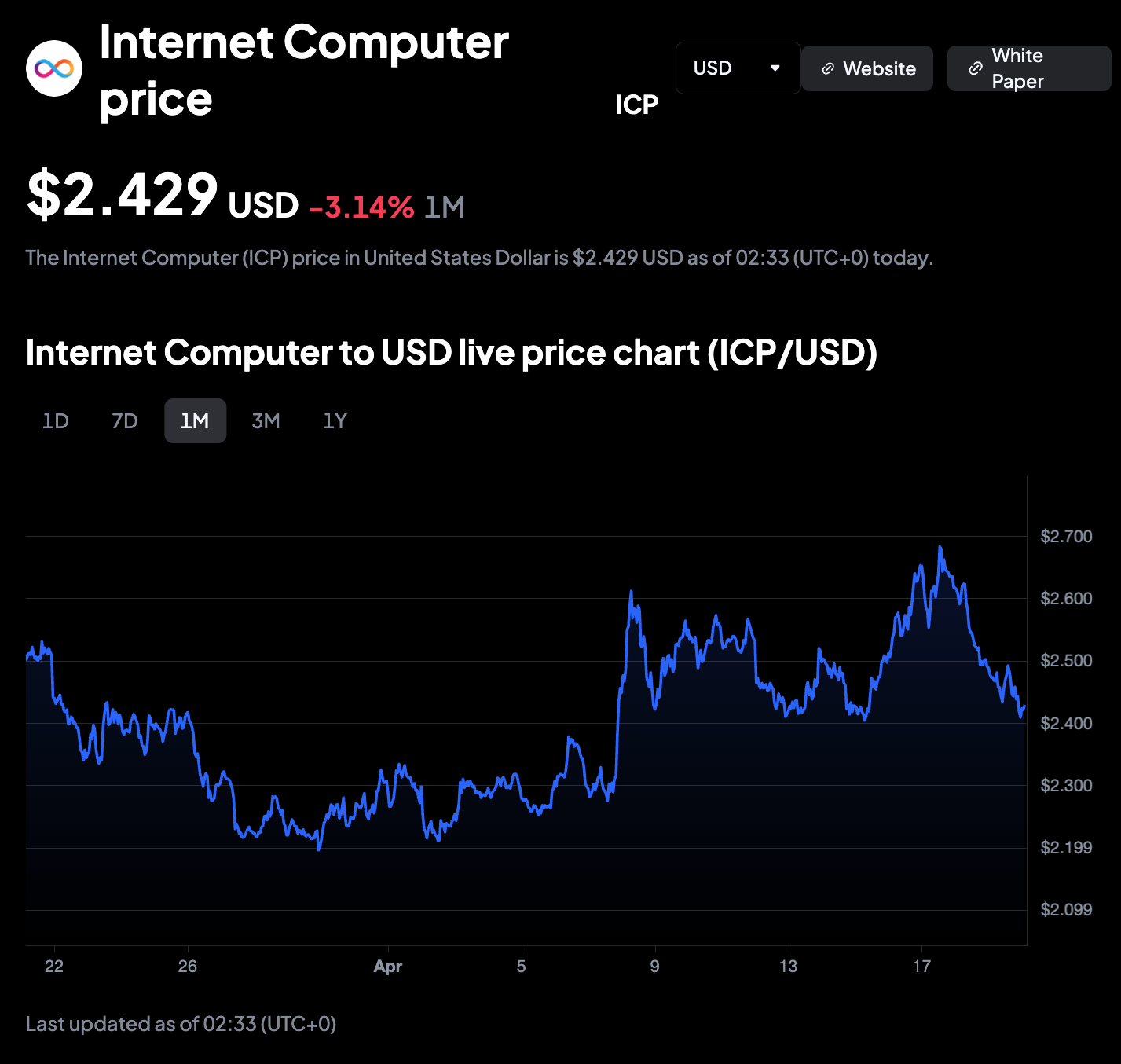
Internet Computer to USD live price chart on April 20, 2026, 2:33 UTC from Toobit
The ICP price chart currently reflects the price has been grinding upwards since March 29, 2026. It must remain above April 15’s $2.404 low to maintain this momentum.
Current market snapshot (April 20, 10:42 UTC+8)
Internet Computer is trading at around $2.428, down 2.02% over the last 24 hours. Its market cap stands at around $1.34 billion with $54.14 million in 24-hour trading volume.
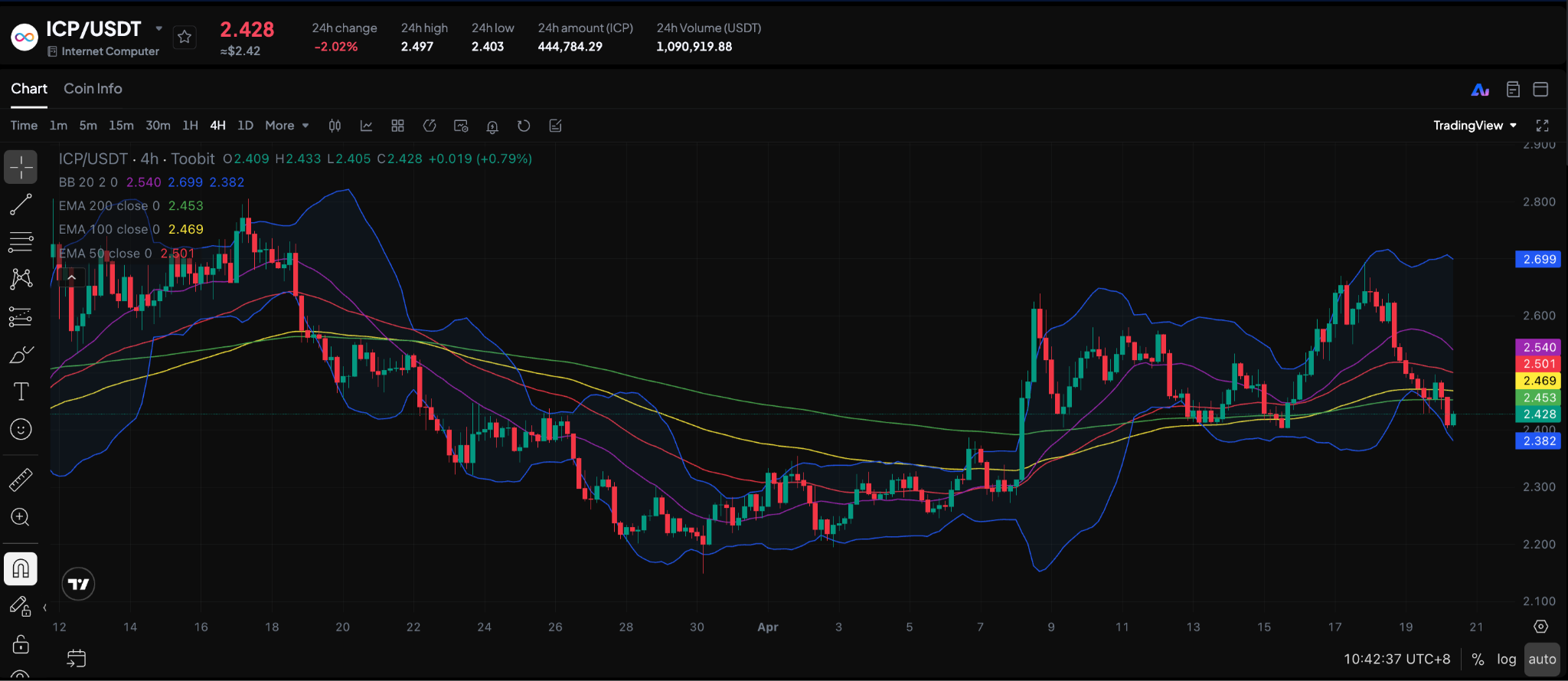
ICP/USDT 4-hour spot trading chart from Toobit
Its 24-hour high was at $2.497, with a low sitting at $2.403. Price has been on a steady decline since its recent sharp pump to $4.822 on January 15, 2025.
ICP’s circulating supply of 551.88 million ICP matches its total supply while currently displaying an infinite maximum supply.
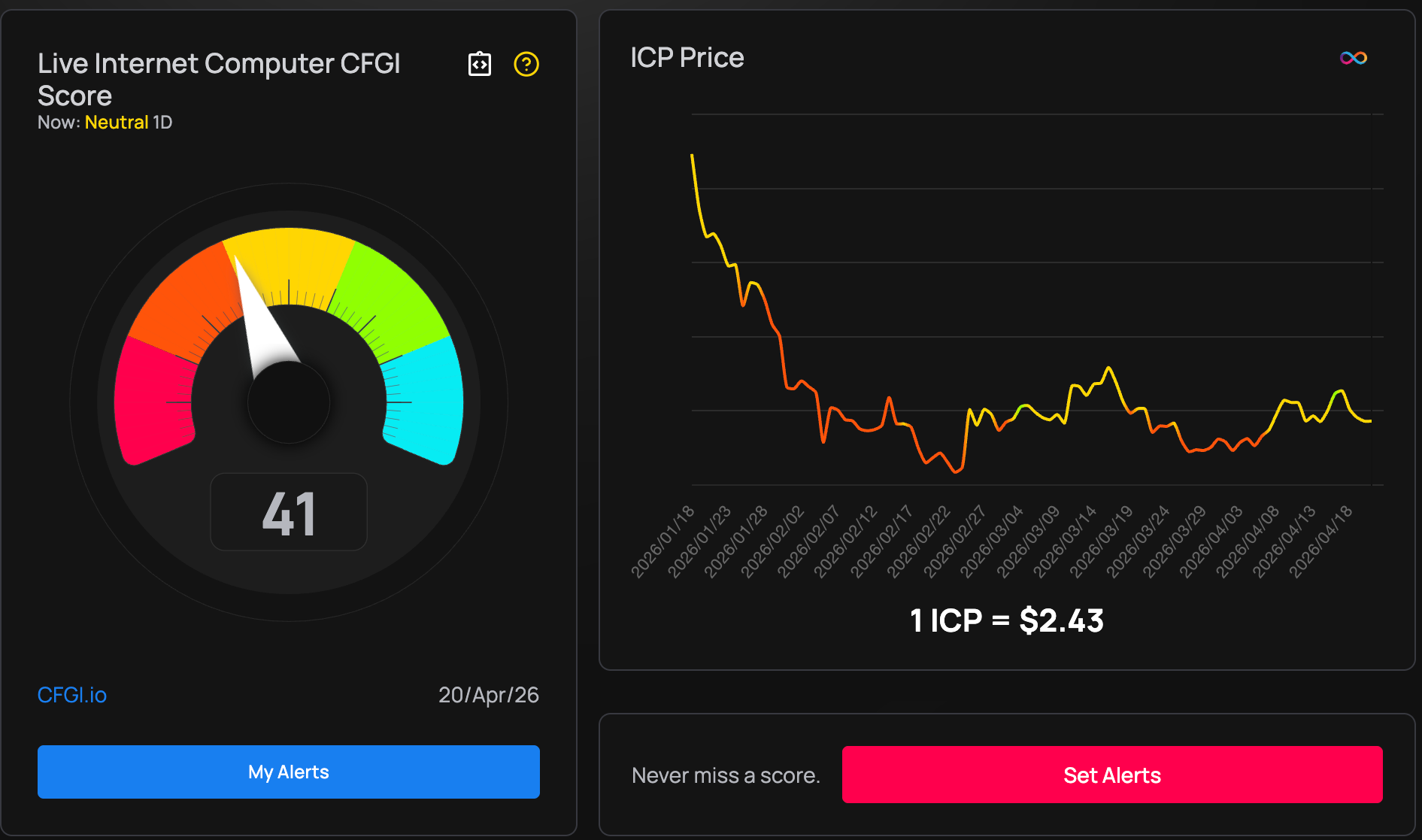
Internet Computer Fear and Greed Index from CFGI.io
The Internet Computer Crypto Fear and Greed Index (CFGI) currently stands at a 41 (Neutral) reading. It is doing better against a similar index for large cryptocurrencies, which is at 29 (Fear).
On-chain and technical analysis
Support and resistance
ICP has built up a support zone at around the $2.230 price mark. There is a wick to the downside marking its ATL in October 2025 to consider.
Tensions in the Strait of Hormuz are sending shockwaves through energy prices and global market liquidity. ICP’s price might just fill the wick, should these conditions continue to persist.
After pumping to $4.822 last January 15, 2026 and then dropping to $2.001, the immediate goal is to hold support at $2.230.
-
Near-term support remains at $2.230, it starts hunting its ATL zone after that.
-
Near-term resistance: $2.655, followed by a reclaim of the $3.448 level.
The $2.230 level defense runs parallel to building on ICP’s positive developments in its tokenomics restructuring initiative. A downward catalyst appears likely however that price will revisit its ATL before resuming its climb back up.
Momentum indicators
ICP shows a 4-hour Relative Strength Indicator (RSI) sitting just above the buy zone at 38.39. It recently punched to 80.29 on April 8, 2026, indicating overbought territory and is currently moving to the downside.
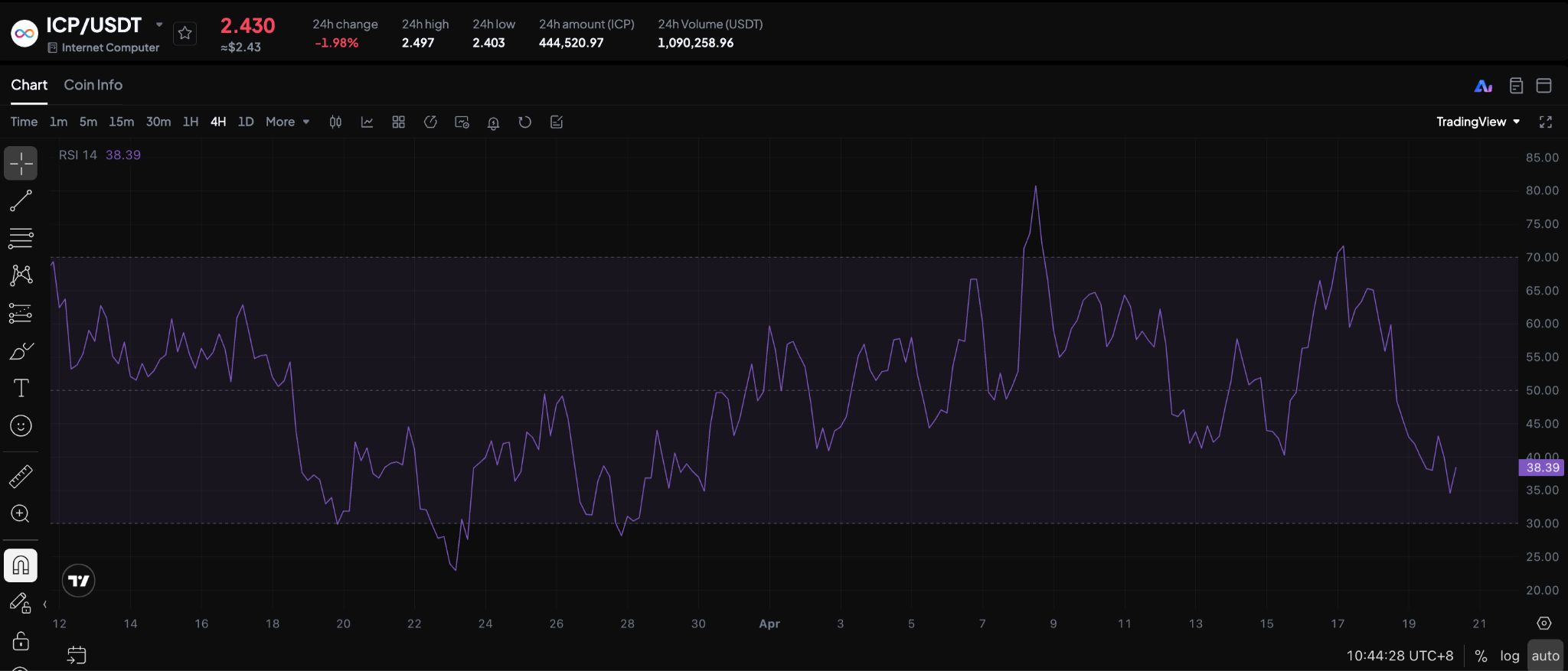
ICP/USDT 4-hour RSI chart from Toobit
A -0.018 histogram on its Moving Average Convergence Divergence (MACD) is between its blue MACD and orange signal lines. These read -0.026 and -0.008 respectively, concurrently displaying further downward movement.
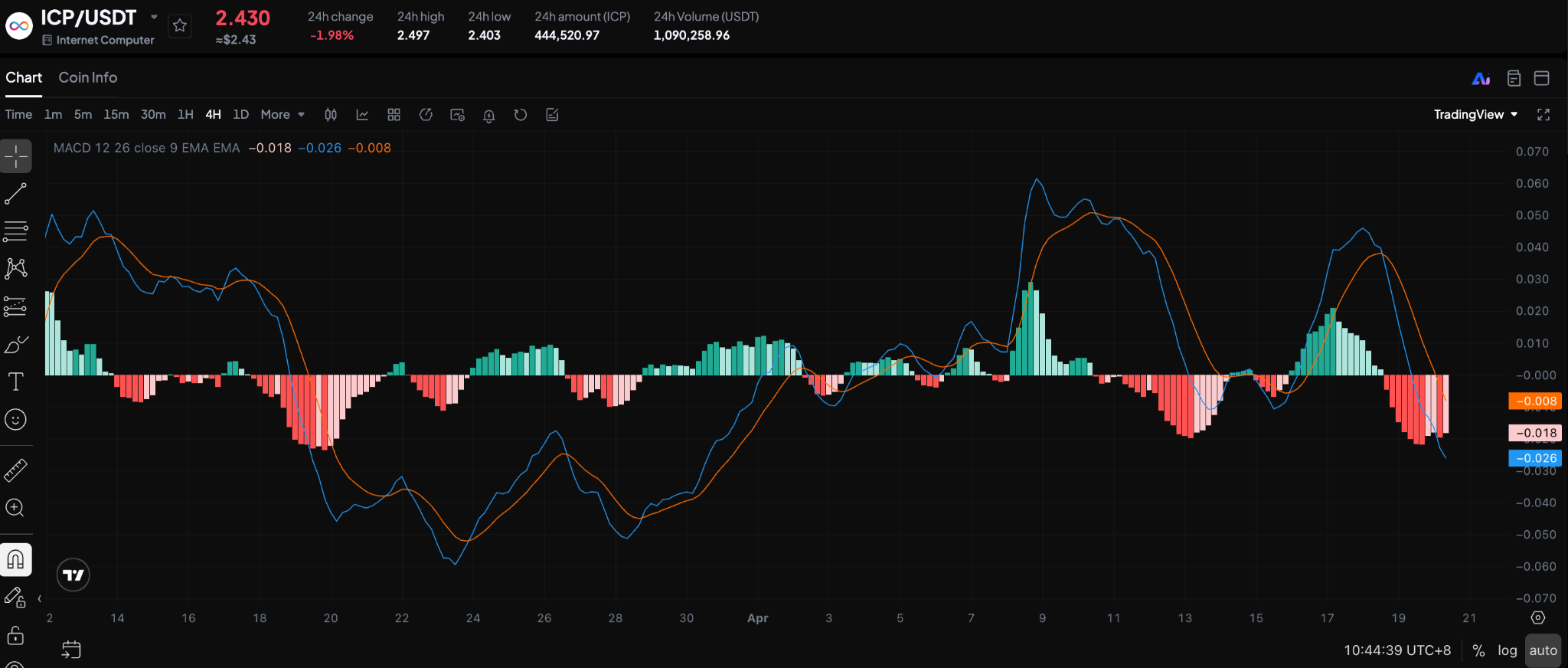
ICP/USDT 4-hour MACD chart from Toobit
A further drop in price appears to be on the horizon before a much awaited pivot starts materializing. Doing so would negate its upward trend it was slowly building which started March 29, 2026.
Moving averages and volume
The 200-day Moving Average (MA) on ICP’s 4-hour chart is at $2.453, just slightly above its current $2.428 price. This may be the first candle forming completely below it after pushing above this 200-day MA on April 8, 2026.
It is now dipping toward its lower Bollinger band, which is reading at $2.382.
Volume has been on a steady decline since January 15’s $526.56 million spike. It has been ranging between $46.17 million and $75.64 million for the week.
On-chain cues
ICP currently has 49 subnets spread out across 33 countries. This is supported by 104 node providers with 100 data centers.
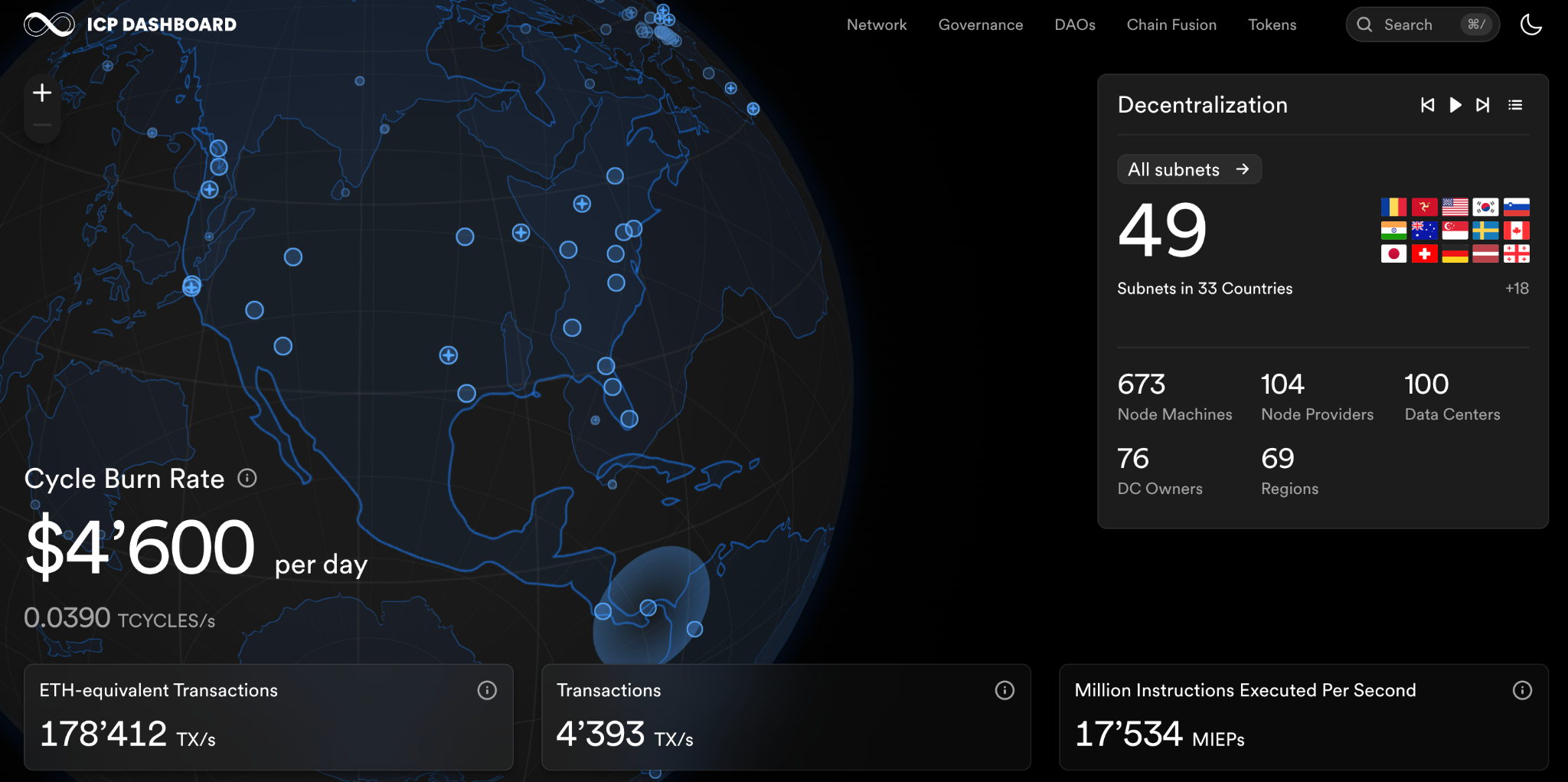
ICP statistics dashboard from Internet Computer
Its cycle burn rate is currently at $4,600 per day with transactions at 4,393. This reflects healthy network activity though it is still in the early growth phase for its deflationary goals.
Meanwhile, over 43.4% of circulating ICP remains locked in neurons for governance. This signals strong Hold On for Dear Life (HODL) conviction among long-term holders.
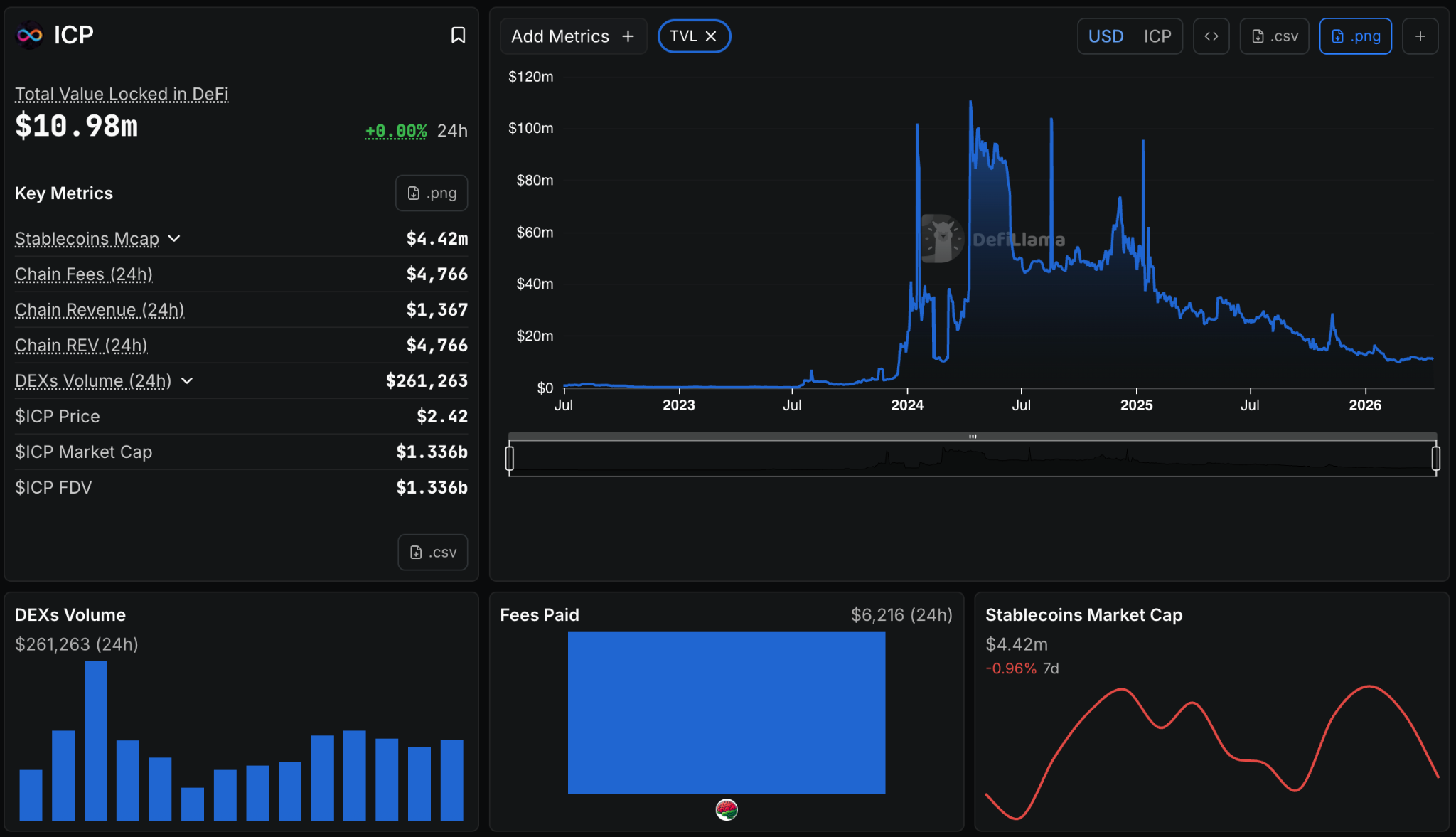
ICP on-chain analytics on April 20, 2026 from DeFiLlama
Its current total value locked (TVL) in DeFi is at $10.98 million with a stablecoins market cap of $4.42 million. Chain fees are a modest $4,766 in the last 24 hours while registering a decentralized exchange (DEX) volume of $261,263.
Internet Computer price prediction and outlook
Due to decentralized cloud hosting on-chain AI, ICP remains one of the most technically ambitious crypto projects. Its 2026 outlook however still depends on whether its infrastructure is more valued than its history of volatility.
A slow recovery rather than a straight-line breakout appears more realistic. Its price action is likely tied to upgrades and governance changes that improve confidence in its tokenomics.
Bull case ($4.50 to $6.50)
Stronger developer activity coupled by a better token model likely sees its price break key resistance near $3.45. An aggressive acceptance of its decentralized cloud and AI narrative would further support a boost in price.
Base case ($2.60 to $3.80)
The $2.23 support zone is held while ICP gradually rebuilds momentum as upgrades continue to land. This path assumes steady but not explosive adoption, with sentiment staying neutral to mildly positive.
Bear case ($1.80 to $2.20)
Short term support is lost and lower levels are revisited if broader crypto sentiment weakens or its tokenomics changes remain unconvincing. Its history of volatility and reputation risk could keep pressure on the price.
These ranges are intentionally more conservative, considering the prevailing geopolitical atmosphere. ICP chart and market structure still show clear resistance overhead and a history of sharp reversals.
At the same time, these are more constructive than a purely defensive view. The protocol’s technical roadmap is still progressing and continues to show signs of ecosystem persistence.
This article is for informational purposes only and does not constitute financial advice. Always do your own research (DYOR) before making any decisions.
Key milestones for Internet Computer
-
October 2016 to February 2018: Establishment of the DFINITY Foundation followed by major funding rounds from Andreessen Horowitz and Polychain Capital.
-
November 2019 to October 2020: A series of technical releases (Copper through Sodium) introducing the Motoko language, the software development kit (SDK), and the NNS.
-
May 2021: Protocol’s public mainnet launch, which decentralized the network and allowed ICP tokens to be used for governance and compute cycles.
-
December 2022 to April 2023: Bridge-less Bitcoin connectivity and Chain-Key Bitcoin (ckBTC) roll-out, enabling smart contracts to interact directly with the Bitcoin ledger.
-
January 2023: Allows ecosystem dApps to transition into community-governed DAOs through decentralization swaps.
-
June to July 2024: UTOPIA for sovereign private clouds is unveiled. A landmark partnership with the United Nations Development Program (UNDP) building Universal Digital Identity for financial inclusion is established.
-
May 2024 to November 2025: Large-scale artificial intelligence (AI) model inference entirely on-chain enabled alongside native bridge-less integrations with networks like Ethereum and Solana.
-
January to February 2026: MISSION70 whitepaper introduction and subsequent governance vote drastically reducing token inflation, shifting to a revenue-sharing model for node providers.
Community sentiment and ICP news
Community sentiment
According to Messari, ICP is showing a neutral sentiment score of 0 as of April 20, 2026. Sentiment Scores range from -1.0 being extremely negative and 1.0 as extremely positive.
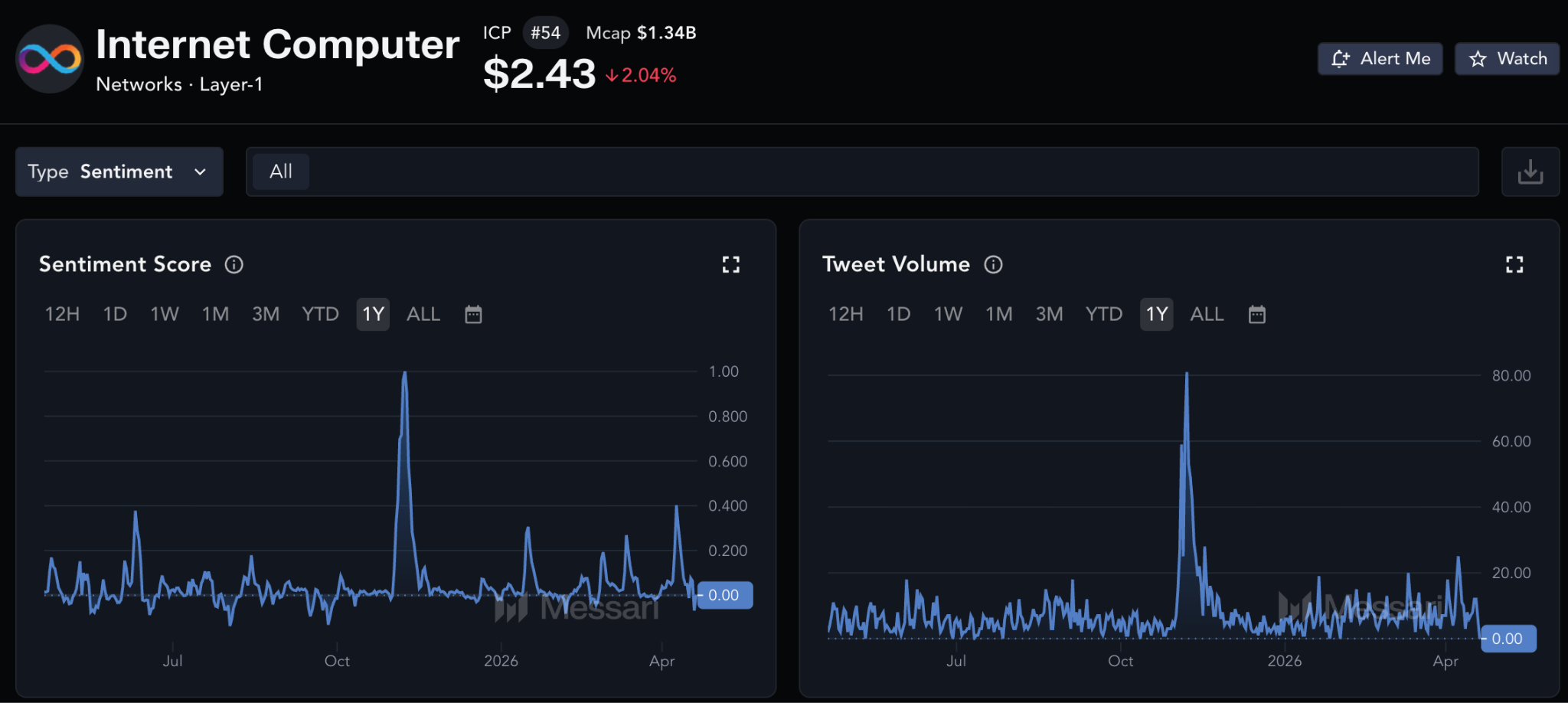
Internet Computer Sentiment Score and Tweet Volume charts from Messari
It had a perfect sentiment score of 1 last November 8, 2025. This was mainly driven by unconfirmed Coinbase integration rumors.
Sentiment however has stayed generally positive throughout 2026. The lowest it registered so far was -0.082 during the industry-wide crash on February 6, 2026.
No Tweet volume has been registered for April 20, 2026 so far. It did however spike to 81 last November 7, 2025 which was around the time of the rumored Coinbase integration.
ICP News
-
(April 17, 2026) The DFINITY Foundation introduced critical governance proposals to adjust staking rewards as part of the ongoing MISSION70 tokenomics overhaul. These refine the incentive structure for neuron holders and curb future inflation to ensure the network's long-term economic sustainability.
-
(April 13, 2026) A significant protocol upgrade enhances the network’s Caffeine AI self-writing platform by improving its core infrastructure and processing scalability. It focuses on high-speed technical execution and expands the decentralized cloud features available to developers building global scale applications.
-
(April 5, 2026) Senate Bill 1649 was introduced proposing the creation of a state-level Digital Assets Strategic Reserve Fund that explicitly includes ICP. It represents a major milestone for ICP in terms of governmental recognition and institutional credibility in the United States.
FAQs
How does ICP achieve web speed for blockchain apps?
Imagine mini-blockchains of 48 nodes each running simultaneously. These confirm transactions within 1 to 2 seconds through threshold relays and chain-key signatures.
Its parallel execution coupled with hypertext transfer protocol (HTTP) streaming from canisters delivers fast User Interfaces (UIs). This does away with the need for centralized delivery networks (CDNs) such as AWS.
What's the difference between ICP cycles and regular gas fees?
Developers buy compute time credits with ICP. These are loaded into app containers, similar to charging a phone battery.
It is utilized steadily, without any surprise spikes during peak times which is different from the gas wars on Ethereum. Users can use the dApps for free with developers refilling the tank when empty.
There are no refunds, only pure expenses.
Can anyone run an ICP node or are there certain requirements?
ICP requires nodes to use enterprise-grade hardware being run by approved data centers. According to its MISSION70 whitepaper, it would cost around $300 to $800 per month to run a node.
Does ICP support languages beyond Rust/Motoko?
Yes, it does. It also supports JavaScript, Go, and Python via WebAssembly (WASM) compilation.
How secure is ICP against hacks like Ronin or Wormhole?
ICP's chain-key technology uses U.S. National Institute of Standards and Technology (NIST)-grade threshold cryptography. This means that no subnet has full access to private keys.
Hackers must compromise over a third of all nodes across every subnet to steal funds. No notable exploits have occurred since 2021 aside from isolated spam attacks hitting single subnets.
The bottom line
ICP is showing sincere efforts coupled with positive signs that it seeks to banish greedy ghosts haunting its reputation.
Its MISSION70 initiative might have been a quick blip in its price chart but remains a positive one. The data confirms a shift toward long-term holder conviction:
Over 43.4% of the ICP supply is staked in governance neurons coupled with exchange reserves steadily declining. What a poetic comeback story it would be if ICP could redeem itself from its 2021 fall.
How to start trading ICP on Toobit
ICP seeks to be the driving force behind a decentralized world computer blockchain. It aims to power the next generation of on-chain apps and infrastructure.
Ready to trade ICP?
Toobit provides user-friendly access through Spot, Futures, and staking markets. It has competitive fees coupled with deep liquidity.
Make use of its advanced charting tools for strategic trade execution.
Start trading ICP/USDT today.


