
The Coldcard hack concerns vulnerable seed generation in certain hardware-wallet firmware, not a compromise of Bitcoin. The failure occurred while some Coldcard devices were creating the secret from which a wallet’s keys are derived. Bitcoin’s protocol, blockchain, and signature system continued operating normally.
Estimated Coldcard losses across 4 attack waves. From Galaxy Research and CoinDesk.
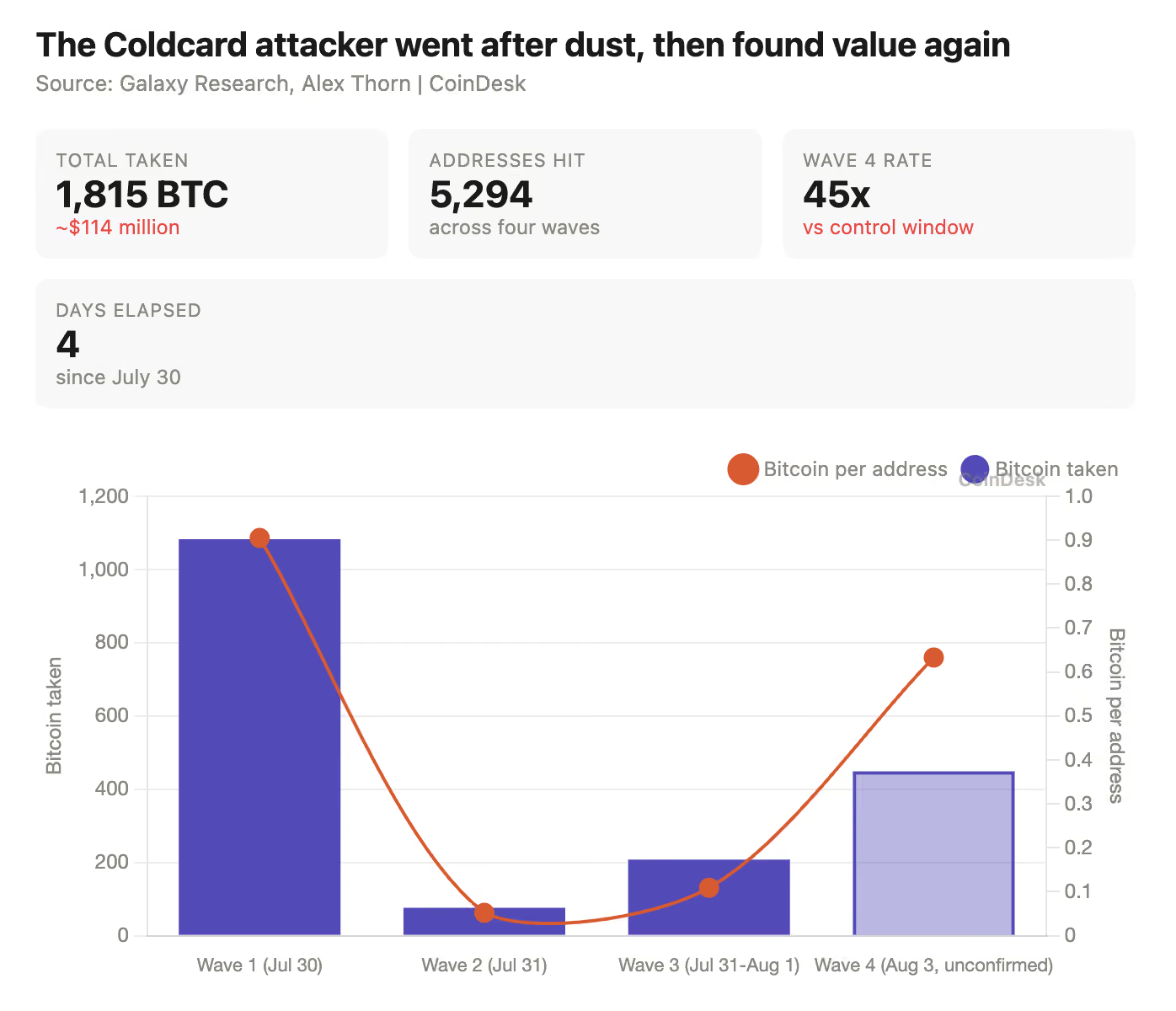
Blockchain analysis available as of August 4 linked 4 suspected sweep waves to approximately 1,815.75 BTC from 5,294 potential source addresses. At a Bitcoin price near $63,789 during final verification, that amount was worth about $115.8 million. The estimate is provisional: it is not an official loss total, and 5,294 addresses do not represent 5,294 confirmed victims.
The incident is unusual because the leading technical explanation does not require an attacker to steal a device, obtain a recovery phrase, infect a user’s computer, or breach Coinkite’s servers. Weak randomness reportedly reduced the number of plausible seeds enough for attackers to calculate candidates offline, derive their addresses, and look for matches on Bitcoin’s public ledger.
That mechanism raises a difficult Bitcoin self-custody question. Hardware wallets remain valuable for isolating keys and approving transactions, but those protections depend on the secret being unpredictable when it is first created. The incident therefore tests how much trust users still place in firmware, build systems, code review, and a single wallet manufacturer.
Incident at a glance
-
First observed attack: July 30, 2026, approximately 01:10:20 to 01:51:26 UTC.
-
Latest estimated loss: About 1,815.75 BTC across 5,294 potential source addresses, based on the latest 4-wave estimate available on August 4.
-
Affected products: Seeds generated on specified Mk2, Mk3, Mk4, Mk5, and Q firmware, subject to the dice and passphrase conditions in Coinkite’s advisory.
-
Main technical failure: Seed generation reached a deterministic software random-number fallback instead of the intended hardware RNG path.
-
Immediate user action: Install the correct fixed firmware before creating a completely new seed, verify the replacement wallet, and migrate funds carefully.
-
Main uncertainty: Blockchain patterns cannot establish that every flagged address came from Coldcard or show how many unique people were affected.
What happened in the Coldcard hack?
The first major sweep unfolded within roughly 41 minutes on July 30. Galaxy Research mapped 1,196 source addresses that moved a combined 1,082.65 BTC during that window. An earlier figure of about 594.5 BTC from roughly 500 addresses represented only a partial view of the same opening event, not a separate amount to add to it.
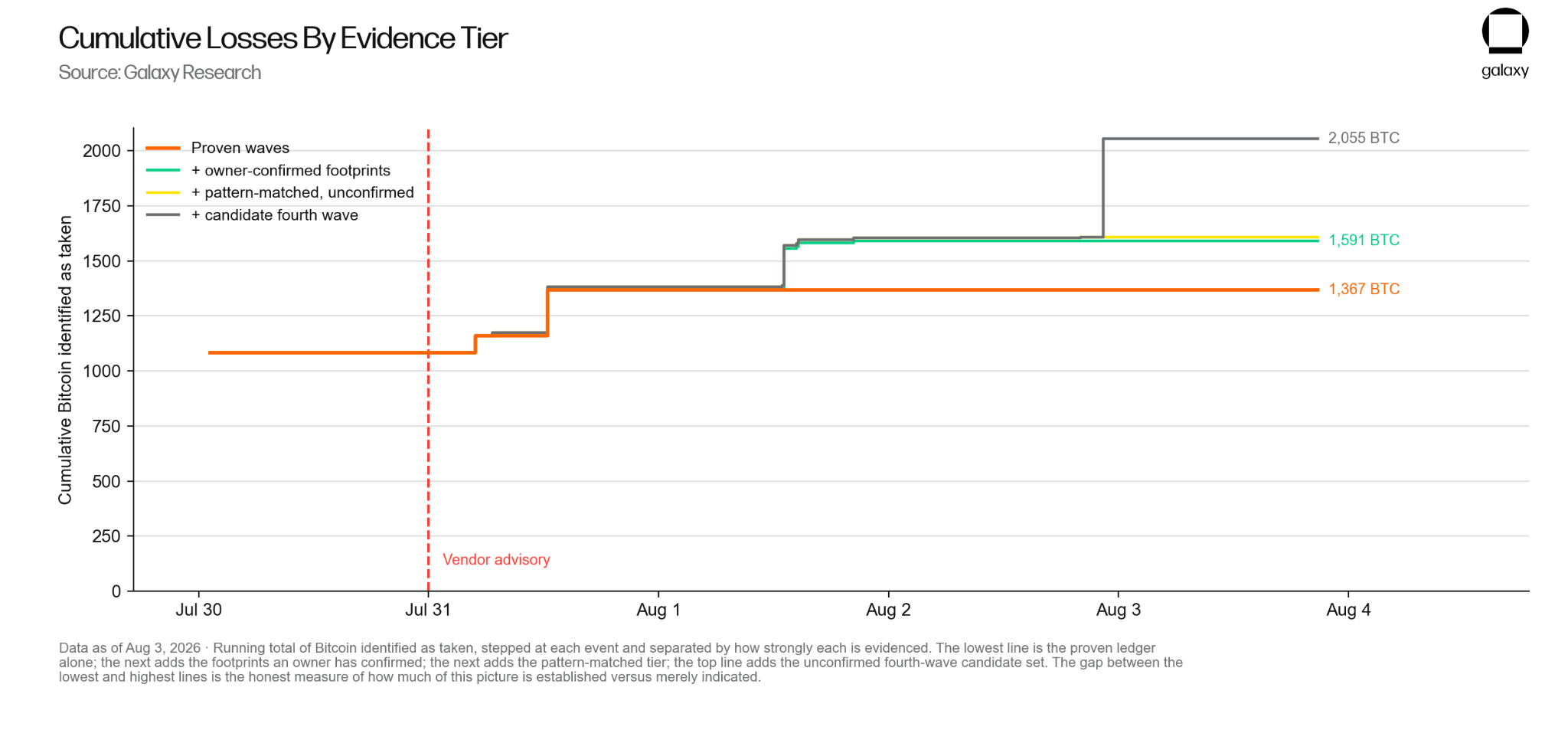
Cumulative Bitcoin losses linked to the Coldcard incident by evidence tier as of August 3, 2026. From Galaxy Research.
The transactions drew attention because many source addresses shared characteristics consistent with the vulnerable wallet pattern. Funds were transferred rapidly and systematically, suggesting that candidate keys and funded addresses had been identified before the sweep began. The blockchain shows the transfers and their structure, but it cannot reveal on its own how each private key was obtained.
Additional clusters appeared after the first disclosure. The cumulative estimate increased to about 1,158.7 BTC across 2,673 potential source addresses after a second suspected wave, then to 1,367.05 BTC across 4,585 addresses after a third. A fourth suspected wave on August 3 added about 448.7 BTC from 709 potential source addresses, producing the current arithmetic estimate of 1,815.75 BTC and 5,294 addresses if the groups do not overlap.
The main sequence was:
-
March 2021: A firmware integration change introduced the vulnerable seed-generation path.
-
July 30, 2026: The first large sweep occurred, and Coinkite published an advisory and technical explanation.
-
July 31–August 2: Fixed firmware became available, the affected scope expanded, and further suspected sweep waves were identified.
-
August 3: A fourth pattern-matched wave raised the observed estimate above 1,800 BTC.
-
August 4: No verified fifth wave, final victim total, compensation program, or recovered-fund announcement had been confirmed.
The event became a hardware-wallet security issue because the suspected thefts originated from wallets whose keys were meant to remain offline. The security boundary was not crossed through conventional remote extraction. Instead, the evidence points to a weakness at an earlier stage: creating the secret that the hardware was then designed to protect.
How the Coldcard vulnerability worked
A Bitcoin wallet seed must begin with sufficient entropy, meaning unpredictable information used to create the recovery words and the keys derived from them. A correctly generated 12-word BIP-39 seed normally targets 128 bits of entropy. That search space is so large that guessing the seed through brute force is not a practical attack.
Coldcard’s intended design drew randomness from hardware sources. During a 2021 integration involving libNgU, however, wallet generation moved from ckcc.rng_bytes() to ngu.random.bytes(). That route resolved to a deterministic fallback inside MicroPython rather than the board-specific hardware random-number implementation expected by the wallet code.
The error survived because both RNG implementations exposed a compatible function signature. The intended hardware implementation was also present in the firmware binary, which made a limited review appear reassuring. What was not verified was the complete route from the wallet-generation function to the RNG implementation that actually supplied its output.
A related build check failed for a subtle reason. The relevant macro was defined with a value of zero, while the guard tested whether the macro existed rather than whether it was enabled. The build therefore completed instead of stopping when the wrong object was included.
Coinkite’s preliminary analysis estimates an effective search space of about 40 bits for Mk2 and Mk3. Mk4, Mk5, and Q incorporated additional values from their secure elements, increasing the company’s estimate to about 72 bits, still below the intended 128-bit target. Independent analysis has examined tighter structural limits in the later-model construction, but those findings should not be simplified into a universal claim that every later-model seed had exactly 32 bits of total security.
From weak entropy to an unauthorized transaction
The technical chain can be explained without reproducing an attack method:
-
Firmware selected a deterministic software generator instead of the intended hardware RNG path.
-
The resulting seed came from a much smaller effective set of possibilities.
-
An attacker who understood and sufficiently constrained the flawed process could calculate candidate seeds and keys offline.
-
Public addresses derived from those candidates could be compared with funded addresses visible on Bitcoin’s blockchain.
-
A matching candidate provided the key needed to sign a transaction from that address.
No physical access is required in that model because the attacker is not extracting a key from the wallet. The attacker is independently arriving at the same key. The Bitcoin network cannot distinguish the legitimate owner’s signature from another valid signature created with an identically derived private key.
This explanation is strongly supported by the firmware history, Coinkite’s technical account, independent analysis, and the observed transaction patterns. It remains subject to revision if a later postmortem changes the root cause, independent testing rejects the entropy estimates, or forensic work shows that a material share of the suspected addresses had an unrelated origin.
Which Coldcard devices and seeds are affected?
Exposure is determined primarily by where and how the current seed was generated, not simply by the model a user owns today. A device running fixed firmware may still hold an old vulnerable seed. A device that once ran affected firmware may hold a sound seed imported from another secure source.
|
Model |
Affected firmware at seed generation |
Fixed firmware |
Who may be exposed |
Required action |
|
Mk2 |
4.0.1 through 4.1.9 |
4.2.0 or later |
Users whose funded seed was generated in this range without sufficient private dice entropy and without a strong, unique BIP-39 passphrase |
Update before creating a new seed, then verify and migrate |
|
Mk3 |
4.0.1 through 4.1.9 |
4.2.0 or later |
Same conditions as Mk2 |
Update before creating a new seed, then verify and migrate |
|
Mk4 |
Before Standard 5.6.0 or Edge 6.6.0X |
Standard 5.6.0+ or Edge 6.6.0X+ |
Users whose seed was created before the applicable fix, subject to the same mitigation conditions |
Install the correct release track, create a new seed, and migrate |
|
Mk5 |
Before Standard 5.6.0 or Edge 6.6.0X |
Standard 5.6.0+ or Edge 6.6.0X+ |
Same later-model conditions as Mk4 |
Install the correct release track, create a new seed, and migrate |
|
Q |
Before Standard 1.5.0Q or Edge 6.6.0QX |
Standard 1.5.0Q+ or Edge 6.6.0QX+ |
Users whose seed was created before the applicable Q fix |
Install the correct release track, create a new seed, and migrate |
Standard and Edge are separate firmware tracks. An older Edge release is not safe merely because its version number appears higher than a Standard release. Users need the fixed version for the model and track they actually use.
A vulnerable seed remains vulnerable if it is restored on a fixed Coldcard, imported into another hardware wallet, or entered into compatible wallet software. None of those actions adds randomness to the original words. By contrast, a seed securely generated elsewhere is not weakened merely because it was later imported into an affected Coldcard; that conclusion follows from the failure occurring during Coldcard’s seed-generation process.
Coinkite states that TAPSIGNER, OPENDIME, and SATSCARD are not affected because they use different codebases. That is a product-specific statement, not evidence that every function or security property of those products has received an independent audit.
How much Bitcoin was stolen?
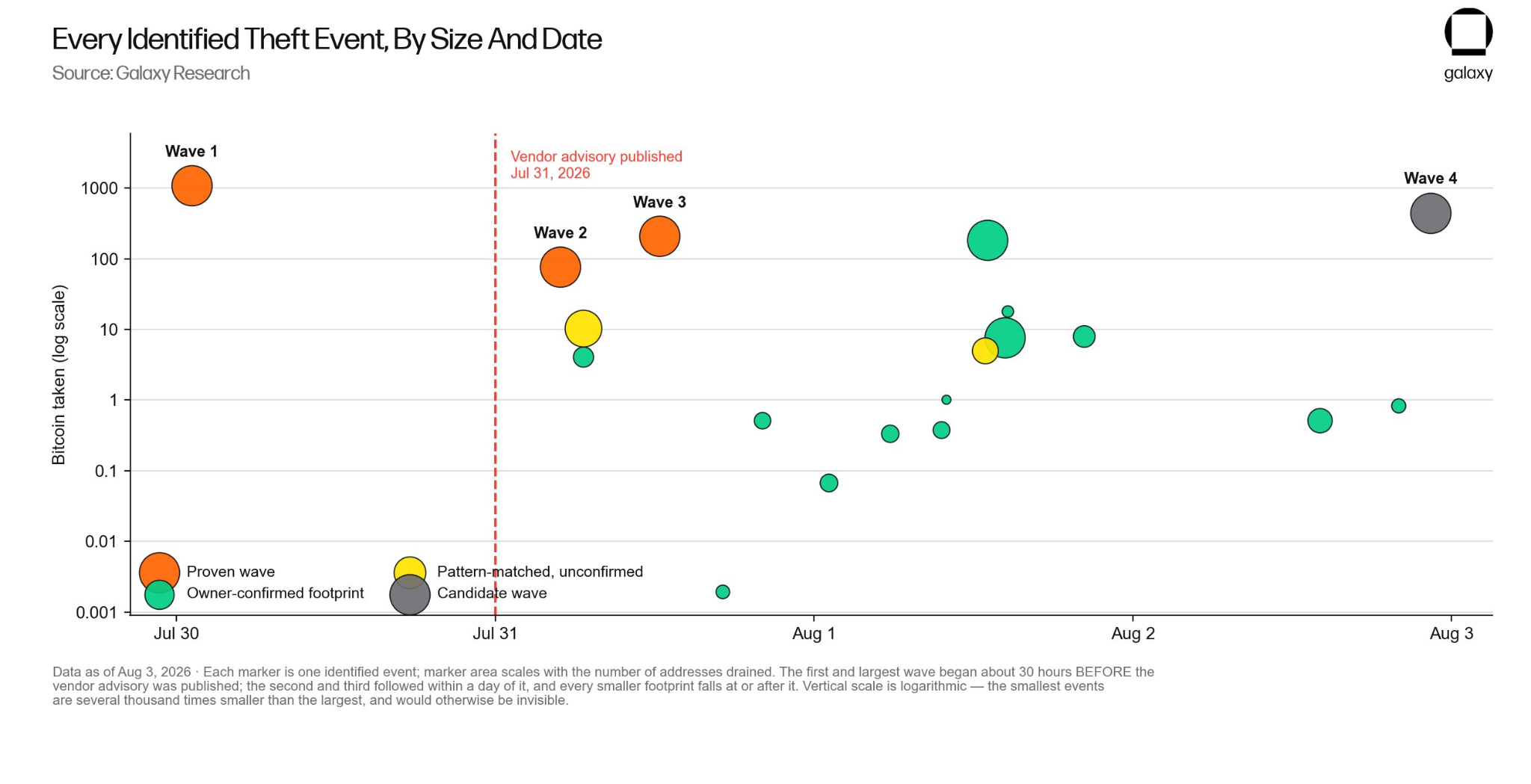
Known and suspected Bitcoin theft events linked to Coldcard by size, date, and evidence tier as of August 3, 2026. From Galaxy Research.
The most defensible current answer is an estimate, not a settled total. As of August 4, the latest 4-wave calculation was approximately 1,815.75 BTC, worth about $115.8 million at a contemporaneous Bitcoin price near $63,789. The figure combines the first 3 suspected waves with the fourth-wave estimate and assumes the newest address set does not overlap the earlier clusters.
|
Forensic snapshot |
BTC |
Potential source addresses |
Correct interpretation |
|
Early partial view of wave 1 |
~594.5 |
~500 |
Superseded subset of the opening sweep |
|
Full first-wave estimate |
1,082.65 |
1,196 |
Pattern-matched July 30 sweep |
|
Cumulative through wave 2 |
~1,158.7 |
2,673 |
Expanded running estimate |
|
Cumulative through wave 3 |
1,367.05 |
4,585 |
Superseded by the fourth-wave calculation |
|
Cumulative through wave 4 |
~1,815.75 |
5,294 |
Latest provisional estimate assuming no overlap |
The numbers changed because the investigation kept finding additional activity. Early reports captured only part of the first sweep, while subsequent updates added new waves and refined address filters. Dollar values also varied because Bitcoin traded between roughly $62,000 and $65,000 during the reporting period.
An address is not the same as a wallet or a person. One user can control many addresses, one seed can derive many addresses, and a forensic cluster can include false positives. Blockchain patterns can show coordinated timing, transaction structure, source history, and destination behavior, but they cannot independently prove that every source key came from a vulnerable Coldcard.
The address count should therefore be described as potential source addresses, not confirmed victims. No authoritative total for unique victims, devices, seeds, or users had been published by the cutoff. Individual victim reports can support the reality of the incident, but they do not establish the full scale.
The total could rise without another attack wave if researchers identify older transactions or receive additional victim confirmations. It could also fall if an address set overlaps another cluster or later analysis removes false positives. A larger circulating headline should not replace the current estimate unless its methodology, blockchain cutoff, and Coldcard connection can be verified.
Why updating the firmware is not enough
Firmware controls what a device does now. A seed records the result of what the device did when that wallet was created. Once insufficient randomness has produced a seed, a later software update cannot retroactively expand the set from which that seed came.
The fixed firmware corrects future generation by excluding the unintended software fallback and adding build-time checks around the RNG symbol. It does not alter the recovery words already written down, change the keys already derived from them, or make an attacker forget a candidate that can reproduce them.
Moving the same words to a different device changes the storage location, not the secret. Buying another wallet and restoring the affected seed produces the same wallet and keys. The official migration principle is therefore: the patch repairs the generator, while the affected seed must be replaced.
A new seed created on the correct fixed firmware generates a different wallet. Funds become protected by the new secret only after the receiving address has been verified and the Bitcoin has moved there. Confirmed unauthorized transactions cannot be reversed by changing firmware or restoring a backup.
What affected Coldcard users should do now
The appropriate response depends on the seed’s origin, the firmware used when it was created, and any independent entropy or passphrase protection. Users should rely on the live Coldcard security advisory for device-specific procedures and avoid improvising under pressure.
A careful general sequence is:
-
Confirm the model and firmware history. The current version is not enough; determine which firmware generated the funded seed.
-
Establish the seed’s origin. Identify whether it was generated on the Coldcard, restored from another affected Coldcard, or imported from an independent source.
-
Install verified fixed firmware. Use the official channel and the correct Standard or Edge release for the device before generating a replacement.
-
Generate a completely new seed. Do not reuse, slightly modify, or re-import the old recovery words as the replacement.
-
Record and verify the new backup. Check the words and recovery information carefully before sending funds.
-
Verify the wallet fingerprint and receiving address. Confirm both through the trusted device display, not only on a connected computer or phone.
-
Send a small test transaction. Use an amount sufficient to confirm the process without moving the entire balance immediately.
-
Confirm receipt and control. Verify that the new wallet shows the test payment and can be restored or accessed as intended.
-
Move the remaining balance. Transfer only after the destination and test result have been checked.
-
Preserve the old backup until completion. Retire it only after the full balance has arrived and the migration is confirmed.
Users who already installed fixed firmware but retained the old seed have completed only the first part. Users who bought a new wallet and restored the same words have not removed the weakness. The deciding factor is whether the funds are now controlled by a fresh seed generated through a corrected or otherwise independent process.
The migration period also creates a separate social-engineering risk. Attackers can exploit urgency even when they cannot calculate a user’s seed.
-
Do not use unsolicited firmware links, migration tools, or recovery services.
-
Never enter seed words, private keys, passphrases, dice sequences, or PINs into a website.
-
Reject support accounts that request secrets or ask users to sign an unverified transaction.
-
Check for clipboard replacement, address poisoning, and small changes in a destination address.
-
Verify the address on the hardware-wallet screen and avoid moving the full balance before a test succeeds.
Coinkite also warns against rushing. A user who loses the new backup, selects the wrong network tool, sends to an unverified address, or mishandles a passphrase can create a more immediate loss than the vulnerability being addressed.
Did air-gapping and secure elements fail?
Air-gapping and secure elements did not prevent this incident because they address different parts of the security model. An air gap is intended to reduce communication between a signing device and networked systems. It can limit remote extraction and help keep transaction signing isolated, but it does not measure the quality of randomness used when the wallet is created.
A secure element protects stored secret material against certain physical and electronic extraction techniques. It can faithfully guard a key that is still too predictable. If another party independently derives the same private key, there is no need to bypass the chip or retrieve data from the device.
Later Coldcard models did mix additional values from 2 secure elements into the software state. Coinkite says this raised the estimated effective search space from the roughly 40-bit Mk2/Mk3 case to about 72 bits for Mk4, Mk5, and Q. The extra input reduced the severity but did not restore the intended 128-bit target.
The failure occurred upstream of storage and signing. The seed-generation function reached the wrong source of randomness, after which the device protected and used the resulting key as designed. Offline storage cannot correct a weak secret any more than physical isolation can change how that secret was originally calculated.
This distinction preserves the value of layered security while identifying its limit. Air-gapping, secure elements, firmware verification, backups, and transaction review solve different problems. No single layer can compensate automatically when the foundational key-generation step is defective.
What the incident reveals about seed generation
Seed entropy is not a secondary feature. It is the control that makes every later hardware-wallet protection meaningful. A well-protected private key remains vulnerable if the original secret came from a set small enough for another party to search.
The Coldcard seed generation bug also shows why reviewing cryptographic software involves more than reading the intended RNG function. Reviewers need to confirm the compiled configuration, imported submodules, symbol resolution, call reachability, entropy mixing, failure behavior, and final binary. In this case, the expected hardware implementation existed, but the wallet-generation path reportedly reached a different implementation with the same interface.
Source transparency still has value because it allows independent researchers to inspect changes and challenge a vendor’s conclusions. It does not prove that the important code has been reviewed, that the reviewed source matches every build, or that reviewers tested the exact path executed on a production device. Visibility creates the possibility of verification; it does not supply verification by itself.
Manufacturers therefore remain part of the trust model. Users depend on them to design the entropy path, configure the build, test releases, disclose failures, sign firmware, and maintain accurate remediation instructions. Even technically advanced users rarely reproduce every build or audit an embedded cryptographic stack before generating a wallet.
The practical lesson is to reduce the consequences of one hidden failure. Independent entropy, multi-vendor signing policies, watch-only monitoring, tested recovery, and clear firmware provenance can distribute risk. Each measure also adds work and possible mistakes, so security architecture should match the user’s ability to maintain it reliably.
Does the Coldcard hack mean self-custody is unsafe?
The incident does not show that Bitcoin self-custody is cryptographically unworkable. Bitcoin’s network was not compromised, properly generated keys remain secure under current assumptions, and the vulnerability was tied to a specific implementation and firmware history. Self-custody still allows users to hold and transfer Bitcoin without giving a financial intermediary unilateral control.
It does show that self-custody is not free of trust. A hardware-wallet user may control the final keys while still relying on device components, firmware, libraries, build settings, security reviews, documentation, and update channels. The phrase “verify, do not trust” describes an objective, but most users cannot personally verify every layer required to reach it.
The strongest criticism is therefore practical rather than philosophical. A person can follow the normal setup process, keep the wallet offline, protect the backup, and still suffer a manufacturer-level generation defect. Treating that outcome as user error would ignore that secure default seed generation is a core responsibility of the product.
The strongest defense of self-custody is that the model can be made resilient to individual component failures. A key created through sound independent entropy was not weakened by this specific Coldcard bug. A multisignature wallet requiring an independent second key could remain secure even if one signer was predictable.
Different custody models distribute risk differently:
-
Single-signature self-custody concentrates generation, backup, and authorization risk in 1 key.
-
Multi-vendor multisig reduces one-device risk but adds setup, descriptor, inheritance, and recovery complexity.
-
Collaborative custody can add recovery and policy controls while introducing provider dependence and privacy considerations.
-
Institutional or exchange custody removes personal seed management but adds counterparty, access, legal, and withdrawal risk.
-
Spot Bitcoin funds provide regulated price exposure but do not provide direct on-chain possession or transfer control.
The Coldcard vulnerability does not establish that an exchange or fund is safer for every user. It provides evidence that self-custody decisions should account for implementation and operational risk, not only remote hacking and physical theft.
Multisig, passphrases, and dice-generated entropy
Additional controls could have changed the outcome for some wallets, but none is costless. The relevant question is whether a control adds an independent barrier or merely repeats the same vulnerable dependency.
Multi-vendor multisig can reduce correlated device risk. In a 2-of-3 arrangement, reconstructing 1 Coldcard-generated key is not enough if a second required key was generated independently and remains secure. A setup in which enough quorum keys came from the same vulnerable generation path may still be exposed.
A BIP-39 passphrase derives a separate wallet from the combination of the seed and passphrase. A strong, unique, secret passphrase can therefore add an independent barrier: recovering the weak base seed alone does not reveal the passphrase-protected wallet. Coinkite still advises affected passphrase users to migrate because the base seed remains weak, and a short, patterned, reused, quoted, exposed, or uncertain passphrase may be guessable.
The Coldcard PIN is not a BIP-39 passphrase. A PIN controls local access to the physical device and may activate device-specific security behavior. It does not change the cryptographic wallet derived from the seed, so it cannot stop an attacker who calculates the key elsewhere.
Coinkite’s current dice guidance applies specifically to this RNG issue:
-
50 to 98 fair, independent, private rolls added during original seed creation contributed at least 128 bits through the dice input, under the advisory’s calculation.
-
99 or more such rolls contributed approximately 256 bits.
-
Fewer than 50 rolls, forgotten counts, exposed sequences, or uncertain procedures do not qualify for the exception.
The rolls must have been incorporated through the relevant original workflow, and the final funded seed must be the one produced after the dice were added. Users should not assume protection if they cannot verify those conditions. The dice sequence is also secret material and should not be photographed, digitized, or entered into a networked service.
After Mk2/Mk3 firmware 4.2.0, Coinkite documents an optional dice-only replacement path requiring at least 99 rolls. That is different from the 50-roll exception for an old seed created with the “Add Dice Rolls” function. Normal seed generation on fixed firmware is described as sufficient; manual dice are optional and add their own counting, transcription, backup, and privacy risks.
Multisig, passphrases, and independent entropy can reduce one failure mode while increasing operational burden. A lost passphrase, incomplete multisig descriptor, inaccessible signer, or incorrectly recorded manual seed can permanently block recovery. More controls are useful only when the user can document, test, and maintain them.
How the incident affected Bitcoin and crypto markets
The market response was visible but difficult to isolate. Bitcoin slipped to about $62,800 on August 3 as the reported Coldcard losses expanded, then traded near $63,789 during verification on August 4. A move of that size can reflect security concerns, but it is not evidence that the incident alone determined the price.
Federal Reserve communication, changing Treasury yields, geopolitical developments, broader crypto participation, and company-specific Bitcoin news were active during the same period. Those factors can alter the dollar, liquidity expectations, and risk appetite independently of hardware-wallet headlines.
U.S. spot Bitcoin ETF flows were also mixed rather than uniformly defensive. The products recorded approximately $233.1 million of net inflows on July 30, $265.4 million of net outflows on July 31, and $170.1 million of net inflows on August 3. That sequence does not support a simple claim that Coldcard users collectively abandoned self-custody for ETFs.
Urgent migrations likely increased some on-chain activity, but a transaction leaving an old wallet is not automatically a sale. It may be moving to a new self-custody address, a collaborative custodian, or an exchange. Without reliable destination labels and subsequent trading data, migration volume cannot be converted directly into selling pressure.
No clean incident-specific evidence was verified for aggregate exchange inflows, derivatives liquidations, or a sustained change in funding and open interest. The most direct market impact was on confidence in hardware-wallet implementation and on the custody debate. Bitcoin’s network economics and monetary rules were unchanged.
A near-term reaction could reverse if no further waves appear, users complete migrations, and the loss estimate stabilizes. It could intensify if a new cluster is confirmed or the final technical scope expands. In either case, macro liquidity and broader market positioning may remain more powerful price drivers than the wallet incident.
Could the stolen Bitcoin be recovered?
Bitcoin’s public ledger allows investigators to follow transactions after a theft. Analysts can monitor known destination addresses, identify consolidation patterns, and flag deposits that reach a service with customer records or asset-control capabilities. That transparency can create investigative leads that do not exist in a fully opaque payment system.
Tracing is not the same as recovery. A confirmed Bitcoin transaction is irreversible at the protocol level, and an analyst cannot move coins merely by labeling an address. Recovery usually requires the funds to reach a cooperative intermediary, a legal order over an identifiable party, control of the relevant keys, or voluntary return.
Speed and jurisdiction complicate that process. Funds can be split across addresses, transferred through multiple services, or moved to entities in countries where legal coordination is slow. Even a known service may not be able to freeze assets that have already left its control.
Coinkite has asked affected users to preserve their devices and said its legal team would coordinate with law enforcement across jurisdictions as warranted. That statement indicates preparation for possible investigation; it does not confirm a named public case or guarantee asset recovery.
As of August 4, no verified announcement established that Coldcard-linked Bitcoin had been seized, frozen, returned, or recovered. Users should also be cautious of recovery scammers who promise access to stolen funds in exchange for an advance payment or secret wallet information.
Coinkite’s response and potential legal consequences
Coinkite published its first Coldcard security advisory and technical explanation on July 30. By the August 1 revision, fixed firmware was available for all affected models and both Standard and Edge tracks. The company also clarified the dice-roll and passphrase conditions, warned that old seeds remain exposed, and provided migration guidance.
The company halted shipments when it confirmed the vulnerability and said it destroyed remaining inventory carrying vulnerable firmware. It worked directly with users, publicly apologized, and promised a formal technical postmortem. Current store information states that newly purchased affected models will ship with corrected firmware, although older devices still require user verification and updates.
Several important questions remain open:
-
Coinkite has not published an official loss or unique-victim total.
-
No reimbursement, compensation, insurance, or formal claims program had been announced by the cutoff.
-
The promised full technical postmortem had not yet been published.
-
No named law-enforcement investigation or public case number had been confirmed.
-
No verified attacker attribution or completed recovery had been announced.
Potential legal claims could involve negligence, product defects, warranties, misrepresentation, failure to warn, or consumer-protection rules. A firmware vulnerability alone does not prove that it caused a particular user’s loss. Causation may depend on the model, seed-generation firmware, dice use, passphrase strength, multisig structure, backup history, and whether the seed was exposed through another route.
Coinkite’s terms include warranty disclaimers, limitations on damages, Ontario arbitration provisions, a 1-year proceeding period, a class-action waiver, and Ontario governing-law language. Those clauses may create significant obstacles, but their enforceability can differ by jurisdiction, purchase channel, consumer law, and the type of claim brought.
Lawyers were evaluating possible actions and gathering information from affected users, but no filed lawsuit or court finding was verified as of August 4. The accurate formulation is that Coinkite faces potential legal claims, not that liability has been established or that a class action is active.
Lessons for hardware-wallet users
The incident supports a more precise security checklist rather than a single universal custody recommendation:
-
Verify firmware provenance and version before generating a new wallet, not only after funds arrive.
-
Understand seed origin and record which device and release created it.
-
Test recovery before placing a material balance behind a new setup.
-
Consider independent entropy only if the method can be performed and documented safely.
-
Evaluate multi-vendor multisig for large balances when the operational complexity is manageable.
-
Use watch-only monitoring to detect unexpected transactions without exposing signing keys.
-
Back up seeds and passphrases separately and include inheritance and recovery needs in the design.
-
Treat urgent migration messages as potential phishing, even when the underlying incident is real.
These practices address different risks. They do not make a wallet immune to every implementation, supply-chain, backup, physical, or human failure. The objective is to reduce single points of failure without creating a setup too complex for the owner to recover reliably.
What to monitor next
The next confirmed developments will determine whether the incident remains primarily an emergency migration story or shifts toward accountability and recovery.
-
A fifth attack wave or a revised 4-wave cluster with overlap removed.
-
New movement from identified destination addresses or entry into a named service.
-
A freeze, seizure, voluntary return, or other verified recovery.
-
Coinkite’s formal technical review and any change to the affected scope.
-
Compensation, insurance, claims, refund, or device-replacement announcements.
-
A named law-enforcement action or attacker attribution.
-
A filed lawsuit, arbitration, regulator proceeding, or court order.
-
Further firmware fixes or disclosures involving other generated secrets or products.
Every loss figure should retain a timestamp. A higher address count does not necessarily represent a new theft wave, and a new dollar total may reflect only a change in Bitcoin’s price.
Final read
The Coldcard hack was a seed-generation failure in affected firmware. The wrong randomness path reportedly reduced the effective seed space, allowing attackers to reconstruct candidate keys without possessing users’ devices or recovery phrases. Bitcoin itself was not hacked, and no evidence shows that Coinkite’s servers or Coldcard secure elements were directly breached.
The most urgent action for an affected or uncertain user is to consult the live official advisory, install the correct fixed firmware, generate a completely new seed, verify the replacement wallet, and migrate carefully. Updating alone cannot repair an existing weak seed, and restoring the same words elsewhere preserves the exposure.
Self-custody remains technically viable, but the incident shows that it relies on correct key generation, trustworthy implementations, review quality, and manageable operational design. The largest unresolved questions are how many of the 5,294 potential source addresses were truly Coldcard-linked, how many unique people were affected, whether more waves will emerge, and whether any stolen Bitcoin can be recovered.
This article is for informational and educational purposes only. It does not constitute financial, investment, legal, cybersecurity, or trading advice. Cryptocurrency storage involves custody, software, operational, and security risks. Always verify device-specific instructions through official manufacturer channels and seek qualified assistance when necessary.


