
Preheader: Track the latest BNB price, key BNB USD levels, key technical indicators, and the network milestones that could shape BNB’s market outlook in 2026.
When BNB Chain performance meets BNB token economics
BNB enters 2026 with a clearer setup than many large-cap exchange-linked assets, as BNB Chain pushes faster execution and higher throughput while BNB’s supply-reduction mechanics remain a core part of the token narrative.
The near-term focus is simple: network upgrades and scaling. If faster blocks and Layer 2 (L2) expansion translate into sustained usage, BNB has a stronger case for follow-through because its relevance still depends on activity across the ecosystem.
The next sections outline what the chart must confirm, which milestones matter most, and how sentiment is evolving around BNB.
What is happening to BNB lately?
BNB’s latest narrative is being shaped by institutional product momentum, tokenomics, and network upgrades that keep performance and scalability in focus.
-
CoinShares BNB staking exchange-traded product (ETP) launch (March 4, 2026): CoinShares launched the CoinShares Physical BNB Staking ETP on Deutsche Börse Xetra and Euronext with a 0% management fee, offering regulated BNB exposure with an estimated 2.4% annual staking yield accruing into the product.
CoinShares BNB staking ETP from Cointelegraph

-
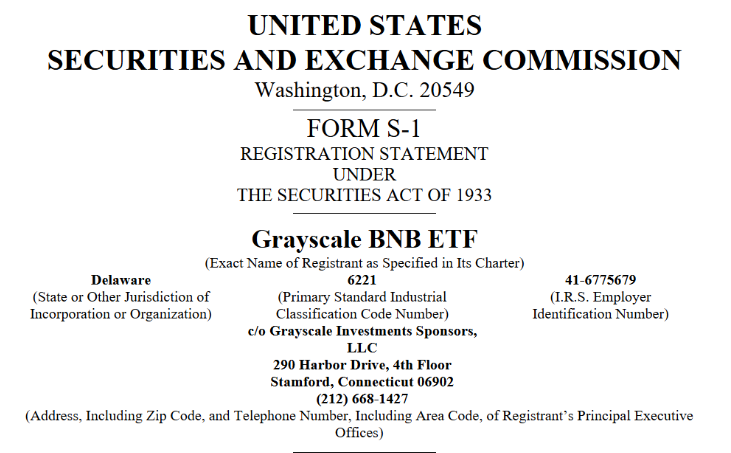
Spot BNB exchange-traded fund (ETF) filing (January 23, 2026): Grayscale filed with the U.S. Securities and Exchange Commission (SEC) for a spot BNB ETF designed to hold BNB directly and trade on Nasdaq under GBNB, subject to approval.
Spot BNB ETF from SEC
What is BNB (BNB)?
BNB token overview from BNB
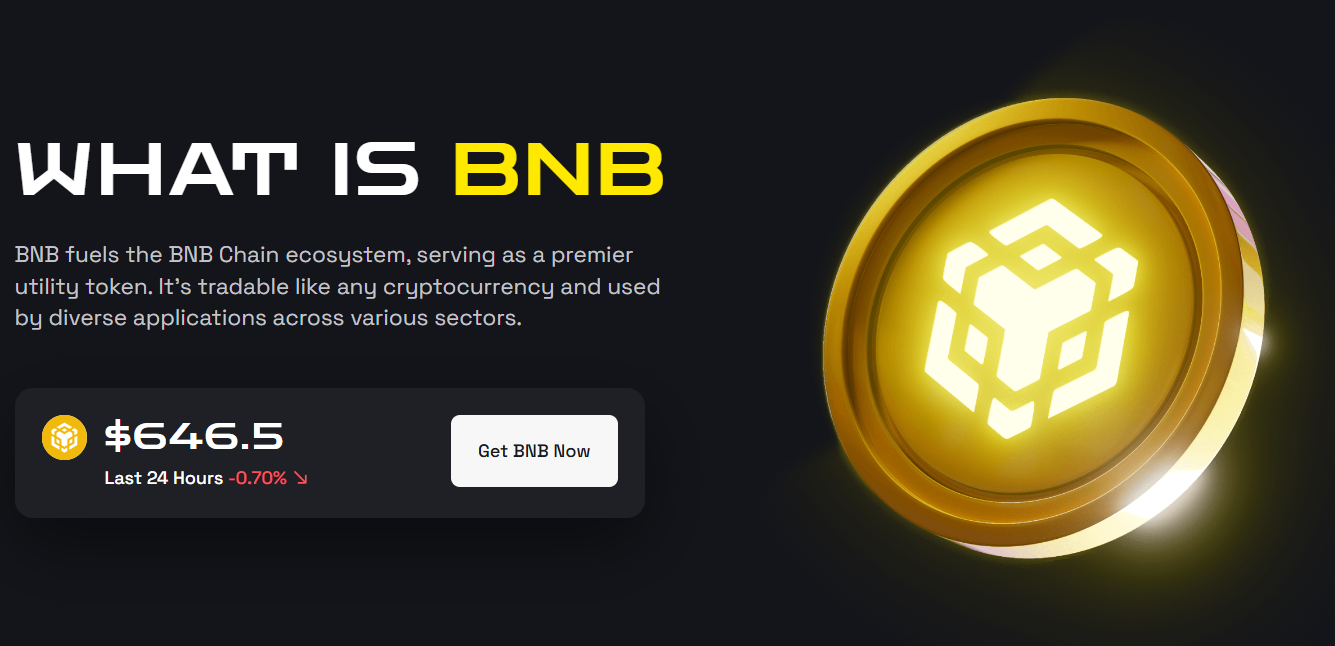
BNB is the native token of the BNB Chain ecosystem and a core utility asset across the broader Binance ecosystem. In practice, BNB sits at the intersection of network activity and token economics. It is used to run transactions and reinforce scarcity through ongoing supply reduction.
Here is how it works at a product level:
-
Network utility (gas): BNB is used to pay transaction fees across BNB Chain environments. This ties part of the token’s relevance to how much the network is actually used, including applications, transfers, and on-chain activity.
-
BNB Chain stack: BNB Chain is built as a multi-network setup designed to support high-throughput applications.
-
- The most commonly referenced components are BNB Smart Chain (BSC), the smart contract network, and opBNB, the scaling network.
- BSC is Ethereum Virtual Machine (EVM)-compatible, meaning developers can deploy EVM applications using familiar tooling.
Where token economics fits in
BNB’s supply reduction mechanics are a major part of its longer-term narrative:
-
Auto-Burn: A scheduled mechanism designed to reduce supply over time.
-
Real-time burn (BEP-95): A burn mechanism tied to network activity, linking supply reduction more directly to usage.
-
Pioneer Burn: A program that can remove certain recovered or eligible amounts from supply, depending on the case.
BNB’s structure is designed so that network usage and supply reduction reinforce each other, making it one of the few large-cap assets where infrastructure upgrades and token mechanics are often discussed together.
BNB price history and performance overview
BNB price history
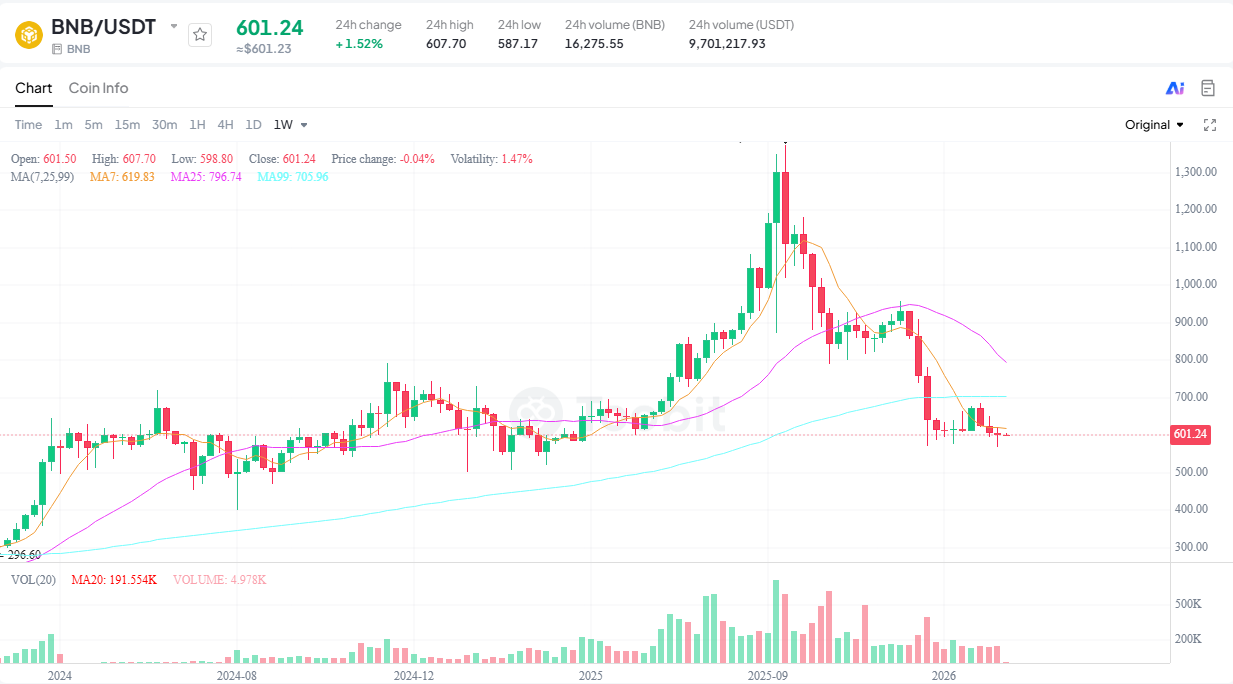
BNB’s long-term chart has traded through a full expansion-and-reset cycle. There was a move in 2025 that resulted in a new peak, but the months after that looked more like a deep correction than a clean continuation.
-
All-time high (ATH): around $1,391.95 (September 2025)
-
All-time low (ATL): around $296.60 (early 2024)
The main question now is whether the current rebound is the start of structure repair or just another short-term bounce inside a broader reset.
BNB price from Toobit, as of April 6, 2026, around 06:00 UTC
BNB’s latest performance
-
BNB price: around $601.24
-
24h high: around $607.70
-
24h low: around $587.17
-
24h volume: around 16,275.55 BNB (around $9.701 million in USDT)
At the time of writing, BNB is trading near the middle of its recent short-term rebound. That matters because price has pushed back above some lower timeframe averages, but it is still sitting below the heavier resistance zone that would need to break for the chart to look more constructive.
Current market snapshot (April 6, 2026)
BNB Fear and Greed Index from CFGI.io, as of April 6, 2026, around 06:08 UTC
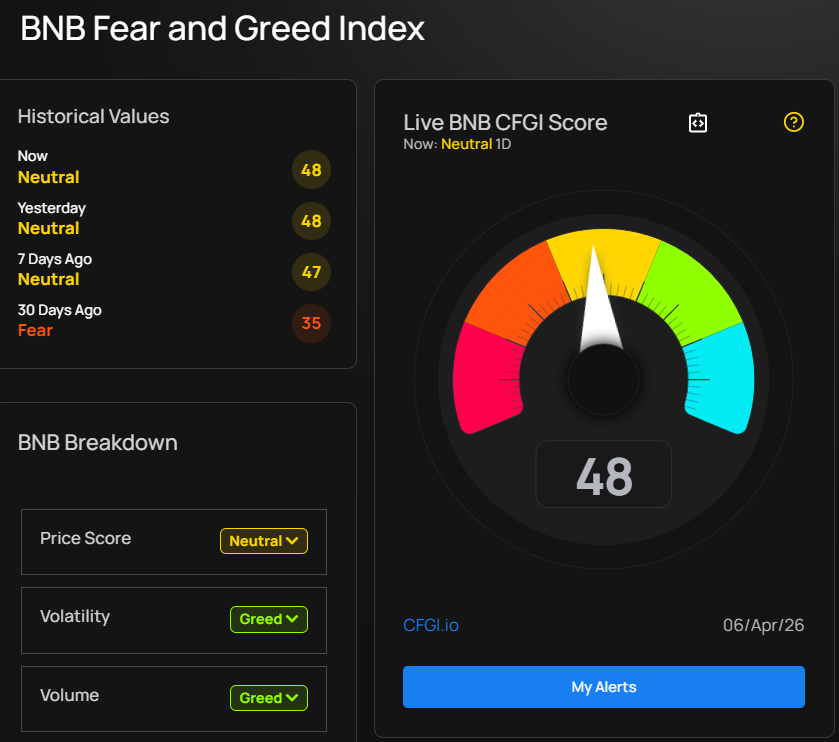
The BNB Fear and Greed Index score is 48 (Neutral), unchanged from yesterday (48). One week ago it was 47 (Neutral), while 30 days ago it sat at 35 (Fear).
In other words, sentiment has moved out of last month’s fear zone and back into neutral territory, but it is still not strong enough to confirm a full risk-on shift. That fits the current chart setup: BNB is stabilizing and rebounding locally, but it still needs a cleaner push through resistance before the move can look more durable.
The broader setup also explains that caution. Price has recovered from the recent dip and short-term momentum has improved, but BNB is still trading below the heavier resistance zone around $632.36, which keeps the market in repair mode rather than full breakout mode.
On-chain and technical analysis
Support and resistance
On the 4-hour chart, price is sitting around the short-term moving average (MA) cluster, with the 20-day MA near $591.90 and the 50-day MA near $601.18. That makes the immediate band around $591.90 to $601.18 the first area that needs to hold. Below that, the recent swing low near $570.31 remains the more important downside reference.
Near-term support sits at $591.90 to $601.18.
Near-term resistance remains $632.36, where the 200-day MA is sitting on the 4-hour chart.
Momentum indicators
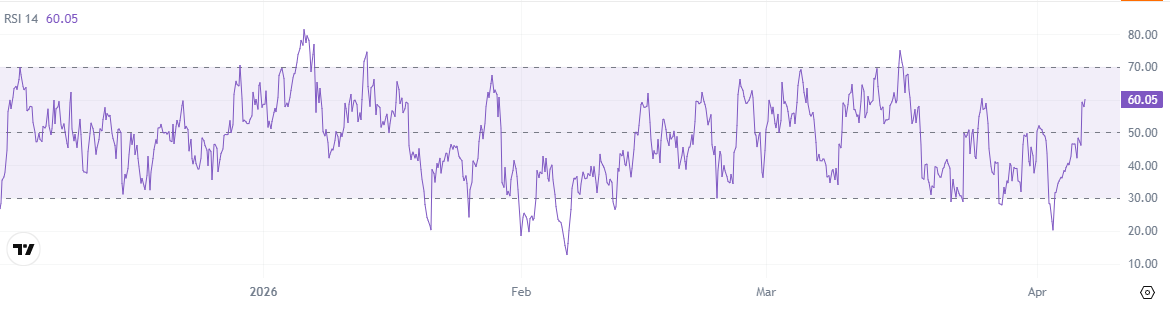
BNB’s 14-period Relative Strength Index (RSI) has recovered to around 60, which points to improving short-term momentum rather than an overextended move. However, BNB still looks more like a recovery than a full breakout.
BNB RSI from TradingView, as of April 6, 2026, around 06:00 UTC
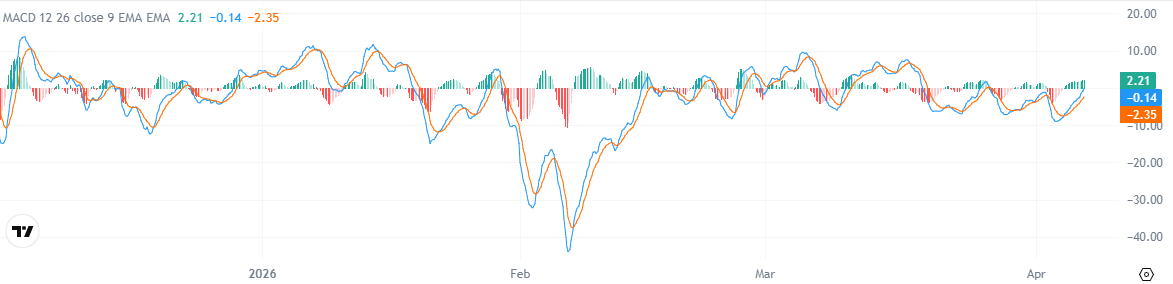
Moving Average Convergence Divergence (MACD) has also improved, with the indicator back above zero and the histogram positive. That suggests downside pressure has eased and short-term momentum is turning more constructive, even if the broader chart has not fully flipped yet.
BNB MACD from TradingView, as of April 6, 2026, around 06:00 UTC
Moving averages and volume
BNB is now trading above the 20-day MA and roughly around the 50-day MA on the 4-hour chart, but it still remains below the 200-day MA at $632.36. That distinction matters because the rebound has improved the short-term picture without fully repairing the higher-timeframe structure.
Volume also looks more consistent with stabilization than aggressive accumulation. The larger spikes seen during the earlier trend and breakdown phases have faded, and recent participation looks lighter by comparison.
In practical terms, this still looks more like a recovery attempt inside a broader reset than a confirmed upside continuation.
On-chain cues
Derivatives positioning still looks active, but not clearly one-way.
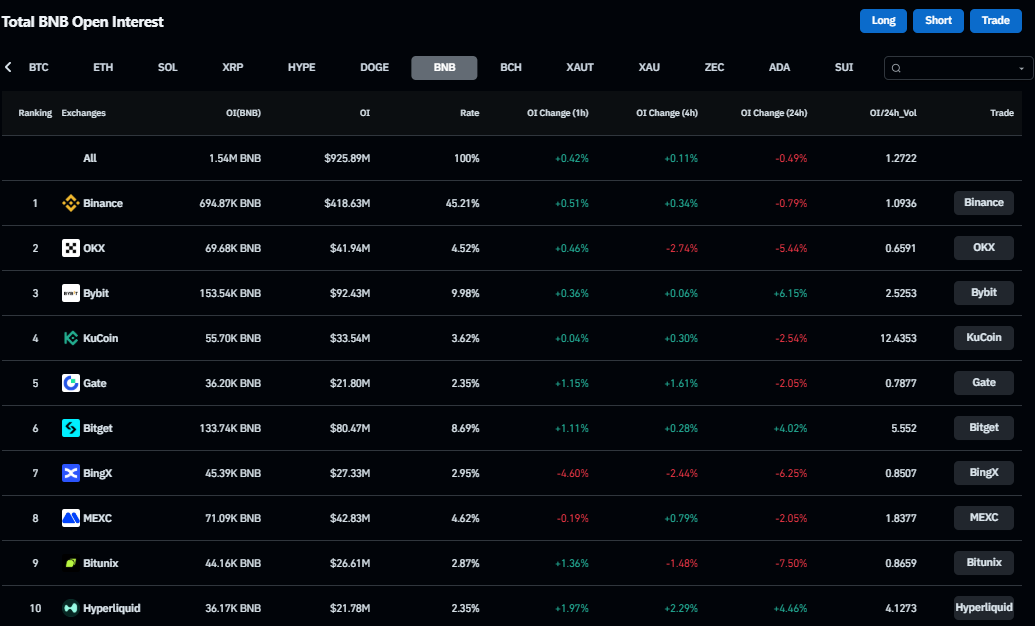
Total open interest (OI) is around 1.54 million BNB (around $925.89 million). Short-term changes are mixed, with OI up around 0.42% (1-hour), up around 0.11% (4-hour), and down around 0.49% (24-hour).
BNB OI from Coinglass, as of April 6, 2026, around 06:00 UTC
The OI-weighted funding rate (FR) looks close to neutral overall, with a slight positive tilt in the most recent prints. For BNB, that matters because price is bouncing from a local weak zone, but the market is not yet showing the kind of crowded long positioning that usually confirms a strong breakout.
BNB OI-weighted funding rate from Coinglass, as of April 6, 2026, around 06:00 UTC
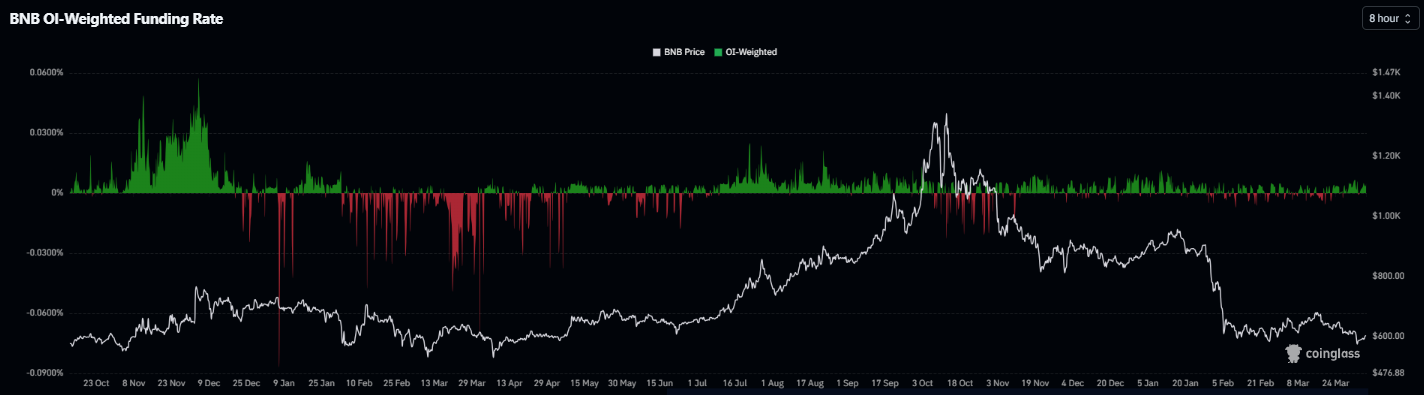
In this setup, a move toward $632.36 looks cleaner if OI starts building with price while FR stays controlled. If price rises but OI stays flat or fades, the rebound is more likely to remain a short-covering or low-conviction move than the start of a stronger extension.
What to watch next
-
BNB holds $591.90 to $601.18 and avoids slipping back below the short-term support band
-
BNB reclaims $632.36 and starts holding above it
-
OI begins building with price instead of drifting lower
-
FR stays controlled rather than spiking too positive during a rebound
BNB price prediction and outlook
Base case
-
BNB keeps trading in a recovery range while holding the $591.90 to $601.18 band.
-
Price stays capped below $632.36, which keeps the rebound constructive in the short term but still incomplete on the broader chart.
-
The setup remains stable as long as price stays firm above the recent rebound base, while OI remains stable and FR stays close to neutral.
Bull case
-
BNB reclaims $632.36 and starts holding it as support.
-
That would improve the short-term structure and open the door to a move back toward the next broader resistance zone near the high-$600s.
-
The move becomes more credible if price starts pressing back toward the $680 area, with OI rising and FR remaining controlled.
Bear case
-
BNB loses $591.90 to $601.18 and fails to reclaim it quickly.
-
That would weaken the current repair attempt and put the recent low near $570.31 back in focus.
-
If price revisits $570.31 with weak rebound behavior while OI fades or delivers
A controversial viewpoint
BNB may remain structurally important, but that does not guarantee strong momentum leadership in the near term. In that setup, ETF headlines, chain upgrades, and stablecoin-related usage can keep the narrative active while price still struggles to break cleanly into a stronger trend.
The more realistic risk is not a sharp breakdown. It is a broad repair range where rebounds keep attracting attention but still fail to turn into sustained upside unless on-chain activity stays firm after the catalyst window.
The key twist
-
The institutional access lane is tied to the ETF pipeline, which can reshape how BNB is framed and make it easier to access through traditional wrappers.
-
The upgrade lane is tied to BNB Chain’s scaling cycle, with BSC and opBNB positioned to support faster execution and higher throughput if usage remains consistent.
BNB Key milestones
-
July 1 to July 21, 2017: Completed the BNB ICO, priced at $0.15 and raising $15 million.
-
September 1, 2020: Launched BNB Smart Chain (BSC), establishing the EVM smart contract layer that became the center of BNB Chain application activity.
-
October 22, 2021: Introduced BEP-95 (real-time burn), linking a portion of gas fees to ongoing BNB supply reduction.
-
February 15, 2022: Rebranded to BNB Chain, structuring the ecosystem around BNB Beacon Chain and BNB Smart Chain.
-
September 13, 2023: Launched opBNB mainnet, positioning L2 scaling as the capacity lane beyond the base chain.
-
March 2025: Rolled out the Pascal hard fork, improving Ethereum compatibility and expanding smart account support.
-
April 29, 2025: Activated the Lorentz hard fork, reducing BSC block time from 3s to 1.5s.
-
June 30, 2025: Rolled out the Maxwell hard fork, reducing block time from 1.5s to 0.75s.
-
May 6, 2026: VanEck filed an S-1 with the SEC for a potential spot BNB ETF
-
January 2, 2026: BNB Chain was cited among the busiest networks of 2025 with 3.89B transactions (Nansen data).
-
January 7, 2026: Completed the opBNB Fourier upgrade, reducing block time from 500ms to 250ms.
-
January 14, 2026: Activated the Fermi hard fork, reducing BSC block time from 0.75s to 0.45s and tightening fast finality rules.
-
January 15, 2026: Completed the 34th BNB burn, removing 1,371,803.77 BNB (about $1.277B at the time).
-
January 23, 2026: Grayscale filed with the SEC for a spot BNB ETF intended to hold BNB directly and trade on Nasdaq under GBNB, pending approval.
-
February 2, 2026: BNB was added to the Grayscale CoinDesk Crypto 5 ETF (GDLC) as part of a rules-based quarterly rebalance.
Community sentiment and BNB news
BNB chatter has stayed active lately as the token’s 2026 narrative tightens around treasury accumulation, BNB Chain activity, and expanding payment and stablecoin-related use cases.
A community post discussing BNB from X

On social media, the tone is broadly constructive but still selective. BNB is often framed as one of the stronger large-cap exchange-linked assets because of its balance-sheet demand, ecosystem reach, and staying power.
Even so, the market still wants cleaner follow-through above resistance before treating that relative strength as a stronger trend shift.
Community sentiment from Coinmarketcap as of April 6, 2026, 06:00 UTC
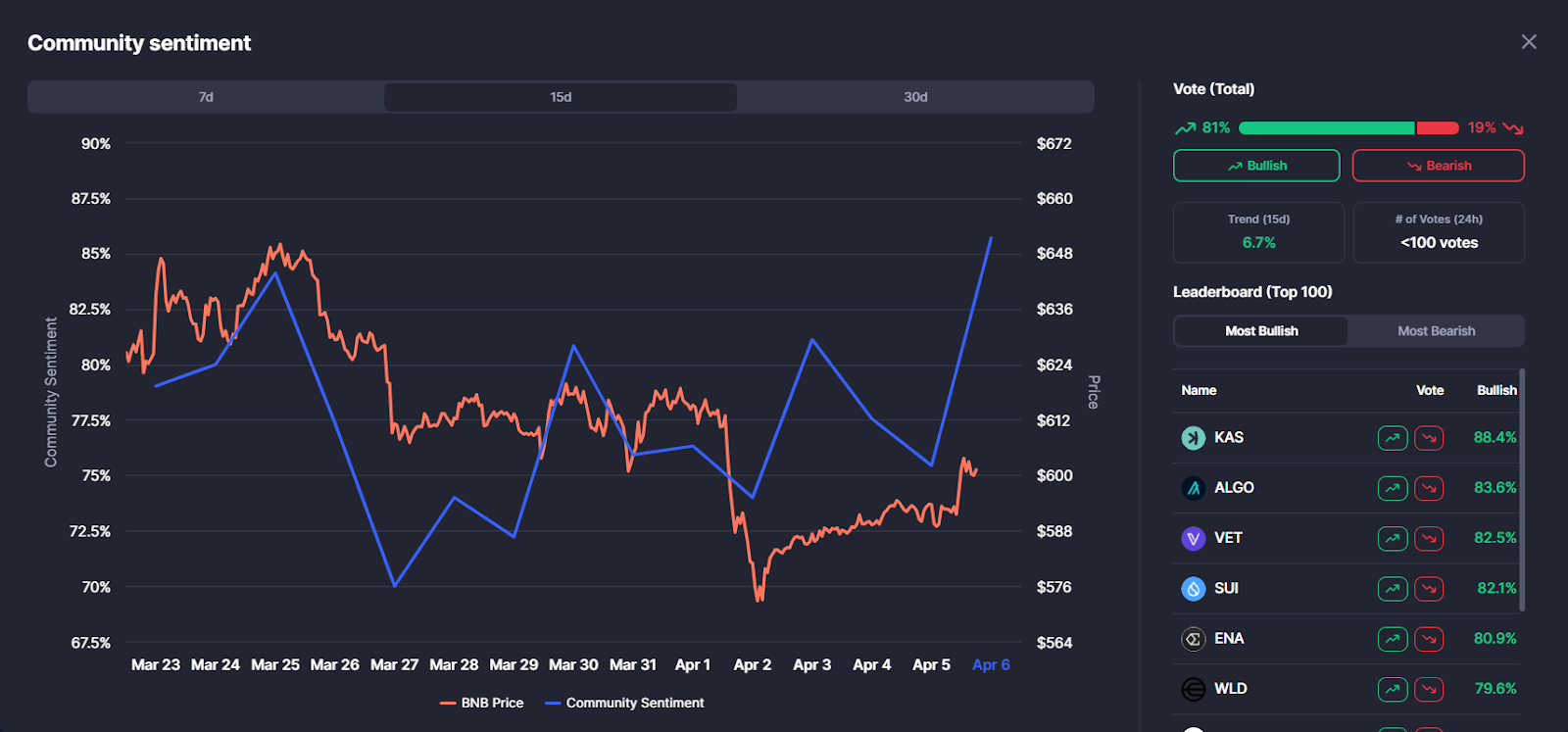
Community sentiment from CoinMarketCap, as of April 6, 2026, shows 81% bullish vs 19% bearish, with a 6.7% 15-day trend and <100 votes in the last 24 hours. That keeps the signal directionally supportive, but the vote count is still small and not strong enough on its own to confirm conviction.
The bottom line
BNB is entering 2026 with multiple catalysts in motion, led by the ETF pipeline, a steady burn-driven tokenomics framework, and a visible performance upgrade runway across BSC and opBNB. The key question is whether those catalysts translate into sustained on-chain usage and liquidity depth, not just short-lived attention around headlines.
If activity stays consistent after upgrades and incentive windows fade, BNB tends to benefit because its narrative strength is ultimately tied to network usage and the broader ecosystem’s ability to keep users and builders engaged.
This article is for informational purposes only and does not constitute financial advice. Always do your own research (DYOR) before making any decisions.
How to start trading BNB (BNB) on Toobit
BNB is one of the most watched large-cap assets, and it can react quickly when attention shifts toward major ecosystem upgrades or ETF-related headlines.
Ready to trade BNB? Toobit offers spot and futures trading with low fees, deep liquidity, and clean charting tools to help you plan entries and manage risk.
Start trading BNB/USDT today.


