
BitMart is shutting down its main global crypto trading platform. The process began on July 26, 2026, when the exchange began suspending new registrations, crypto and fiat deposits, new spot orders, and new futures positions. Existing futures accounts have entered reduce-only mode, while automated services are being phased out.
Official shutdown announcement from BitMart.
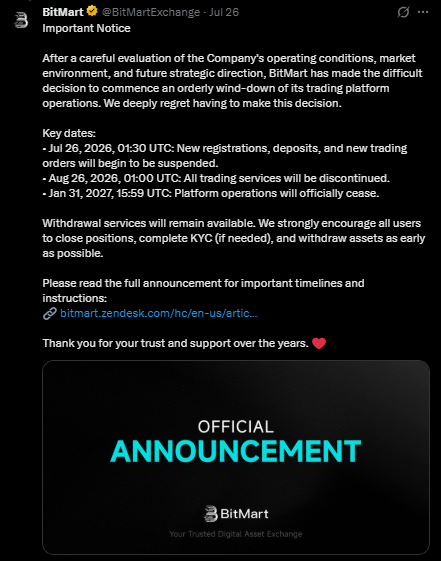
All spot, futures, and other trading services are scheduled to end on August 26, 2026, at 01:00 UTC. BitMart then plans to cease trading-platform operations on January 31, 2027, at 15:59 UTC. Withdrawals remain available under the current instructions, although additional compliance reviews and higher request volumes may extend processing times.
The confirmed timeline is clear. The reason for the shutdown is not. BitMart has referred broadly to its operating conditions, the market environment, and future strategic direction, without identifying insolvency, regulatory enforcement, China, declining revenue, or another single event as the cause.
That leaves 3 connected questions. What changed inside BitMart? Does its closure reveal a wider problem for crypto exchanges? And what should traders consider when evaluating a BitMart alternative? The evidence supports several possible contributing pressures, but it does not yet provide one definitive explanation.
BitMart shutdown at a glance
-
Current status: BitMart is conducting an orderly wind-down of its main global trading platform.
-
Trading ends: August 26, 2026, at 01:00 UTC.
-
Platform closes: January 31, 2027, at 15:59 UTC.
-
Withdrawals: Currently available, subject to asset, network, security, and compliance conditions.
-
Immediate user priority: Review balances, close remaining exposure, preserve account records, and follow official product-specific instructions.
-
Main unanswered question: BitMart has not disclosed the specific operating or strategic issue that triggered the decision.
Is BitMart really shutting down?
Yes. This is not a temporary maintenance period, a limited product closure, or another regional restriction. BitMart’s official cessation notice confirms that the exchange is ending its main trading-platform operations through a phased global wind-down.
Beginning July 26, the platform started suspending new registrations and all new crypto and fiat deposits. Spot markets stopped accepting new orders, while futures accounts were limited to reducing existing positions. Copy trading, grid trading, API trading, and other automated products are also being discontinued.
Existing open orders must be canceled by users or may be canceled automatically. Futures positions that remain open when trading ends may be settled using the relevant mark price, index price, or settlement rules in effect at that time. BitMart has said detailed settlement arrangements will be announced separately.
Earn, staking, lending, Launchpad, and related products are not all being handled through one universal deadline. They are being discontinued in phases, with affected users expected to receive dedicated announcements or in-platform notifications covering redemption and settlement.
One important distinction concerns BitMart U.S. BitMart’s global notice covers its main international platform, while BitMart U.S. is described in a separate notice as a different platform requiring a separate account and verification process. The global closure announcement does not establish that BitMart U.S. is closing under the same schedule.
BitMart shutdown timeline
|
Date and time |
BitMart change |
What users should know |
|
July 24, 2026 |
AMM Bot service suspended |
Assets and generated earnings in AMM liquidity pools were automatically returned to spot accounts. |
|
July 26, 2026, 01:30 UTC |
Phased suspension of registrations, deposits, new spot orders, and new futures positions began |
Users should no longer make new deposits. Futures accounts entered reduce-only mode, while automated trading services began closing. |
|
July 26, 2026, 02:00 UTC |
Spot margin forced-liquidation time |
Remaining margin positions could be liquidated, with outstanding loans repaid from the proceeds. |
|
August 26, 2026, 01:00 UTC |
All spot, futures, and other trading services end |
Open positions should be closed before this point. Remaining futures exposure may be settled by BitMart. |
|
August 26, 2026, 05:00 UTC |
Recommended withdrawal request cutoff |
This is BitMart’s recommended submission time, not a confirmed final withdrawal deadline. Later requests move to a dedicated procedure. |
|
January 31, 2027, 15:59 UTC |
Trading-platform operations cease |
BitMart says account access will continue for a specified period, but it has not defined the final post-closure access period. |
The timeline also reveals that some operational preparation preceded the main announcement. BitMart suspended its AMM Bot on July 24 and announced the discontinuation of spot margin on July 25. Around the same period, it published notices covering the delisting of dozens of assets.
Those actions do not establish when the final decision was made. They show, however, that the operational wind-down had started before users received the full closure announcement.
Why is BitMart shutting down?
BitMart’s official explanation is deliberately broad. The company said the decision followed an evaluation of its operating conditions, market environment, and future strategic direction. It has not published a more detailed breakdown of what those terms mean.
No official announcement reviewed for this article identifies:
-
A confirmed liquidity shortfall
-
A bankruptcy or insolvency process
-
A regulatory order requiring closure
-
A specific financial loss
-
An acquisition or merger
-
A direct connection to mainland China
-
A new security incident
The absence of those explanations does not prove that none played any role internally. It means they cannot be presented as established causes.
A decision above the Global CEO level
The strongest new clue comes from BitMart’s own leadership structure. Global CEO Nenter “Nathan” Chow said he was informed on July 24 that his employment was being terminated and that his offboarding would begin immediately. He also said he was not consulted about the wind-down and learned about it when the announcement became public.
Chow had been appointed Global CEO in April 2025 when founder Sheldon Xia moved into the role of Group President. BitMart’s leadership announcement described Chow as responsible for day-to-day leadership, while Xia would focus on long-term strategy and product development.
Because the Global CEO says he was removed before the announcement and excluded from the decision, the wind-down appears to have been authorized above his level. Public evidence does not identify who approved it or whether the process involved the founder, group management, shareholders, or another controlling body.
This governance gap is more significant than many of the speculative explanations circulating online. A global platform closure decided without the involvement of the executive publicly responsible for daily operations indicates an unusually centralized or compartmentalized decision process.
The contradiction with BitMart’s growth report
The timing also conflicts with BitMart’s recent public messaging. In its H1 2026 report, published less than 2 weeks before the closure announcement, the exchange described an expanding product and compliance footprint.
BitMart said:
-
Asset-management assets under management increased around 256% period over period.
-
The platform added 495 spot assets and 492 perpetual-futures pairs.
-
It listed 197 assets linked to traditional financial markets.
-
Card issuance and transaction volumes increased.
-
New products attracted users who had not previously traded on BitMart.
Chow said BitMart intended to remain active for another 8 years. Eleven days later, the exchange announced its exit.
These claims came from BitMart and were not a substitute for audited company-wide financial statements. Growth in one business line, such as asset-management AUM, does not demonstrate that the overall exchange was profitable, sufficiently capitalized, or strategically sustainable.
The contrast nevertheless requires explanation. Either the closure decision emerged suddenly at the group or ownership level, or the positive operating metrics did not capture the complete condition of the business. BitMart has not publicly resolved that contradiction.
What the public record cannot establish
BitMart is privately held, and users do not have access to a current audited balance sheet that compares liquid reserves with total customer and corporate liabilities. Public wallet labels are also incomplete and cannot independently determine solvency.
In May, BitMart said it was preparing proof of reserves and would publish it at an appropriate time. The company had previously disclosed several wallet addresses, while explaining that they represented only part of its holdings. A comprehensive, current reconciliation of customer liabilities and reserves was not located before the shutdown.
This creates a transparency gap. It does not support a conclusion that customer assets are missing, but it limits what outside observers can verify about BitMart’s financial position.
Did regulation and China contribute?
Regulation provides relevant background because a global centralized exchange must manage licensing, sanctions screening, anti-money laundering controls, identity verification, Travel Rule obligations, and different product restrictions across many jurisdictions. These requirements increase fixed costs and can make international expansion more difficult.
BitMart had been adjusting its regional coverage for years. Its July 23 notice for legacy U.S.-linked accounts required affected users to close positions and withdraw by August 8. The notice also clarified that BitMart U.S. operates separately from the international platform.
The proximity of that notice to the global closure is notable, but it does not prove that U.S. regulation caused the wider decision. BitMart has not announced an enforcement action or regulator-imposed closure connected to the wind-down.
The mainland China theory
China’s crypto restrictions are frequently used to explain BitMart’s shutdown. The available timeline does not support presenting China as the confirmed cause.
BitMart stopped accepting new registrations and identity-verification applications from mainland China in September 2021. It then ended trading, withdrawals, login access, lending, staking, and other services for mainland users in November 2021, according to its mainland China exclusion notice.
Those restrictions followed China’s decision to treat services provided by offshore crypto exchanges to mainland residents as illegal financial activity. That regulatory history could have affected BitMart’s long-term market strategy and operating costs.
It does not demonstrate that mainland China remained BitMart’s largest market in 2026. No credible, current geographic user data reviewed for this article establishes that claim, and BitMart’s shutdown announcement does not mention China.
The most accurate interpretation is limited: China formed part of BitMart’s historical regulatory environment, but the company had officially stopped serving mainland users almost 5 years before the global closure. A direct causal connection has not been confirmed.
Competition, market share, and operating pressure
A centralized exchange can report substantial trading volume and still face an unattractive business outlook. Volume does not show net revenue, customer-acquisition costs, market-making expenses, technology spending, insurance or custody expenses, regulatory costs, or the profitability of individual products.
BitMart was competing in several demanding markets at once:
-
Spot trading dominated by larger exchanges with deeper order books
-
Futures markets where liquidity and risk controls determine retention
-
On-chain perpetual platforms with lower barriers and self-custodial access
-
Fiat services requiring regional banking and payment relationships
-
Earn and lending products carrying operational and compliance costs
-
Token-listing markets where users increasingly evaluate liquidity quality
Scale creates a reinforcing advantage. More users attract more liquidity, deeper liquidity improves execution, and better execution attracts institutions and market makers. Smaller and mid-sized exchanges must spend continuously to keep pace without receiving the same network effects.
The timing of BitMart’s exit also places it inside a wider exchange shakeout. BitMEX announced its own closure during the same week after a strategic review. Reuters cited Kaiko data indicating that BitMEX had fallen below 0.01% market share, illustrating how an established brand can lose commercial relevance as activity moves elsewhere.
AscendEX also ceased operations earlier in July after citing regulatory, financial, operational, and liquidity challenges. Its disclosed circumstances were different from BitMart’s, so the 2 exchanges should not be treated as identical cases.
The common signal is competitive concentration. Crypto trading remains active, but activity can migrate toward a smaller number of larger centralized platforms and specialized decentralized venues. An exchange may therefore become commercially unsustainable even while the underlying market continues operating.
Security costs and the 2021 breach
BitMart lost an estimated $196 million in a December 2021 hot-wallet breach. The exchange said it would compensate affected users and continued operating for several years afterward.
That incident remains relevant when evaluating BitMart’s security history and the long-term cost of maintaining trust. A major breach can increase spending on custody controls, monitoring, audits, insurance, and customer support.
There is no evidence connecting the 2021 breach directly to the 2026 shutdown. It should be treated as part of the exchange’s history, not as the confirmed trigger.
What happened to the BMX token?
BMX carries more direct exposure to BitMart’s business than Bitcoin or Ethereum. Its utility has historically been linked to platform functions such as trading benefits, participation programs, and the broader BitMart ecosystem.
The market reacted accordingly. BMX fell approximately 58% during the first 24 hours following the announcement, extending a decline that had already begun before the closure became public.
At approximately 00:00 UTC on July 28, BMX traded around $0.0566, with a market capitalization of approximately $19.2 million and 24-hour volume near $4.36 million. It was down approximately 81.8% over 7 days, according to the contemporaneous CoinGecko market snapshot.
The loss cannot be interpreted through price alone. Three structural issues now affect BMX:
-
Utility: Closing BitMart removes or weakens functions tied to the platform.
-
Liquidity: Much of BMX trading has historically been concentrated on BitMart.
-
Execution: A displayed market price does not guarantee that large holders can sell at that price when order-book depth is limited.
BMX may remain transferable and may continue trading on external venues that support it. However, external availability does not replace its primary platform-linked use case, and BitMart has not announced a redemption, buyback, token migration, or replacement utility plan.
The token’s decline therefore reflects company-specific exposure. It does not provide a direct measure of Bitcoin, Ethereum, or the entire crypto market.
Does the BitMart shutdown mean crypto is dead?
No single exchange closure establishes that crypto is dead. BitMart is a business that provides custody, trading, product distribution, and account services. Bitcoin and Ethereum are independent networks whose operation does not depend on BitMart remaining open.
Crypto exchanges can close in an active market for the same reason that brokers, banks, payment companies, and technology platforms can exit functioning industries. Revenue may weaken, market share may concentrate, operating costs may rise, or owners may decide that future returns no longer justify continued investment.
The shutdown still provides legitimate warning signals.
First, centralized-exchange competition is becoming less forgiving. Platforms need sufficient scale to maintain liquid markets, meet compliance obligations, secure infrastructure, and support many products across multiple jurisdictions.
Second, reported trading activity does not equal financial strength. BitMart was still displaying considerable volume around the announcement, but public volume data cannot reveal whether the underlying operation was profitable.
Third, exchange-issued tokens carry concentrated risk. Unlike BTC, whose network is not controlled by one exchange, BMX depends heavily on the commercial relevance of BitMart.
Fourth, custody creates exposure to company decisions. Users holding assets on an exchange depend on its operational processes, risk controls, compliance reviews, and withdrawal systems.
The wider conclusion is consolidation rather than industry disappearance. Larger exchanges may gain share, decentralized venues may capture specialized activity, and weaker or strategically misaligned platforms may leave the market.
What BitMart users should do now
Users do not need to determine the exact cause of the shutdown before reviewing their exposure. The relevant question is what remains inside the account and which official deadline or product notice applies to it.
The immediate priorities are:
-
Confirm balances across spot, futures, funding, Earn, staking, lending, and subaccounts.
-
Close open trading positions and cancel remaining orders.
-
Review product-specific redemption or settlement instructions.
-
Complete or update identity verification where required.
-
Download transaction, deposit, withdrawal, and trading records.
-
Check withdrawal availability for each asset and blockchain network.
BitMart recommends closing positions before August 26 at 01:00 UTC and submitting withdrawal requests before 05:00 UTC on the same date. The later time is a recommended cutoff, not an absolute final withdrawal deadline.
Requests submitted afterward may be transferred to a dedicated process requiring additional documentation. Users should avoid waiting unnecessarily, while also avoiding rushed transfers that increase the risk of incorrect addresses or networks.
How to withdraw and move assets safely
A careful migration sequence reduces avoidable operational errors.
-
Confirm the official announcement
Access BitMart through its official website or mobile application. Do not use links sent through private messages, unofficial groups, or search advertisements that imitate the exchange. -
Secure and verify the account
Review the registered email, password, two-factor authentication, identity-verification status, and withdrawal security settings. BitMart may request additional identity, address-ownership, or source-of-funds documentation. -
Review every balance and product
Check spot accounts, futures collateral, subaccounts, Earn, staking, lending, Launchpad balances, and any assets returned from automated products. Do not assume everything has automatically moved into the main account. -
Close orders and obligations
Cancel open orders, close remaining futures exposure, and confirm that any margin borrowing or interest has been repaid. Spot margin positions were subject to BitMart’s separate discontinuation procedure. -
Preserve account records
Export transaction history, deposits, withdrawals, trades, balances, and available tax records. Store copies outside the platform because the length of post-closure account access remains undefined. -
Choose the destination carefully
Confirm that the receiving exchange or wallet supports both the asset and the exact blockchain network. An exchange supporting USDT, for example, may not support every network used to transfer USDT. -
Check the memo or destination tag
Assets such as XRP, XLM, or other network-specific tokens may require a memo or destination tag. A correct wallet address without the required tag may still create a recovery problem. -
Send a small test transfer
Transfer a small amount first, verify that it arrives, and confirm that the destination credits it correctly. Only then consider sending the remaining balance through the same verified route. -
Retain transaction evidence
Save transaction hashes, withdrawal confirmations, support tickets, and relevant screenshots. These records may be necessary if a withdrawal enters manual review.
How to choose a BitMart alternative
A BitMart alternative should be selected by matching the user’s jurisdiction, assets, products, and custody preferences. A platform with more listed tokens may still be unsuitable if it lacks the required withdrawal network or reliable liquidity for the intended market.
|
Evaluation factor |
What to check |
Why it matters |
|
Availability |
Whether registration and services are permitted in the user’s location |
A platform may operate globally while restricting specific countries or products. |
|
Regulation and restrictions |
Contracting entity, licenses, restricted jurisdictions, and product limitations |
Legal access and consumer protections vary by location. |
|
Supported assets |
The exact assets and trading pairs required |
Listing a token does not guarantee useful liquidity. |
|
Liquidity |
Order-book depth, spreads, and executable volume |
Better liquidity can reduce slippage and failed execution. |
|
Fees |
Trading, withdrawal, network, conversion, and product fees |
Headline trading fees do not show the complete transfer cost. |
|
Deposit and withdrawal networks |
Supported blockchains, minimums, and current network status |
Asset and network compatibility is essential for safe transfers. |
|
Security controls |
Two-factor authentication, withdrawal controls, custody structure, and reserve disclosures |
These features affect account and custody risk. |
|
Product support |
Spot, futures, copy trading, API access, or other required functions |
Product availability may depend on jurisdiction and verification. |
|
Customer service |
Official support channels and escalation procedures |
Account reviews and technical problems may require documented assistance. |
Proof of reserves can help users verify whether certain balances were included in a platform’s reported reserve process. It should not be treated as complete proof of solvency unless the report also addresses liabilities, asset ownership, encumbrances, methodology, and independent verification.
Best exchange options after BitMart
There is no universally best exchange after BitMart. Users generally have 4 destination categories to evaluate.
-
Locally regulated exchanges: May provide clearer domestic access, local currency services, and jurisdiction-specific compliance. They may support fewer assets or products.
-
Large global exchanges: Often provide deeper liquidity and broader trading infrastructure, but geographic restrictions and verification requirements can be extensive.
-
Specialized trading platforms: May focus on futures, copy trading, automated tools, or particular asset categories. Product concentration can create additional risk.
-
Self-custody and decentralized access: Can reduce long-term dependence on a centralized custodian, but requires users to manage private keys, network fees, smart-contract exposure, and transaction accuracy.
The correct choice depends on whether the user needs active trading, fiat access, specialized tokens, derivatives, or only long-term storage. Maintaining assets on a trading platform without an active need also creates continued custody exposure.
When Toobit may be an alternative to BitMart
Users comparing BitMart alternatives may evaluate Toobit as one possible centralized platform, particularly if they require spot markets, perpetual futures, copy trading, or other active-trading tools. Eligibility and product availability must be checked before registration or transfer.
Toobit’s current published information shows:
-
Spot and futures markets are available to eligible users.
-
Copy trading and related trading tools are offered.
-
The platform applies jurisdictional restrictions.
-
Verification status affects fiat access and withdrawal limits.
-
Deposit and withdrawal support varies by asset and network.
-
Withdrawal fees are dynamic and displayed through the relevant interface.
-
Security settings include two-factor authentication and configurable withdrawal controls.
-
Toobit publishes a proof-of-reserves page with Merkle-tree verification tools.
Under Toobit’s current fee schedule, regular spot trading is listed as commission-free, while Assessment Zone markets use a separate fee structure. Base-level futures fees are published at 0.0200% for makers and 0.0600% for takers, although current account-level rates should always be checked directly.
Its published verification information states that users without advanced verification may access a 5 BTC-equivalent 24-hour withdrawal limit, while advanced verification can raise that limit to 50 BTC. Risk controls and individual reviews may still affect processing.
Availability should never be assumed. Toobit previously discontinued services for U.S. users, while its current terms also identify multiple restricted jurisdictions. Readers should review the latest terms applicable to their location rather than relying on a general description of global availability.
Before transferring, users should confirm:
-
The account is legally available in their jurisdiction.
-
The required asset and blockchain network are supported.
-
Current KYC and withdrawal limits meet their needs.
-
Spot or futures liquidity is adequate.
-
Current fees and minimum withdrawal amounts are acceptable.
-
The latest reserve report and security tools have been reviewed.
A natural first step is to compare Toobit with other available platforms using the same criteria. A small test transfer should precede any larger movement of assets.
When self-custody may be more appropriate
Users who do not need active trading may decide that moving long-term holdings directly from one centralized exchange to another does not address their primary concern. A self-custodial wallet removes continuous dependence on an exchange’s withdrawal policies and business decisions.
Self-custody transfers responsibility to the user. Lost recovery phrases, compromised devices, malicious wallet software, incorrect networks, and signing unsafe transactions can lead to irreversible losses.
It is most relevant for users who understand wallet security, can protect backups, and do not need to keep the assets available for immediate trading. Hardware wallets may provide an additional security layer for longer-term storage, but the device and recovery process must still be handled correctly.
Risks during the BitMart migration period
Exchange closures create an environment where urgency can be exploited. Fake support agents, counterfeit websites, and fraudulent migration programs may appear credible because users expect special withdrawal procedures.
The main risks include:
-
Phishing: Fake BitMart pages may attempt to capture login or authentication information.
-
Impersonation: Scammers may claim to offer priority withdrawal, account unlocking, or migration assistance.
-
Address poisoning: A deceptive address may be inserted into transaction history to resemble a legitimate destination.
-
Wrong networks: Sending an asset through an unsupported chain can make recovery difficult or impossible.
-
Missing memos: Some exchange deposits require both an address and a destination tag.
-
Low-liquidity conversion: Converting a thinly traded asset under pressure may create substantial slippage.
-
Deadline congestion: Higher request volume and manual reviews may lengthen processing.
BitMart says it will not request an expedited-processing fee, account-unfreezing fee, or security deposit through Telegram, WhatsApp, WeChat, or private social accounts. Legitimate support should never request a password, private key, recovery phrase, or authentication code.
What to monitor before BitMart fully closes
The wind-down is still developing. Several important details may change through later announcements.
Readers should monitor:
-
Product-specific instructions for Earn, staking, lending, and Launchpad
-
Settlement rules for futures positions still open on August 26
-
Withdrawal availability for individual assets and networks
-
Any change to the recommended withdrawal timetable
-
The duration of account access after January 31, 2027
-
The status of BitMart U.S. and other separate entities
-
Any management statement explaining who authorized the closure
-
Any financial, regulatory, liquidation, or court filing
-
Any proof-of-reserves publication
-
Any BMX redemption, migration, or utility plan
The largest unresolved issue remains the decision itself. BitMart has described how it will close, but it has not fully explained why a platform that was publicly describing growth and expansion in mid-July changed direction days later.
Final read
BitMart is shutting down its main global trading platform, with trading scheduled to end on August 26 and platform operations scheduled to cease on January 31, 2027. The operational timeline is confirmed, but the underlying cause remains only partly explained.
BitMart’s broad reference to operating conditions, the market environment, and strategy does not establish insolvency, regulatory enforcement, or China as the cause. The more revealing evidence is the sudden leadership change, the Global CEO’s exclusion from the decision, and the contradiction between the shutdown and BitMart’s expansion-focused H1 report.
The closure does not show that crypto is dead. It shows how scale, liquidity, compliance, security, and sustainable revenue increasingly determine which centralized exchanges remain competitive.
Users comparing a BitMart alternative should evaluate legal availability, liquidity, network support, custody controls, fees, and withdrawal procedures. Toobit can be considered as one option where available, but it should be assessed through the same standards as every other platform. Official links, current product terms, and a verified small test transfer remain essential.
This article is for informational and educational purposes only. It does not constitute legal, financial, investment, or trading advice, or a recommendation to use any specific platform. Cryptocurrency services involve substantial market, custody, operational, and regulatory risk. Always verify all deadlines, supported networks, fees, and withdrawal procedures through official platform channels before taking action.


