
Toobit TradFi brings global markets into the same environment where crypto already lives. If you have ever spotted an opportunity outside crypto while managing a portfolio, you already know the friction that comes with switching between multiple platforms and funding methods.
For years, traders kept traditional finance and crypto in separate mental buckets. Stocks lived in one account, forex in another, and crypto on a separate exchange entirely. That structure worked when markets moved independently. It breaks down when macro forces start driving multiple asset classes at the same time.
As correlations increase across global markets, execution speed and capital mobility matter more. The gap is no longer about access to markets, but about how quickly capital can move between them.
This is the context TradFi on Toobit is built for: a trading environment where global markets sit inside the same ecosystem as crypto, so decisions and execution are not split across platforms.
What Toobit TradFi is and what you can trade
Toobit TradFi is a trading environment that gives you access to global markets through a single account. Inside the TradFi section, you can trade stocks, forex, indices, commodities, and precious metals without leaving the platform.
The key change is not the number of markets available, but how they are structured. Instead of treating traditional markets as external destinations, they become part of the same trading flow as crypto.
This makes it easier to compare how different asset classes respond to the same macro conditions. A shift in interest rate expectations, currency strength, or risk sentiment can play out differently across instruments, and seeing them side by side helps make those relationships clearer.
It turns markets into a connected system rather than separate watchlists.
How settlement in USDT changes the workflow
At the center of Toobit TradFi is a simple design choice. Positions are settled in USDT. That changes how capital flows through your trading process.
Rather than constantly converting between fiat currencies and crypto, USDT acts as a unified settlement layer. This reduces operational delay and keeps your focus on positioning rather than transfers. It also makes it easier to track performance across multiple markets in a single unit of account.
USDT is already one of the core liquidity layers in crypto markets.
It is not just a convenience unit. USDT has become one of the largest settlement rails in crypto. As of June 22, 2026, data from CoinMarketCap shows a market cap of about $186.2 billion on roughly 186.4 billion circulating USDT, with around $50 billion traded in the last 24 hours and a price near $0.9988.
This scale reflects how deeply USDT is embedded in daily market liquidity and operational capital flows across trading venues.
Zooming out, stablecoins represent a significant share of the crypto cash layer. Global metrics show stablecoins at roughly $286.8 billion in total market cap with about $59.7 billion in daily volume. This is the environment that makes USDT-settled trading feel natural.
There is also a broader convergence trend forming at the edges of TradFi and crypto. Category data shows tokenized stocks and tokenized assets still relatively small compared to the wider market, but large enough to function as early bridge instruments between traditional exposure and crypto-native trading behavior.
How to start trading TradFi on Toobit in minutes
Getting started is straightforward. Open the TradFi section, browse the available markets, and select an instrument that matches your objective, whether that is diversification, hedging, or a directional trade.
The platform is designed around the idea of one account and global access, so you are not required to move through a separate onboarding process just to explore new markets.
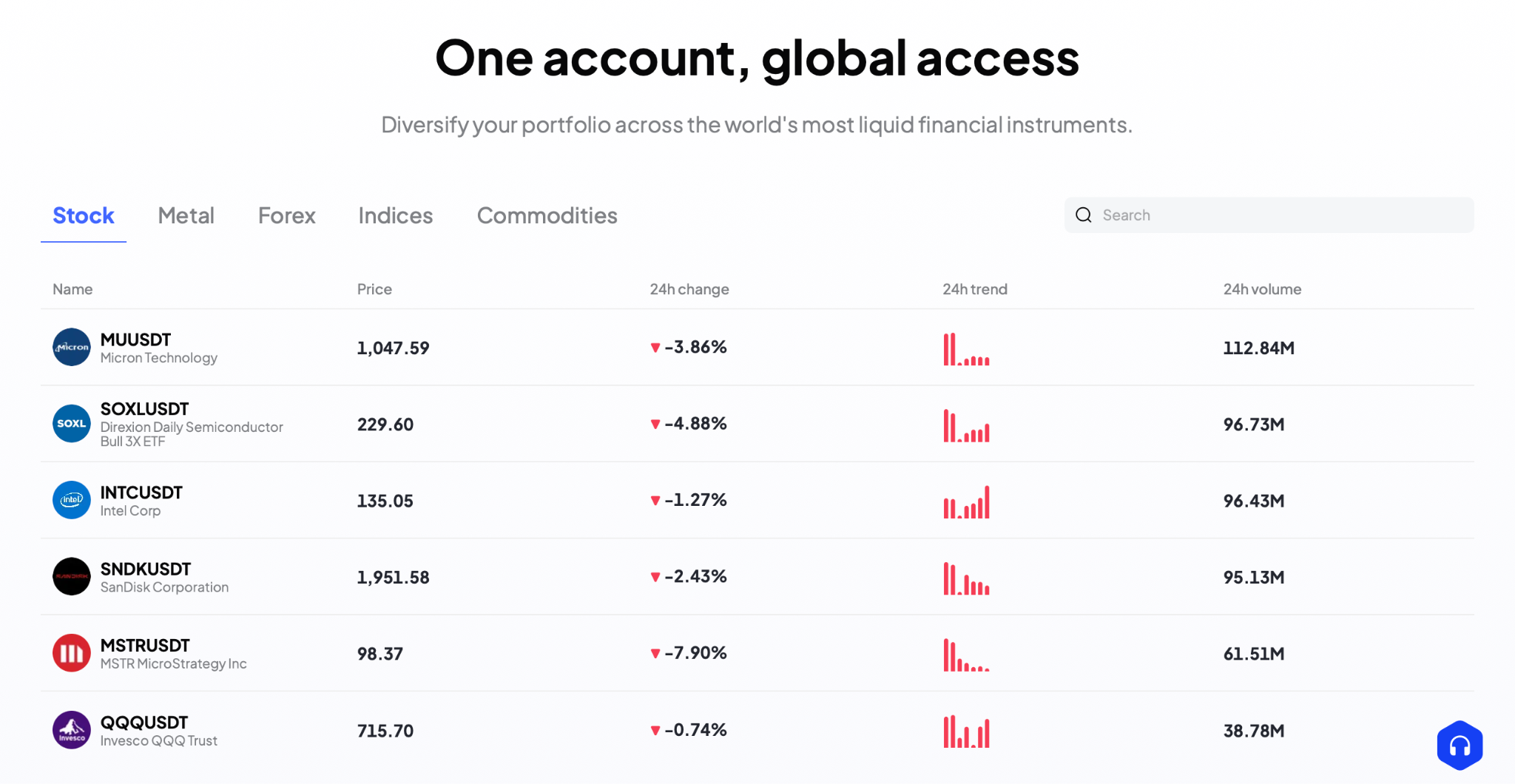
As a practical routine, first decide what you want to achieve and then choose the category that best expresses that view. A trader expecting inflation concerns may look at commodities and precious metals. Someone with a view on economic growth may prefer indices or stocks.
If you are new to these markets, it often helps to begin with observation before execution. Spend time watching how a forex pair reacts to economic data or how an index behaves during periods of uncertainty. Building familiarity with market behavior usually leads to better decisions than rushing into a position simply because the instrument is available.
Key features that shape how you trade
Toobit TradFi highlights several features that can change the way you think about execution and market access.
First, it offers flexible two-way trading. This means you can structure positions around both bullish and bearish scenarios rather than relying on only one direction.
Second, it provides 24/7 access with low funding rates and no hidden fees. Cost matters because expected returns are shaped not only by market direction but also by the efficiency of execution.
Third, it allows users to deposit, trade, and withdraw instantly with USDT. For traders who actively rotate capital between strategies, reducing operational delays can become a meaningful advantage.
Finally, the platform offers leverage of up to 500x. This can significantly increase capital efficiency, but it also reduces the margin for error. At higher leverage, risk is no longer only about predicting direction correctly. Timing, volatility, and execution precision become equally important.
The combination of multiple asset classes and flexible execution also creates more ways to express a market view. Instead of relying on a single crypto position, traders can spread ideas across instruments that may respond differently to the same macro event. The goal is not to trade everything at once, but to have more tools available when market conditions change.
A simple risk checklist for TradFi trading with leverage
Leverage changes the structure of risk before it changes outcomes.
Before entering any position, define the maximum loss you are willing to accept and determine how that loss will be triggered. That could be a stop level, a volatility threshold, or a time-based exit.
Next, make sure you understand two-way trading mechanics so that your intended exposure matches your actual position.
Then, stress test your idea. Ask what happens if spreads widen, correlations break down, or price gaps following an unexpected event.
Finally, remember that settlement in USDT does not remove portfolio risk. It simplifies execution and accounting, but position sizing, leverage, and concentration still determine the overall risk profile.
It also helps to separate conviction from position size. A strong thesis does not automatically justify larger leverage. The best risk management routines assume that even well-researched ideas can be wrong and are built around preserving capital so that the next opportunity can still be taken.
Where to explore Toobit TradFi next
If you want to build a cross-market watchlist and explore global opportunities in one place, the next step is simple: open Toobit TradFi and browse the Stock, Metal, Forex, Indices, and Commodities sections.
Spend some time comparing how different markets react to the same headlines and narratives. Notice where movements align and where they diverge. Over time, this process can help build a more connected understanding of how capital flows across asset classes.
The practical advantage is not only convenience. It is the ability to think about markets as an interconnected system rather than a collection of isolated products.
When access, settlement, and execution come together in one environment, TradFi stops feeling like a separate world and becomes another set of tools that you can use deliberately within your broader trading strategy.


