
In 2026, understanding traditional finance (TradFi) is not optional anymore. It is the reference point.
Every exchange-traded fund (ETF) approval, stablecoin reserve, or tokenized treasury ultimately traces back to the same place: banks, clearinghouses, and legal contracts that existed long before blockchains were a whitepaper experiment.
In short, it is used to describe the centralized financial system that has run the global economy for centuries. Crypto loves to mock it as outdated, yet most of the world’s payments, credit, and savings still move through these rails.
So let us unpack the system crypto claims to disrupt but increasingly integrates with.
What is TradFi?
TradFi refers to the conventional financial system: banks, stock exchanges, payment networks, insurance firms, asset managers, and regulators that facilitate the movement of money. Its defining feature is centralization.
Think:
-
Commercial banks (deposits, loans)
-
Investment banks (capital markets)
-
Stock exchanges (equities trading)
-
Central banks (monetary policy)
-
Payment rails like SWIFT and card networks
Instead of code enforcing rules, TradFi runs on law, contracts, and institutional trust.
In practice, the system runs on government oversight and regulatory safeguards that billions of people rely on every day.
How does TradFi work?
TradFi runs on institutional trust. You do not know the person on the other side of a transaction, so you trust the bank to stand in the middle.
These institutions manage risk by supervising markets, offering insurance protections, and enforcing Know Your Customer (KYC) and Anti-Money Laundering (AML) rules.
Under the hood, the system still relies on legacy infrastructure. An international transfer does not move instantly, it hops between intermediary banks, often through the SWIFT network. The process can take days and add fees along the way.
When you send money internationally in TradFi, you are not actually sending money. You are updating ledgers across institutions that trust each other, slowly.
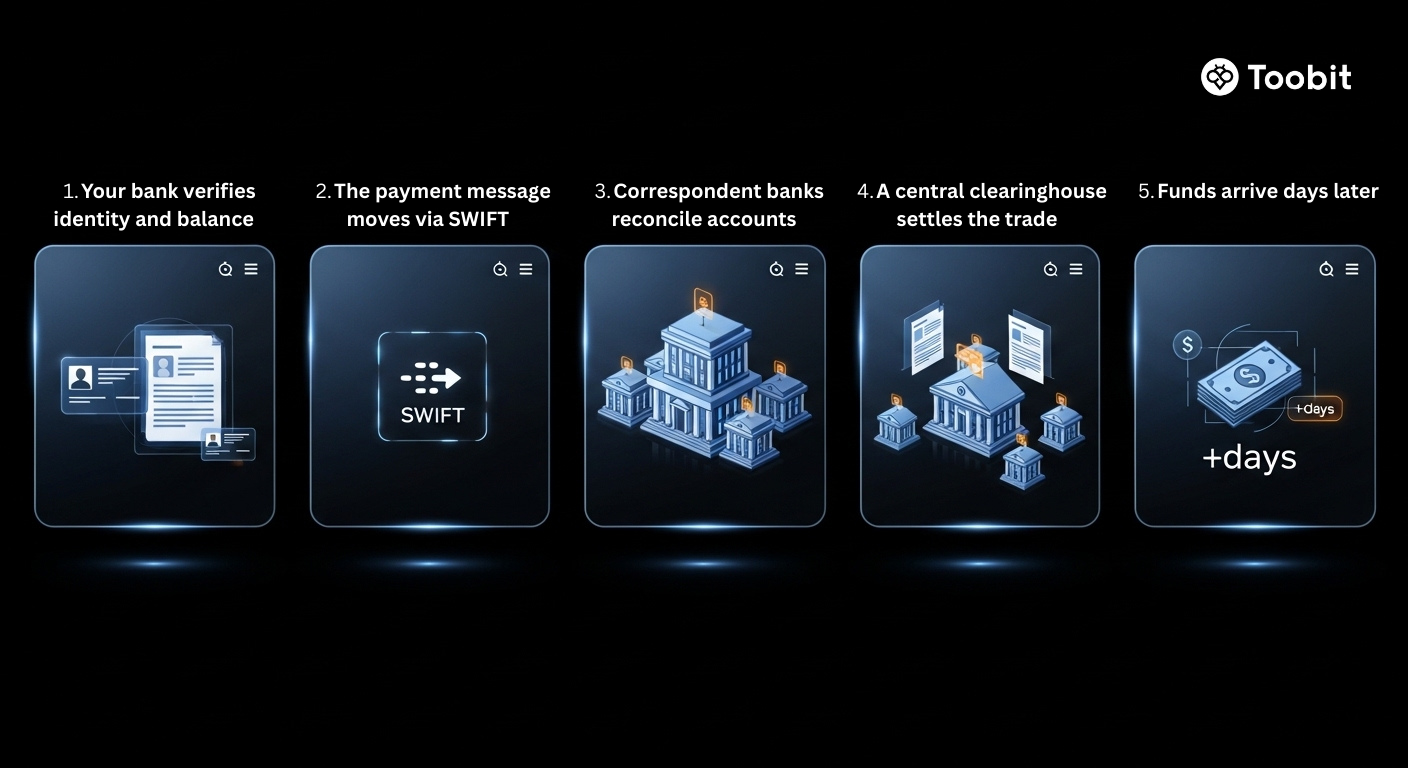
A simplified version of a bank transfer.
Source: Toobit
Settlement delays exist because ownership must legally change hands, not just digitally update.
TradFi prioritizes finality over speed. Crypto flipped that priority.
Even in 2026, many transactions marketed as “instant” still settle on T+1 or T+2 timelines (one or two business days after the trade).
Who founded TradFi?
There is no single “Satoshi” behind TradFi. It evolved over centuries through merchants, clergy, and states trying to keep money moving without chaos.
Key milestones:
-
Lending dates back to around 2000 BCE in Mesopotamia, where temples issued grain loans to farmers and tracked repayment on clay tablets.
-
In 15th-century Florence, the Medici family helped shape modern banking by spreading double-entry bookkeeping: the accounting system businesses still use today.
-
1602: Amsterdam Stock Exchange launches (often cited as first formal exchange)
-
The Bank of Amsterdam (1609) and Sweden’s Sveriges Riksbank (1668) introduced currency stability and reserve practices that later influenced institutions like the Bank of England.
-
1913: Federal Reserve System created
-
1973: SWIFT network formed for global payments
TradFi is basically centuries of trial-and-error risk management. Crypto is the attempt to compress that learning curve into 15 years.
Advantages of TradFi
For all the jokes about it being outdated, TradFi has stuck around because it works at scale. Its strengths support most of global commerce.
Regulatory protection
If your bank account is hacked, there are laws and insurance schemes, such as Federal Deposit Insurance Corporation (FDIC) coverage in the U.S., that can help recover funds. In crypto, losing your private key usually means losing access permanently.
Deep liquidity
According to World Bank Data, global equity market capitalization surpassed $110 trillion in 2024.
Stability
Traditional currencies like the U.S. dollar and euro are backed by governments and central banks. They do not move 10% in an hour. That predictability matters for payroll, trade, and savings.
Wide acceptance
Payment networks like Visa and Mastercard are accepted almost everywhere. According to the World Bank’s Global Findex report, roughly three-quarters of adults worldwide now have access to a financial account or mobile money service.
TradFi is slow by design, and that slowness is often the safety feature.
Limitations of TradFi
That said, the system is not perfect.
Cost and settlement delays
Wire transfers, overdraft fees, and currency conversion charges add up. Many core banking systems are still not built for real-time settlement.
Gatekeeping
Opening a brokerage account still requires jurisdictional approval.
Barriers to entry
Access to certain financial products depends on credit history, income, or net worth. If you do not meet the criteria, the door stays closed.
Limited accessibility
Over a billion adults globally still lack access to formal banking, often due to missing identification, geography, or cost barriers.
TradFi optimizes for compliance first, inclusion second. Crypto reversed that priority and created new risks instead.
What are the differences between TradFi, CeFi, and DeFi?
|
Feature |
Traditional Finance (TradFi) |
Centralized Finance (CeFi) |
Decentralized Finance (DeFi) |
|
Control |
Centralized/ Legal institutions (Banks/Government) |
Centralized/ Company custody (Exchanges like Toobit) |
Decentralized/Code (Smart contracts) |
|
Custody |
Bank holds assets (Fiat like USD, EUR) |
Exchange holds assets |
User holds keys |
|
Settlement |
Slow (Days) |
Fast (Off-chain) |
Instant (Blockchain-speed) |
|
Regulation |
Full |
Partial |
Minimal/Varies |
|
Recovery |
Possible |
Sometimes |
Rare |
TradFi = trust people
CeFi = trust company
DeFi = trust math
Most real-world finance now sits somewhere between them.
TradFi’s connection to crypto
If 2021 was “crypto vs. TradFi,” 2026 looks more like a partnership.
Institutional adoption
According to data on BitcoinTreasuries, by Q3 2025, over 170 publicly listed companies held Bitcoin on their balance sheets, representing roughly 5% of circulating supply.
Real-world asset (RWA) tokenization
Traditional finance is moving assets on-chain. Treasury bills, funds, and even property are being tokenized so they can trade around the clock with faster settlement.
Regulatory clarity
New frameworks, including U.S. stablecoin legislation, have given banks room to offer custody, settlement, and brokerage services tied to digital assets.
Bitcoin ETFs
Approved spot ETFs brought crypto directly into brokerage accounts.
TradFi did not die. It absorbed.
The real role of TradFi in 2026
TradFi is no longer the opposite of crypto. It is the settlement layer behind it. TradFi is not disappearing. It is changing: from closed systems into infrastructure connected to blockchains.
In 2026, finance looks less like a battle and more like a merger:
-
Blockchain handles execution
-
Institutions handle accountability
The future financial system probably would not be purely decentralized or purely institutional. It will be programmable trust backed by legal trust: code with a court system behind it.
We can joke about fax machines, but the stability still matters. The future is not bank or blockchain. It is the blockchain running behind the bank.
Why choose Toobit?
Toobit is connecting traditional markets and crypto by introducing tokenized stock futures. Instead of opening a brokerage account, traders can access major U.S. equities directly from a crypto platform.

We now offer USDT-settled perpetual contracts tied to popular stocks like Tesla (TSLA), Nvidia (NVDA), and Apple (AAPL). These contracts include up to 25× leverage, support both long and short positions, and trade 24/7, even outside normal market hours.
As demand for RWA derivatives grows, Toobit’s dedicated TradFi section lets crypto users trade equities, forex, and metals in one place. Through the Futures tab, users can access stock futures alongside assets like EUR, gold (XAU), and silver (XAG), without bank transfers or currency conversion steps.
For more details on Stock Futures, please visit the official announcement page.


