
Avalanche (AVAX) is a bet on speed that actually holds up under pressure: low fees, fast finality, and custom chains that do not turn into a maintenance nightmare.
That ambition shows up as a clean stack: AVAX (the token that powers the network), Primary Network + Avalanche L1s (multi-chain architecture and customizable blockchains), and Avalanche Consensus (built for speed and reliability). The pitch is simple, even if the engineering is not: build fast, settle fast, and stay flexible.
What is Avalanche (AVAX)?

Avalanche (AVAX) is an ultra-fast, low-latency blockchain platform designed for builders who need high performance at scale.
Source: Toobit.
Avalanche is a high-performance, low-latency network built for teams that need speed at scale.
It was launched in 2020 by Ava Labs, led by Cornell Professor Emin Gün Sirer, with the intention of tackling the blockchain trilemma. By combining multi-chain architecture with Avalanche Consensus, Avalanche aims to deliver scalability, security, and decentralization without the usual trade-offs.
The result is an open, programmable platform where teams can deploy decentralized applications (dApps) and custom blockchains with near-instant transaction finality and low fees. This allows flexibility for institutions, enterprises, and developers to build compliant, scalable Web3 solutions for almost any use case.
What can the AVAX token do?
AVAX is the native token of the Avalanche network, and it serves multiple purposes:
-
Peer-to-peer (P2P) payments: Fast low-cost global transfers
-
Staking and securing the network: Validators must stake a minimum of 2,000 AVAX to secure the network and earn rewards (currently ~5% APY).
-
Gas fee payments: All transaction fees on the primary network are paid in AVAX and burned, creating deflationary pressure.
-
Governance as a decentralized autonomous organization (DAO): Token holders can vote on protocol upgrades.
What is AVAX price now?
At the time of writing, AVAX price is $9.11, with a market cap near $3.93 billion.
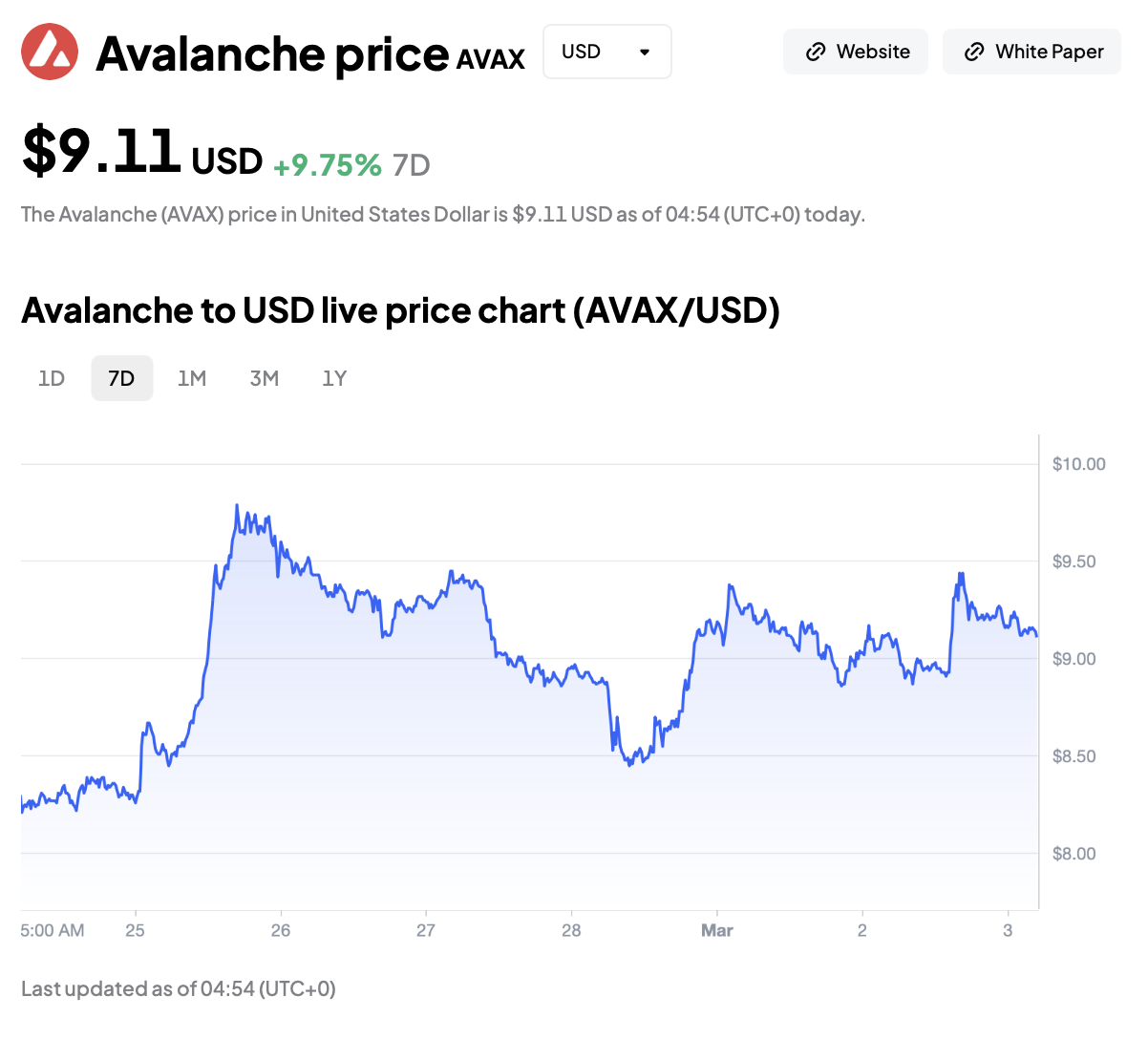
Figures from Toobit, accurate as of March 3, 2026, 04:54 UTC
Quick facts about AVAX coin price (as of March 3, 2026)
|
AVAX 24h trading volume |
$368.3 million |
|
AVAX 24h high/low |
$9.44 / $8.88 |
|
AVAX total supply |
463.44 million |
|
AVAX circulating supply |
431.77 million AVAX |
|
AVAX market cap |
$3.93 billion |
|
AVAX all-time high (ATH) |
$146.22 (November 21, 2021) |
|
AVAX all-time low (ATL) |
$2.79 (December 31, 2020) |
How does Avalanche work?
Avalanche is built to avoid the "one chain does everything" traffic jam. Instead, it runs a multi-chain setup: the Primary Network (3 core chains) plus a wider universe of Avalanche L1s that can be tailored for specific use cases.
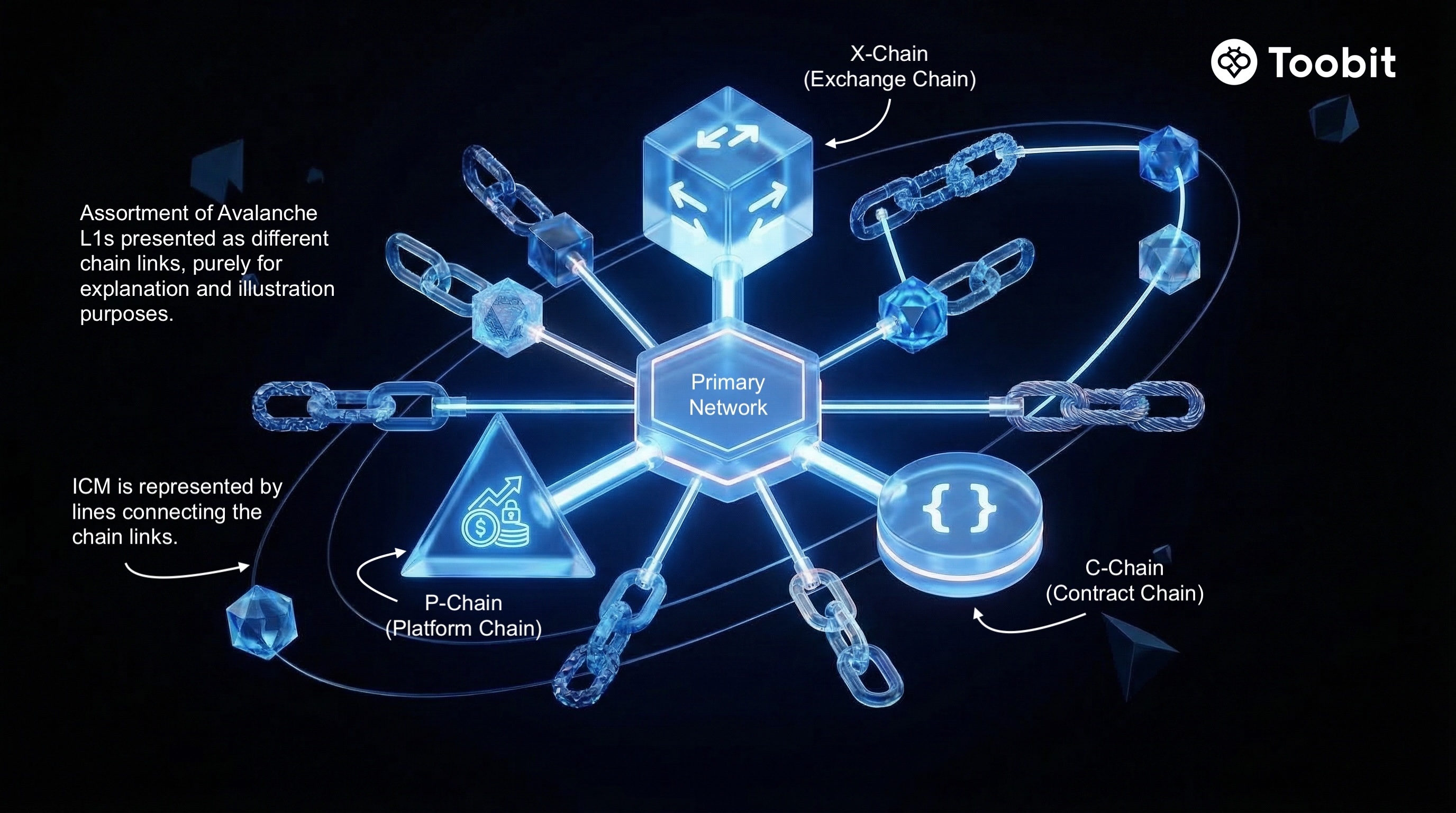
How Avalanche (AVAX) works, with the Primary Network as the core and customizable Avalanche Layer 1 blockchains surrounding it.
Source: Toobit.
The Primary Network
Think of this as Avalanche's home base. It is the economic and coordination layer where liquidity and validators anchor the system, and where activity can route cleanly across the network.
The primary network is composed of 3 built-in blockchains:
-
X-Chain (Exchange Chain): Used for creating and transferring digital assets like AVAX.
-
P-Chain (Platform Chain): Coordinates validators and manages active Avalanche L1s and staking.
-
C-Chain (Contract Chain): This is the layer where most decentralized finance (DeFi) and non-fungible token (NFT) activity occurs. The C-Chain supports the Ethereum Virtual Machine (EVM), making it easy for developers to port over Ethereum-based smart contracts, and execute them at lightning speed and low cost.
Avalanche L1s
Avalanche L1s are sovereign L1 blockchains launched using Avalanche's L1 framework.
They run independently, but plug into Avalanche's infrastructure, with their own rules, virtual machines (VMs), and tokenomics. Because the setup is modular, teams can build purpose-built chains with custom rule sets, without giving up the network's core benefits like speed and security.
Avalanche L1s can also connect through Interchain Messaging (ICM), which is how Avalanche pushes the "separate chains, shared outcomes" idea.
What is the Avalanche Consensus mechanism?
According to Avax.network, the Avalanche consensus "blends classical consensus and Nakamoto-style decentralization". What this means is that, instead of waiting for every node to agree, nodes perform randomized "subsampled voting", an act of randomly polling neighbors repeatedly until a supermajority consensus is reached.
This results in sub-second finality, making it one of the fastest blockchains in existence.
AVAX ecosystem mapped to real utility
Now that the plumbing is clear, the interesting part is where it gets used.
The quickest way to understand AVAX is to map the pieces above to real deployments, where the design choices actually show their value.
Institutional assets moving on-chain (Progmat)
One of the clearest execution signals is Progmat's migration plan.
Just last month, Avalanche reported that Progmat, Japan's largest security token platform, is preparing a technical move from Corda to a dedicated Avalanche L1. More than $2 billion in tokenized real estate assets and corporate bonds are expected to transition onto Avalanche infrastructure.
The point is not hype, it is plumbing: a purpose-built L1 can enforce the compliance and operating requirements institutions care about, while staying interoperable with the broader network design.
Digital liquidity gateways and faster settlement (Intain and FIS)
Traditional finance (TradFi) settlement lag is still a problem that no amount of marketing can fix. However, using Avalanche's sub-second finality, Intain facilitates the securitization of thousands of loans for community banks, connecting them to institutional capital in real-time.
The Digital Liquidity Gateway from Intain and FIS is a platform built to help community banks buy, sell, and securitize loan portfolios using Intain's Avalanche L1, with automation and transparency baked into the process.
Yield-bearing RWAs (Fosun Wealth. FUSD)
Another practical use case is stable, yield-bearing liquidity that settles at any time of the day.
The FUSD is the first major yield-bearing real-world asset (RWA) stablecoin in Asia, and unlike traditional stablecoins, the FUSD is minted natively on Avalanche's C-Chain to tap into existing DeFi liquidity.
The launch of FUSD by Fosun Wealth's FinChain bridges Asian institutional assets with global liquidity, allowing for 24/7 settlement that traditional banking cannot match.
Gaming-grade throughput without fighting for block space (Shrapnel)
Games like Shrapnel utilize dedicated L1s so that high-volume in-game transactions do not congest the main C-Chain, keeping fees at near-zero for players.
Avalanche's L1 Explorer lists Shrapnel L1 as a dedicated network for Shrapnel's content, commerce, and community layer, which is the whole point of application-specific chains.
Thirdweb's chain overview adds that it is EVM-compatible and designed for low-latency, low-cost transactions for on-chain items and user-generated content marketplaces, with its own gas token.
That is horizontal scaling in plain terms: isolate the workload, keep the experience predictable.
What drives AVAX prices?
Several fundamental catalysts are currently influencing the AVAX price prediction for the remainder of the year:
-
Retro9000 builder incentives Retro9000 is a $40 million retroactive grant program, and Avalanche Foundation says the C-Chain round kicks off March 2, 2026, rewarding projects based on real on-chain impact.
-
Institutional exchange-traded funds (ETFs) and treasuries The VanEck AVAX ETF (VAVX) listing and the Avalanche Treasury Co. (AVAT) planned Nasdaq listing have created a "buyer of last resort," absorbing sell pressure and providing a regulated entry for big capital.
-
Token burn mechanism Avalanche states that every transaction fee on the primary network is permanently burned. As L1 usage increases, the deflationary pressure on the 720 million max supply intensifies.
-
Avalanche9000 upgrade This upgrade replaced the old 2,000 AVAX validator fee with a subscription-style model (reported as 1 to 10 AVAX per month), lowering the barrier to launch L1s and potentially expanding activity across the network.
Common risks of Avalanche
AVAX also has very normal, very real risks. Here are the ones that actually matter.
-
Extreme competition Solana and Ethereum Layer 2s (L2s) like Base and Arbitrum are competing for the same builders, participants and liquidity as Avalanche.
-
Regulation can hit staking and intermediaries first While Avalanche has focused on compliance, shifting global regulations on "staking-as-a-service" could impact validator participation.
-
Not every L1 will earn the right to exist Avalanche makes it easier to launch custom chains. The flip side is that some chains will be underused. If activity fragments across too many low-traffic L1s, fee burn and network "buzz" can look weaker than the headline count of chains suggests.
-
Macro headwinds can dampen trading activity Low risk appetites, high interest rates and sustained Bitcoin (BTC) dominance often limit the capital available for altcoins like AVAX.
Closing perspective
Avalanche is no longer just "a fast chain." It is positioning itself as infrastructure for tokenizing real-world value, from on-chain assets to purpose-built networks that can actually run at scale.
AVAX price will still swing with the broader tape, but the longer-term signal is whether usage keeps compounding. If that trend holds, Avalanche's story shifts from speculative momentum to measurable utility.
This article is for informational purposes only and does not constitute financial advice. Always do your own research (DYOR) before making any decisions.
How to start trading Avalanche (AVAX)
Avalanche is a Layer-1 blockchain known for its Subnet architecture and fast finality. If you are ready to trade AVAX/USDT and track AVAX price movements in real time, Toobit provides a streamlined process from sign-up to execution.
AVAX FAQs
-
What is AVAX used for?
AVAX is the network's utility token. It is used to pay transaction fees, secure the network through staking, and power activity across Avalanche's core chains and Avalanche L1s.
-
What makes Avalanche different from a single-chain network?
Avalanche uses a multi-chain design: a Primary Network for coordination plus Avalanche L1s that can be customized for specific apps or compliance needs. That helps reduce bottlenecks and lets workloads scale in parallel.
-
What is Interchain Messaging (ICM) and why does it matter?
ICM is Avalanche's way to let different L1s communicate. It matters because "multi-chain" only works if chains can share value and data without duct tape.
-
What is the difference between the X-Chain, P-Chain, and C-Chain?
X-Chain is for creating and transferring assets, P-Chain coordinates validators and manages Avalanche L1s and staking, and C-Chain is the EVM smart contract layer where most dApps run.
-
Can Avalanche L1s be public or private?
Yes. Teams can launch L1s that are open to anyone or permissioned for specific participants, depending on the use case and compliance needs.
-
What should I watch to gauge whether Avalanche is growing beyond hype?
Look at measurable usage. Active addresses and transactions on key chains, the number of live L1s with real activity (not empty dashboards), and whether on-chain assets and integrations keep expanding over time.


