
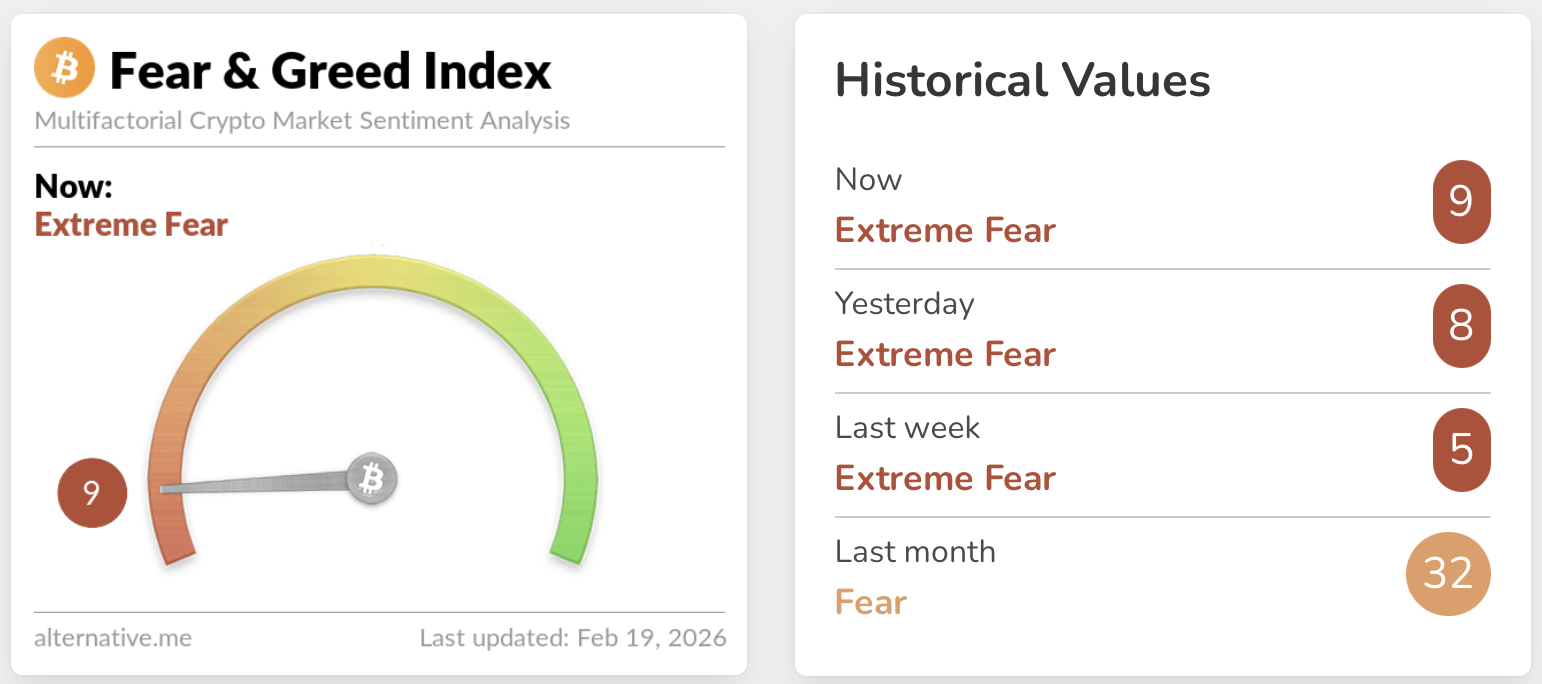
Source: Alternative.me
And yet, in the middle of that drawdown, Abu Dhabi did not flinch. It increased its exposure to BlackRock's iShares Bitcoin Trust (IBIT), bringing its position to close to 21 million shares of the spot Bitcoin exchange-traded fund (ETF).
Source: Fintool.com
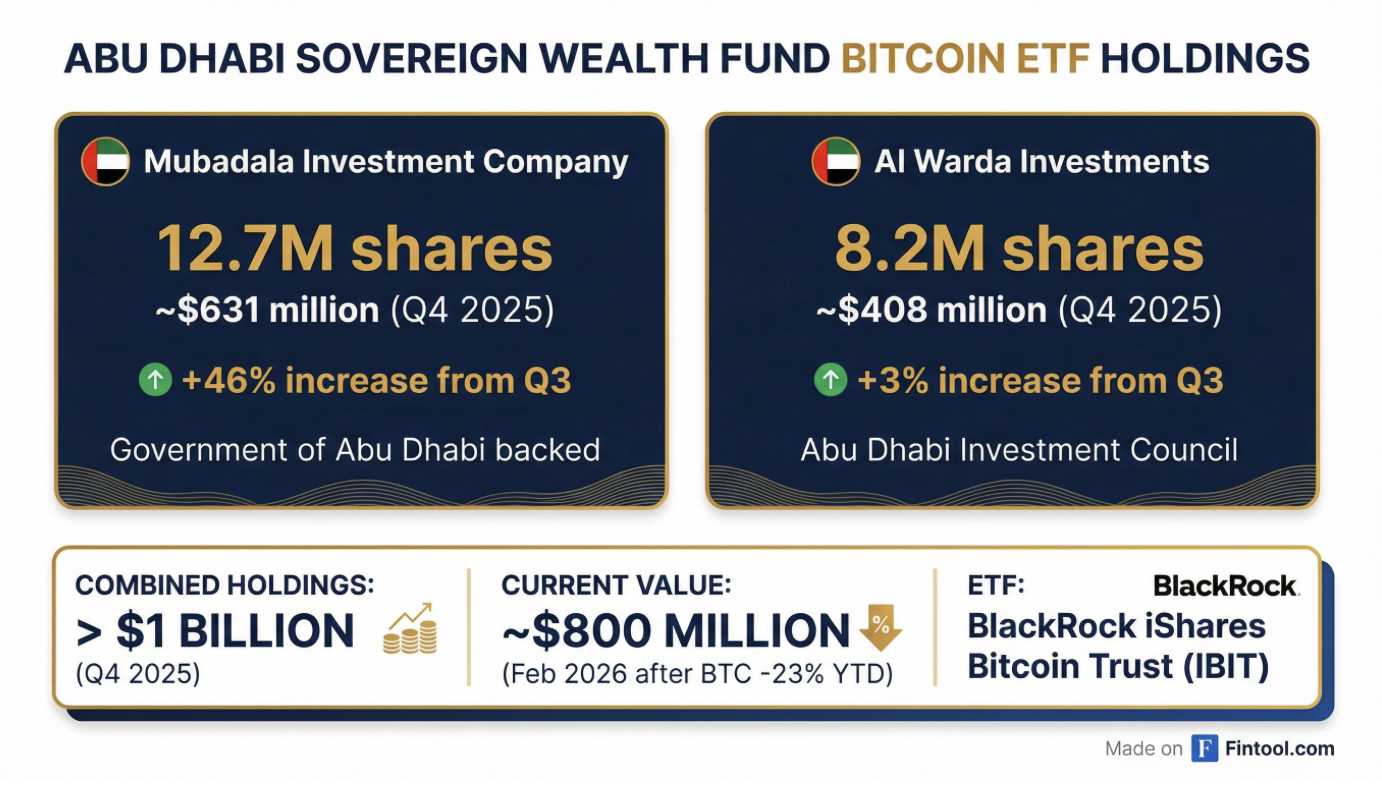
Fresh 13F filings from this Tuesday (February 17) revealed that Mubadala Investment Company, the government-backed sovereign wealth fund, raised its holdings by 46% from the previous quarter to 12.7 million shares as of December 31, 2025. Abu Dhabi Investment Council (ADIC)'s Al Warda Investments, an independently-run unit of Mubadala, also boosted its position by 3% to 8.2 million shares.
According to Bloomberg, the two funds now control more than $1 billion of Bitcoin exposure through the world's largest spot Bitcoin ETF.
How the UAE accumulates BTC amid volatile market
While most institutions are buying BTC, the United Arab Emirates (UAE) has quietly amassed a Bitcoin reserve reportedly worth $700 million over the last few years through mining.
Research from blockchain analytics firm Arkham Intelligence points to a massive 80,000-square-meter facility on Al Reem Island. Bitcoin was mined through Citadel Mining, which is majority owned by the UAE government-owned conglomerate, the International Holding Company (IHC).
Sazmining reported that UAE's mining success comes down to large-scale efficient infrastructure, renewable energy usage and government-backed initiatives.
Key players like NIP Group and Phoenix Group led UAE's mining sector with Citadel Mining, backed by cutting-edge facilities and renewable energy integration. Clear regulatory frameworks and requirements from authorities like Dubai's Virtual Assets Regulatory Authority (VARA) also allow mining companies to operate safely.
Why buy Bitcoin when the UAE could mine more?
The answer lies in market agility.
Mining operations on Al Reem Island function like a long-term, "wholesale" factory for sovereign reserves. The BlackRock IBIT investment is the opposite: instant, regulated liquidity.
By holding over $1 billion in the world's most liquid Bitcoin ETF, Abu Dhabi gains a flexible financial tool that can be used as collateral in global markets, rebalanced in seconds, and integrated into traditional portfolios in a way that raw, self-custodied mined coins cannot.
What does this mean
Abu Dhabi's continued commitment signals that sovereign wealth funds view Bitcoin as a strategic asset class worth holding through volatility.
A spokesperson from ADIC described Bitcoin as "a digital counterpart to gold", and that allocation is intended to sit alongside the fund's traditional store-of-value assets. Mubadala manages over $330 billion in global assets; a $631 million Bitcoin position is less than 0.2% of the portfolio but it carries symbolic weight.
The timing was also notable. Bitcoin fell around 23% during Q4 2025 amidst fading spot ETF approvals and growing macro headwinds. That pushed the combined Abu Dhabi position down to roughly $800 million at current prices. Despite the paper loss of around $230 million since 2026, there was no indication of a strategy shift from either fund.
This pattern also highlights how regulated ETF products have opened the door for institutional capital that previously avoided direct custody.
All Abu Dhabi exposure here runs through BlackRock's IBIT, a product launched in early 2024 that has quickly become the primary access point for institutions seeking Bitcoin exposure within traditional portfolio structures.
Why do government-backed funds buy Bitcoin through regulated ETFs?
Government-backed capital rarely takes shortcuts. It enters through regulated rails because every decision has to survive committees, auditors, and public scrutiny.
Spot ETFs fit that mandate. They trade on regulated venues, come with standardized custody and reporting, and plug into existing portfolio workflows the same way traditional assets do. For a sovereign-style allocator, that structure is the point.
ETFs also leave clearer footprints. Filings, holdings, and flows are easier to monitor than guessing at on-chain wallets, which makes these moves easier to read as policy-backed positioning, not hype.
Is this headline noise or a structural shift?
Institutional headlines are easy to overtrade. Use this checklist to see whether Abu Dhabi's IBIT buying is a one-off headline or part of a broader shift.
A practical checklist for investors
-
Is it repeatable or is it a one-off?
A structural shift shows up as repeated behavior across multiple quarters and multiple institutions, not just one splashy disclosure. According to Reuters, 13F filings show managers actively adjust spot Bitcoin ETF exposure quarter to quarter, so the signal is strongest when you see consistent adds across multiple quarters and multiple allocators, not a single disclosure. -
Is the vehicle scalable?
ETFs are scalable by design. They can absorb large allocations without the operational overhead of direct custody for every institution. That makes the ETF route a stronger "structure" signal than a retail-driven spot frenzy. -
Is it tied to a governance framework?
When buyers are constrained by policy, risk committees, and regulatory requirements, their actions are typically slower but stickier. That stickiness can also explain why these moves can matter even when price is weak. -
Follow the paper trail, not the noise
ETF exposure is legible. As coverage of the Abu Dhabi position emphasizes, filings and reported holdings let you track positioning without guessing at on-chain wallet labels.
How to use this without getting chopped up
-
Treat the headline as context, not a trade trigger, then look for follow-through in the next filing cycle. Reuters highlights that these positions can change meaningfully from quarter to quarter.
-
Watch whether exposure keeps concentrating in regulated wrappers like IBIT, which Bloomberg and Yahoo Finance both frame as the preferred institutional route.
What to watch
-
Q1 2026 13F filings (due mid-May) for clues on whether Abu Dhabi kept accumulating through the current drawdown
-
Bitcoin price action around $65,000 to $70,000, a key support zone that could trigger further institutional repositioning
-
Regulatory developments in the UAE, which has positioned itself as a crypto-friendly jurisdiction even more recently, with the launch of the USDU.
The bottom line
By utilizing BlackRock's IBIT, Abu Dhabi is not just making a price call. It is signaling that Bitcoin has matured enough to be treated as a core pillar of a $1.7 trillion sovereign wealth strategy, bridging the gap between desert-based energy production and the heart of Wall Street.


