
Markets have always been a competition between information and timing.
The challenge for traders is not a lack of data. Charts, indicators, price levels, and market signals are available everywhere. The difficulty is processing all of that information quickly enough to identify a potential setup before conditions change.
This is where AI-assisted trading tools are beginning to reshape the analysis process.
Toobit AI Trading Assistant is designed to turn complex chart information into structured trade plans, helping traders review potential setups without manually comparing every indicator, timeframe, and market level. The tool organizes key elements such as direction, entry zones, take-profit levels, and stop-loss levels into a clearer view.
The purpose is not to remove uncertainty from trading. Markets remain unpredictable, and no system can guarantee future price movements. Instead, AI Trading Assistant focuses on improving the workflow behind decision-making by helping traders move through analysis more efficiently.
What is Toobit AI trading opportunity
Toobit AI trading opportunity is part of the broader AI Trading Assistant experience, designed to identify potential market setups directly within supported trading charts.
Traditionally, traders need to move between different tools to compare price structure, technical indicators, and multiple timeframes before forming a view. AI-powered analysis changes this process by bringing those elements together in a single trading environment.
The feature works by analyzing historical market data and technical models before presenting structured opportunities across different trading styles. Short-term traders can use scalp mode, which focuses on one-minute to one-hour setups involving momentum, intraday pullbacks, and breakout patterns.
For traders who operate with broader market perspectives, swing mode focuses on four-hour and higher timeframes, highlighting trend direction, structural levels, and important support or resistance zones.
However, identifying a possible setup is only one part of the trading process. The final decision still depends on market conditions, risk tolerance, and individual strategy.
How AI Trading Assistant turns charts into plans
A market idea becomes more useful when it moves beyond a simple bullish or bearish signal.
Toobit AI Trading Assistant structures each supported setup around key trading factors, including potential direction, entry zones, take-profit levels, stop-loss levels, and risk-to-reward considerations. This gives traders a clearer framework before entering a position instead of building a plan after the trade has already started.
The move toward AI-based decision support reflects a broader shift across financial markets. AI is becoming increasingly integrated into financial workflows, but adoption does not mean removing the need for human judgment.
KPMG’s Global AI in Finance report highlights that organizations are seeing improvements from AI in areas such as decision-making quality and decision-making speed. These developments explain why traders and institutions are increasingly interested in tools that can process information faster while still requiring users to validate outputs against live market conditions.
The biggest benefit of structured AI analysis is consistency.
When markets move quickly, traders often react emotionally, chase price movements, or focus only on information that confirms their existing view. A structured AI-generated plan can help create a more disciplined process by placing important decision points in front of the trader.
The trader remains responsible for execution. AI simply helps organize the information behind the decision.
Generative AI and agentic AI systems are also moving from experimentation into practical financial applications. A summary of NVIDIA’s State of AI in Financial Services survey notes that many organizations are already using or assessing generative AI, while some have moved toward deploying AI agents.
For traders, this signals a broader industry change. AI will increasingly influence how market ideas are generated and reviewed, but the real advantage will come from combining these tools with proper sizing, invalidation levels, and risk management.
How to use it on Toobit
Using AI Trading Assistant begins with opening a supported trading pair on Toobit and accessing the AI insights above the chart.
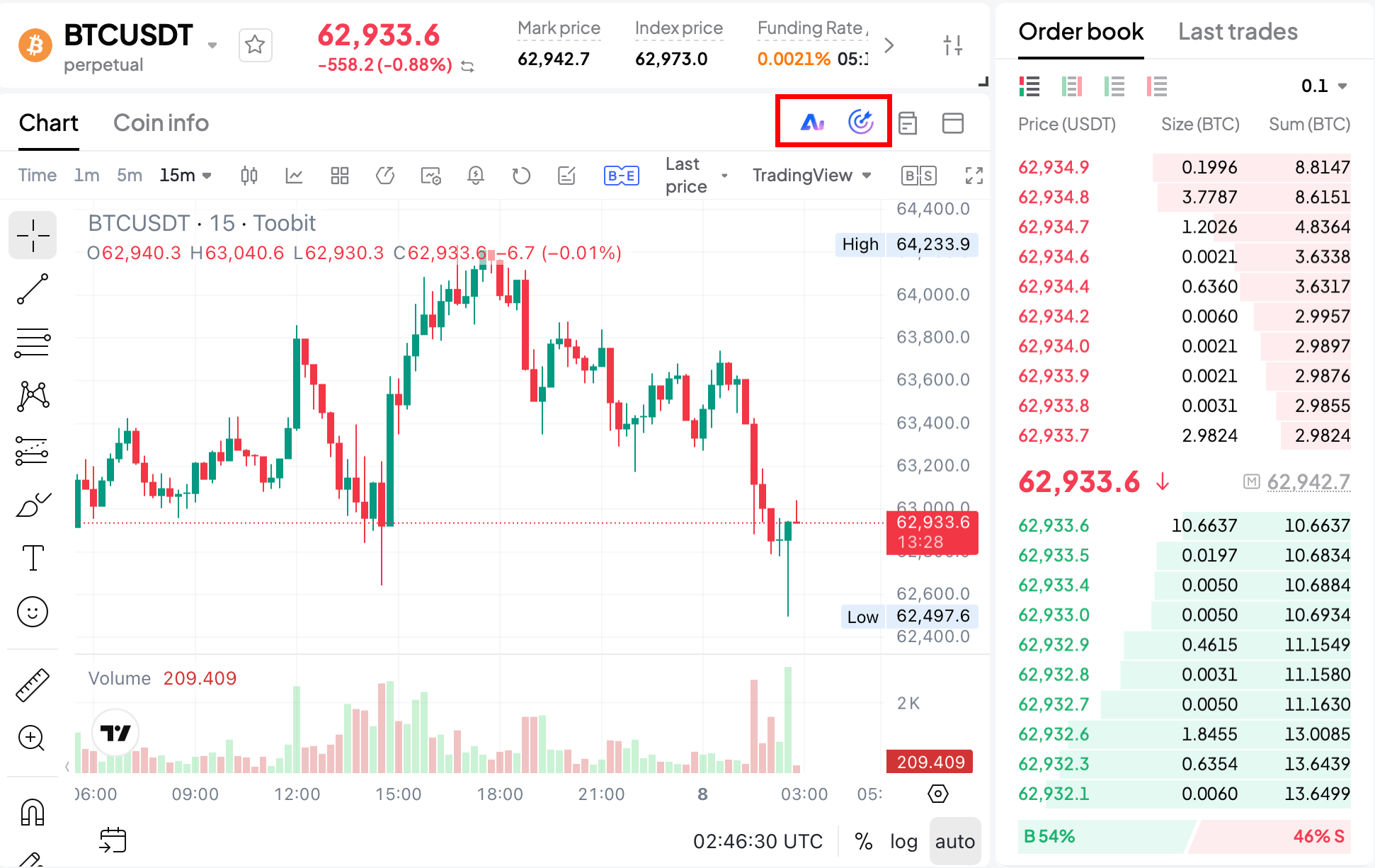
From there, traders can review whether the setup is designed for scalp or swing trading and compare the suggested direction with the current market environment. A potential long setup should still be evaluated against factors such as support strength, market momentum, and overall trend conditions. A potential short setup requires similar consideration around resistance levels and weakening price structure.
Before placing an order, traders should review the suggested entry zone, take-profit levels, and stop-loss level.
Toobit’s AI Trading Assistant can help organize these trade parameters and reduce the time required to move from analysis to execution. However, it does not remove the need to evaluate position size, exposure, and downside risk.
A technically attractive setup can still become unsuitable if market liquidity is weak, volatility increases, or the trade size exceeds a trader’s risk limits.
What traders should check before using AI signals
AI-generated insights can improve the analysis process, but traders should understand their limitations.
These insights are based on historical data and technical models. They can identify patterns and organize information quickly, but they cannot predict unexpected market events. Sudden macro developments, liquidity changes, large market movements, or extreme volatility can invalidate even well-structured setups.
Markets are also becoming increasingly automated. In traditional financial markets, algorithmic systems already represent a significant share of trading activity. WallStreetZen estimates that around 70% of U.S. stock market trading volume is generated by algorithmic systems.
For crypto traders, the lesson is not that they need to compete with automation. Instead, it highlights why execution quality and risk control remain essential.
Structured entries, realistic timeframes, and clearly defined stop-loss levels help ensure AI-assisted trading remains a decision-support tool rather than a source of unnecessary overtrading.
That is why traders should treat AI trading opportunities as a starting framework rather than a final answer. Before acting on any setup, consider the timeframe, level quality, reward-to-risk ratio, broader trend, and whether the invalidation point matches your actual risk tolerance.
A smarter way to use speed
The real value of Toobit AI Trading Assistant is not simply making traders faster.
Speed alone does not create an advantage. The value comes from reducing repetitive analysis so traders can focus more attention on judgment, position sizing, and risk management.
As markets become faster and more information-driven, structured decision-making will become increasingly important. AI can help traders navigate the complexity of modern markets, but discipline remains the factor that determines whether a strategy can withstand changing conditions.
If you want to explore the feature, read Toobit’s official announcement on how to find trading opportunities in real time with AI Trading Assistant, then test it through controlled decisions before applying it to larger positions.
AI can support the trading process, but the final decision still belongs to the trader.
This article is for informational purposes only and does not constitute financial advice. Always do your own research (DYOR).


