
AI trading is no longer just about watching dashboards, copying signals, or waiting for alerts after the market has already moved.
More traders are starting to explore a different approach. Instead of clicking through multiple pages and tools, they are using prompts to access markets, organize information, and manage trading workflows.
That is where Toobit AI Agent Trade Kit comes into the conversation.
Built for traders and developers, the kit connects AI agents with Toobit trading functions and turns natural language instructions into structured workflows. Rather than treating automation as a black box, it gives traders a more direct way to interact with markets through AI tools they may already use.
What is Toobit AI Agent Trade Kit
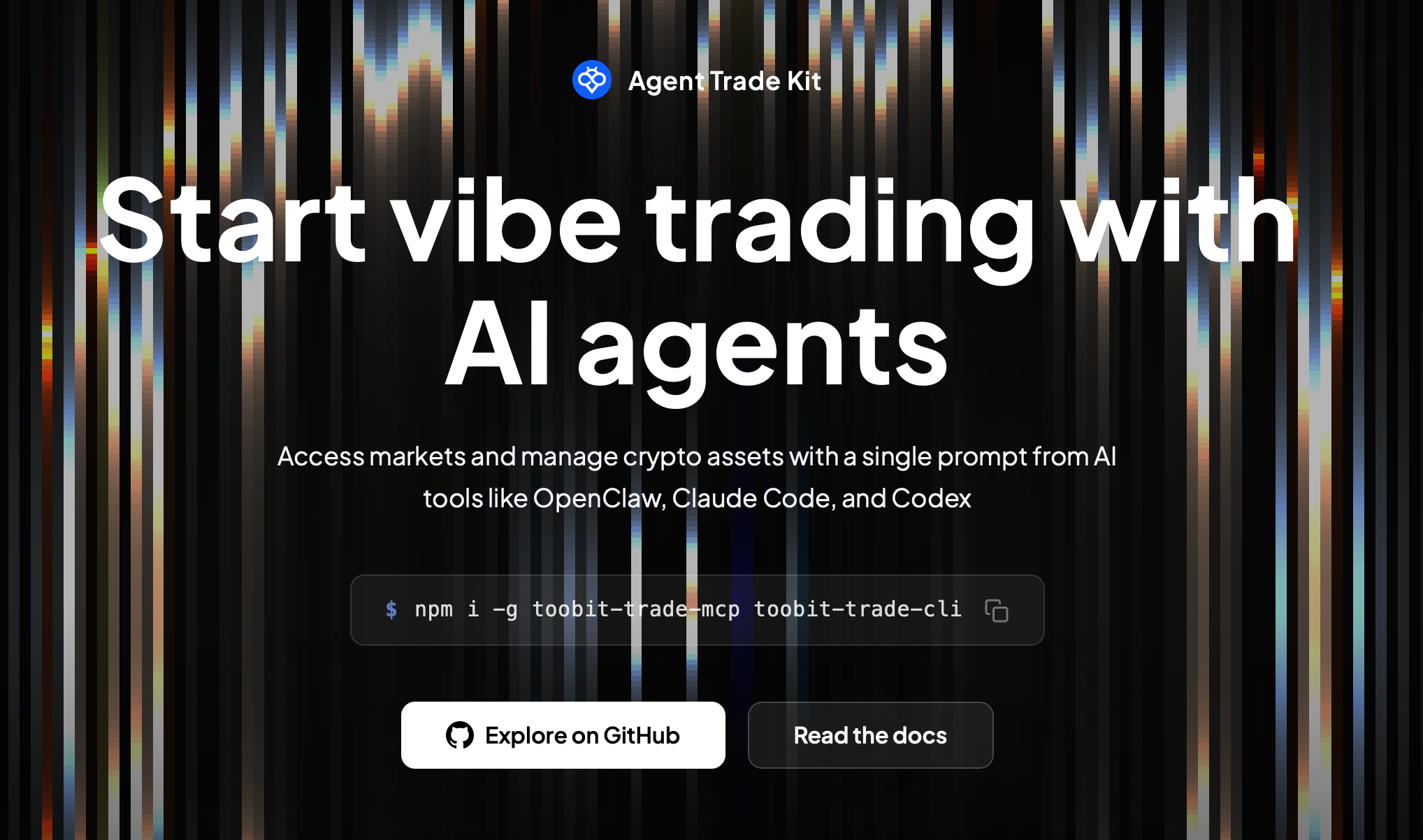
Toobit AI Agent Trade Kit is a developer-friendly toolkit that helps AI agents connect with Toobit trading functions.
The product is designed to let traders access markets and manage crypto assets through a single prompt from AI tools such as OpenClaw, Claude Code, and Codex. In simple terms, it is built for traders and builders who want AI assistants to help translate intent into action.
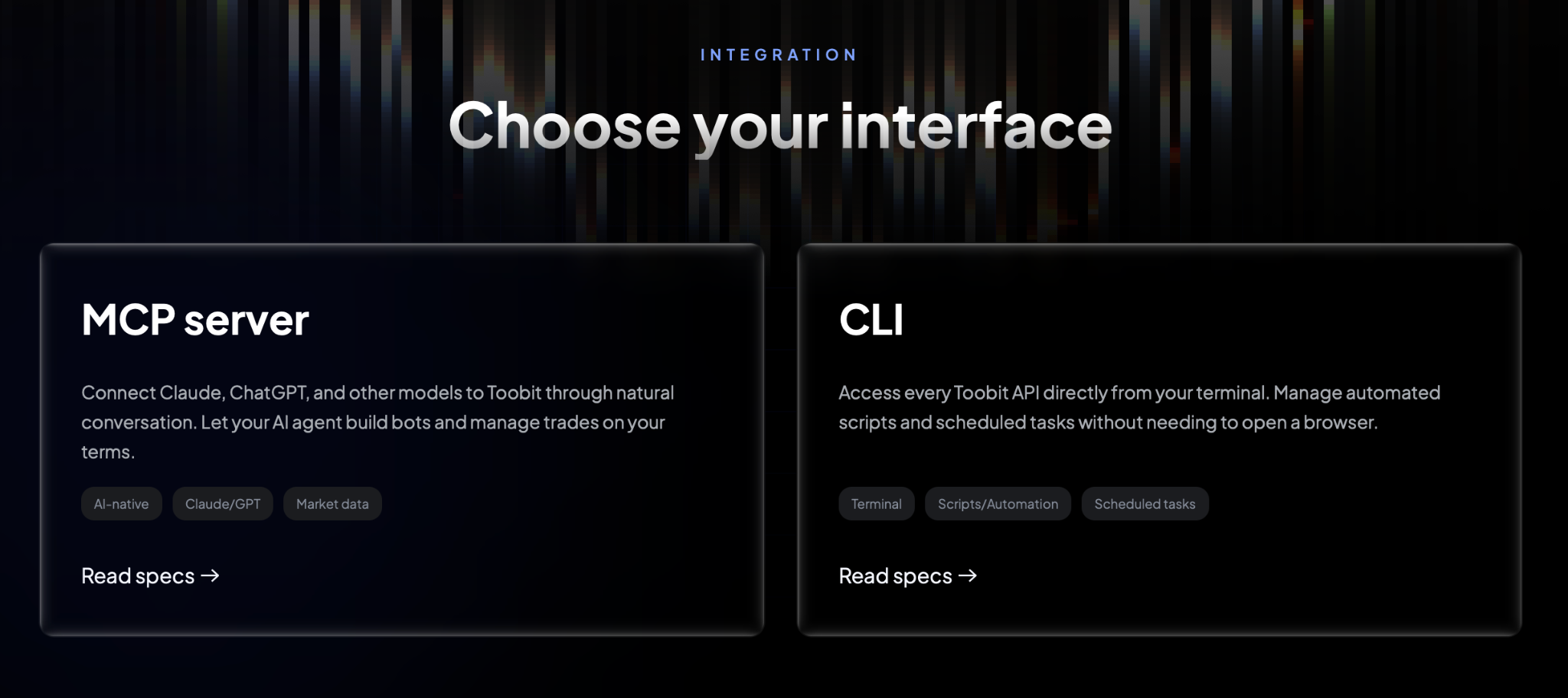
The kit currently includes two installable packages, toobit-trade-mcp and toobit-trade-cli, allowing traders to work through both agent-connected environments and command-line workflows.
This matters because many traders already use AI tools to summarize markets, test ideas, and organize strategies. It brings the workflow one step closer to execution.
Why prompt based trading matters
Prompt-based trading changes the starting point of a trading workflow.
Instead of opening several tabs to check markets, review balances, or prepare a trade, traders can begin with a natural instruction. The goal is not to remove decision-making. It is to reduce the friction between analysis and action.
The timing also makes sense.
Crypto has become too large for most traders to monitor efficiently through manual workflows alone. According to CoinMarketCap global metrics, the market currently spans roughly 8,085 active cryptocurrencies, around 112,831 active market pairs, and about 947 active exchanges, all operating across a market worth approximately $2.20 trillion.
That is a lot of information moving at the same time.
Liquidity is also concentrated in places where speed and precision matter. The same market snapshot reported roughly $59.7 billion in stablecoin volume and around $546.3 billion in derivatives volume over the previous 24 hours. When that much capital is flowing through markets, traders naturally start looking for better ways to organize information and reduce operational friction.
This helps explain why prompt-based workflows are gaining attention.
An AI agent can help organize a request, identify what needs to be checked, and prepare the next step in a workflow. It can turn scattered tasks into something more structured and easier to follow.
But the trader still makes the decision.
The practical takeaway is simple. AI agents work best when they help reduce workflow friction by finding the right market, checking constraints, and generating a checklist before action. They are not a replacement for risk management.
The bigger the market becomes, the more valuable disciplined structure becomes as well.
How to get started without overthinking it
The first step is to visit the official AI Agent Trade Kit page and review the available setup options.
The page currently highlights two installation commands, npm i -g toobit-trade-mcp and npm i -g toobit-trade-cli. These packages are designed for traders who are comfortable working with developer tools, terminal commands, and AI agent environments.
After installation, connect the tool only through trusted devices, secure networks, and official documentation.
This step matters because trading tools can involve sensitive account and market actions. Before using prompts for anything live, traders should understand what permissions are being granted, which account functions are accessible, and whether the AI environment being used is reliable enough for financial workflows.
What you can actually ask an AI agent to do
Most traders already follow routines.
They check markets, compare assets, review positions, and organize information before entering a trade. An AI agent can help make those workflows more structured.
For example, a prompt could ask the agent to review a market, explain current conditions, compare assets, or prepare a checklist for a specific trading idea.
The goal is not to let the agent replace the trader. It is to make the workflow easier to follow and less scattered.
For more advanced traders, the kit can also support repeatable routines around crypto asset management. Traders can build prompts for checking market exposure, reviewing open ideas, or preparing pre-trade questions.
This turns the agent into a disciplined assistant rather than an emotional shortcut, especially when volatility starts pushing traders toward rushed decisions.
Smart rules before using AI to trade
Any tool that brings AI closer to trading should be used with clear rules.
Broad instructions such as "make me money" or "trade for me" are vague and risky. A better approach is to use specific prompts that ask for information, structure, and checks before action.
The clearer the instruction, the easier it becomes to review whether the agent's response actually makes sense.
It also helps to separate research prompts from execution prompts whenever possible.
Research can be exploratory, but execution should always be controlled, reviewed, and based on a defined risk plan. That means checking position size, market type, fees, liquidity, and potential downside before any trade is placed.
AI can speed up workflows, but it should never become an excuse to skip basic trading discipline.
Common mistakes to avoid
The biggest mistake is assuming that an AI agent understands market risk simply because it can write confident responses.
AI tools can summarize, organize, and even execute instructions depending on their integration, but they do not guarantee profitable trades. A convincing answer can still be based on incomplete context, outdated assumptions, or a prompt that failed to include the most important risk factor.
Another mistake is using automated workflows before testing them in a low-risk setting.
Traders should first understand how the toolkit responds, what each command does, and how confirmation steps appear. If a workflow feels unclear, stop and review the documentation before continuing.
When money is involved, convenience should never move faster than comprehension.
Final thoughts
AI Agent Trade Kit points toward a future where crypto trading workflows become more conversational, more programmable, and more connected to the tools traders already use.
For traders who work with OpenClaw, Claude Code, Codex, or command-line environments, it can make access to Toobit feel more natural and efficient.
The real advantage, however, comes from combining AI speed with human review.
As with every trading tool, the best results come from using it with structure. Start small, verify each step, and treat prompts as part of a trading process rather than a replacement for one.
If you are ready to explore how AI agents can help manage crypto workflows, Toobit AI Agent Trade Kit is a good place to start.


