
CoinGecko estimated that crypto exchanges processed more than $1.32 trillion in notional TradFi perpetual trading volume between January and May 2026. The contracts referenced stocks, indexes, ETFs, commodities, currencies, and pre-IPO companies, extending crypto-style perpetual trading into traditional markets.
TradFi perpetual volume from Coingecko
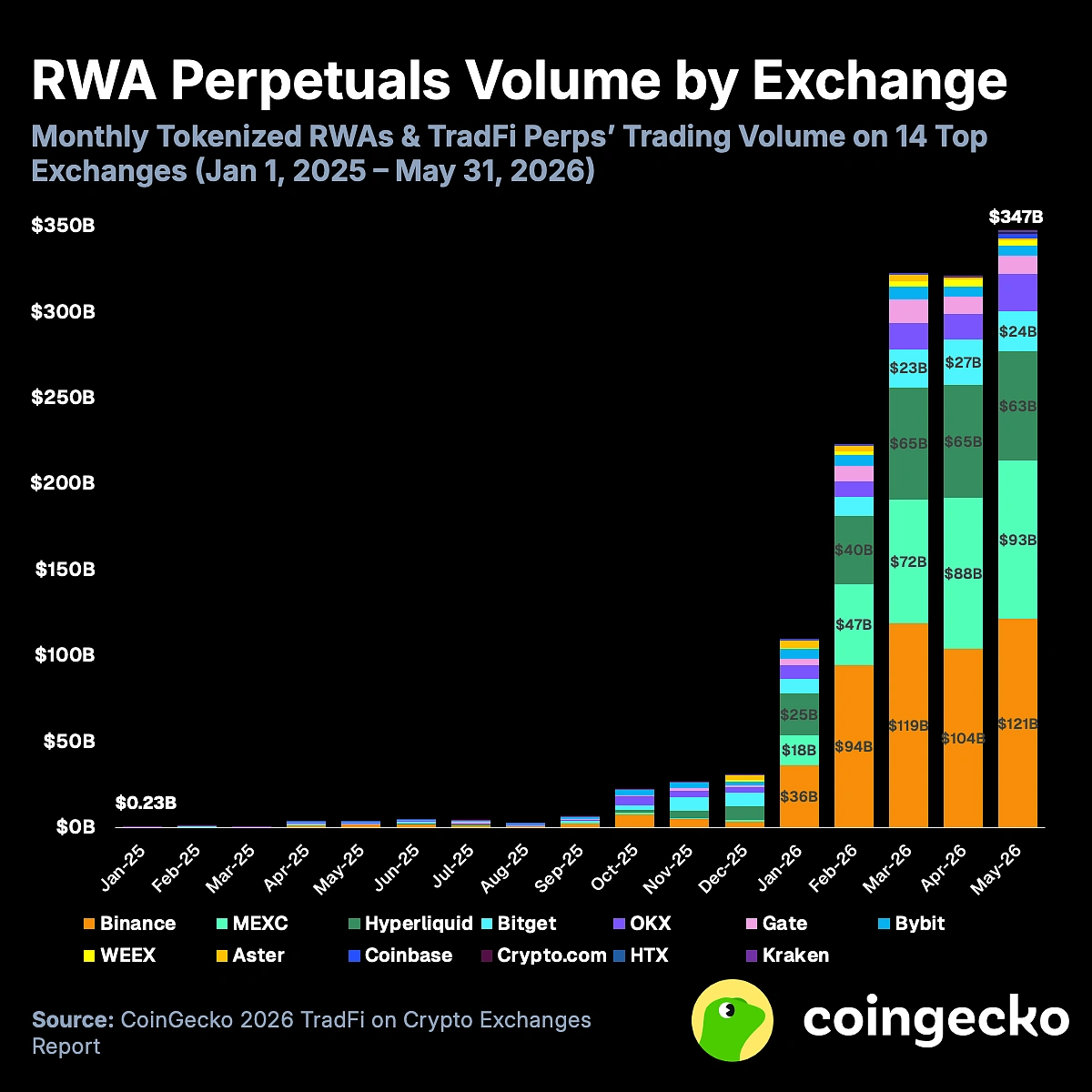
The figure does not mean $1.32 trillion of stocks or other assets moved onchain. It is not deposited capital, assets under management, open interest, collateral, or proof that traders owned the underlying instruments. It measures the face value of contracts traded, including repeated turnover generated with leverage.
Crypto exchanges are expanding in this direction because perpetual-market infrastructure already exists. Stablecoin margin, continuous order books, funding payments, liquidation engines, and long-short trading can be adapted to traditional-asset reference prices without turning each contract into a transferable share or commodity claim.
The resulting market sits between crypto derivatives and traditional finance. Its growth could represent a durable expansion in global market access, but the same numbers could also reflect concentrated, leverage-driven turnover in products whose pricing, liquidity, and legal structure are still developing.
Market at a glance
-
2026 volume: More than $1.32 trillion from January through May.
-
2025 volume: Approximately $104.21 billion for the full year.
-
May 2026 volume: Approximately $347.17 billion.
-
Main structure: Stablecoin-margined perpetual contracts referencing traditional assets.
-
What traders own: A derivatives position, not necessarily the underlying stock, ETF, commodity, or currency.
-
Main risk: Leverage operating through a market that may remain open when its strongest reference price and deepest liquidity are unavailable.
-
Primary source: CoinGecko’s TradFi on Crypto Exchanges Report 2026, covering January 2025 through May 2026.
What the $1.32 trillion figure actually measures
CoinGecko’s July 2026 report examined real-world-asset spot products and TradFi-linked perpetuals across leading centralized and decentralized crypto exchanges. Its main volume analysis covered 13 venues: Binance, MEXC, Hyperliquid, Bitget, OKX, Gate, Bybit, WEEX, Aster, Coinbase, Crypto.com, HTX, and Kraken.
Tokenized Stock Perpetuals Volume from Coingecko
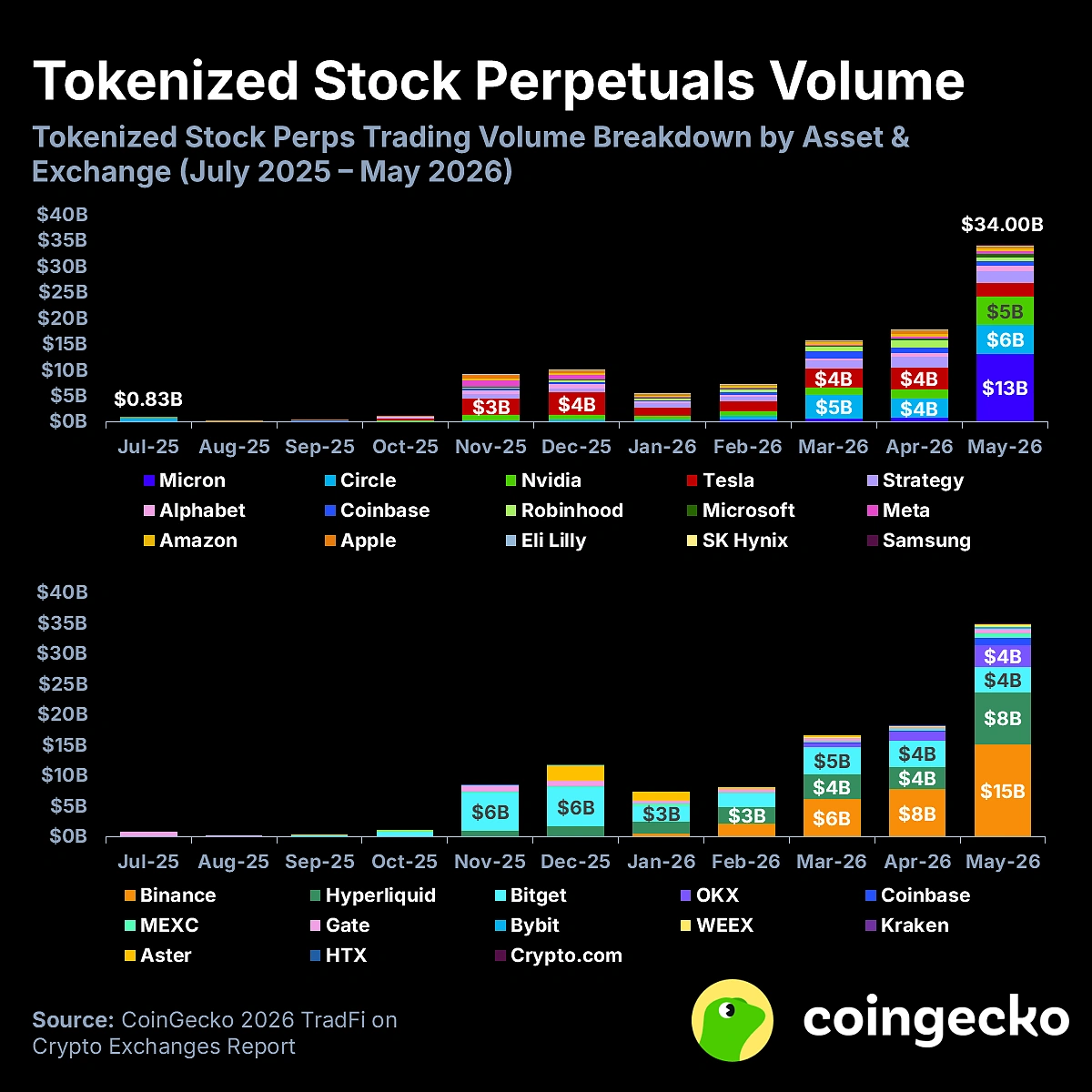
The sample included perpetual contracts linked to commodities, equities, ETFs, indexes, foreign exchange, and selected pre-IPO companies. It excluded ordinary Bitcoin and altcoin perpetuals. CoinGecko sometimes uses “RWA perpetuals” and “TradFi perpetuals” for the same broad category, although not every reference asset is a tokenized real-world asset held or transferred onchain.
The report describes the $1.32 trillion as trading volume. In derivatives markets, volume records the notional value changing hands during a period. If a trader opens and closes a $100,000 position several times, each transaction contributes to turnover even though the trader did not commit $100,000 of fresh capital each time.
Leverage increases the gap between turnover and actual collateral. A position with $100,000 of notional exposure may require only a fraction of that value as margin, depending on the contract and leverage selected. The same collateral can then support a sequence of positions, allowing notional volume to grow much faster than balances held on the platform.
|
Measurement |
Verified figure |
Period |
What it means |
|
TradFi perpetual volume |
More than $1.32 trillion |
January–May 2026 |
Estimated notional value of contracts traded during five months |
|
TradFi perpetual volume |
$104.21 billion |
Full-year 2025 |
Estimated turnover during all 12 months of 2025 |
|
Monthly TradFi perpetual volume |
$0.23 billion |
January 2025 |
Approximate starting monthly volume in the study |
|
Monthly TradFi perpetual volume |
$347.17 billion |
May 2026 |
Estimated monthly turnover at the study cutoff |
|
Perpetual versus spot RWA volume |
More than 8x |
January–May 2026 |
TradFi perpetual turnover relative to spot RWA turnover |
Several conclusions cannot be drawn from the headline. It does not establish $1.32 trillion of capital inflows, institutional allocations, customer deposits, outstanding positions, or underlying assets held by exchanges. It also does not identify how many unique people traded or how evenly liquidity was distributed.
Methodology creates another limitation. CoinGecko disclosed the exchanges, categories, periods, and aggregate results, but its public report does not provide a complete venue-by-venue audit of volume quality or a detailed explanation of every filter used to address self-reported activity. The data are useful for measuring direction and approximate scale, although the aggregate should be described as CoinGecko’s estimate rather than an audited industry total.
Different sections use different samples. The listing analysis covers 12 centralized exchanges plus Hyperliquid and Aster, while the principal volume and open-interest analysis names 13 venues, apparently reflecting section-specific data availability.
How fast TradFi perpetuals have grown
The acceleration began from a very small base. CoinGecko describes the increase from January 2025 to May 2026 as 1,472 times, although the rounded endpoints produce a slightly different result. The published multiple should therefore remain explicitly attributed to CoinGecko.
The growth sequence is easier to read as a timeline:
-
January 2025: Monthly TradFi perpetual volume stood at approximately $230 million.
-
November 2025: Monthly perpetual turnover reached $26.39 billion, exceeding $17.70 billion in spot RWA volume for the first time in the dataset.
-
Full-year 2025: TradFi perpetual volume totaled approximately $104.21 billion.
-
January–May 2026: Volume exceeded $1.32 trillion, more than 12 times the prior full-year total despite covering less than half as much time.
-
May 2026: Monthly volume reached approximately $347.17 billion.
These periods cannot be treated as interchangeable. The full-year comparison establishes the speed of the expansion, while the monthly figures reveal how heavily the total was weighted toward the end of the study.
Equity-linked contracts followed the broader pattern. Across 13 exchanges, monthly equity-perpetual volume rose from approximately $831.17 million in July 2025 to $34 billion in May 2026. The rounded figures imply growth of roughly 41 times, while CoinGecko describes it as almost 40 times.
Large percentage and multiple comparisons need context when the starting value is small. A newly listed category can post exponential growth before it develops deep order books, a broad user base, or stable participation across market conditions. Volume measures activity; it cannot reveal whether the growth came from new users, existing high-frequency traders, market makers, or the repeated use of leveraged collateral.
Open interest provides a useful counterweight. CoinGecko’s full presentation placed TradFi perpetual open interest at approximately $6.24 billion on May 31, 2026, compared with $347.17 billion in turnover during May. The gap does not make the volume invalid, but it shows that outstanding exposure was far smaller than the amount traded.
Why crypto exchanges are expanding beyond crypto
Crypto exchanges have spent years developing infrastructure for perpetual futures. Their matching engines already manage collateral, leverage, funding, liquidation, cross-margin accounts, and continuous settlement. Extending that machinery to an Nvidia stock, gold, oil, or EUR/USD reference is operationally closer to adding another derivatives market than building a conventional securities brokerage from the ground up.
The commercial and operational logic has five main parts:
-
Product diversification: Stocks, commodities, indexes, and currencies respond to different events than crypto assets, giving exchanges additional sources of activity.
-
Unified collateral: A USDT or USDC balance may support several markets without repeated conversion into national currencies.
-
Two-way exposure: Perpetuals embed long and short positioning without requiring the trader to borrow an underlying share.
-
Capital efficiency: Margin supports a larger notional position than the collateral posted, increasing both flexibility and liquidation risk.
-
Listing flexibility: A cash-settled reference contract can be introduced without distributing the underlying stock, ETF, commodity, or currency.
The last advantage is important. A tokenized share with genuine ownership or redemption features needs an issuer, custodian, legal structure, shareholder records, and corporate-action procedures. A perpetual avoids direct delivery, although it still requires credible data feeds, market makers, transparent adjustments, and jurisdictional controls.
CoinGecko’s listing data support this preference. The exchanges in its listing sample averaged approximately 75 TradFi perpetual listings, compared with 37 spot RWA listings. MEXC recorded the broadest combined selection in that sample, with 199 spot RWAs and 159 TradFi perpetual references during the 17-month study.
Revenue incentives are an editorial inference rather than a variable isolated by CoinGecko. More listings and trading hours can create more fee-generating activity, but the dataset does not reveal product profitability, acquisition costs, or the share of volume produced by market makers.
How TradFi perpetuals work
A perpetual future is a derivative contract designed to track a referenced price without a predetermined expiration date. A trader deposits margin, chooses a long or short position, and gains or loses according to the contract’s price movement. The position can remain open while margin requirements are met and the contract remains listed.
The absence of expiry separates perpetuals from conventional dated futures. Traditional futures converge toward settlement or delivery at a specified maturity. Perpetuals instead use recurring funding payments and price-index mechanisms to discourage the contract from drifting too far from its reference.
Funding is normally exchanged between long and short position holders. When a contract trades persistently above its reference, a positive funding rate commonly requires longs to pay shorts. When the imbalance reverses, shorts may pay longs. The exact formula, interval, caps, and payment rules depend on the venue and contract.
Three prices can appear at the same time:
-
Last price: The price of the most recent transaction on the exchange.
-
Index price: A reference calculated from one or more external price sources.
-
Mark price: A risk-management value used to calculate unrealized profit, margin requirements, and liquidation.
An exchange uses the mark price to reduce the chance that one unusual trade in its own order book immediately liquidates leveraged positions. The protection is incomplete: an inaccurate index, delayed data, extreme basis movement, or thin market can still affect the mark and create losses.
Liquidation occurs when the position’s remaining margin no longer meets the platform’s maintenance requirement. High leverage places the liquidation price closer to the entry price, so a relatively small adverse move can close the position. Funding deductions can also reduce available margin over time and bring liquidation closer even when the reference asset has not moved substantially.
Stablecoins usually serve as collateral and settlement assets. A USDT-margined stock perpetual records margin, fees, funding, profit, and loss in USDT. The contract can track the stock’s price without holding or delivering a share to the trader.
Why 24/7 access changes market structure
Traditional reference markets are not uniformly open. The New York Stock Exchange’s current schedule places its core session between 9:30 a.m. and 4:00 p.m. Eastern Time, with additional early and late sessions for eligible products. Currency markets operate across most of the business week, while commodity and futures venues have their own schedules and maintenance windows.
A crypto exchange can keep a perpetual order book open outside those hours because the contract is a separate market. Traders continue to submit bids and offers, market makers quote prices, and the exchange calculates its index and mark price using whatever approved inputs remain available. The existence of an order book allows trading to continue; it does not ensure that the price is anchored as firmly as it is during the reference market’s most liquid session.
The quality of that connection changes across four trading conditions:
-
During core market hours: Live cash prices and active arbitrage provide the strongest reference anchor.
-
During extended hours: Alternative trading venues and updated data still exist, but depth may be lower than during the core session.
-
During weekends or holidays: The perpetual relies more heavily on its own order flow, related markets, market-maker models, and available third-party data.
-
When the cash market reopens: The underlying market may confirm the perpetual’s move, pull it back, or open with a gap that triggers rapid repricing and liquidations.
Earnings announcements illustrate both sides of the structure. A 24/7 perpetual can absorb results released after the cash market closes and remain tradable through other time zones. If the underlying share and its best hedging instruments are unavailable, however, spreads can widen because arbitrageurs cannot immediately trade both sides of the discrepancy.
Funding can make a crowded position more expensive before the reopening. It cannot guarantee convergence or replace missing liquidity.
Continuous trading can therefore contribute to price discovery without becoming the definitive price. A credible, liquid perpetual may reveal how global traders interpret new information. A thin contract may instead amplify a small number of leveraged orders and create a signal that the deeper cash market later rejects.
Corporate events add another layer. Stock splits, dividends, mergers, bankruptcies, trading halts, ticker changes, and delistings can alter a contract’s reference or economics. Exchanges need published procedures for adjusting contract size, index inputs, settlement, or funding, particularly when an event occurs outside regular hours.
The phrase “24/7 market” should consequently describe availability, not constant market quality. Access may be continuous while spreads, depth, data quality, and liquidation risk change materially by hour.
TradFi perpetuals are not tokenized stocks
Familiar ticker symbols can obscure major legal differences. A TSLA perpetual may track Tesla’s share price, but the position is not necessarily recorded on Tesla’s shareholder register, backed by a redeemable share, or entitled to shareholder protections.
|
Product |
Underlying ownership |
Expiry |
Dividends and voting |
Settlement |
Typical trading hours |
|
Direct stock |
Investor owns a share through the applicable brokerage and settlement structure |
None |
Dividends and voting may apply according to share class and record date |
Cash and securities settlement |
Exchange hours, often with extended sessions |
|
Tokenized stock |
Depends on issuer, custodian, and legal structure |
Usually none, but terms vary |
May provide ownership, redemption, cash adjustments, or no direct rights |
Token transfer, redemption, or cash under product terms |
Venue-dependent; may extend beyond cash-market hours |
|
Stock perpetual |
No underlying share ownership |
None |
No conventional shareholder voting; any dividend effect is contractual |
Usually cash or stablecoin P&L settlement |
Potentially 24/7 |
|
CFD |
No underlying ownership |
Usually no fixed expiry |
No voting; contractual dividend adjustments may apply |
Bilateral cash settlement with broker |
Broker-defined |
|
Conventional futures |
No current ownership of the underlying asset |
Fixed maturity |
No shareholder voting; settlement follows contract rules |
Cash settlement or delivery under contract terms |
Exchange-defined, often extended but not continuously open |
A genuine tokenized security represents a security through blockchain or crypto-asset infrastructure. Its holder’s rights depend on the legal issuer, custody arrangement, transfer system, and redemption terms. Some products represent beneficial ownership in custodied shares; others provide only a synthetic claim whose payout follows the share price.
A stock perpetual is more straightforward in one sense: it is a derivative. The user takes price exposure governed by the exchange’s contract terms and receives no automatic claim on the company’s assets. Dividends may influence the reference price or lead to a contractual adjustment, but that treatment is not equivalent to receiving a corporate distribution as a registered shareholder.
The difference affects risk as well as rights. A direct shareholder depends on a broker, custodian, clearing system, and issuer. A tokenized-share holder adds token issuer, smart-contract, and redemption risks. A perpetual trader depends on the exchange or protocol, stablecoin collateral, market makers, indexes, margin rules, and liquidation engine.
Where the trading volume is concentrated
CoinGecko identified Binance, MEXC, and Hyperliquid as the three leading venues by cumulative TradFi perpetual volume over the 17-month study. Binance recorded approximately $498.66 billion, MEXC $323.86 billion, and Hyperliquid $272.39 billion.
|
Exchange |
Verified volume |
Measurement period |
2025 average monthly share |
2026 average monthly share |
Important limitation |
|
Binance |
$498.66 billion |
January 2025–May 2026 |
24.6% |
35.9% |
Global and product availability varies by entity and jurisdiction |
|
MEXC |
$323.86 billion |
January 2025–May 2026 |
21.7% |
22.8% |
Reported volume is not equivalent to audited liquidity or user count |
|
Hyperliquid |
$272.39 billion |
January 2025–May 2026 |
6.0% |
19.8% |
Decentralized structure and onchain access create a different risk model |
The direction of the shares is informative. Binance’s average monthly share increased by more than 11 percentage points between the two periods, while Hyperliquid rose from 6.0% to 19.8%. MEXC remained comparatively stable near 22%, suggesting that growth benefited both established centralized venues and at least one major decentralized derivatives market.
Open interest tells a different part of the story. CoinGecko placed Hyperliquid’s TradFi perpetual open interest at approximately $2.89 billion on May 31, equal to 46.4% of the sampled total. Binance held about $1.18 billion, or 19.0%, while MEXC held approximately $480 million, or 7.7%.
Volume leadership and open-interest leadership therefore did not belong to the same venue. Binance generated the highest cumulative turnover, while Hyperliquid held the largest outstanding exposure at the cutoff. Volume can favor a venue with rapid trading and large market-maker activity; open interest can favor one where positions remain open longer.
Concentration can improve execution in the leading contracts because traders and market makers gravitate toward the deepest order books. It also creates dependence on a small group of venues, price feeds, and liquidity providers. A technical outage, product restriction, or market-maker withdrawal at one major platform could affect the visible market more than the headline number suggests.
Stocks, commodities, forex, indexes, and pre-IPO markets
TradFi perpetuals are often discussed through prominent U.S. stocks, but CoinGecko’s complete presentation shows a broader and uneven market. Each category has a different demand driver, reference-price problem, and liquidity profile.
-
Commodities: Average monthly volume rose from approximately $5.68 billion in 2025 to $223.17 billion during January–May 2026, making commodities the largest source of the increase. Gold, silver, and oil can attract macro and supply-related positioning, but the contract must identify the benchmark, oil grade, reference maturity, and treatment of conventional futures rolls.
-
Stocks: Nvidia and Tesla were among the most actively traded references, while Micron’s May spike showed how an earnings or sector theme can dominate a short period. The market-quality test is whether activity persists after the event and whether depth develops outside the largest tickers.
-
Indexes and ETFs: A Nasdaq-100-linked or QQQ-linked perpetual can provide broader exposure than a single-stock contract. It still depends on reliable reference prices and adjustment rules, and the trader owns neither the index nor the ETF’s underlying portfolio.
-
Foreign exchange: Forex perpetuals combine stablecoin collateral with markets that already trade through most of the business week. Their additional appeal is unified margin and weekend access, while their limitations include basis divergence and liquidity that may be thinner than institutional currency venues.
-
Pre-IPO companies: CoinGecko’s detailed presentation indicates that volume rose from approximately $60.51 million in April 2026 to $701.44 million in May. The public prose labels those months as 2025, but the surrounding chronology indicates 2026, making the year label an apparent typographical error.
Pre-IPO activity was especially concentrated. SpaceX generated approximately $305 million, or 43.55%, of May turnover, while SpaceX, OpenAI, and Anthropic together accounted for 95.62%. Those figures describe strong interest in a small group of companies rather than broad liquidity across private markets.
Pricing these contracts is also more difficult because no continuously traded public share exists. Venues may rely on private secondary-market indications, funding rounds, related instruments, or platform-specific indexes, allowing contracts tied to the same company to publish materially different prices.
Why stablecoins are becoming the settlement layer
Stablecoins connect TradFi perpetuals with infrastructure crypto exchanges already operate. A USDT- or USDC-margined account can record collateral, fees, funding, profit, and loss in one unit while offering exposure to markets normally quoted in several currencies.
The settlement layer changes the workflow in several ways:
-
Less conversion friction: A user can close a Bitcoin position and open a gold or equity-index contract without first funding a separate brokerage account.
-
One accounting unit: Margin, funding, fees, profit, and loss can all be calculated in the same stablecoin.
-
Unified risk management: The exchange may apply one margin engine across several asset categories where its rules permit.
-
No underlying ownership: A profitable Tesla-linked contract increases the user’s stablecoin balance rather than delivering Tesla shares.
-
Additional collateral risk: A depeg, issuer problem, redemption constraint, network disruption, or platform restriction can affect the position independently of Tesla or another reference asset.
Cross-margin can deepen the connection between markets. Losses in one contract may reduce collateral supporting another, turning a sharp crypto, currency, or commodity move into a broader account-level event.
There is no verified causal study showing that stablecoin supply growth produced CoinGecko’s TradFi perpetual volume. The strongest supported claim is operational: liquid stablecoins make multi-asset settlement easier for crypto exchanges and their existing users. Whether that convenience creates durable demand must be evaluated through open interest, active users, spreads, and retention rather than supply alone.
How pricing works when underlying markets are closed
An exchange needs a reference price that is difficult to manipulate and available often enough to support margin calculations. It may construct a composite index from regulated-market data, licensed feeds, other derivatives venues, extended-hours prices, or several third-party providers with dynamic weights.
During the underlying market’s core session, arbitrage helps align the perpetual with observable cash prices. A market maker can compare the contract with the stock, ETF, futures contract, or currency quote and trade discrepancies. That process is less direct when the reference market closes.
Outside regular hours, the perpetual order book becomes a larger source of price information. Market makers may use related instruments, after-hours venues, news, sector proxies, and models to update quotes. An exchange can also narrow or cap index inputs when a source becomes stale, but the exact safeguards differ by platform.
The mark price is designed to prevent the last trade from controlling every liquidation. It commonly combines the index with a basis or funding-related component. Users should verify whether liquidation is triggered by mark price, last price, or another measure because a stop order tied to the last price may not activate before a mark-price liquidation.
Funding provides an economic incentive for convergence. If buyers drive the perpetual above its reference, positive funding can make long positions more expensive and compensate shorts. Funding does not force the two prices together, and an extreme rate can itself become a material holding cost.
Weekend trading creates the clearest stress test. The contract may process new information while the underlying exchange is unavailable, but arbitrage capacity and reference data may weaken. When the cash market reopens, the reference can gap, the perpetual can reverse, or both can converge through rapid trading.
Users evaluating a contract should check:
-
The index constituents and data providers.
-
How stale or unavailable sources are handled.
-
The mark-price formula and liquidation trigger.
-
Funding intervals, caps, and exceptional adjustments.
-
Trading-halt and index-disruption procedures.
-
Treatment of dividends, splits, mergers, and delistings.
Without those details, “tracks Nvidia” or “tracks gold” is incomplete. The quality of a synthetic market depends not only on the name of the reference but on the rules connecting the contract to it.
What this shift means for traders
The main practical change is access to multiple markets through one crypto-native account. Traders can compare Bitcoin with gold, technology stocks with equity indexes, or currency moves with commodity prices without transferring balances between several venues. That can reduce operational friction, especially outside conventional banking hours.
For users, the practical changes extend beyond longer trading hours:
-
Cross-asset comparison: Bitcoin, gold, technology stocks, indexes, currencies, and commodities can be monitored through one interface.
-
Long and short positioning: Traders can express either direction without directly borrowing the referenced share.
-
Potential hedging combinations: Crypto and TradFi references can be combined, although effectiveness depends on correlation, liquidity, basis, funding, and platform continuity.
-
A larger information set: Earnings calendars, dividends, splits, economic releases, market holidays, futures rolls, and trading halts become relevant.
-
Connected margin risk: A loss in one market can consume collateral supporting an unrelated position when cross-margin is enabled.
Familiar tickers can create false familiarity. A trader experienced with crypto volatility may still misunderstand a stock’s corporate calendar, a commodity benchmark, or the way an exchange adjusts a contract after a market event.
The risks behind 24/7 leveraged markets
-
Leverage and liquidation: A small adverse move can exhaust margin when leverage is high. Liquidations may occur quickly during thin markets or price gaps.
-
Funding and basis: Crowded positioning can make a contract expensive to hold, while the perpetual may trade away from the underlying reference.
-
Tracking and oracle risk: Delayed, unavailable, or poorly weighted price inputs can distort the index, mark price, or liquidation process.
-
Weekend liquidity: Continuous availability can coexist with wider spreads, shallow order books, and weaker arbitrage outside reference-market hours.
-
Counterparty and custody: Centralized users depend on the exchange’s systems, asset controls, solvency, and withdrawal operations; decentralized users accept smart-contract, oracle, and governance risks.
-
Stablecoin settlement: Depegging, issuer, redemption, network, and custody problems can affect collateral independently of the referenced asset.
-
Corporate actions: Dividends, splits, mergers, halts, bankruptcies, and delistings can require adjustments that vary by venue.
These risks interact rather than remain isolated. An earnings surprise released after hours may widen the basis, draw market makers away, increase funding, and push a highly leveraged position toward liquidation. If the stablecoin collateral also weakens or the exchange experiences an outage, a market-risk event becomes an operational and counterparty event.
High volume offers some reassurance that active trading exists at the aggregate level, but it cannot answer contract-level questions. Liquidity may be deep in gold, Nvidia, or a major index while remaining poor in a smaller stock or pre-IPO reference. Market quality must be assessed by spreads, depth, slippage, open interest, and resilience during stress—not volume alone.
What could slow the market’s growth
The strongest skeptical case begins with leverage. The first five months of 2026 produced extraordinary notional turnover, but May open interest remained a small fraction of monthly volume. If the same collateral and traders generated repeated short-duration positions, growth in economic participation may be much narrower than the headline suggests.
The main obstacles are identifiable:
-
Liquidity remains concentrated: A long list of available products can coexist with shallow order books beyond the leading contracts, especially during weekends and outside U.S. market hours.
-
Pricing failures can damage trust: An inaccurate oracle, poorly handled stock split, delayed dividend adjustment, or severe reopening gap can produce liquidations that appear disconnected from the reference market.
-
Access can change by jurisdiction: Traditional-asset references can trigger securities, commodities, derivatives, and consumer-protection restrictions, leading to regional suspensions.
-
Stablecoin stress can disrupt margin: A depeg can change effective leverage and settlement value while the referenced asset is also moving.
-
Conventional venues are extending access: Longer brokerage hours, fractional shares, and better international availability may attract users who prefer direct ownership and established investor protections.
-
Repeated leveraged losses can reduce retention: Familiar stock tickers do not make the contract unleveraged, and a market centered on maximum leverage may struggle to build lasting participation.
Each obstacle affects more than future volume. Liquidity, pricing, stablecoin stability, and product availability determine whether existing open interest can survive periods of stress without disorderly closures.
The market’s strongest structural evidence would be sustained open-interest growth, narrower off-hours spreads, broader venue participation, reliable corporate-action handling, and volume that survives quieter market periods. Falling open interest, declining depth, rising funding distortions, product closures, or repeated pricing incidents would support the view that the 2026 surge was temporary.
Where Toobit fits into the 24/7 TradFi shift
Toobit is one platform applying crypto-native perpetual infrastructure to traditional-asset references. Its relevance here is as a current product example, not as a venue whose contribution to CoinGecko’s headline figure can be quantified.
Toobit TradFi snapshot
-
Current categories: Stocks, metals, forex, indexes, and commodities.
-
Settlement: Contracts are presented as USDT-settled derivatives.
-
Original launch: Stock futures began on February 5, 2026, with references including Tesla, Nvidia, Apple, Microsoft, Strategy, Coinbase, Meta, Invesco QQQ, Alphabet, and Circle.
-
Contract structure: The launch terms specified perpetual contracts with no expiry or physical delivery, plus cross and isolated margin.
-
Trading access: The original stock contracts were presented as available 24/7.
-
CoinGecko dataset: Toobit was not among the 13 venues named in the principal volume and open-interest analysis.
The CoinGecko report therefore does not establish how much, if any, of the aggregate $1.32 trillion came from Toobit. The product terms also confirm synthetic exposure rather than stock ownership: profit or loss is settled in USDT, without placing the user on a shareholder register or establishing conventional voting and dividend rights.
The launch documentation said prices were derived from a composite index using multiple third-party data sources, with dynamically adjusted weights intended to reduce reliance on one source. Toobit’s general futures documentation separately explains that the mark price triggers liquidation, while the index price represents a weighted view of external market prices.
Funding terms require product-level verification. The initial stock contracts used four-hour funding with a published maximum rate of plus or minus 3%. Toobit’s broader futures guidance says intervals may be one, two, four, or eight hours depending on the contract, so the launch schedule should not be applied automatically to every current TradFi listing.
Leverage presents a similar conflict between historical and current material. The February stock-futures announcement specified adjustable leverage from 1x to 25x. Toobit’s current TradFi landing page markets leverage “up to 500x,” but its public static page does not show a complete per-contract matrix establishing which products qualify for that ceiling.
The accurate publication language is that leverage varies by contract. The live contract page should be checked before naming a maximum for Tesla, Nvidia, gold, forex, or another reference. The platform-wide 500x statement must not be represented as the limit available on every TradFi product.
Toobit’s fee schedule, updated June 26, lists standard VIP 0 futures rates of 0.0200% for makers and 0.0600% for takers. The schedule says the futures tiers apply to TradFi products, with lower rates at higher VIP levels. Funding, spreads, liquidation costs, and any contract-specific charge remain separate from the execution fee.
Eligibility is less explicit. Toobit’s accessible KYC FAQ, dated August 1, 2025, says users may currently trade spot and futures without completed identity verification, while card purchases require KYC. The same page warns that requirements may change with applicable laws, and Toobit’s risk disclosure says it does not accept users from certain jurisdictions without publishing a complete TradFi-specific country list on the reviewed page.
Readers should therefore verify all of the following on the live platform:
-
Whether the required contract is currently listed.
-
Eligibility in the user’s country and any product-specific restriction.
-
The contract’s actual leverage range and margin mode.
-
Index constituents, mark-price rules, and liquidation trigger.
-
Funding interval, current rate, and applicable cap.
-
Maker, taker, and other potential costs.
-
Corporate-action and market-disruption procedures.
-
Current KYC and source-of-funds requirements.
Toobit’s public materials demonstrate how the wider model works: a stablecoin account can provide continuous derivatives exposure to several traditional-asset categories. They do not establish equal liquidity across those products, direct ownership of the reference assets, universal availability, or suitability for every trader.
Readers interested in seeing how this market structure works in practice can review Toobit TradFi’s current listings and contract specifications. Availability, index rules, leverage, fees, funding, and risk parameters vary by product and jurisdiction and should be verified before using any leveraged contract.
Key indicators to watch
The market needs confirmation beyond another large aggregate-volume figure. The following indicators can distinguish durable market development from temporary leveraged turnover:
-
Monthly volume and open interest: Growth in both is stronger evidence than turnover rising while outstanding exposure stagnates.
-
Spot-versus-perpetual share: A continuing derivatives lead would confirm product preference, while stronger spot growth could signal demand for ownership-based structures.
-
Exchange concentration: Broader distribution may improve resilience; increasing dependence on a few venues raises infrastructure risk.
-
Funding rates: Persistent extremes would suggest one-sided speculative demand rather than balanced participation.
-
Weekend depth and spreads: Better off-hours execution would support the 24/7 value proposition.
-
Stablecoin conditions: Depegs, redemption pressure, or collateral restrictions could disrupt settlement.
-
Product launches and closures: Listings show supply, while sustained activity and limited closures show whether demand follows.
-
Price-tracking performance: Repeated divergence from cash-market reopenings would weaken confidence in synthetic price discovery.
-
Regulatory availability: Product access must be measured by eligible users, not only by global listing counts.
-
Toobit updates: Current contracts, leverage, fees, funding, index rules, and regional access should be monitored separately from market-wide statistics.
Durable growth would combine higher open interest, stable funding, tighter off-hours spreads, reliable price tracking, broader liquidity, and transparent contract adjustments. A pattern of high volume alongside thin order books, severe funding imbalances, product closures, and repeated oracle disputes would support the more skeptical interpretation.
Final read
CoinGecko’s $1.32 trillion figure measures estimated notional TradFi perpetual turnover during January–May 2026. It does not represent stocks moved onchain, capital deposited, underlying ownership, or open positions still outstanding.
The market grew because crypto exchanges could reuse stablecoin collateral, perpetual engines, leverage, long-short trading, and continuous order books across new reference assets. That infrastructure makes stocks, commodities, indexes, forex, ETFs, and pre-IPO companies tradable beyond conventional market hours without making each contract an owned or redeemable asset.
The structural case rests on rapid volume growth, expanding open interest, multiple asset categories, and participation by centralized and decentralized venues. The skeptical case rests on leverage, concentration, incomplete volume-quality disclosure, and the gap between continuous availability and continuous liquidity.
Toobit is one exchange applying this model through USDT-settled TradFi contracts, but CoinGecko’s report does not connect it to the $1.32 trillion total. Its live listings and contract-level leverage, pricing, fees, funding, eligibility, and risk rules need to be checked directly. The wider shift is credible; whether it develops into a deep global market depends on the quality of that infrastructure, not the headline turnover alone.
This article is for informational and educational purposes only. It does not constitute financial, investment, legal, or trading advice, or a recommendation to use any specific product or platform. Perpetual futures are leveraged derivatives that can result in rapid and substantial losses, including liquidation. Product availability, leverage, fees, funding, trading hours, and regulatory treatment vary by jurisdiction and may change. Always verify current contract specifications and consider their own circumstances before participating.


