
From "bank coin" to real execution
When a single token can move value across borders in seconds for a fraction of a cent, the question isn’t whether XRP matters. It’s whether you’re ready for a payment system that doesn’t wait for banks to catch up.
XRP entered 2026 as one of the market’s most closely watched payment assets. It sits at the intersection of cross-border finance, on-chain liquidity, and institutional adoption.
Notably, XRP doesn’t lean on the “digital gold” story like Bitcoin. Its value case is about execution. It has real payment corridors and real settlement speed. A growing stack of use cases on its XRP Ledger (XRPL) have the potential to turn regulatory headlines and liquidity shifts into sharp price moves.
What is XRP?
XRP is a decentralized digital asset secured by the open-source XRPL consensus protocol. Ripple Labs, founded by XRPs creators, drives much of its payments adoption through major partnerships and On-Demand Liquidity (ODL).
Developed by David Schwartz, Jed McCaleb, and Arthur Britto, it was designed for fast cross-border payments. All its 100 billion XRP tokens were pre-mined at launch, with 80 billion XRP gifted to Ripple. No mining was involved.
Validators reach agreement every 3-5 seconds via federated consensus, burning tiny fees (~0.00001 XRP) for deflationary pressure.
XRP serves two core roles in markets:
-
A bridge currency for instant global transfers via ODL
-
A liquidity asset for decentralized finance (DeFi), tokenization, and exchange-traded funds (ETFs)
XRP is the network’s native token. It is used for transaction fees, cross-border bridging, staking for network security, and as a liquidity foundation in decentralized finance (DeFi) ecosystems. In theory, XRP competes with traditional payment networks like SWIFT and other payment-focused blockchains such as Stellar. In practice, it is still proving whether financial institutions and everyday users will adopt it as the default channel for cross-border value transfer.
Fun fact: Did you know that XRP Ledger’s consensus algorithm—RPCA (Ripple Protocol Consensus Algorithm)—went live in 2012, three years before Ethereum was even launched?
XRP price history and performance overview
XRP price history
The price of XRP hit an all-time high (ATH) of $3.84 on January 4, 2018, during the explosive altcoin rally amid early Ripple partnerships and market euphoria.
At the other extreme, early historical pricing is recorded as low as $0.002686 on May 22, 2014. It is a reminder that XRP's long-term chart reflects cycles driven by regulatory news, adoption waves, and liquidity shifts.
XRP's latest performance
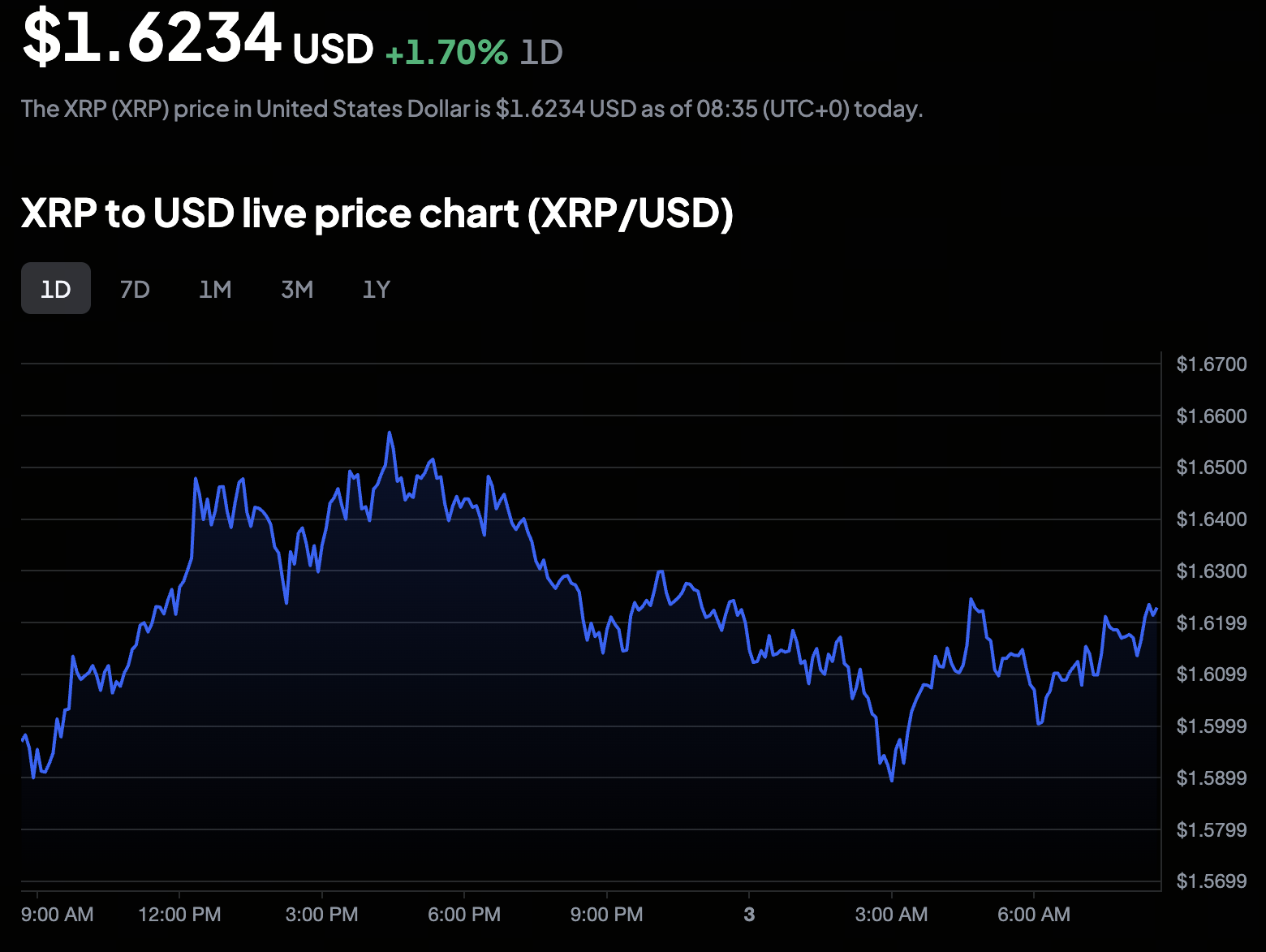
XRP price from Toobit, as of February 2, 2026, 16:36 UTC
Over the past week (January 7–14, 2026), XRP fluctuated between $2.05 lows and $2.17 highs, posting a net +2.8% gain amid ETF positioning and XRPL upgrade anticipation. Market cap holds steady near $130 billion with ~60.25 billion tokens circulating out of 100 billion total supply.
Recent XRP price charts confirm range-bound action around $2.10 after 25% year-to-date (YTD) returns, but with improving dynamics. Buyers defend dips more aggressively thanks to ETF accumulation while upside probes attract institutional conviction. This sets XRP up for a classic range compression ahead of directional resolution.
Current market snapshot (January 15, 2026, 00:54 UTC+8)
XRP trades at $2.16 per price charts, marking a 2.44% increase in the past 24 hours. Its market capitalization is approximately $131.08 billion, alongside $4.96 billion in daily trading volume.
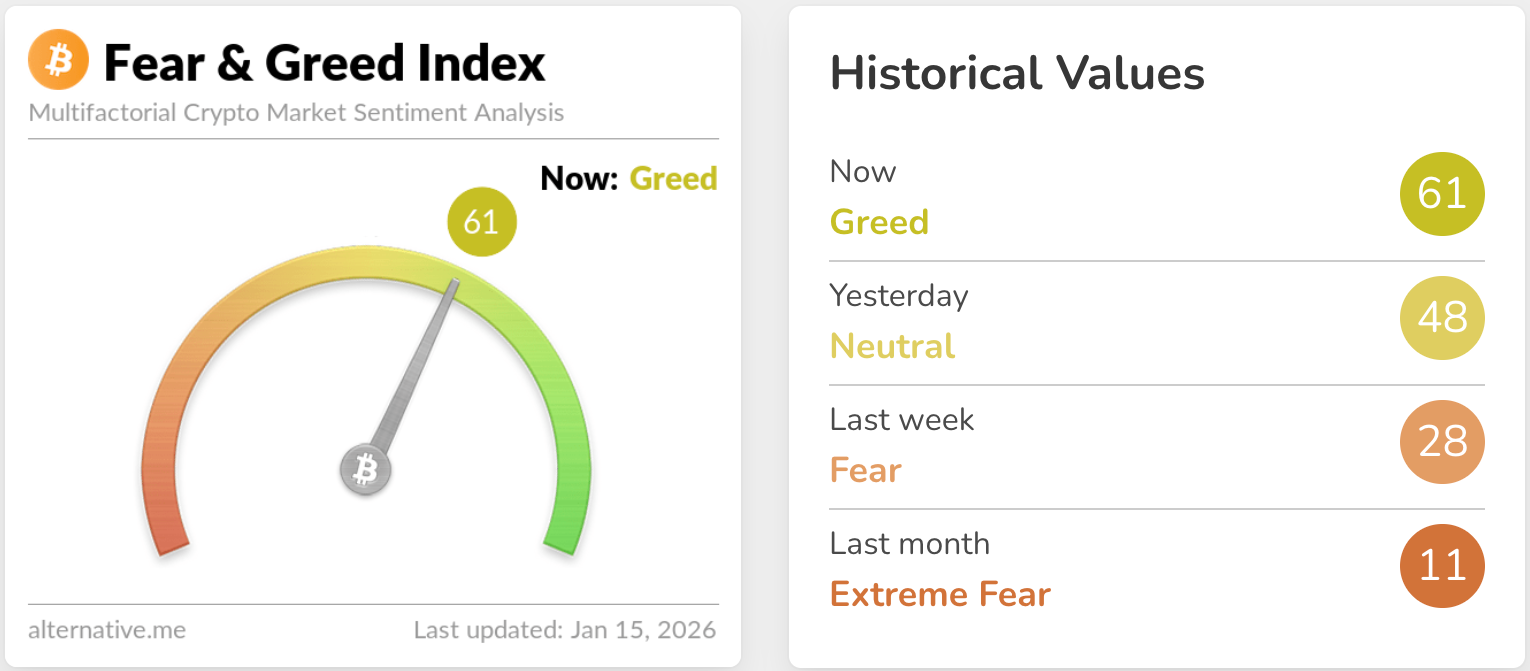
The Fear & Greed Index registers 61 (Greed), quickly rising from 48 just a day ago. XRP is driven by its early 2026 recovery, boosting momentum metrics and reducing volatility in the index components.
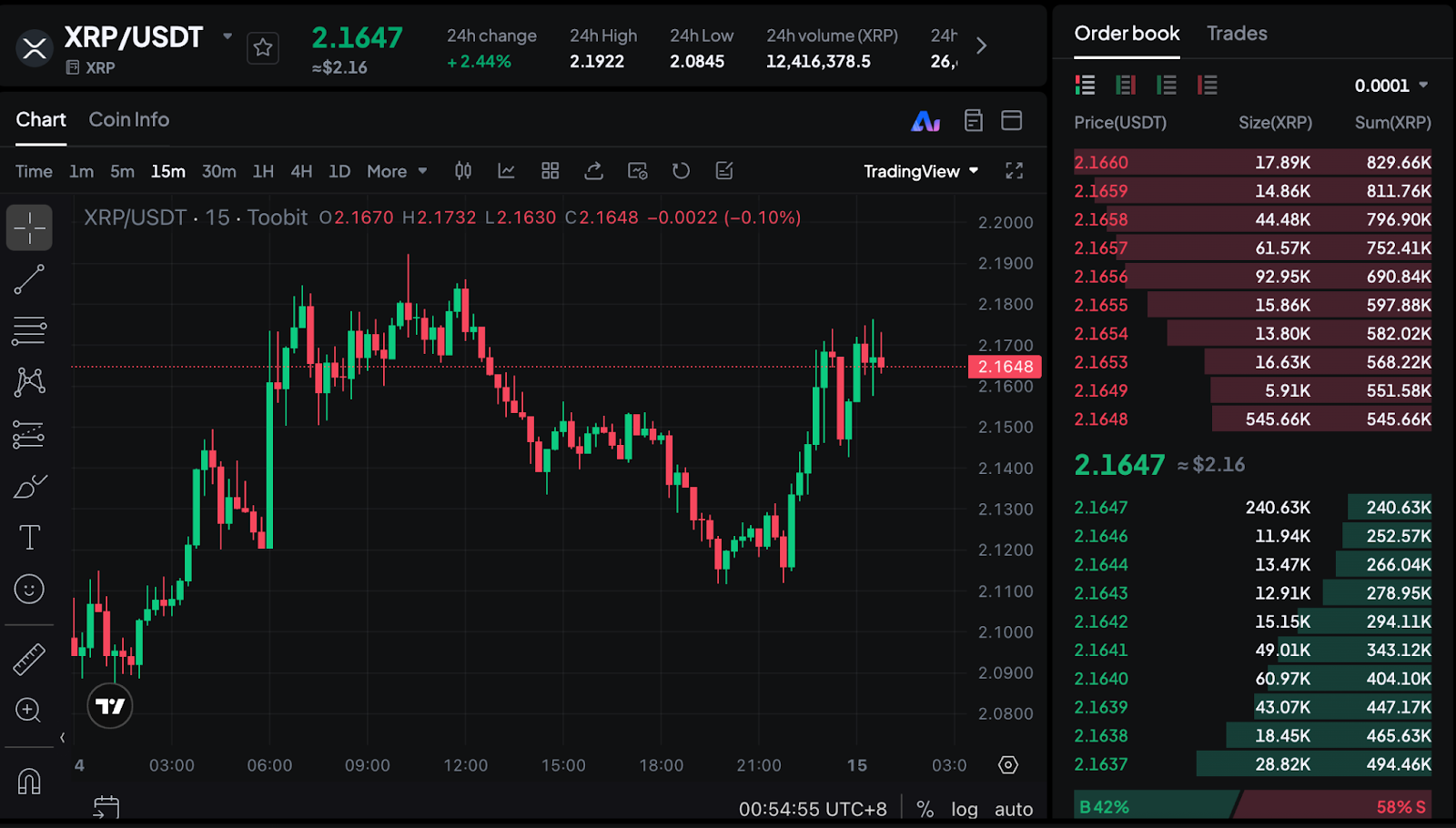
Trading ranged from an intraday peak of $2.19 to a low of $2.08, signaling stronger buying support amid recovering sentiment.
XRP appears poised for upward direction but awaits a catalyst to move decisively.
On-chain and technical analysis
Support and resistance
XRP traders now face a critical test at the $2.00 level, solidified as key support during its recent recovery.
The asset climbed to $2.19 intraday before pulling back to $2.08, leaving the central question: can XRP defend higher lows above $2.08 to sustain momentum?
-
Immediate support rests at $2.01, backed by the pivotal $2.00 mark.
-
Resistance looms first at the $2.20 barrier.
On the bigger picture, early 2026 analysis frames the action between firm $1.90–$2.00 floors and selling pressure through $2.10–$2.35. The structure is holding firm amid ETF-driven range trading.
Momentum indicators
Technical readings show balanced momentum without extreme positioning.
XRP displays a 14-day Relative Strength Index (RSI) around 52-55 (neutral zone) paired with Moving Average Convergence Divergence (MACD) histogram near zero or slightly positive (~0.01), reflecting consolidation strength rather than aggressive buying pressure.
The decisive factor remains price action validation. XRP defends crucial support levels during XRPL advancements while upholding its bullish framework.
Failure below $2.00 reframes recent gains as relief rally rather than trend continuation.
Moving averages and volume
On the 4-hour time frame, XRP maintains a position above its key 50-day moving average near $2.12 and the 200-day moving average around $1.98, preserving a constructive longer-term trend despite short-term price fluctuations.
Volume analysis shows accumulation of pullbacks above these averages, attracting buyers during dips. A sustained momentum, however, requires a decisive break above $2.20 resistance with confirming volume to signal the next bullish phase.
On-chain cues
Exchange reserves for XRP have dropped to near multi-year lows alongside over $1.3 billion in ETF inflows since November 2025. It signals diminished available supply for immediate sales on trading platforms.
This supply constraint doesn't ensure price gains but amplifies potential moves when buying pressure emerges, particularly as XRPL network shows 20% YTD growth in active addresses and elevated transaction activity ahead of anticipated protocol upgrades.
XRP price prediction and outlook
Market experts evaluate XRP's future path based on regulatory clarity, institutional adoption, and Ripple's token release schedule.
In the medium term, XRP benefits from predictable supply dynamics. Ripple's monthly escrow releases typically 1 billion tokens, with most relocked. They maintain balanced availability without flooding the market.
Adoption grew after the launch of regulated spot XRP exchange-traded products (ETPs) in late 2025, opening doors for mainstream market players through regulated vehicles.
The price of XRP is mainly influenced by multiple factors such as market sentiment, regulatory progress, macro environment, technological development and supply-demand structure. Among them, regulatory news (especially those related to the SEC) and global risk sentiment tend to cause the most intense short-term fluctuations:
Macro market sentiment and global risk events:When the overall risk appetite in the crypto market declines, XRP usually follows the decline of the broader market.
Regulation and legal developments (particularly in the SEC cases): Clearer regulation usually brings benefits, while negative judgments or tightened regulations can cause pressure. The long-term impact of the lawsuit filed by the US SEC against XRP has affected its price fluctuations.
Technology upgrade and the development of the XRPL ecosystem: updates to XRPL's efficiency, scalability, NFT, DeFi, AMM and other features will affect investors' expectations.
supply-demand structure: The total supply of XRP is fixed at 100 billion. The regular release of managed XRP by Ripple will affect the market supply.
XRP price tracks broader risk appetite closely. Current Fear & Greed reading at 61 suggests potential towards more upwards momentum. Participants may be eyeing macro catalysts for more directional conviction.
This article is for informational purposes only and does not constitute financial advice. Always do your own research (DYOR) before making any decisions.
Key milestones for XRP
-
2011-2012: XRP Ledger development and launch Developers created the XRP Ledger as an alternative to Bitcoin, launching its native currency XRP in June 2012 with 80% of supply gifted to OpenCoin (later Ripple Labs).
-
2013: OpenCoin rebrands to Ripple Labs The company behind XRP rebranded from OpenCoin to Ripple Labs, focusing on payment solutions using XRP for cross-border transfers.
-
2017-2018: First major bull run XRP surged from under $0.01 to an ATH near $3.84 in January 2018 during the crypto bull market, marking massive retail adoption.
-
2020: SEC lawsuit filed The U.S. SEC sued Ripple Labs in December 2020, alleging XRP sales were unregistered securities, causing price drops and exchange delistings.
-
2023: Partial court victory Judge Analisa Torres ruled XRP sales to retail buyers on public exchanges were not securities, though institutional sales violated securities laws, providing regulatory clarity.
-
2025: SEC case settlement and new ATH Ripple settled with the SEC after paying a fine, boosting sentiment. XRP hit a new ATH around $3.65 amid market strength and ETF developments.
-
Late 2025: XRP ETF launches Spot XRP ETFs debuted in the U.S. following SEC approval, attracting over $1.3 billion in inflows by early 2026 and driving institutional adoption.
-
Q1 2026 (Ongoing)
The XRP network is transitioning toward the “XRPL 2.0” phase, a unified enterprise-grade financial infrastructure platform that includes programmable inter-chain payments, institution-level private settlement, and automated liquidity routing.
Unlike traditional crypto assets, XRP has not relied on a single “breakout moment” to drive its price. XRP price history reflects a gradual path of regulatory clarity unfolding, institutional adoption steadily progressing, and liquidity layering maturing—rather than sudden market euphoria.
Community sentiment and XRP news
Community Sentiment
XRP community sentiment shows mixed signals in mid-January 2026, with retail caution contrasting with institutional optimism. Social media reflects bearish undertones from recent price dips, yet ETF inflows exceeding $1.3 billion signal growing confidence among large stakeholders.
Fear & Greed Index at 61 underscores a possible reversal. It rose from extreme lows near 24 in late December 2025, as early-year rallies sparked hope before volatility resumed.
Key XRP News
Ripple's escrow released 1 billion tokens this month, mostly relocked, maintaining supply discipline while trading around $2.05. Spot XRP ETF approvals continue to drive adoption, outpacing Bitcoin ETF flows in recent weeks.
Discussions heat up around potential Clarity Act passage and RLUSD stablecoin scaling past $2 billion, positioning XRP for cross-border payment gains. Former Ripple CTO David Schwartz's retirement comments fueled lighthearted community buzz.
The bottom line
If XRP stays on track with its ecosystem roadmap, 2026 could be the year it proves the real value of scalable settlement infrastructure.
XRP is shaping up as the default choice for users and institutions who are done tolerating the inefficiency of traditional finance and the instability of emerging chains. In short: it is not hype, it is functioning financial infrastructure with upside.
How to start trading XRP on Toobit
XRP is where global payment efficiency meets institutional-grade liquidity. If you are ready to trade on a network built for real financial needs, Toobit gives you a simple, streamlined way to get started.
Start trading XRP today.


