
Kaspa (KAS) enters 2026 with one of the clearer technical stories in Proof-of-Work (PoW): a fair-launched network that moved from 1 block per second (BPS) to 10 BPS through the Crescendo Hardfork. The harder question is whether that speed can turn technical progress into sustained demand for KAS.
Two forces are shaping that test. The first is the push to expand Kaspa beyond a settlement currency through Layer-2 (L2) programmability, including Kasplex, Igra Network, Toccata, and the DAGKNIGHT roadmap. The second is the still-unresolved Project Market Fit (PMF) problem: the network has stronger throughput, but the market still wants clearer proof of app activity, fee demand, and economic use.
The next sections explain how Kaspa works, where KAS sits inside the system, and what must improve before technical progress becomes a stronger token story.
What is Kaspa (KAS)?
Kaspa is a fair-launched Layer-1 (L1) PoW network built around a blockDAG design instead of a single linear blockchain. Its core function is simple: process transactions through parallel block creation while keeping the security model tied to mining.
KAS is the network’s native token. The token is used for settlement, transaction fees, and miner rewards. Unlike staking-based assets, KAS does not give holders on-chain voting power.
Kaspa is easiest to understand through 3 product lanes:
-
PoW settlement: Kaspa uses GHOSTDAG to order parallel blocks, allowing the network to process activity faster than a traditional single-chain PoW design.
-
10 BPS throughput: After Crescendo, Kaspa moved to 10 BPS, giving the network faster block production while keeping issuance tied to its fixed emission schedule.
-
L2 programmability: Kaspa does not run native smart contracts on its base layer. Smart-contract activity is being built through L2 ecosystems such as Kasplex and Igra Network.
Governance is also different from many L1 networks. Kaspa has no controlling foundation and no one-token-one-vote system. Protocol changes are handled through off-chain coordination, developer proposals, miner adoption, and community discussion.
This gives KAS a more distinct angle than a standard high-speed L1 story. The stronger case depends on whether the network can turn fast PoW settlement and L2 activity into sustained economic demand.
Kaspa price history and performance overview
KAS price history
KAS traded through a major expansion cycle that resulted in a new peak in 2024. Since then, price has reset sharply and is still sitting far below its all-time high, even though it remains well above its early historical low.
-
All-time high (ATH): around $0.207 on August 1, 2024
-
All-time low (ATL): around $0.000169 on June 1, 2022
KAS price from Toobit, as of May 14, 2026, around 16:38 UTC
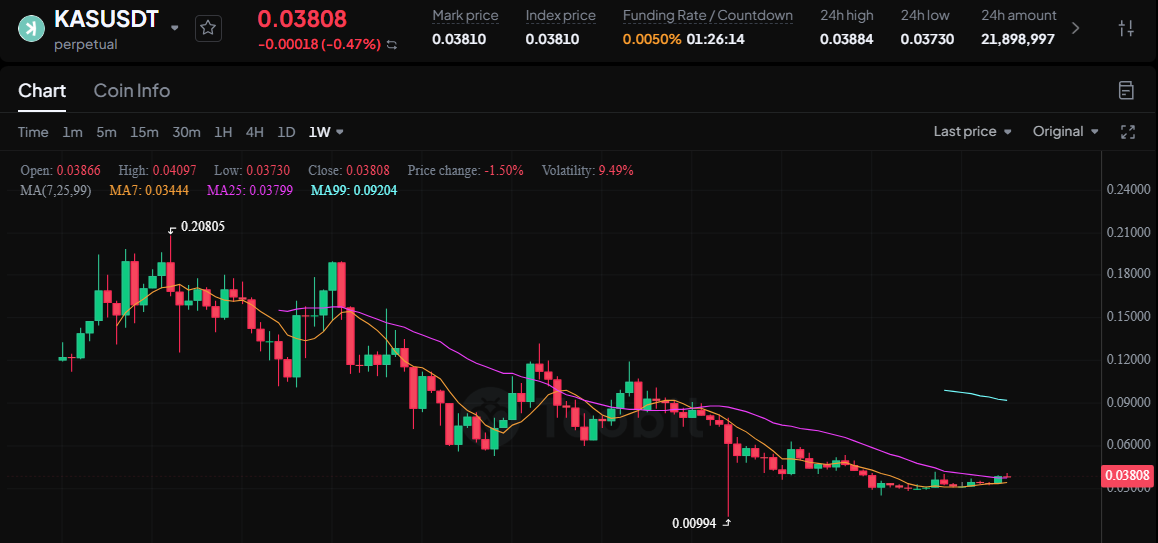
KAS’s latest performance
-
KAS price: around $0.03808
-
24h high: around $0.03884
-
24h low: around $0.03730
-
24h volume: around 21,898,997 KAS
At the time of writing, KAS is trading near the upper half of its 24-hour range, but the broader price context still reflects a deep reset from the 2024 peak.
Current market snapshot
Kaspa Fear and Greed Index from CFGI.io, as of May 13, 2026
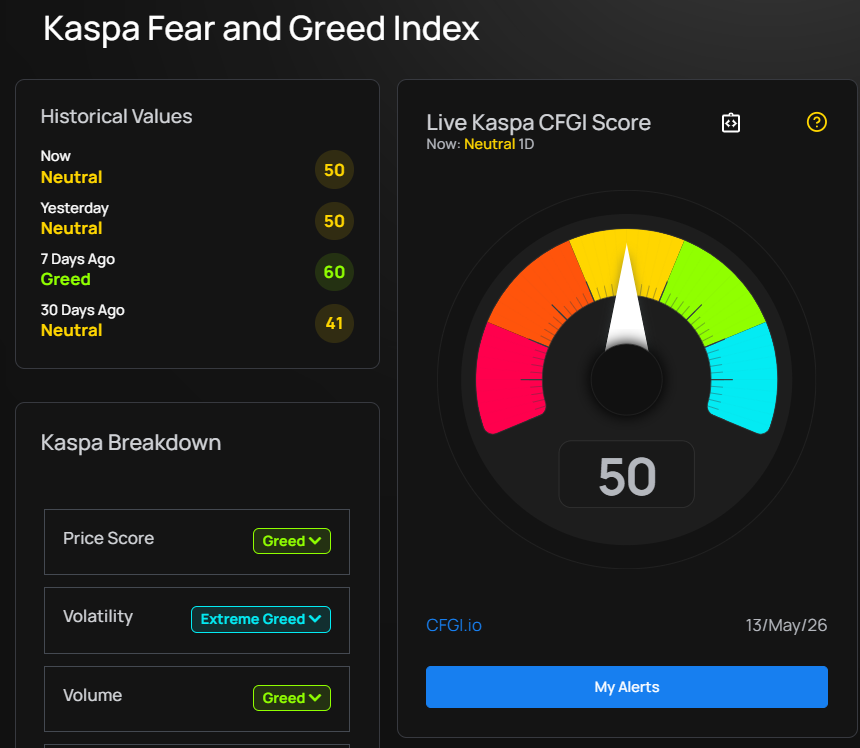
Kaspa Fear and Greed Index is at 50 (Neutral) as of May 13, 2026. The reading is unchanged from yesterday, which keeps the current mood balanced rather than clearly risk-on.
The comparison is mixed. KAS is below the 60 (Greed) reading from 7 days ago, but still above the 41 (Neutral) reading from 30 days ago. Sentiment has improved from last month, but it has cooled from last week’s stronger reading.
The index breakdown is more active under the surface, with price, volatility, and volume all leaning into Greed or Extreme Greed. For KAS, that supports a short-term stabilization read, but the neutral headline score means stronger follow-through still needs cleaner participation.
On-chain and technical analysis
Support and resistance
KAS is trading around $0.03808, near the upper half of its latest 24-hour range. The first area to hold sits around $0.03730 to $0.03790, using the 24-hour low and the 25-day moving average (MA25) area as the nearest downside references.
Near-term resistance sits around $0.03884. A cleaner push above that level would bring the next chart reference near $0.04097 into focus.
Momentum indicators
KAS Relative Strength Index (RSI) is around 45.91, which keeps momentum below the stronger bullish zone but no longer near deep oversold conditions. The read supports stabilization, not a confirmed upside trend.
KAS RSI from TradingView, as of May 14, 2026, around 16:38 UTC

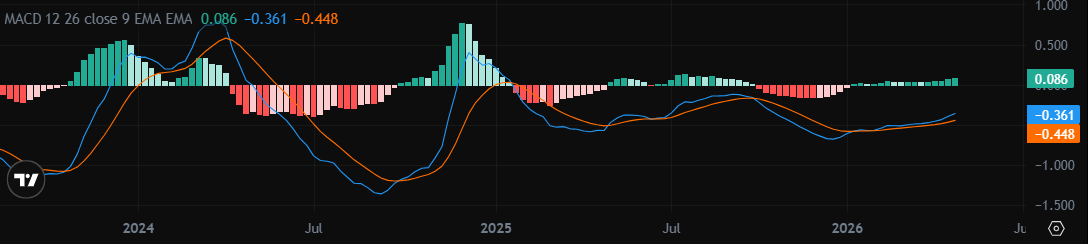
Moving average convergence divergence (MACD) is still below zero, with the MACD line near -0.00577, the signal line near -0.00807, and the histogram near 0.00230. Downside pressure has eased, but the signal still looks closer to recovery than a clean trend change.
KAS MACD from TradingView, as of May 14, 2026, around 16:38 UTC
Kaspa spot and futures flows show negative net flows across the visible 7-day, 14-day, 30-day, and 60-day windows. The read suggests that KAS is trying to stabilize while broader capital flow still leans outward rather than back into the market.
Kaspa spot and futures flows from CoinGlass, as of May 14, 2026, around 16:38 UTC
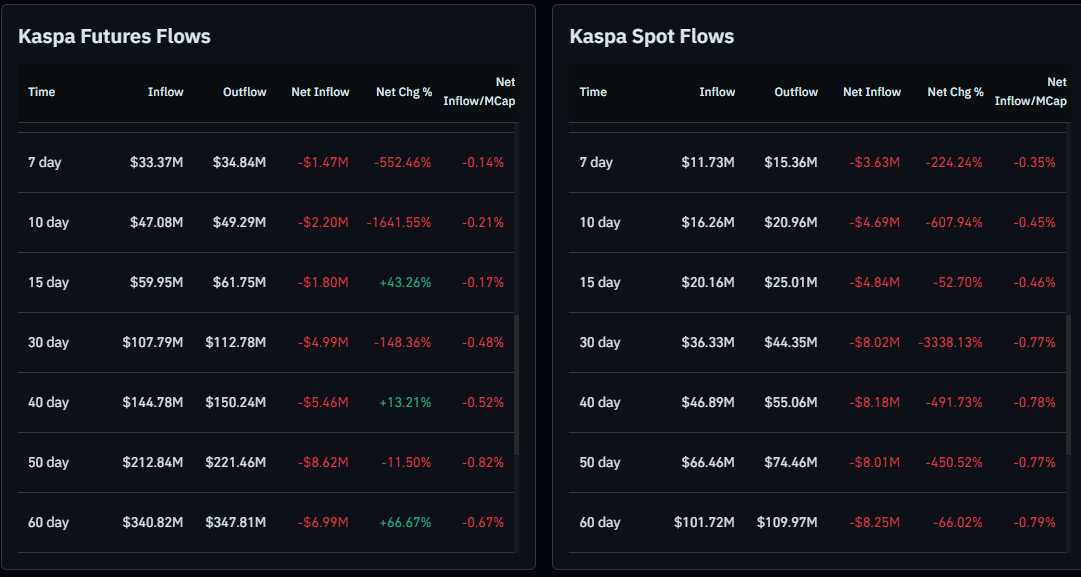
That weakens the participation signal. A cleaner recovery would usually look stronger if negative flows started narrowing first, then shifted closer to neutral or positive while price held above the short-term support area.
Moving averages and volume
KAS is trading above the 7-day moving average (MA7) near $0.03444 and slightly above MA25 near $0.03790, which points to firmer short-term momentum. The larger cap remains the 99-day moving average (MA99) near $0.09204, showing that the current move has not repaired the broader chart.
KAS volume from Toobit, as of May 14, 2026, around 16:38 UTC

Volume is around 76.655 million, compared with the 20-day volume average near 157.516 million. That leaves current volume roughly 51% below the average, so participation looks more consistent with stabilization than aggressive accumulation.
On-chain cues
Derivatives positioning is still active, but it is not confirming a stronger move yet. For KAS, that leaves the rebound looking low-conviction rather than fully supported.
Total open interest (OI) is around 1.43 billion KAS, or roughly $54.33 million. Short-term changes are negative across the board, with OI down around 1.67% (1-hour), down around 0.49% (4-hour), and down around 1.06% (24-hour). That decline suggests positioning is not building with price. The market is still active, but participation is fading, which makes it harder to treat the latest rebound as a stronger extension.
KAS OI from CoinGlass, as of May 14, 2026, around 16:38 UTC
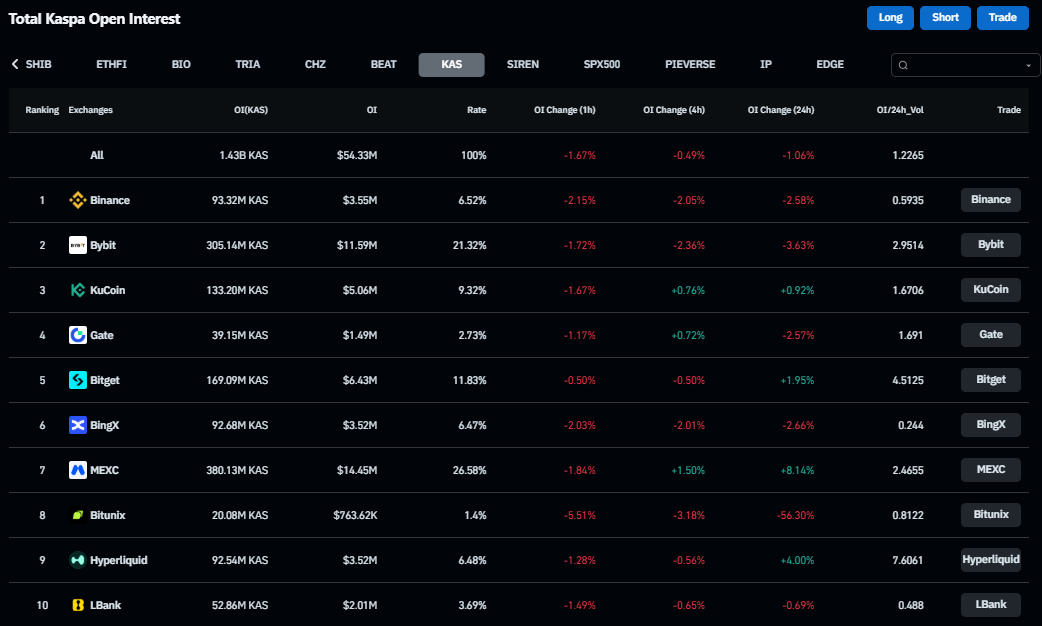
That decline across all 3 windows shows participation is fading rather than building with price. For KAS, this makes the rebound less convincing until OI starts expanding alongside a reclaim of resistance.
KAS OI-weighted FR from CoinGlass, as of May 14, 2026, around 16:38 UTC
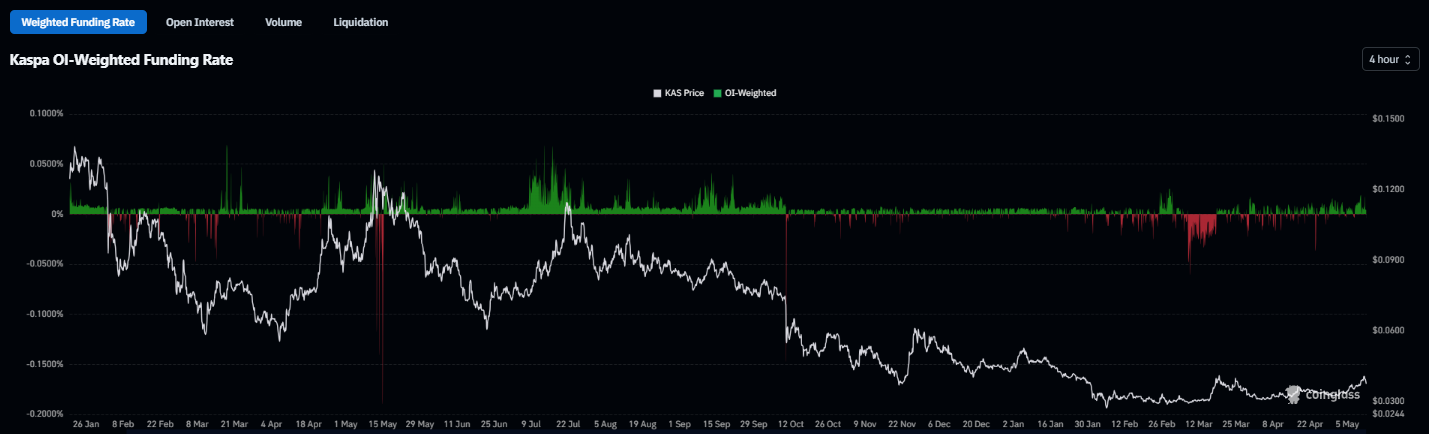
The OI-weighted funding rate (FR) is near neutral to slightly positive. Toobit shows 0.0050%, while the CoinGlass OI-weighted reading also appears controlled. This means long positioning does not look aggressively crowded, but it also does not confirm a strong directional push.
What to watch next
-
First, KAS needs to hold $0.03730 to $0.03790
-
Next, a reclaim of $0.03884 would improve the short-term read
-
A push toward $0.04097 needs stronger volume to avoid looking thin
-
Confirmation improves if OI stops declining and rebuilds with price
-
FR should stay controlled while spot and futures flows turn less negative
KAS price prediction and outlook
Base case
KAS keeps stabilizing while holding the recent spot floor near $0.03737.
Price remains capped below the recent spot high near $0.03883, which keeps the move constructive in the short term but still incomplete. The setup stays steady if volume does not fade further, OI stops declining, and FR remains controlled.
Bull case
KAS reclaims $0.03883 on spot and starts holding above it.
A sustained reclaim improves the short-term read and opens room toward the $0.04 area. The move becomes more credible if spot volume improves, OI rebuilds with price, and negative spot and futures flows start narrowing.
Bear case
KAS loses $0.03737 on spot and fails to reclaim it quickly.
The setup weakens if price falls back below the recent base and cannot recover the level. The lower short-term range comes back into focus if volume stays light, OI keeps falling, and flows remain negative across the visible windows.
A controversial viewpoint
Kaspa can remain technically distinctive without becoming a clear momentum leader. Its PoW blockDAG design gives the network a stronger scalability story than older single-chain PoW assets, but that does not automatically create sustained demand for KAS.
The sharper risk is relevance without re-rating. The network can keep its infrastructure narrative alive while the token stays range-bound if market participation, liquidity, and flow data fail to improve together.
The key twist
-
Scalable PoW lane: Kaspa’s blockDAG design keeps the network positioned around faster PoW settlement and parallel block processing. This gives KAS a cleaner infrastructure identity than a generic legacy PoW token.
-
Participation lane: The market still needs stronger evidence that interest is turning into durable demand. Better volume, improving flows, and rebuilding OI can make KAS easier to frame as a utilization-linked asset rather than a low-base rebound.
Community sentiment and KAS news
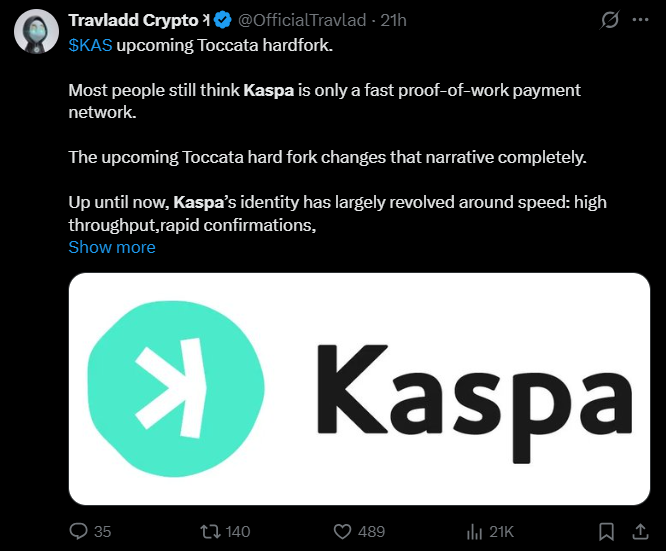
KAS chatter has stayed active as the token’s 2026 narrative tightens around scalability, PoW infrastructure, and the upcoming Toccata hard fork. A community post from Travladd Crypto framed the upgrade as a shift beyond Kaspa’s fast-payment identity, with the focus moving toward broader network capability.
A community post discussing KAS from X, as of May 13, 2026
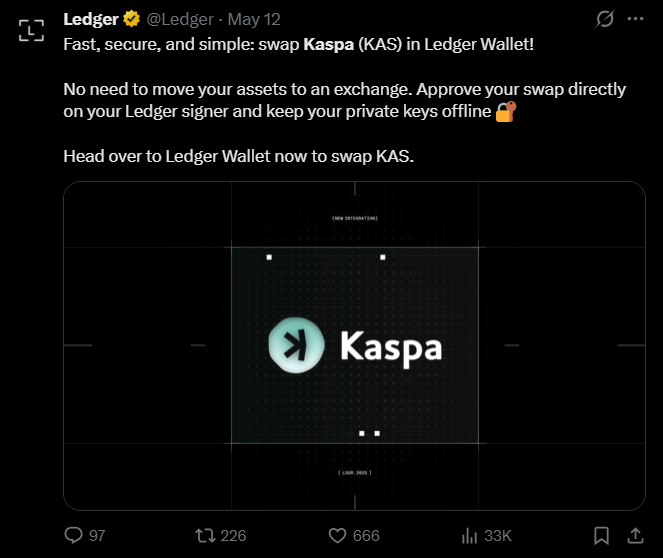
Ledger also said KAS can now be swapped directly inside Ledger Wallet, giving holders a cleaner self-custody swap route without moving assets to an exchange. The update supports token accessibility, even if it does not directly confirm stronger market demand.
Ledger Wallet KAS swap update from X
Community sentiment from CoinMarketCap also leans supportive. The latest read shows 89% bullish versus 11% bearish, with the 7-day trend up 4.4%. That keeps the signal directionally positive, though the vote count is still limited, with 204 votes recorded in the last 24 hours.
Community sentiment for KAS from CoinMarketCap, as of May 13, 2026
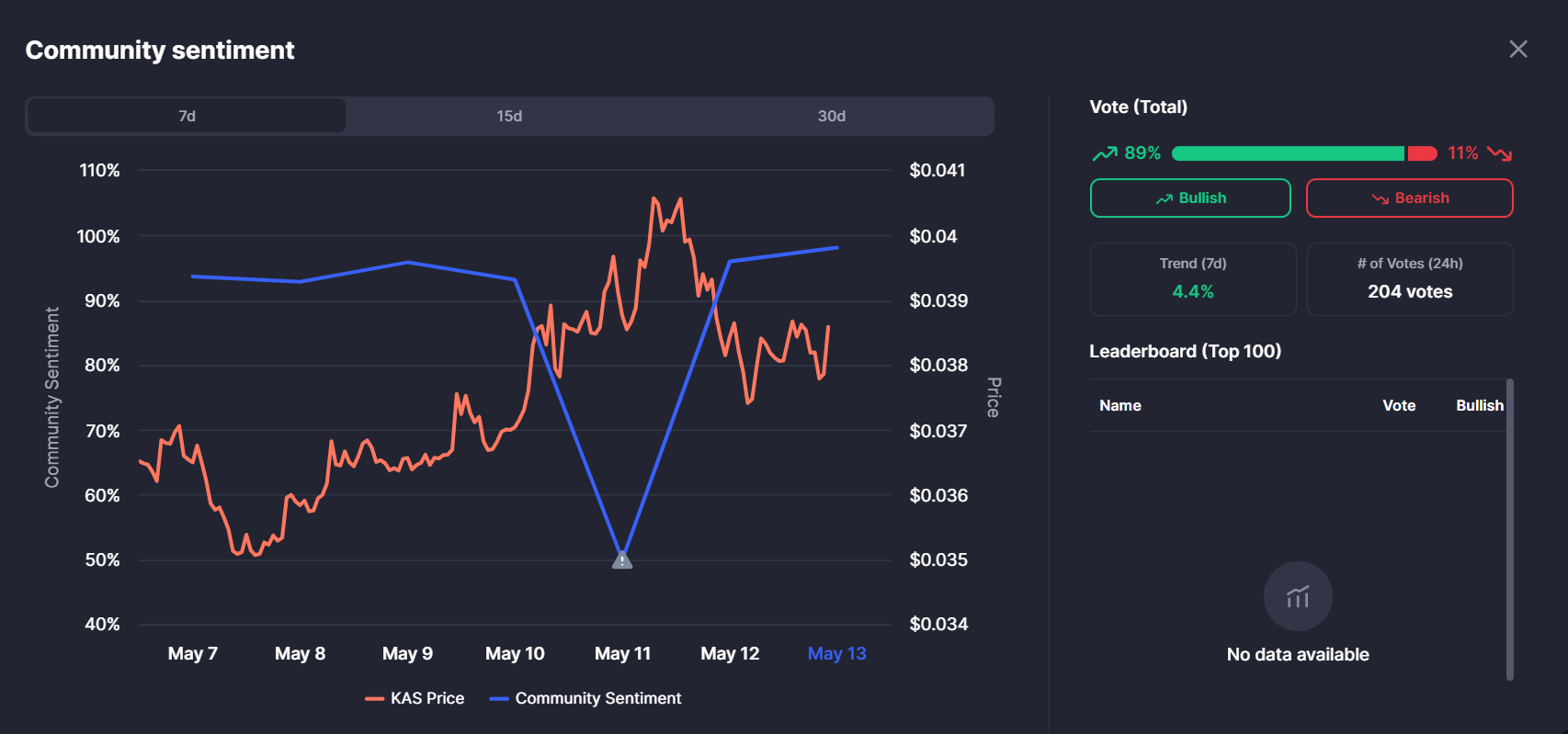
The broader takeaway is that the market still recognizes Kaspa as a distinctive PoW asset with an active scalability narrative. Even so, KAS still needs stronger participation and cleaner follow-through before that constructive tone becomes stronger token conviction.
FAQs
How does Kaspa process blocks?
Kaspa uses GHOSTDAG to order blocks that are created in parallel. Instead of forcing every block into one linear chain, the network can include multiple valid blocks in its structure and still maintain ordering.
This is the core reason Kaspa can keep a PoW security model while targeting faster throughput than older single-chain PoW designs.
What is KAS used for?
KAS is used for transaction fees, settlement, and miner rewards. It is the asset paid across the base network when activity moves through Kaspa.
KAS is not a staking token and does not give holders on-chain governance power. Its economic role is closer to a mined settlement asset than a typical PoS utility token.
Why is 10 BPS important for Kaspa?
10 BPS increases Kaspa’s block production rate and gives the network more room to process activity at the base layer. It is one of the clearest technical upgrades behind Kaspa’s 2026 narrative.
The practical test is demand. Faster blocks improve capacity, but KAS still needs stronger activity, fees, and app-layer usage to turn that performance into durable economic value.
Does Kaspa support smart contracts?
Kaspa does not run native smart contracts directly on the base layer. Its current design keeps the L1 focused on fast PoW settlement, while programmability is being developed through L2 ecosystems such as Kasplex and Igra Network.
That keeps the base layer simpler, but it also means Kaspa’s app-layer thesis depends on whether L2 activity can grow around the network.
Should I buy KAS now?
That depends on risk tolerance, time horizon, and how you view Kaspa’s role in the PoW market. KAS is worth studying because it combines fair-launch distribution, capped supply, PoW mining, and high-speed block production in a category where few networks are still trying to scale the base settlement layer.
The stronger long-term case depends on whether Kaspa can turn its technical design into sustained economic activity. The network still needs stronger L2 usage, clearer fee demand, and more visible app activity before its technical credibility can support a more durable token story.
Key milestones for Kaspa
-
November 7, 2021: Kaspa fair-launched on mainnet with no premine, no presale, and no founder allocation. That launch remains central to KAS because the token’s supply started through mining rather than private allocation.
-
May 2022: Kaspa’s chromatic emission schedule activated, setting monthly reward reductions under a capped supply model of around 28.7 billion KAS. This made monetary policy a core part of the token’s hard-money narrative.
-
March 2023: Kaspa’s community-governance model became more visible through public crowdfunding, including development funding, exchange-listing support, and wallet-related initiatives. This reinforced Kaspa’s unusual funding path: community coordination instead of a central treasury or traditional token sale.
-
April 2023: ASIC mining expanded across Kaspa, increasing network hashrate and pushing the project deeper into industrial PoW mining. This helped move KAS beyond early community mining into a more competitive security model.
-
January 2024: Testnet 11 went live at 10 BPS, giving developers a live environment to test the Rust rewrite and higher-throughput network behavior before the mainnet upgrade.
-
June 2024: The KRC-20 beta launched on Kaspa mainnet through Kasplex, creating one of the network’s first major activity spikes. It showed that demand for token activity could stress-test Kaspa’s high-throughput design.
-
September 2024: KRC-20 functionality moved further into mainnet activity, bringing tokens such as NACHO, KASPER, KONAN, and KDAO into the ecosystem. This gave Kaspa an early app-layer narrative, even before full L2 programmability.
-
May 5, 2025: The Crescendo Hardfork activated on mainnet, moving Kaspa from 1 BPS to 10 BPS. This remains the project’s most important shipped upgrade because it turned Kaspa’s high-speed PoW thesis into live production infrastructure.
-
March 2026: Igra Network launched public mainnet as an EVM-compatible L2 on Kaspa, according to ecosystem-distributed materials. This added another path for smart-contract activity while keeping the heavy lifting off Kaspa’s base layer.
-
April 2026: The Toccata Hard Fork roadmap was published, setting up Kaspa Covenants++ and the next stage of protocol-level programmability. This keeps the 2026 focus on whether Kaspa can turn technical progress into stronger economic use.
What KAS still needs to prove
Kaspa enters 2026 with one of the clearer technical proof points in the PoW category. Crescendo moved the network to 10 BPS, and the roadmap now points toward Toccata, DAGKnight, and L2 activity as the next tests for whether that speed can support real usage.
The setup improves if app-layer traction starts creating repeatable fee activity, settlement demand, and a clearer role for KAS beyond mining rewards and basic transfers. The main risk is that Kaspa keeps shipping protocol upgrades while the ecosystem still lacks enough product demand to support a broader token re-rating.
Until that gap narrows, KAS remains a technically credible asset with an unfinished demand story.
This article is for informational purposes only and does not constitute financial advice. Always do your own research (DYOR) before making any decisions.
How to start trading Kaspa (KAS)
Kaspa is worth watching because it sits in a rare lane: a fair-launched PoW network with live 10 BPS performance, a capped supply model, and a growing L2 roadmap. The stronger case for KAS depends on whether that technical base turns into real activity, fee demand, and broader settlement use.
Ready to trade KAS? Toobit gives you a straightforward way to track KAS price moves, compare market conditions, and trade with spot and futures tools in one place.
Start trading KAS/USDT on Toobit today.


