
Humanity Protocol (H) enters 2026 with an adoption narrative that outpaces its token performance. The network has moved beyond testnet identity creation into Human ID, Proof of Trust (PoT), and enterprise integrations, but the market still wants clearer proof that verified identity activity can create durable demand for H.
Humanity Protocol Architecture from Messari, as of May 21, 2026
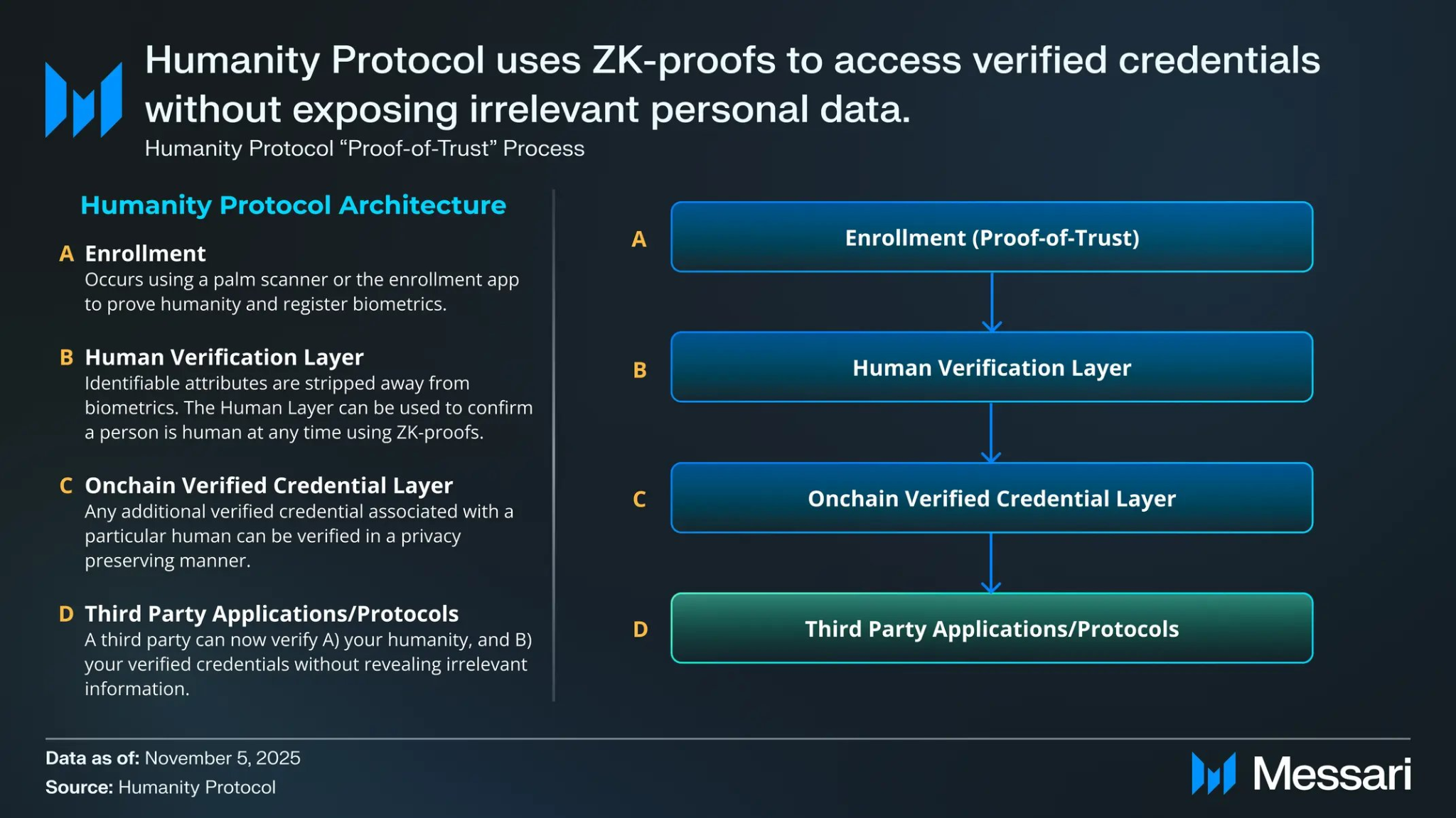
Two forces shape the setup. The first is rising demand for human verification as artificial intelligence (AI) agents, deepfakes, and Sybil activity make digital trust harder to prove. The second is the token’s value-capture test: H sits across gas, staking, governance, credential fees, and Fairdrop incentives, but those roles still need measurable usage from partners, builders, and verified participants.
The next sections explain how Humanity Protocol works, where H sits inside the identity stack, and what must improve before identity traction becomes a stronger token story.
What is Humanity Protocol (H)?
Humanity Protocol is a decentralized identity network built to prove that a digital account belongs to a unique person without exposing personal data. It runs as a zero-knowledge Ethereum Virtual Machine (zkEVM) Layer-2 (L2) built with Polygon Chain Development Kit (CDK), using palm biometrics and zero-knowledge proofs to issue privacy-preserving Human IDs.
H is the network’s native token. It is used for L2 gas, staking, governance, credential issuance and verification fees, and rewards across Fairdrop campaigns. This gives H a role across identity verification, network security, and ecosystem incentives.
Humanity Protocol is easiest to understand through 3 product lanes:
-
Human ID: The core credential that lets a person prove uniqueness across apps, platforms, and partner services without making raw identity data public.
-
PoT: The verification layer that uses palm biometrics and zero-knowledge proofs to reduce Sybil activity, fake accounts, and AI-driven identity fraud.
-
Developer tools: Fairdrops, Verifiable Credentials, zkProofers, application programming interface (API), and software development kit (SDK) access allow builders and institutions to integrate human verification into apps, rewards, finance, ticketing, education, and other credential-based use cases.
Governance is expected to become more important as the protocol decentralizes. H holders and verified Human IDs are designed to influence protocol decisions, while zkProofers help verify identity credentials and support the network’s trust layer.
This makes H’s story broader than a normal L2 token. The stronger case depends on whether verified identity, credential fees, staking, and enterprise integrations can turn Humanity Protocol’s adoption into sustained token demand.
Humanity Protocol price history and performance overview
H price history
H has already gone through a visible expansion-reset cycle in its trading history. The token reached its peak in October 2025 and is now trading below that level, while still holding far above its June 2025 low.
-
All-time high (ATH): $0.3887 on October 25, 2025
-
All-time low (ATL): $0.01799 on June 27, 2025
H price from Toobit, as of May 21, 2026, around 05:00 UTC
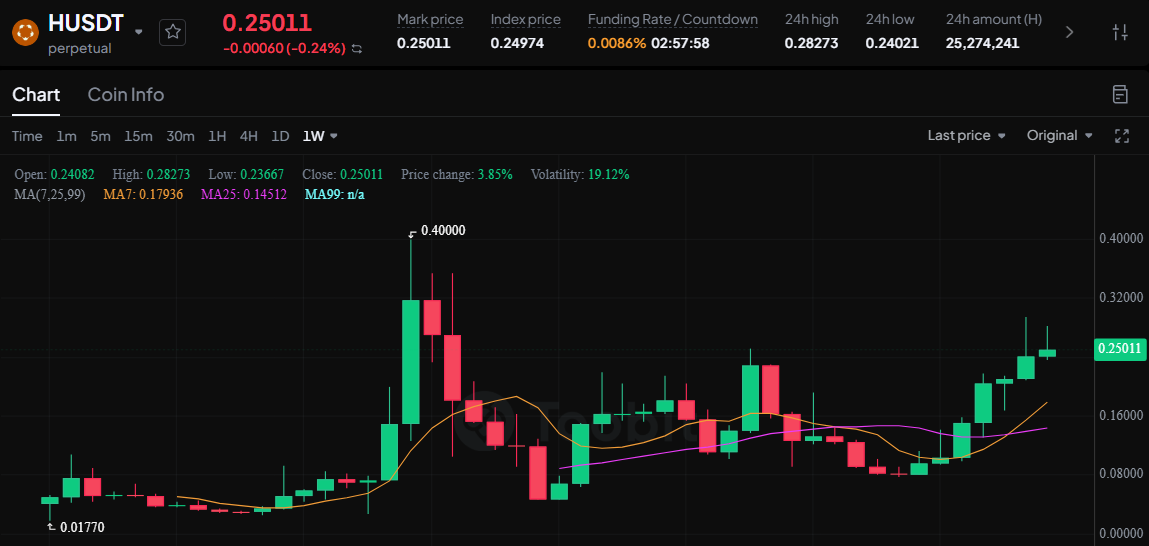
H’s latest performance
-
H price: around $0.25011
-
24h high: around $0.28273
-
24h low: around $0.24021
-
24h volume: around 25,274,241 H (around 6.32 million USDT)
At the time of writing, H is trading about 35.81% below its ATH and about 1,286.87% above its ATL. The implication is that price remains well above its historical low, but any stronger recovery still needs clearer follow-through.
Current market snapshot (May 21, 2026)
Bitcoin CFGI from CFGI.io, as of May 21, 2026, around 05:00 UTC
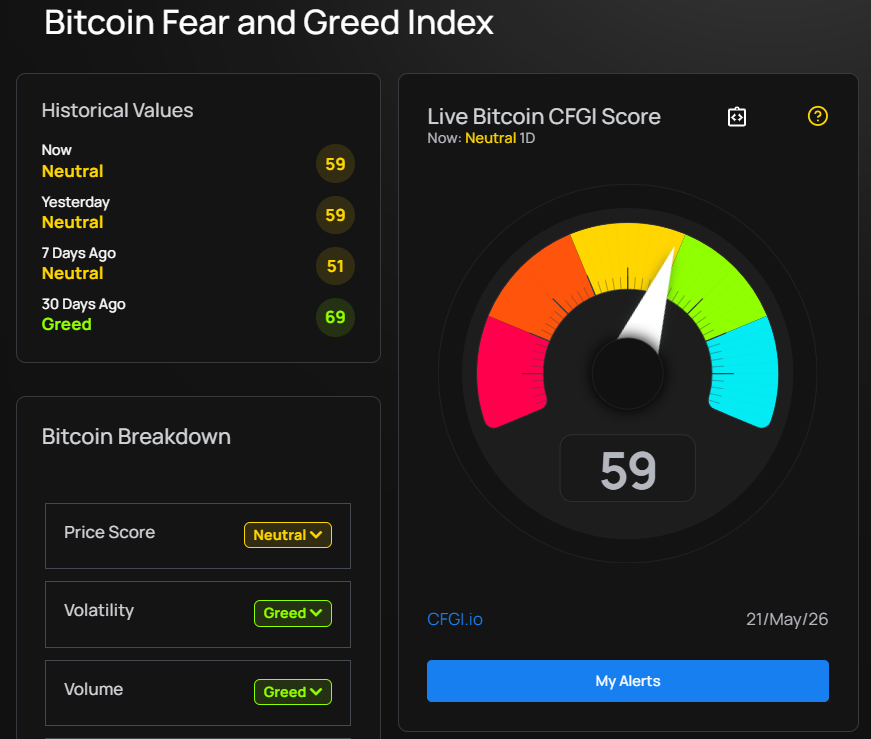
The Bitcoin Crypto Fear and Greed Index (CFGI) score is 59 (Neutral), unchanged from yesterday. A week ago it was 51 (Neutral), while 30 days ago it stood at 69 (Greed).
The market mood has improved from last week but remains below last month’s greed reading. For H, this creates a more balanced backdrop: short-term rebounds can still develop, but the setup is not fully risk-on.
The CFGI breakdown is more active under the headline score. The price score is neutral, while volatility and volume both read greed. This suggests market participation has improved, but H still needs stronger token-specific follow-through before the broader mood becomes a reliable confirmation signal.
On-chain and technical analysis
Support and resistance
H is trading around $0.25011 in the perpetual market, below its latest 24-hour high but still above the first near-term support. The first level to hold sits around $0.24021, with a deeper local reference near $0.23667 if the range weakens.
Near-term resistance sits around $0.28273. A cleaner reclaim above that area would shift attention back toward the wider historical reference near the $0.3887 ATH.
Momentum indicators
The Relative Strength Index (RSI) is around 35.71, which keeps momentum weak but not deeply oversold. The reading suggests H is trying to stabilize, but it does not yet show a stronger recovery signal.
H RSI from TradingView, as of May 21, 2026, around 05:00 UTC

The Moving Average Convergence Divergence (MACD) is mixed. The MACD line is near 0.00024, above the signal line near -0.00278, but the histogram remains negative near -0.00303. Downside pressure appears to be easing, though the signal still looks closer to stabilization than a clean trend change.
H MACD from TradingView, as of May 21, 2026, around 05:00 UTC

Spot and futures flows
H flow data is uneven across timeframes. Futures flows are positive on the 12-hour window at around $738,320, but mid-range pressure is still visible, including a 4-hour futures outflow of around $186,480.
H spot and futures flows from CoinGlass, as of May 21, 2026, around 05:00 UTC
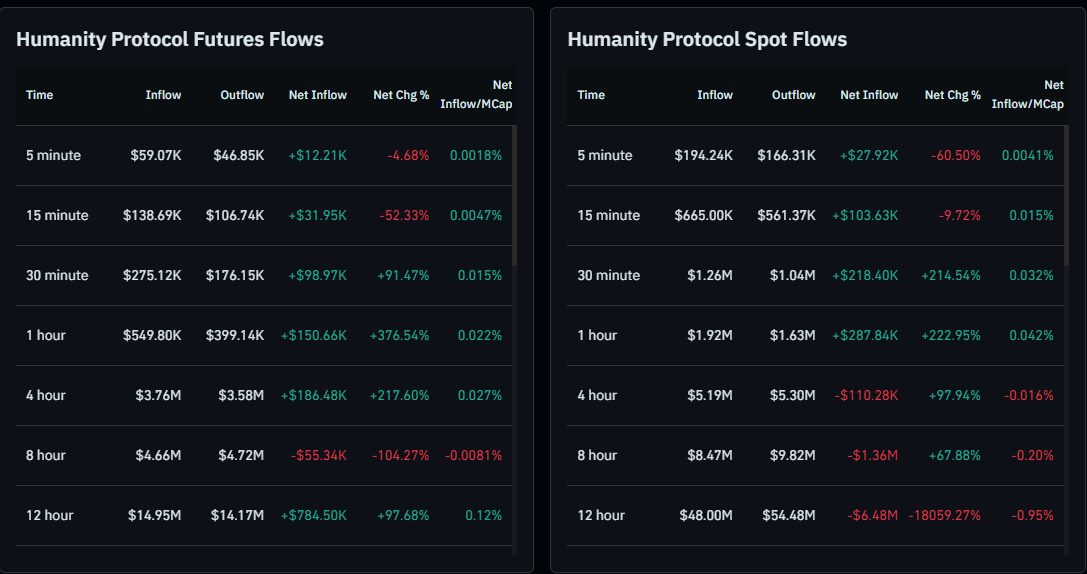
Spot flows are the weaker part of the read. Short windows show inflows, but the 12-hour spot flow shows a larger outflow of around $4.48 million. That makes the rebound less convincing because longer-window spot demand is not confirming the move.
Moving averages and volume
The moving average (MA) read is still supportive for the short-term base. H is trading above the 7-day MA at $0.17936 and the 25-day MA at $0.14512, which means price remains above the nearest average-price levels. The 99-day MA is unavailable in the chart, so it should not be used as a broader structure reference.
H volume from Toobit, as of May 21, 2026, around 05:00 UTC

Volume still limits the read. The latest volume is around 71.167 million H, below the 20-day volume average of around 223.149 million H. The implication is that price is holding above key MAs, but participation is not strong enough yet to confirm a cleaner recovery phase.
On-chain cues
Derivatives positioning is still active, but it is not confirming a stronger move yet. For H, the rebound looks uneven because price is stabilizing while Open Interest (OI) is slipping across the main visible timeframes.
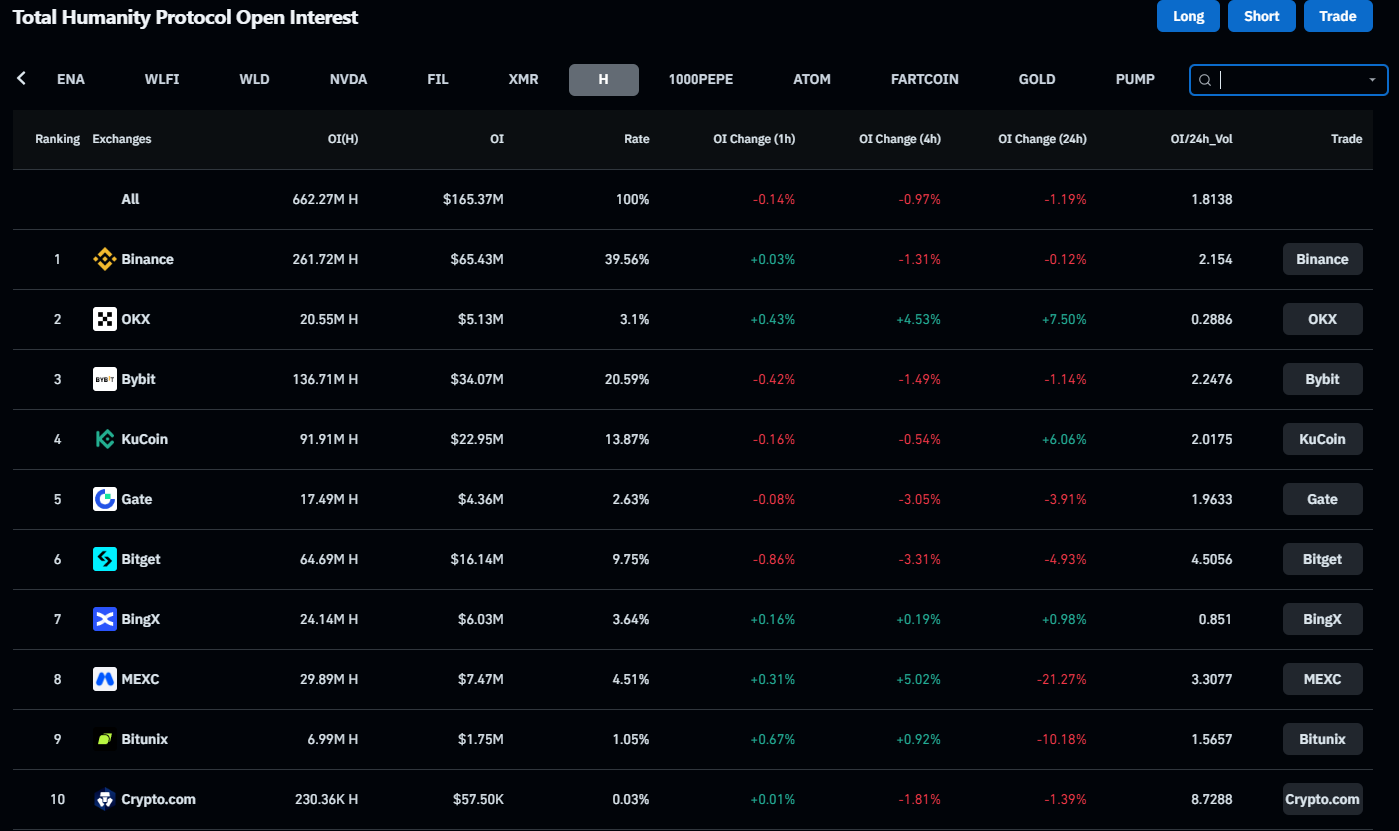
H OI from CoinGlass, as of May 21, 2026, around 05:00 UTC
OI is around 662.27 million H, or roughly $165.37 million. OI is down around 0.14% over 1 hour, 0.97% over 4 hours, and 1.19% over 24 hours. This reflects fading derivatives participation, confirming the current move lacks a fresh build-up of positions.
H OI-weighted FR from CoinGlass, as of May 21, 2026, around 05:00 UTC.
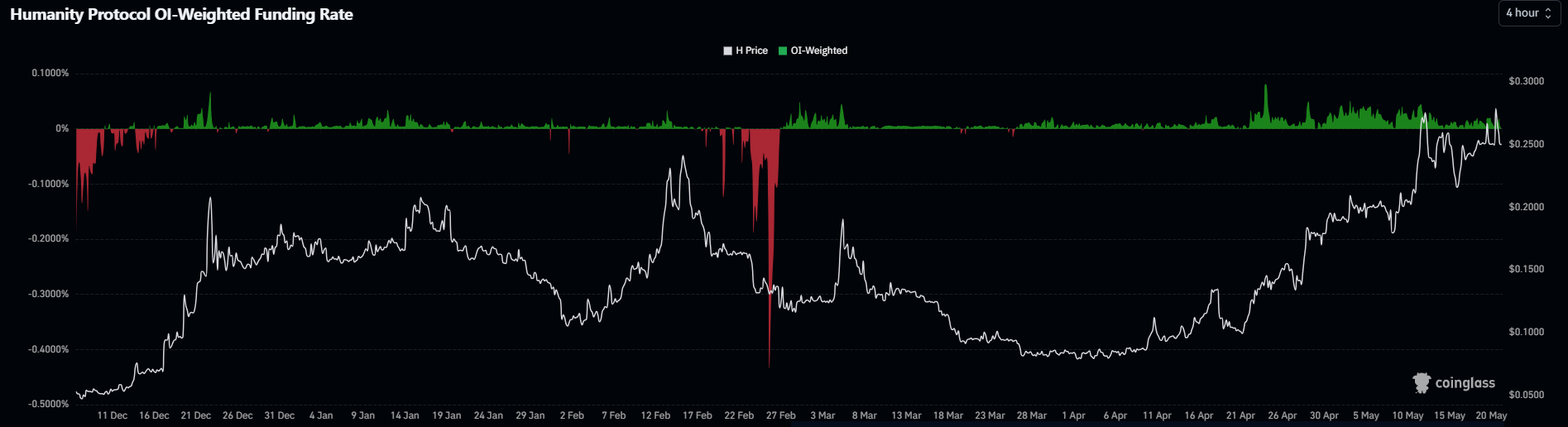
The Funding Rate (FR) from Toobit is around 0.0086%, while the OI-weighted FR from CoinGlass is hovering near neutral to slightly positive on the visible 4-hour view. Long positioning does not look overheated, but FR is not strong enough to offset weaker OI and spot-flow confirmation.
What to watch next
-
$0.28273 reclaim: Confirm with price holding above the 24-hour high area.
-
$0.24021 hold: Keeps the near-term range intact.
-
$0.23667 hold: Confirms the deeper local low has not broken.
-
Volume expansion: Needs improvement from 71.167 million H toward the 20-day volume average.
-
12-hour spot outflow narrows: Improves confirmation if selling pressure fades.
-
OI stabilizes with controlled FR: Supports participation without making the move leverage-heavy.
-
RSI moves toward 50: Confirms momentum is improving from weak territory.
-
MACD histogram improves: Confirms downside pressure is easing further.
H price prediction and outlook
Base case
H can stay in a short-term stabilization range if spot price holds above $0.24021, with $0.23667 as the deeper level that keeps the current range intact. The main cap remains $0.28273, where price needs a cleaner reclaim before the move can look stronger.
The current setup is supported by price holding above the nearest MA levels, but volume is still below the 20-day volume average. OI is also slipping across 1-hour, 4-hour, and 24-hour windows, so derivatives positioning is not confirming a stronger move yet.
Bull case
A spot reclaim above $0.28273 would improve the short-term setup first. If H holds above that level, the next wider reference becomes the $0.3887 ATH area.
A cleaner recovery would need stronger volume and better spot-flow confirmation. OI stabilizing with controlled FR would support the move, but the main trigger remains spot price reclaiming resistance and holding above it.
Bear case
A loss of $0.24021 would weaken the near-term range and put $0.23667 back into focus. If H loses that deeper local level, the recovery attempt becomes harder to defend.
The bear read becomes stronger if volume stays below average while spot outflows remain heavy. Falling OI would add to the weak-participation read, but the main warning signal remains spot price losing support.
A controversial viewpoint
H can remain relevant as an identity-infrastructure token without leading on price. The proof-of-humanity angle may keep the project visible, but the token still needs stronger spot demand and clearer usage signals before market participants treat the rebound as durable.
The key twist
-
Identity infrastructure: Humanity Protocol’s stronger narrative is tied to whether proof of humanity becomes a practical verification layer for apps, networks, or human-centric digital access. If that use case gains clearer adoption, H may be framed beyond short-term trading flows.
-
Token demand: The price case still depends on whether project activity translates into visible demand for H. Stronger spot flows, higher volume, and controlled derivatives positioning would give the token a cleaner path than narrative relevance alone.
Key milestones for Humanity Protocol
-
February 2024: Humanity Protocol emerged from stealth with a focus on palm biometrics, zero-knowledge proofs, and privacy-preserving digital identity. This set the foundation for its human-verification framework.
-
May 2024: The project raised $30 million at a $1 billion valuation, giving Humanity Protocol a larger funding base before its mainnet and token launch.
-
End of 2024: Humanity Protocol reached around 2 million Human IDs, giving the network its first major scale signal before wider product and enterprise expansion.
-
January 2025: The Humanity Foundation launched, creating the formal governance and ecosystem entity for protocol growth, partnerships, and future decentralization.
-
January 2025: Humanity Protocol raised $20 million at a $1.10 billion valuation, bringing disclosed funding to $50 million before the H launch cycle.
-
June 2025: Humanity Protocol launched mainnet alongside the H Token Generation Event (TGE), with the first Fairdrop distributing tokens through a Sybil-resistant claim flow.
-
June 2025: Humanity Protocol acquired Moongate, extending the identity stack into event access, ticketing, loyalty programs, and real-world credential use cases.
-
November 2025: The Mastercard Open Finance partnership was announced, connecting Human ID to financial verification use cases such as credit, lending, and access to real-world financial services.
-
December 2025: Humanity Protocol integrated Walrus Protocol as a decentralized storage layer for identity and credential data, supporting the network’s push toward larger credential scale.
-
January 2026: The Fireblocks integration went live, giving more than 2,400 institutions custody and treasury access to H and Humanity Mainnet assets. By 2026, the network had reported around 9 million Human IDs registered.
Community sentiment and H news
H community sentiment from CoinMarketCap, as of May 21, 2026, around 05:00 UTC
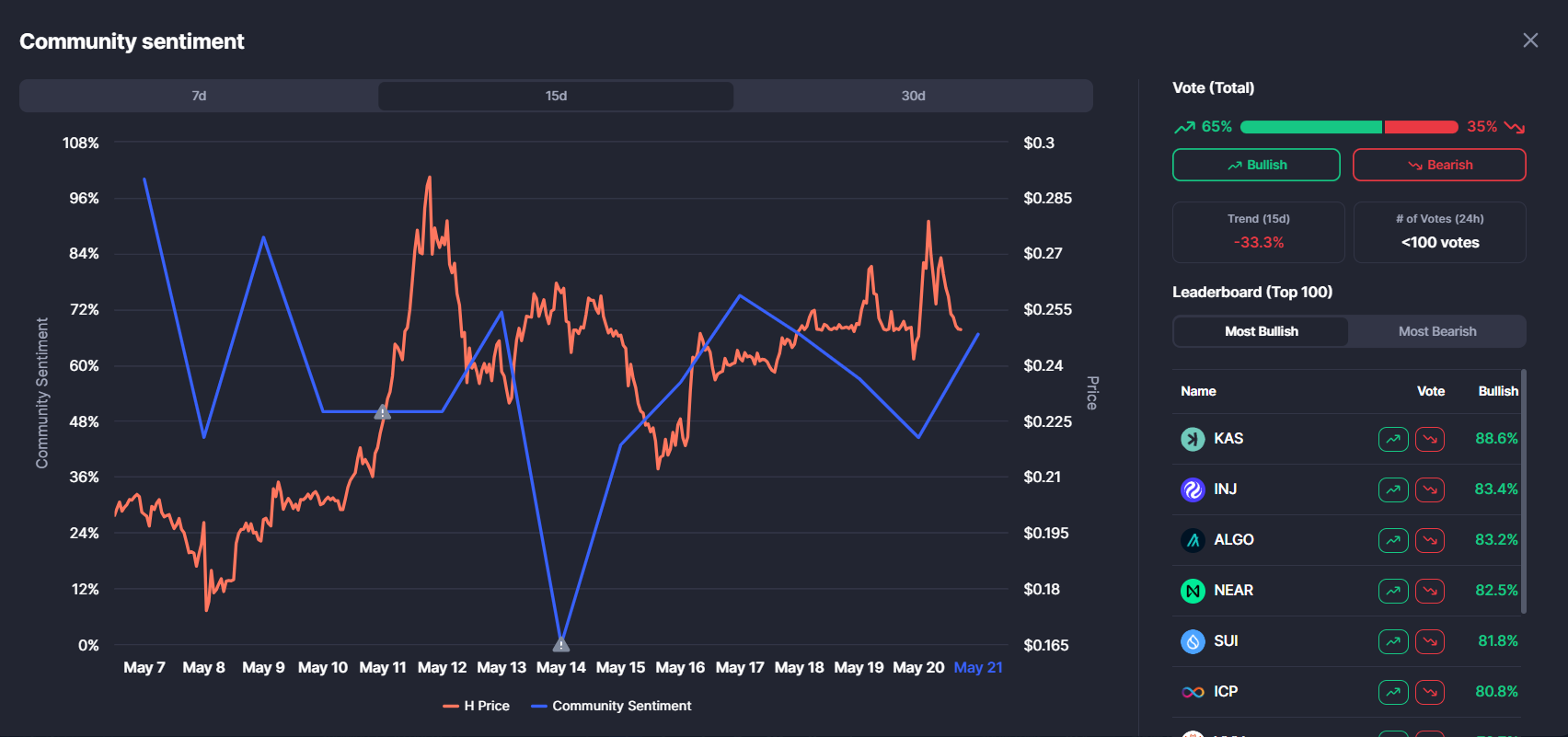
H sentiment is positive, but the signal still needs context. The latest community panel shows 68% bullish versus 32% bearish, with a +7.9% 15-day trend, but the vote count is below 100 in the last 24 hours.
H community post from BSCN, as of April 26, 2026, around 05:00 UTC
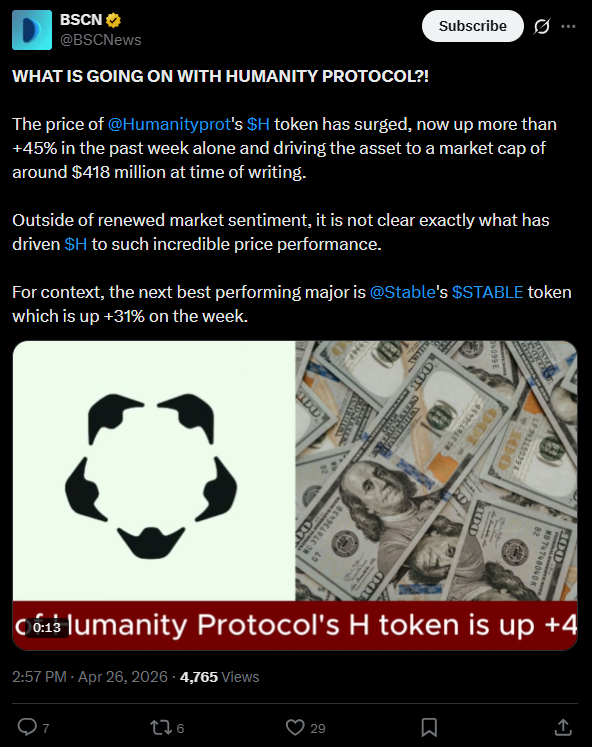
The clearest news driver is the recent price move. BSCN noted that H had risen more than 45% over the past week, lifting the token’s market capitalization to around $418 million at the time of writing.
The same post also noted the exact driver behind the move remained unclear beyond renewed market sentiment. This reflects short-term market attention instead of proof of new protocol adoption.
Community focus is now centered on whether the rally reflects more than short-term trading interest. The proof-of-humanity narrative keeps H visible, but social attention and media coverage do not confirm app activity, active wallets, integrations, or recurring demand.
For H, the credibility test is still measurable usage. Sentiment becomes more useful if it lines up with stronger spot volume, clearer product activity, and visible demand for Humanity Protocol’s identity infrastructure rather than only a weekly price surge.
Frequently asked questions
How does Humanity Protocol prove someone is human?
Humanity Protocol uses palm biometrics and zero-knowledge proofs to create a Human ID. The goal is to prove that a person is unique without exposing the raw biometric data behind the credential.
The practical use is Sybil resistance. Apps, platforms, and partners can check whether an account is tied to a verified person, while the person does not need to reveal full identity details every time.
How does Humanity protect biometric privacy?
Humanity Protocol is designed so biometric data is not posted publicly on-chain. Palm data is converted into cryptographic proofs, while the verification layer checks uniqueness without exposing the underlying scan.
This is why privacy-preserving identity is central to the project’s pitch. Instead of just proving identity, the network makes verifications reusable without triggering a data-sharing event each time.
What is H used for?
H is used for L2 gas, staking, governance, credential issuance and verification fees, and rewards across Fairdrop campaigns. It also supports the zkProofer layer, where identity validators help verify credentials.
Driven by validators verifying credentials, the token’s long-term utility depends on repeatable usage. H needs to move beyond one-time claims or launch incentives toward ongoing demand fueled by credential checks, staking, governance, and partner integrations.
How is Humanity different from Worldcoin?
Humanity and Worldcoin both focus on proof of personhood, but they use different biometric approaches. Humanity uses palm biometrics, while Worldcoin is known for iris-based verification.
The difference affects market positioning. Humanity’s case depends on whether palm-based verification feels easier to adopt across enterprise, finance, ticketing, education, and app-based identity flows, while still competing with Worldcoin’s larger network presence.
Should I buy H now?
That depends on risk tolerance, time horizon, and how you view decentralized identity as a long-term category. H is worth studying because it sits across gas, staking, governance, credential fees, Fairdrops, and the broader Human ID stack.
The stronger long-term case depends on real-world deployment. Humanity Protocol needs enterprise integrations, Human ID growth, credential usage, and zkProofer activity to translate into durable token demand. Price context can help with timing, but the larger question is whether identity adoption becomes measurable economic use.
The macro outlook
Humanity Protocol enters 2026 with real identity traction, not just a privacy narrative. Human IDs, enterprise integrations, Fairdrops, and zkProofers give H several utility lanes, but the token still needs stronger proof of repeatable economic demand.
While the main catalyst relies on credential usage turning into fees, staking activity, and partner-driven verification volume, a major risk remains: adoption could continue growing at the identity layer while H struggles with weak value capture and supply pressure.
The unresolved question is whether Humanity Protocol can turn verified identity into measurable token demand, or whether H stays a governance and incentive asset waiting for stronger commercial proof.
This article is for informational purposes only and does not constitute financial advice. Always do your own research (DYOR) before making any decisions.
How to start trading Humanity Protocol (H)
Humanity Protocol is worth watching because it sits at the intersection of decentralized identity, AI fraud prevention, credential verification, and enterprise adoption. The stronger case for H depends on whether Human IDs, Fairdrops, zkProofers, and partner integrations can turn identity usage into repeatable token demand.
Ready to trade H? Toobit gives you a straightforward way to track H price moves, compare market conditions, and trade with spot and futures tools in one place.
Start trading H/USDT on Toobit today.


