
Preheader: Track the latest ATOM price, key technical levels, and the Cosmos Hub catalysts that could shape ATOM’s market outlook in 2026.
When ecosystem growth starts testing ATOM demand
Cosmos (ATOM) enters 2026 with a stronger ecosystem story than token story. The stack keeps expanding through interoperability, Ethereum Virtual Machine (EVM) compatibility, and enterprise infrastructure, but the market still wants clearer proof that this growth can translate into durable demand for ATOM.
The Cosmos Hub is moving into a new phase shaped by revenue-based tokenomics and Inter-Blockchain Communication (IBC) Eureka. If those efforts give the Hub a stronger economic role, ATOM could start trading less like a staking asset and more like exposure to broader Cosmos adoption.
The next sections outline what is changing, why Interchain Security is no longer the easy bull case it once was, and what the chart needs to confirm before the market prices a stronger case for ATOM.
What is Cosmos (ATOM)?
Cosmos is a modular blockchain stack and interchain ecosystem built for sovereign chains. It is often framed too narrowly as an interoperability project, but the broader role is infrastructure: teams can launch their own networks, choose their own validator set and governance model, define their own execution environment, and still connect those chains through IBC.
ATOM is the native token of Cosmos Hub, not the token for every Cosmos-based chain. It is used to secure the Hub through staking, pay fees on the Hub, and participate in governance. That gives ATOM a direct role in the Hub’s economic model rather than a generic role across the entire ecosystem.
Cosmos is easiest to understand through 3 product lanes:
-
Sovereign chain infrastructure: The Cosmos software development kit (SDK) and CometBFT let teams build application-specific chains instead of relying on a shared execution layer.
-
Interchain connectivity: IBC moves messages and assets across separate ledgers, which is why cross-chain settlement and broader network coordination sit at the center of the Cosmos story.
-
Financial infrastructure: Cosmos is pushing further into stablecoins, tokenized assets, payments, and cross-border settlement, which is where the ecosystem’s current institutional angle is becoming clearer.
Governance on Cosmos Hub is stake-weighted, not one-token-one-vote. Validators vote on proposals, delegators can vote directly, and governance can change parameters, approve upgrades, and direct community spending. That keeps the Hub tied to both coordination and economic policy, not just chain security.
In 2026, the Cosmos story is less about interoperability on its own and more about whether this broader stack can give ATOM a stronger economic role inside the Hub.
Cosmos price history and performance overview
ATOM price history
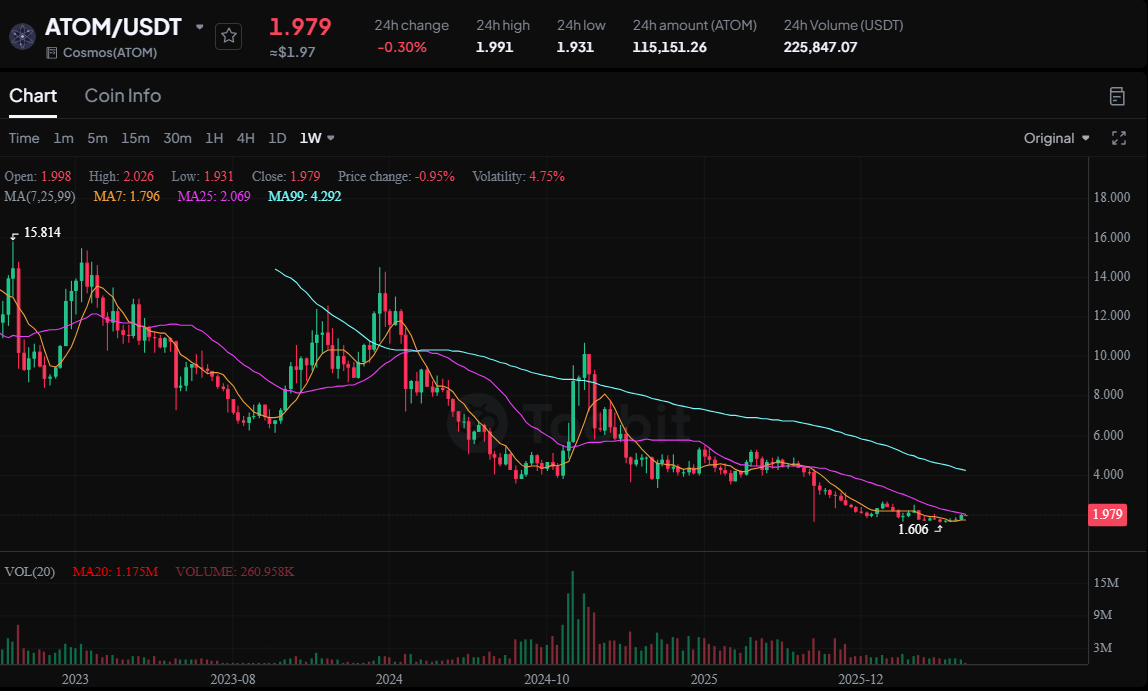
ATOM’s long-term spot chart has traded through a full reset since its 2021 peak. There was a move in 2021 that resulted in a new high, with the price now sitting close to the lower end of its historical range.
-
All-time high (ATH): $44.70 (September 20, 2021)
-
All-time low (ATL): $1.13 (March 13, 2021)
ATOM price from Toobit, as of April 29, 2026, around 06:40 UTC.
ATOM’s latest performance
-
ATOM price: around $1.980
-
24h high: around $1.991
-
24h low: around $1.931
-
24h volume: around 115,151.26 ATOM (around $225,847.07 in USDT)
At the time of writing, ATOM is trading near the lower end of its recent short-term range. The implication is that price has stabilized locally, but the next move still needs stronger follow-through.
Current market snapshot (April 29, 2026)
Cosmos Fear and Greed Index from CFGI.io, as of April 29, 2026.
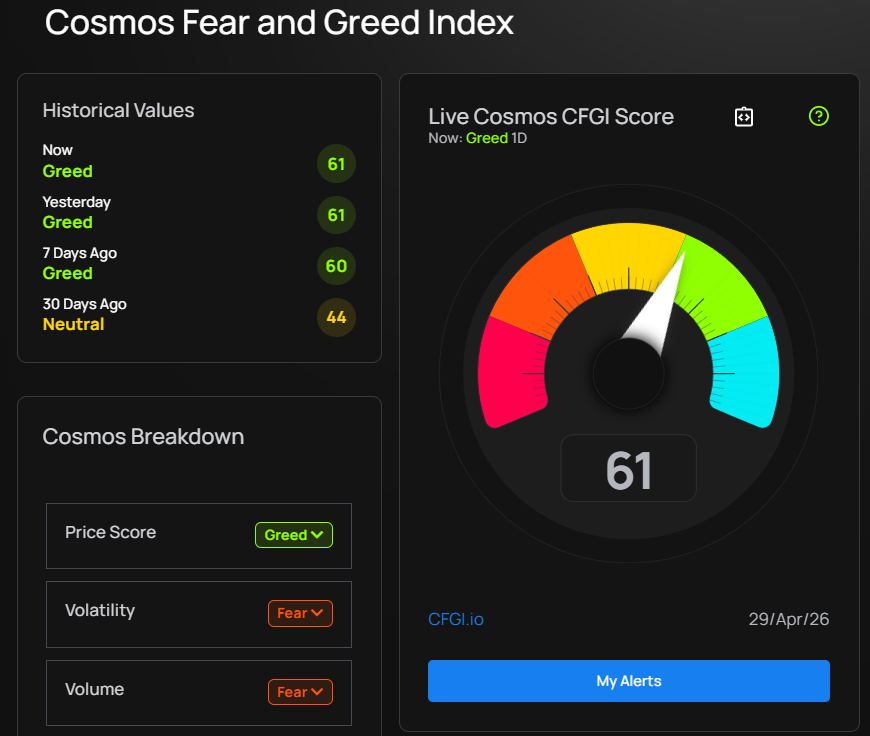
The Cosmos Fear and Greed Index score is 61 (Greed), unchanged from yesterday (61). A week ago it was 60 (Greed), while 30 days ago it stood at 44 (Neutral).
That keeps the market mood in greed territory, which fits the current chart setup: ATOM has stabilized after rebounding from recent lows, but price still needs stronger participation to confirm a broader recovery.
The index breakdown points in the same direction. The price score is Greed, while volatility and volume both read Fear. That suggests sentiment has improved, but participation is still not strong enough on its own to confirm a more durable move.
On-chain and technical analysis
Support and resistance
ATOM is trading near the lower end of its broader structure, with the latest 24-hour range sitting between $1.931 and $1.991. Price is still holding above the recent floor, but it remains below the local chart high near $2.026 and the heavier spot moving-average cap.
Near-term support sits at $1.931.
Near-term resistance is near $1.991 first, followed by $2.026. Above that, the more important higher-timeframe break level is the 25-day moving average near $2.069.
Momentum indicators
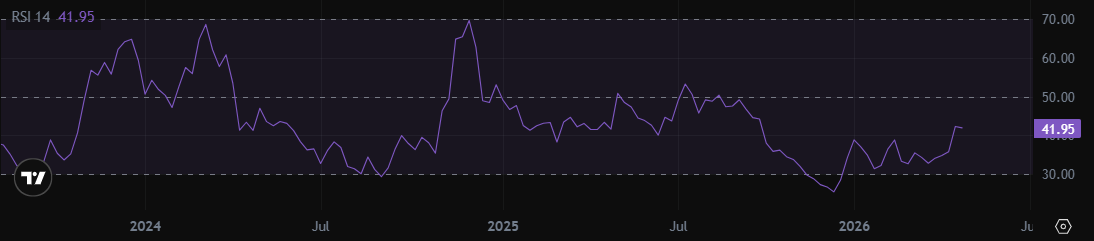
ATOM’s 14-period Relative Strength Index (RSI) is around 41.95, which keeps momentum below neutral rather than clearly repaired. That fits a market that has stabilized above its recent low, but has not yet shown stronger upside follow-through.
ATOM RSI from TradingView, as of April 29, 2026, around 06:44 UTC.
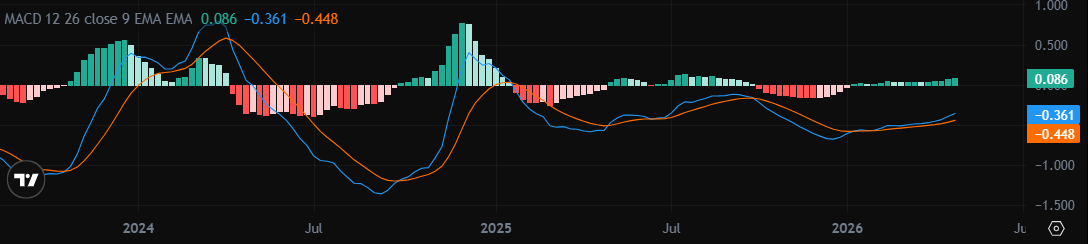
Moving Average Convergence Divergence (MACD) is still below zero, with MACD around -0.361, the signal line around -0.448, and the histogram around 0.086. Downside pressure has eased, but the move still looks more like a recovery attempt than a clean trend change.
ATOM MACD from TradingView, as of April 29, 2026, around 06:44 UTC.
Moving averages and volume
ATOM is now trading above the 7-day moving average (MA) at $1.796, which points to firmer short-term momentum. It still remains below the 25-day MA at $2.069 and far below the 99-day MA at $4.292. The short-term picture has improved, but the heavier levels that would signal a more durable trend shift still have not been reclaimed.
ATOM volume from TradingView, as of April 29, 2026, around 06:44 UTC.
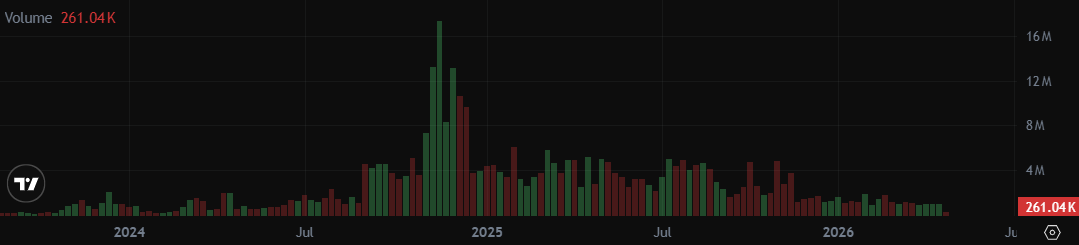
Volume also looks more consistent with stabilization than aggressive accumulation. The latest reading is around 260,958 ATOM, which is roughly 78% below the 20-period volume average of around 1.173 million ATOM. The implication is that price has stabilized locally, but conviction still looks limited and participation is not yet strong enough to confirm a stronger accumulation phase.
On-chain cues
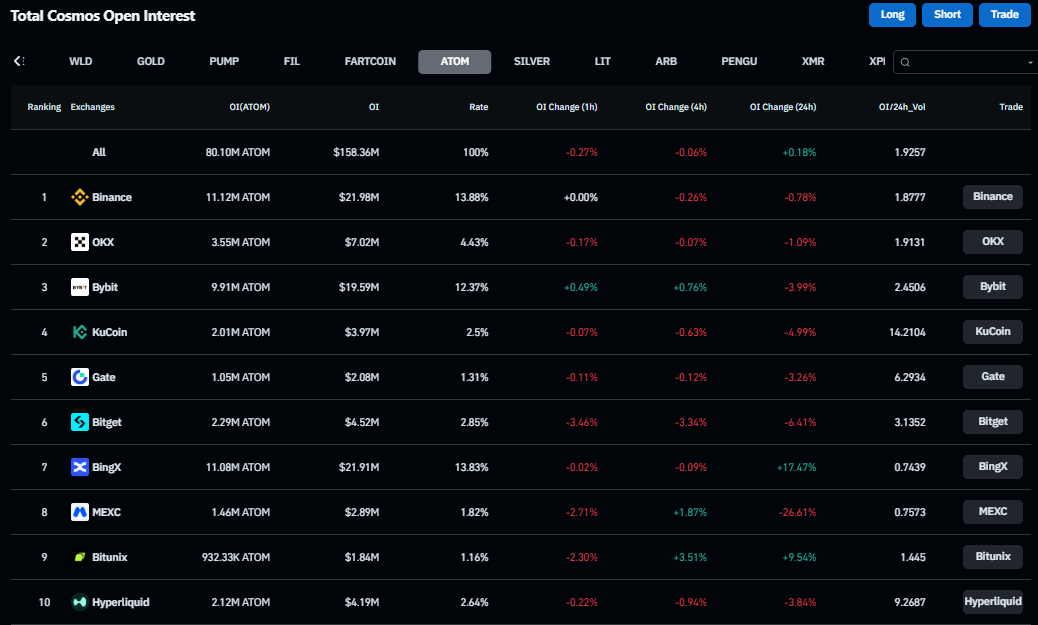
Derivatives positioning is still active, but it is not confirming a stronger move yet. For ATOM, that leaves the rebound looking low-conviction rather than fully supported.
Total open interest (OI) is around 80.10 million ATOM, or roughly $158.36 million. Short-term changes are mixed, with OI down around 0.27% (1-hour), down around 0.06% (4-hour), and up around 0.18% (24-hour). That divergence suggests positioning is not building in a clean trend. The market is still active, but conviction is uneven, which makes it harder to treat the latest rebound as a stronger extension.
ATOM OI from Coinglass, as of April 29, 2026, around 06:44 UTC.
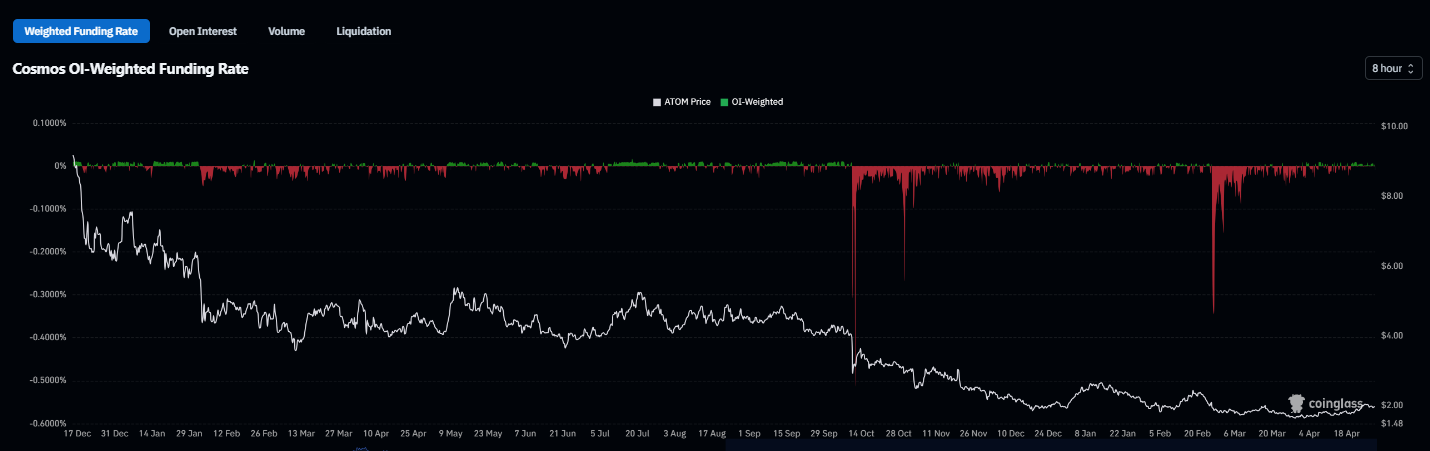
The OI-weighted funding rate (FR) still looks near neutral to slightly negative overall. That leaves ATOM without crowded long positioning, but it also means derivatives are not yet giving the kind of confirmation that usually supports a stronger breakout.
ATOM OI-weighted FR from Coinglass, as of April 29, 2026, around 06:44 UTC.
What to watch next
-
First, ATOM needs to hold $1.931. If that floor breaks, the repair attempt weakens quickly.
-
Next, a reclaim of $1.991 would improve the short-term structure and shift attention toward $2.026.
-
After that, the 25-day MA near $2.069 becomes the cleaner structure test.
-
Final confirmation should come from participation. Volume needs to improve from current levels, while OI should start building more cleanly and OI-weighted FR should stay controlled.
ATOM price prediction and outlook
Base case
-
ATOM keeps stabilizing above $1.931 while the price remains capped below the $1.991 to $2.026 spot resistance zone.
-
Price is holding above the recent floor, but it still needs a cleaner reclaim before the move can be treated as more than local repair.
-
The setup stays intact if spot volume improves gradually and, in the perpetuals, OI remains mixed rather than breaking down sharply.
Bull case
-
ATOM reclaims $2.026 and starts holding above it on spot.
-
That improves the short-term read and shifts attention toward the 25-day MA near $2.069. A stronger hold above that level would make the rebound look more credible.
-
The move looks stronger if spot volume starts building and, in the perpetuals, OI expands while FR stays controlled.
Bear case
-
ATOM loses $1.931 and fails to reclaim it quickly on spot.
-
That weakens the current repair attempt and brings the lower support area near $1.606 back into focus.
-
The downside read becomes more vulnerable if spot participation stays weak and, in the perpetuals, OI fails to build while FR remains soft.
A controversial viewpoint
ATOM’s core risk may not be a lack of Cosmos adoption. The Cosmos stack can keep expanding across interoperability, enterprise infrastructure, and tokenized finance while ATOM still fails to become the main market expression of that growth.
In that outcome, Cosmos stays useful as infrastructure, but ATOM trades more like a Hub-specific staking and governance asset than a broad ecosystem proxy.
The key twist
-
Hub economics: The ATOM thesis now depends more on whether Cosmos Hub can build stronger revenue design, utility, and tokenomics around its own role. Broader ecosystem growth alone is not enough if the Hub does not capture more of that activity.
-
Financial infrastructure: The stronger narrative lane is tied to sovereign chains, IBC, stablecoins, tokenized assets, and institution-led settlement. If those lanes create clearer demand for Hub services, the market may start treating ATOM as exposure to Cosmos adoption rather than only a low-conviction rebound token.
Key milestones for Cosmos
-
March and April 2017: Cosmos raised $300,000 in a seed round at $0.025 before completing its Initial Coin Offering (ICO) with $16.00 million raised at $0.10.
-
March 13, 2019: Cosmos Hub mainnet launched, moving the project from pre-launch development into a live Proof-of-Stake network with ATOM as its staking and governance token.
-
February 18, 2021: The Stargate upgrade brought IBC into the Cosmos stack. That turned interoperability into a live network function rather than a design goal.
-
May 2023: Interchain Security went live with its first consumer-chain rollout, giving Cosmos Hub a clearer shared-security role inside the broader ecosystem.
-
November 2023: Proposal 848 reduced ATOM’s maximum inflation rate to 10%. That made tokenomics a more active governance issue and tightened focus on ATOM’s long-term economic design.
-
August 2025: Proposal 1007 enabled permissionless CosmWasm deployment on Cosmos Hub, expanding the Hub’s execution layer and product scope.
-
February 2026: Gaia v26 introduced tokenfactory on Cosmos Hub. That added native token issuance tooling and pushed the Hub beyond pure staking and governance functions.
-
February 2026: Hub governance moved to remove new consumer-chain expansion through Interchain Security, showing that the shared-security model was no longer the simple growth case it once appeared to be.
-
April 2026: Cosmos Labs selected Gauntlet for the ATOM tokenomics redesign initiative. That made the Hub’s next phase more directly tied to revenue design, utility, and long-term value capture.
Community sentiment and ATOM news
ATOM chatter has stayed constructive lately as Cosmos returns to the center of the cross-chain infrastructure discussion. The recent narrative is less about a single Hub catalyst and more about whether interoperability, sovereign chains, and broader ecosystem connectivity can translate into stronger ATOM relevance.
AP Collective cross-chain ecosystem posts from X, as of April 21, 2026.
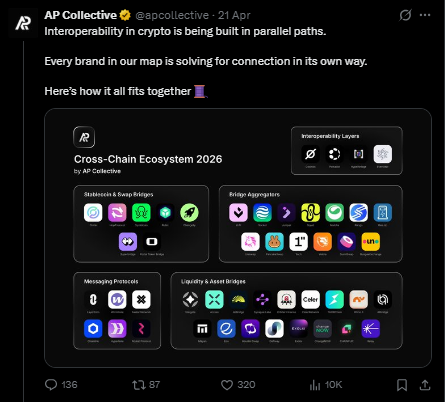
AP Collective highlighted Cosmos as part of the 2026 cross-chain ecosystem map and described Cosmos and Polkadot as ecosystems built around interoperability as a first principle. That keeps Cosmos visible in a market where liquidity, messaging, and bridge infrastructure are being rebuilt across parallel paths.
Community sentiment for ATOM from CoinMarketCap, as of April 29, 2026.
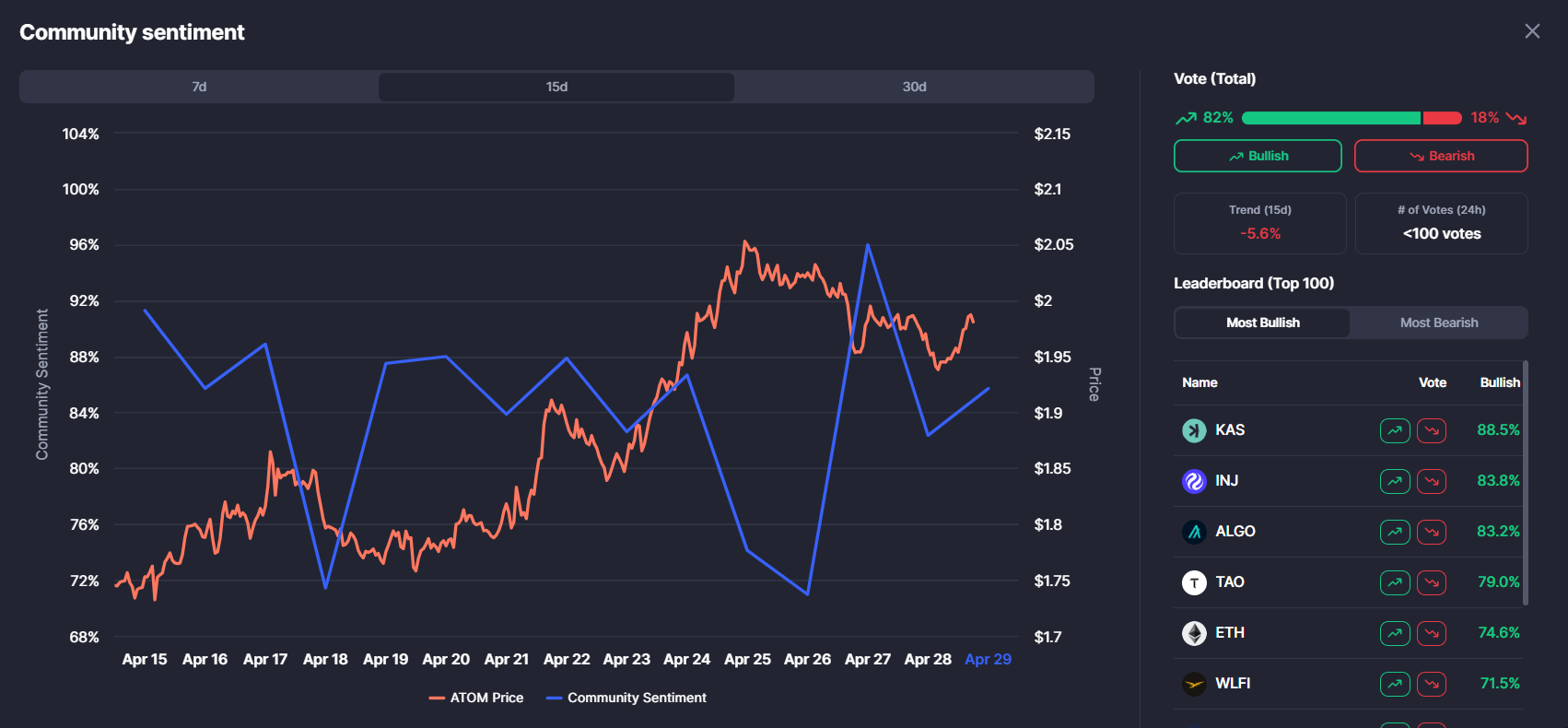
Community sentiment from CoinMarketCap also leans supportive. The latest read shows 82% bullish versus 18% bearish, but the 15-day trend is down 5.6%. That keeps the signal directionally positive, though the vote count is still small, with fewer than 100 votes recorded in the last 24 hours.
The broader takeaway is that the market still recognizes Cosmos as an important interoperability network, but ATOM needs cleaner Hub-level value capture before that constructive tone becomes stronger token conviction.
FAQs
What does Cosmos actually do?
Cosmos provides infrastructure for teams that want to build their own blockchains instead of deploying everything on 1 shared execution layer. Its value comes from combining sovereign chain design with cross-chain communication, so separate networks can keep their own validator set, governance model, and execution environment while still interacting across the broader ecosystem. That design makes Cosmos more relevant for payments, tokenized assets, and institution-led infrastructure than a simpler single-chain model.
What is ATOM used for?
ATOM is the native token of Cosmos Hub, not the default token for every chain built with Cosmos technology. It is used for staking, governance, and fee activity on the Hub, and its long-term relevance depends on whether Hub-level services create stronger economic demand around those functions. That is why the main ATOM question is not whether the Cosmos stack can grow, but whether Hub relevance can translate into more durable utility and value capture.
Why does IBC matter?
IBC is the interoperability layer that lets separate ledgers move messages and assets without collapsing into 1 chain. In practice, it is what turns Cosmos from a chain-building framework into a networked infrastructure stack. That makes IBC important not only for ecosystem connectivity, but also for settlement flows, tokenized asset movement, and the broader case for Cosmos as financial infrastructure.
How does Interchain Security affect ATOM?
Interchain Security gives smaller chains a way to use Cosmos Hub validators instead of bootstrapping a full security set on their own. For ATOM, that creates a clearer economic link between Hub security and ecosystem growth because Hub participation can become more directly useful. The bigger issue is not whether the model works in theory, but whether it becomes strong enough in practice to support lasting Hub demand.
Should I buy ATOM now?
That depends on what you want exposure to. ATOM is more useful to study as a way to track whether Cosmos Hub can turn interoperability, financial-infrastructure growth, and product expansion into a stronger economic role than as a simple short-term momentum trade. The reason to keep watching it is structural: if Hub utility, governance, and revenue design improve, ATOM could gain a clearer long-term role inside the broader Cosmos stack.
The bottom line
ATOM enters 2026 in a transition phase. Cosmos keeps expanding as interchain infrastructure, but the market is no longer focused only on ecosystem growth. The bigger question is whether the Cosmos Hub can turn that growth into clearer and more durable demand for ATOM.
That is what makes the current setup more important than the headline count. The Hub is moving toward revenue-based tokenomics, Hub-native activity is being pushed more directly, and the broader Cosmos stack is still gaining relevance through interoperability. At the same time, Interchain Security is no longer the clean bull case it once was, which leaves ATOM in a more demanding position than before.
The key question is simple. If the Cosmos Hub can build stronger economic gravity, ATOM can start trading on a clearer fundamental case. If not, ecosystem strength alone may still fall short of giving the token a stronger re-rating.
This article is for informational purposes only and does not constitute financial advice. Always do your own research (DYOR) before making any decisions.
How to start trading Cosmos (ATOM)
Cosmos sits at the center of the interchain narrative, and ATOM tends to stay relevant when market focus shifts back toward interoperability, Cosmos Hub catalysts, and broader ecosystem coordination.
Ready to trade ATOM? Toobit offers spot and futures trading with low fees, deep liquidity, and clean charting tools to help you plan entries and manage risk.
Start trading ATOM/USDT today.


