
Introduction
Bancor (BNT) has moved the crypto industry forward using innovative technologies since 2017. Its role in the growth of decentralized finance (DeFi) can hardly be overstated.
Numerous foundational DeFi concepts were built on Bancor’s blueprints. The automated market maker (AMM) and smart tokens, or liquidity provider (LP) tokens, are just some of its notable inventions.
Recently, a US federal court in New York dismissed a long-standing patent infringement lawsuit against Uniswap stating its patented AMM technology covered abstract ideas. This February 2026 decision provided legal clarity for the broader DeFi sector but owes technological advancements to the pioneering contributions of Bancor.
What is Bancor (BNT)?
Think of Bancor (BNT) as the elder statesman of DeFi. It launched the first-ever AMM in 2017 while solving the LP trilemma of impermanent loss, single-sided exposure, and capital efficiency.
Bancor is also the technical architect of the hub-and-spoke model. This model pairs BNT against every token on Bancor unlike standard decentralized exchanges (DEXs) that isolate liquidity in pairs.
It allows liquidity for one asset to be shared across the entire ecosystem, making BNT the universal connective tissue of the protocol. This is accomplished by the protocol’s modern tech stack which comprises Bancor v3 and Carbon DeFi.
Bancor v3 utilizes an Omnipool architecture, a single virtual vault housing all assets, reducing gas costs and enabling single-sided staking. Carbon DeFi pushes the envelope further by introducing asymmetric liquidity, allowing traders to set irreversible buy-low-sell-high ranges.
This creates a programmable trading experience where filled orders automatically rotate into new target prices, bypassing the reversibility risks found in standard AMMs.
Bancor’s legacy is not without its scars, however. Its most infamous chapter remains the 2022 impermanent loss (IL) saga.
A market downturn forced the protocol to abruptly pause its IL feature after marketing 100% IL protection for years. This was done to prevent a BNT hyper-inflationary death spiral.
It was an emergency break that left many long-term liquidity providers in the red. The move is still cited by critics as a cautionary tale of protocol-first survival over user-facing promises.
Today, the protocol has pivoted toward a buy-and-burn model fueled by the Arb Fast Lane. It is a permissionless bot framework that redirects arbitrage profits to stabilize the BNT supply.
Giants like Uniswap and Curve eventually captured the lion’s share of DeFi trade volume. The transition from a protection-centric protocol to a trading engine however, defines Bancor’s grit as a DeFi pioneer.
Bancor price history and performance overview
BNT price history
BNT reached an all-time high (ATH) of $23.73 on June 19, 2017 and is currently down about 98.63% since then. On the flip side, BNT is up by 177.07% from its $0.1174 all-time low (ATL) which it registered on March 13, 2020.
Following its 2020 low, the token saw a resurgence during the 2021 bull market. It peaked at approximately $9.00 after the successful launch of its v2.1 protocol.
In early 2026, BNT entered a period of steady consolidation, maintaining a support floor near $0.30. The revenue-sharing model of its new Arb Fast Lane is contributing to its price stability despite the ongoing bear market.
BNT’s latest performance
From April 30 to May 6, 2026 the price action for BNT was between $0.3041 and $0.3255. Its market cap for the week was between $32.87 million and $35.18 million.
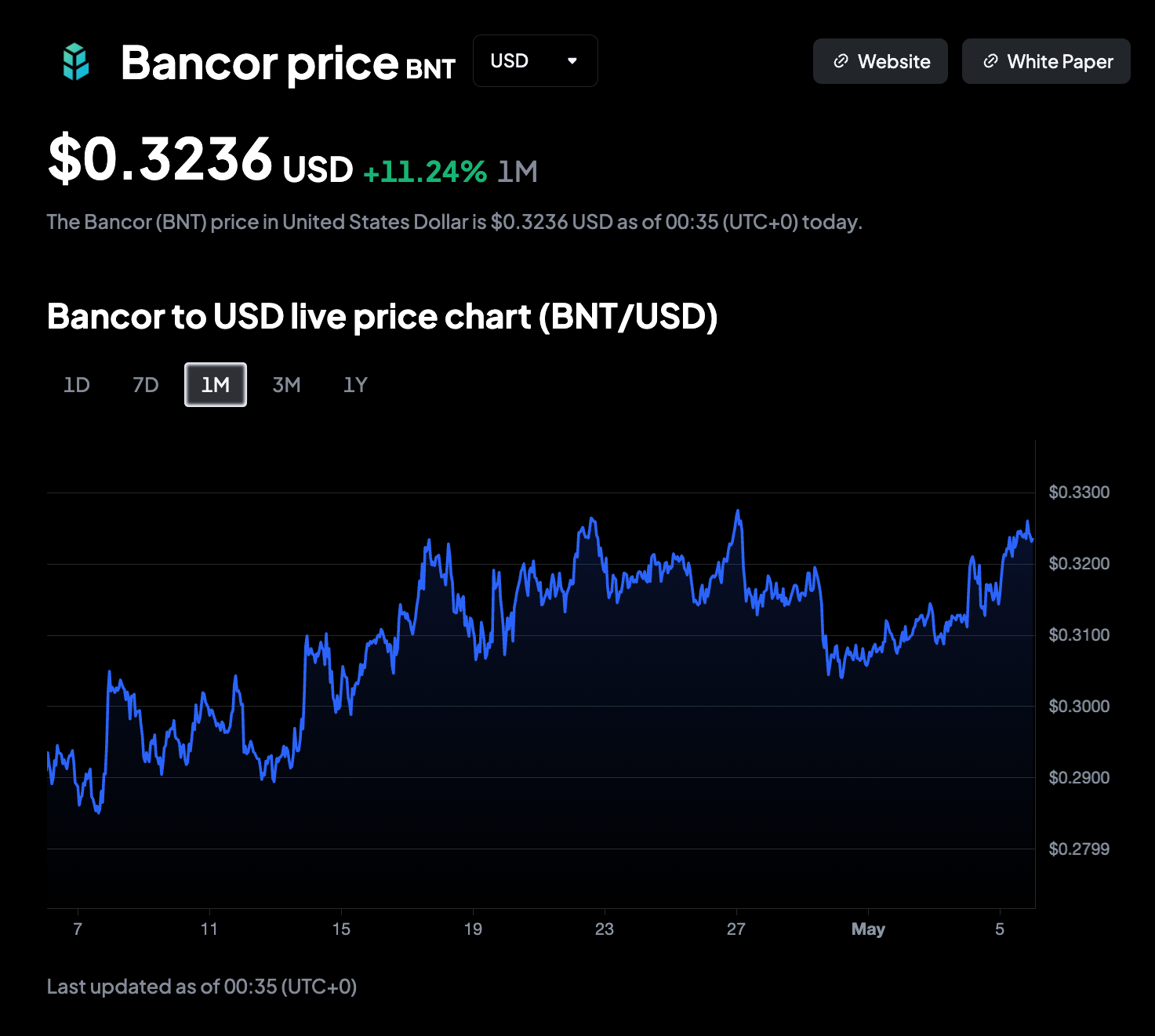
Bancor to USD live price chart on May 6, 2026, 00:35 UTC+0 from Toobit
BNT recently experienced two wicks to the upside, with the first taking place on March 31, 2026. It hit its 100-day moving average (MA) on the 4-hour chart at $0.3449 before closing at $0.2866.
The second wick occurred on April 19, 2026, reaching its 200-day MA at $0.4516 and closed at $0.3072. These sharp rejections suggest sudden interest, but lacks the sustained volume needed to flip these major moving averages into support.
Current market snapshot (May 6, 2026, 8:52am UTC+8)
BNT is currently trading at $0.3239 on the BNT/USDT price chart and is up 2.50% in the last 24 hours. There are a total of 108.05 million BNT in existence with the same amount in circulation.
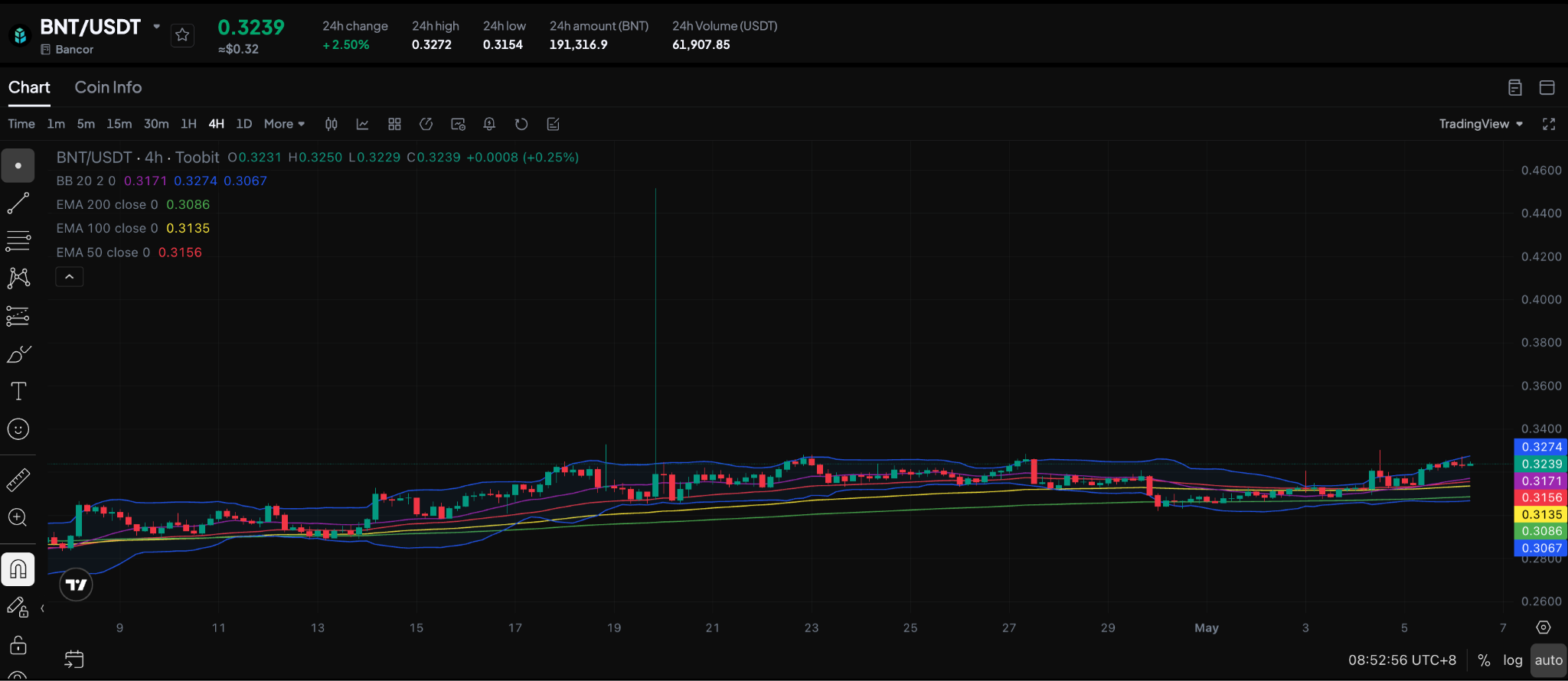
BNT/USDT 4-hour spot trading chart from Toobit
The intraday trading period had a low of $0.3158 and went as high as $0.3272. It appears that BNT has formed local support at around $0.2782 since steadily declining from its August 24, 2025 $0.8627 peak.
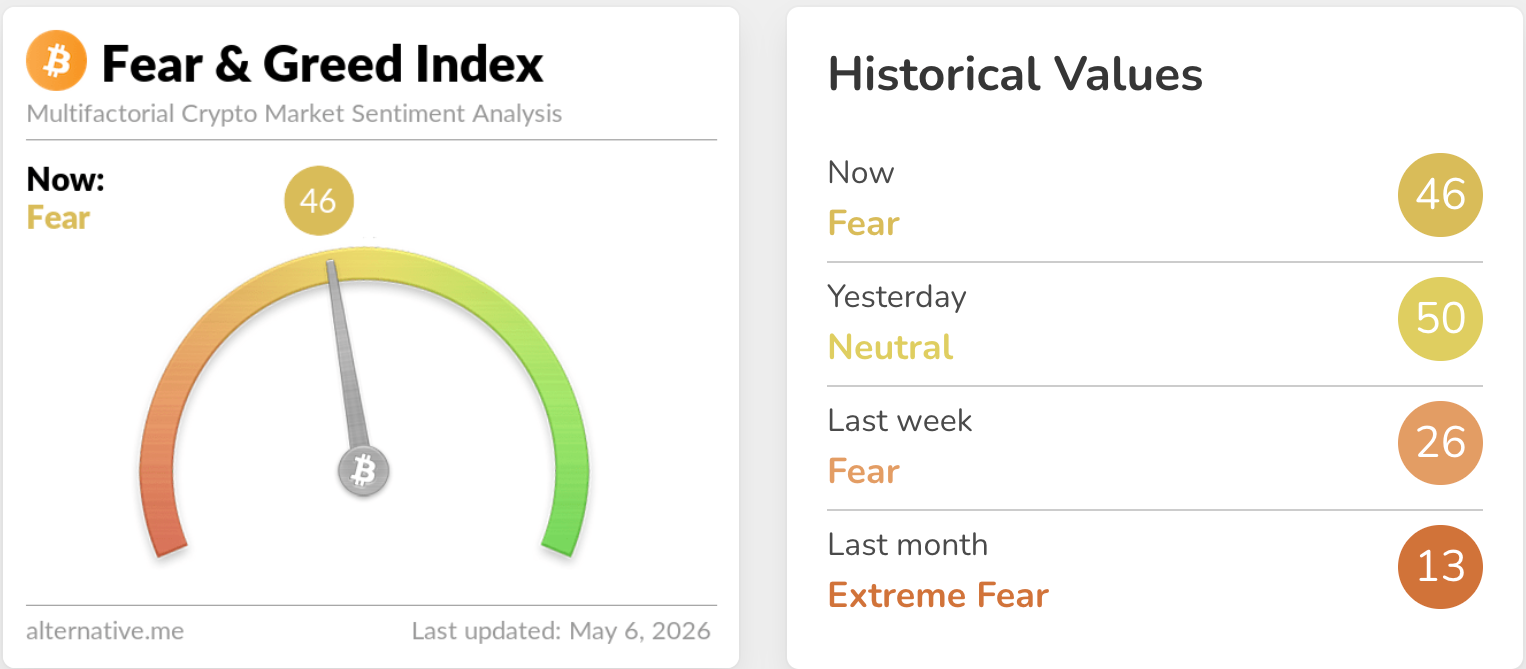
Crypto Fear and Greed Index on May 6, 2026 from Alternative.me
The Crypto Fear and Greed Index currently has a 46 (Fear) rating. Bitcoin and other large cryptocurrencies have been on a noticeable uptrend which began around the latter part of March.
Could this be just a relief rally to trap the bulls? There could be another flush coming while there is no clear indication that the bear market is over.
On-chain and technical analysis
Support and resistance
BNT is currently battling to maintain its lowest support level of $0.2782. It will soon challenge near-term resistance on the 4-hour chart at $0.3250.
The bulls appear to be gearing up for a further push to the upside in the short-term. This could result in challenging the next resistance level of $0.4500.
If this is successfully flipped into support then the next resistance level will be $0.5400. Failure to break decidedly past $0.4500 however could mean further downside.
This could take the price below the current floor and extend to a new ATL.
Momentum indicators
BNT might look deceptively strong on its 4-hour Relative Strength Index (RSI). It is currently at 62.39, indicating high buyer demand, but is unlikely to break the 70 level.
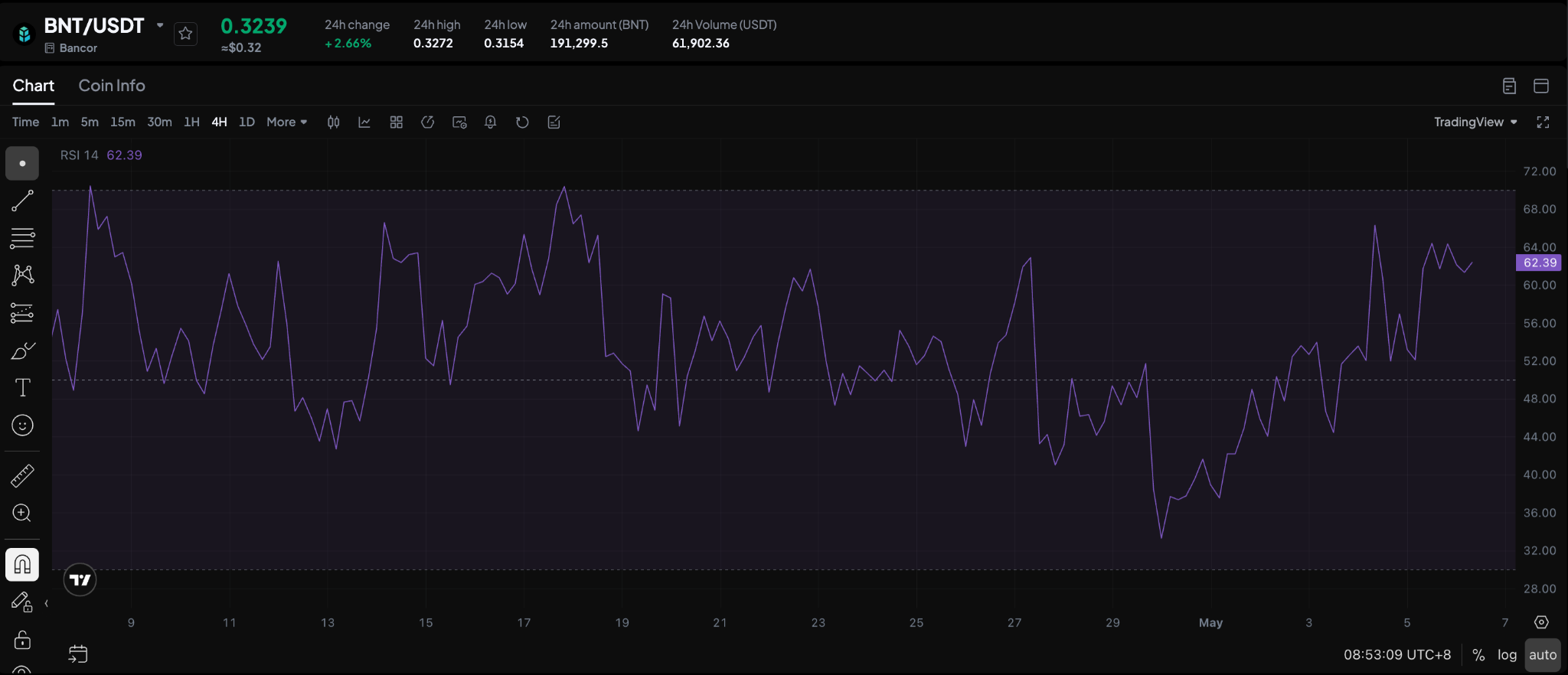
BNT/USDT 4-hour RSI chart from Toobit
The last time it was successfully able to do so was the 80.10 registered on July 21, 2025. It appears more ranging action is likely, absent any major catalysts that would decidedly pull it in either direction.
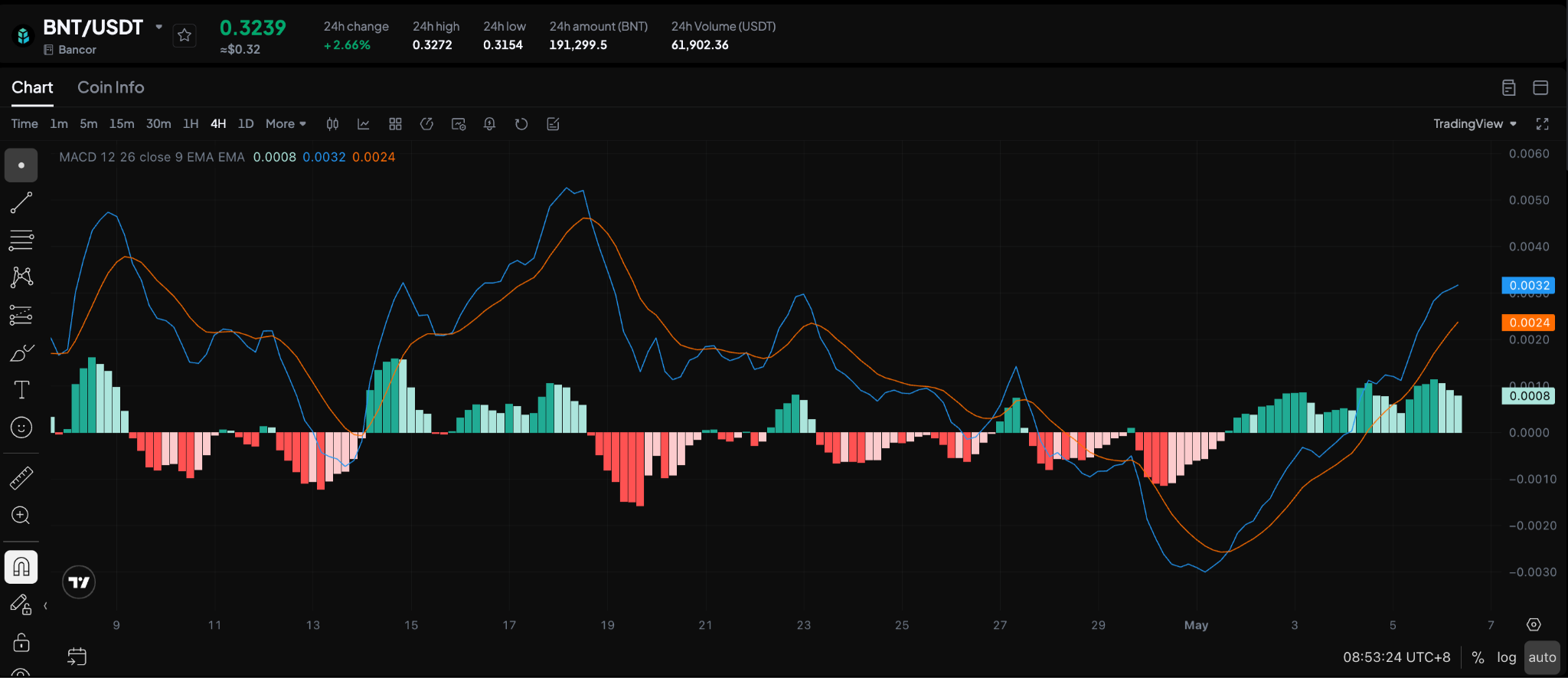
BNT/USDT 4-hour MACD chart from Toobit
Its 4-hour moving average convergence/divergence (MACD) histogram is green at 0.0008 with upwards momentum potentially nearing exhaustion. The blue MACD line of 0.0032 is hovering over the orange 0.0024 signal, likely to intersect again soon.
Moving averages and volume
BNT’s price is currently above its 50-day, 100-day, and 200-day moving averages (MAs) on its May 6, 2026 4-hour chart. There is no clear separation from any of them however, indicating the tight price action since March 2026.
Its 24-hour trading volume is down by 41.99% to $2.71 million across exchanges for May 6, 2026. BNT’s 24-hour trading volume ranged between $1.49 million and $4.95 million for the week.
On-chain cues
Bancor’s Carbon DeFi has carried out 8.8 million total trades on $184 million volume while generating $527,000 in fees. It has helped create over 14,600 strategies and has listed 2,238 unique pairs.
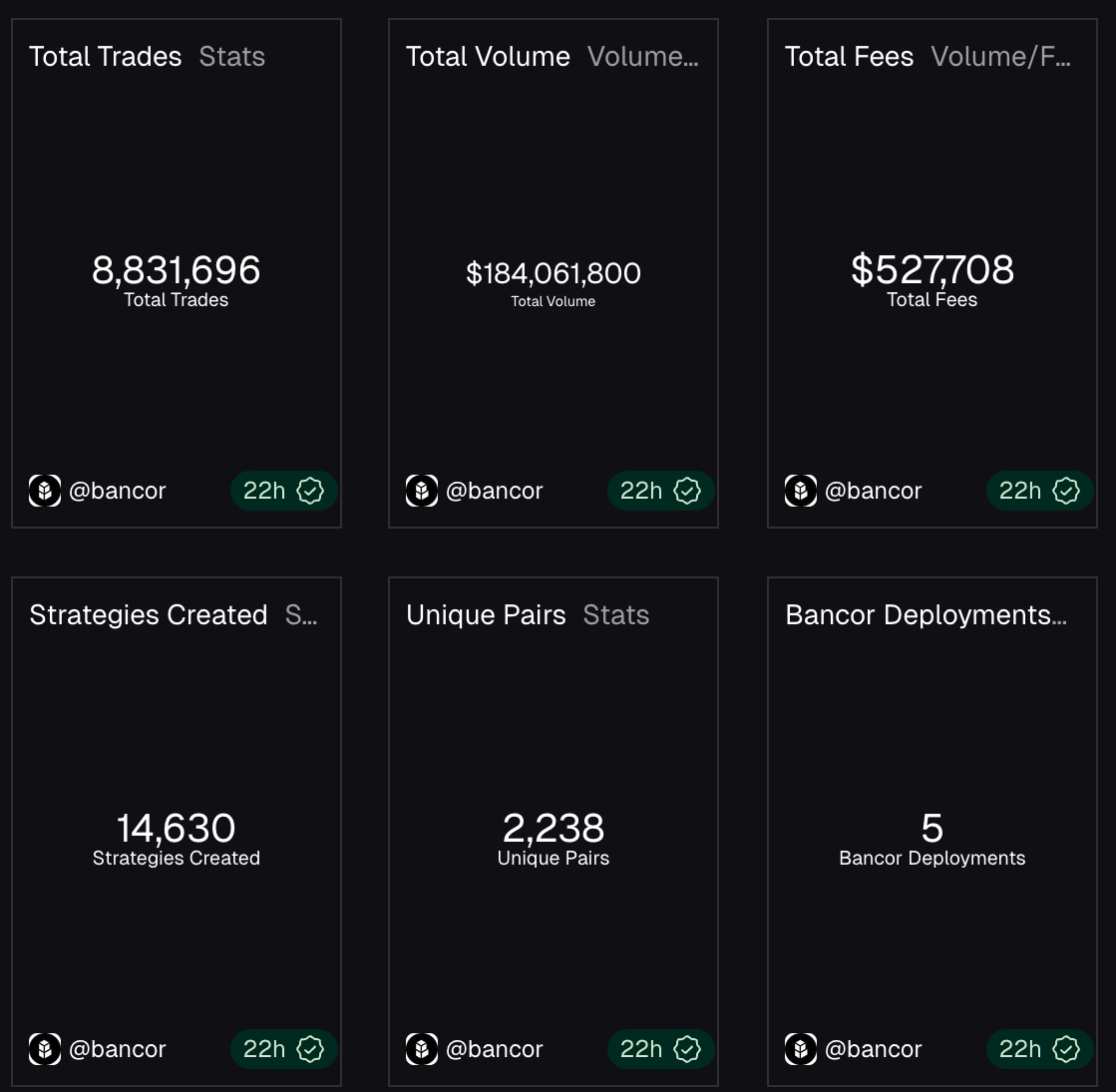
Carbon DeFi statistics from Dune
When it comes to its Arb Fast Lane, it now has over 90 integrations across 10 blockchains. The protocol has completed 3.74 million transactions on $637 million volume with over $1 million total arbitrage value.
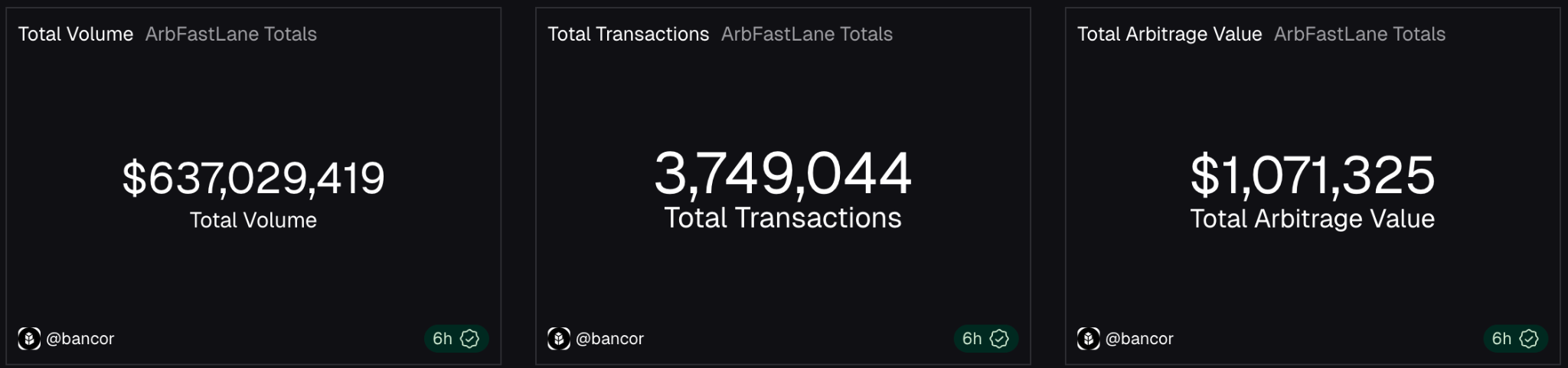
Arb Fast Lane statistics from Dune
Bancor price prediction and outlook
Bancor has evolved from an AMM pioneer into a specialized trading engine focused on asymmetric liquidity and privacy. By May 2026, the protocol had moved past its legal hurdles with Uniswap.
It is now focusing on the eflationary mechanics of its Arb Fast Lane and COTI V2 integration.
Bull Case ($0.85 to $1.15)
High adoption of Carbon DeFi’s MEV-protected trading attracts institutional volume, fueling an aggressive buy-and-burn cycle. This scenario assumes BNT flips its $0.54 resistance into support as the Arb Fast Lane dominates L2 arbitrage.
Base Case ($0.38 to $0.55)
BNT maintains steady consolidation above its $0.27 floor, supported by consistent revenue from its 90-plus cross-chain integrations. Price stability is driven by the protocol’s utility as a liquidity backbone, even amidst lingering market Fear.
Bear Case ($0.12 to $0.20)
A broader macro flush breaks the current support floor, leading to a retest of historic lows near $0.11. In this outlook, low social engagement and a bull trap reversal prevent BNT from sustaining momentum above its 200-day MA.
Bancor’s 2026 outlook is tied to math over marketing. Success depends on whether its unique Garbled Circuits privacy features can drive the volume required for a supply squeeze.
April’s upside wicks show potential, however, a sustained breakout requires the transition from speculative interest to consistent revenue. Stay alert and track the 4-hour RSI for signs of buyer exhaustion near the $0.33 level.
This article is for informational purposes only and does not constitute financial advice. Always do your own research (DYOR) before making any decisions.
Key milestones for BNT
-
AMM debut (June 2017): Its initial coin offering (ICO) raised $153 million to launch the industry’s first AMM on the Ethereum blockchain.
-
Bancor v2.1 release (October 2020): Introduced the revolutionary single-sided liquidity provision paired with 100% impermanent loss protection for long-term stakers.
-
Bancor v3 deployment (May 2022): Network liquidity was consolidated into a single virtual vault for improved gas efficiency and simplified staking through the Omnipool architecture.
-
IL protection suspension (June 2022): Bancor’s decentralized autonomous organization (DAO) voted to pause IL protection, safeguarding the protocol from a potential hyper-inflationary death spiral.
-
Carbon DeFi and Arb Fast Lane launch (March 2023): The ecosystem pivoted toward asymmetric liquidity and programmable, irreversible on-chain trading strategies.
-
Multi-chain expansion to Fantom (March 2024): The Arb Fast Lane framework was integrated with the Fantom blockchain, enabling permissionless arbitrage across diverse decentralized venues.
-
Privacy-centric layer 2 (L2) deployment (early 2025): Carbon DeFi expanded its footprint onto Currency of the Internet (COTI) V2, utilizing Garbled Circuits.
-
Patent lawsuit dismissal (February 2026): AMM formula ruled as an abstract idea by a U.S. Federal Court, effectively ending a long-standing legal challenge against Uniswap.
Community sentiment and BNT news
Community sentiment
As of May 6, 2026, Messari shows BNT with a close to neutral Sentiment Score of 0.00255. Sentiment Scores range from -1.0 being extremely negative to 1.0 as extremely positive.
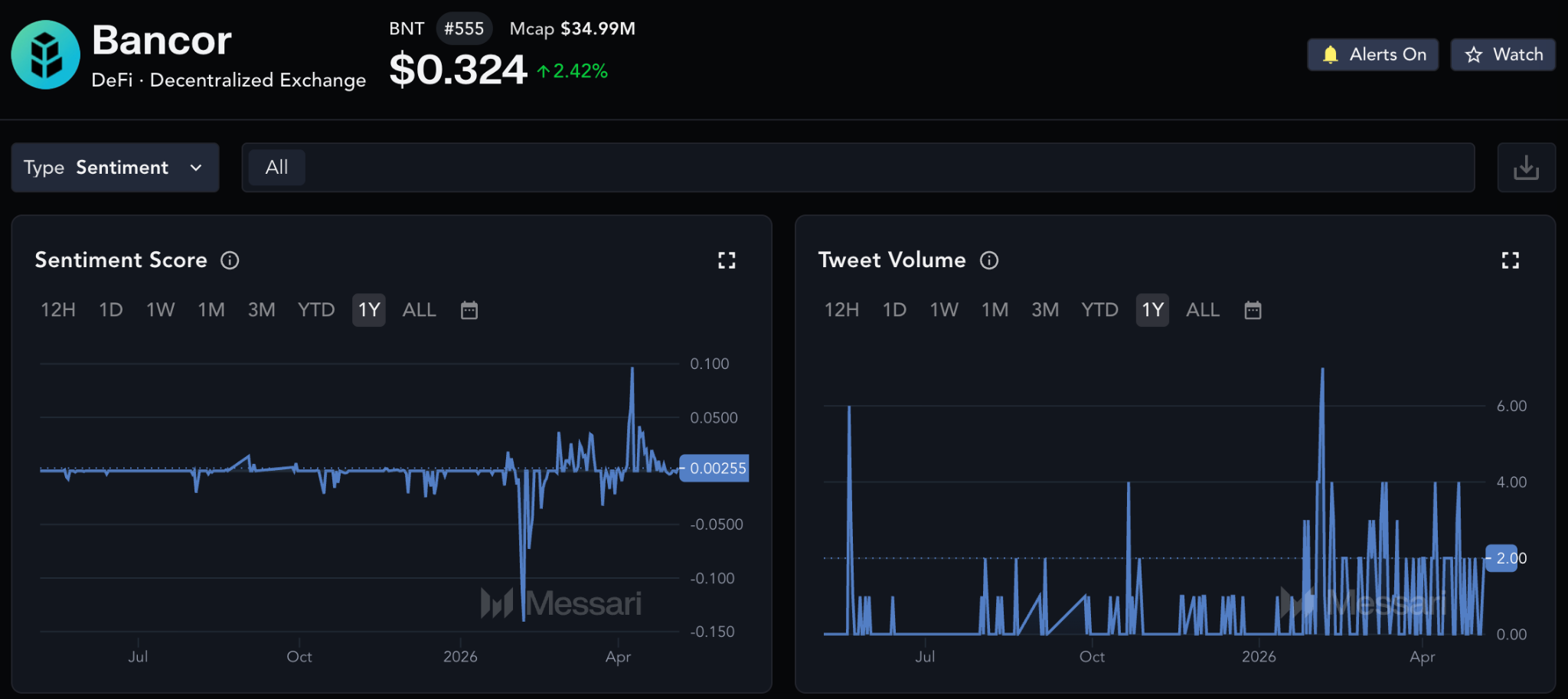
Bancor sentiment score and Tweet volume charts from Messari
Its highest year-to-date peak was 0.0969 which occurred on April 9, 2025, primarily driven by Arb Fast Lane’s performance. Transaction volume and gas consumption reached ATHs following its successful expansion and integration with the Sei network.
Sentiment crashed to -0.141 on February 6, 2026, primarily driven by a massive broader market capitulation. Bancor investors also braced for the imminent legal ruling on its high-stakes patent lawsuit against Uniswap, which was ultimately dismissed.
Tweet volume for May 6, 2026 was at a low of 2 with no spikes for the year. The highest was a moderate 7 registered on February 5, 2026.
BNT news
-
(April 2026) Arb Fast Lane expanded cross-DEX capabilities supporting new L2 ecosystems, aiming to capture automated arbitrage revenue for the Bancor DAO. This ongoing expansion focuses on reinforcing the protocol’s role as a liquidity backbone for programmable trading.
-
(February 11, 2026) Bancor’s patent infringement lawsuit against Uniswap was dismissed. It was ruled that its constant product automated market maker (CPAMM) technology was an abstract idea ineligible for protection. This removes a potential regulatory lever Bancor held over its primary decentralized exchange competitors.
-
(February 10, 2026) Bancor highlighted a major technical integration between its Carbon DeFi protocol and COTI V2’s Garbled Circuits. This enables private arbitrage strategies and enhanced maximal extractable value (MEV) protection. The upgrade allows traders to complete complex, asymmetric orders on-chain without exposing sensitive trade details to the public mempool.
FAQs
How does the BNT token act as a universal intermediary?
It connects all other assets through a single, shared token bridge rather than isolated trading pairs. Liquidity for one token is accessible by every other token on the network, maximizing the efficiency of every trade.
What is impermanent loss (IL)?
The potential loss between holding assets in a wallet versus providing them to a liquidity pool when prices fluctuate.
What is Carbon DeFi?
A DEX with an automated trading protocol allowing traders to create linked, asymmetric buy and sell ranges directly on the blockchain. These orders are irreversible, allowing traders to utilize buy-low-sell-high strategies without automatic trade back if price reverses.
How do COTI V2 Garbled Circuits benefit Carbon DeFi?
This privacy-enhancing technology facilitated secure and private arbitrage strategies for professional traders hiding sensitive order details to the public mempool. It provides a critical layer of protection against front-running and predatory MEV attacks that disadvantage retail participants.
What is the Arb Fast Lane?
An open-source framework allowing permissionless bots to perform automated arbitrage between Bancor’s protocols and external DEXs. A portion of the bot profits is automatically redirected to the Bancor DAO supporting BNT’s liquidity and long-term economic health.
Is BNT a deflationary token in 2026?
Yes, its buy-and-burn model uses trading fee revenue and arbitrage to purchase BNT and permanently removes it from circulation. BNT’s value is aligned with actual protocol usage by creating constant deflationary pressure as the network’s trading volume increases.
Automated and customizable trading
Bancor is currently balancing its AMM legacy while transitioning toward privacy-centric trading. Even if the 2026 patent dismissal removed a legal moat, Carbon DeFi’s asymmetric liquidity remains its primary technical advantage.
Furthermore, the COTI V2 integration and Arb Fast Lane shift BNT toward a deflationary, utility-driven model. Bancor remains a critical infrastructure layer for professional traders who prioritize MEV protection and programmable trade orders.
Stay alert and track BNT price charts on Toobit for real-time insights.
How to start trading BNT on Toobit
Bancor started as a fully decentralized AMM powered exchange. It has grown to provide DeFi developers with the tools to succeed in the industry.
Want to secure some BNT?
Toobit is the exchange for you. Get access to advanced charting tools to implement your trades with low fees on its spot and futures pairs.
Start trading Bancor today.


