
The on-chain standard
Launched by Offchain Labs, Arbitrum (ARB) processes transactions off-chain using optimistic rollup technology at high speeds and low fees.
This efficiency especially during peak usage periods has allowed it to dominate the Layer 2 (L2) landscape. It currently protects over $16 billion in Total Value Secured (TVS) for top decentralized finance (DeFi) projects like Uniswap and GMX.
The network faces ongoing competition from zero knowledge (ZK) rollups and critiques regarding its Sequencer centralization. In spite of these, ARB remains a foundational pillar of the Ethereum roadmap.
What is Arbitrum (ARB)?
Arbitrum is the leading L2 scaling solution designed to boost Ethereum’s (ETH)’s performance without sacrificing security. Historically a DeFi powerhouse, the ecosystem has recently made a strategic shift toward Web3 gaming and institutional partnerships.
This includes a $215 million Gaming Catalyst Program and real world asset (RWA) tokenization. These expansions provide the fundamental utility needed to absorb supply inflation and maintain market dominance.
The ARB token serves as the native governance tool for the Arbitrum decentralized autonomous organization (DAO). It only allows holders to vote on protocol upgrades and treasury allocations, while gas is still paid in ETH.
Technically, Arbitrum operates as a high-speed express lane using the Nitro stack, which improves scalability by 10 to 100 times. It reaches a theoretical limit of 6,000 transactions per second (TPS) through four key technologies:
-
Arbitrum One: The primary chain for high-security DeFi and institutional applications.
-
Arbitrum Nova: An ultra-low-fee chain optimized for high-volume gaming and social media.
-
Arbitrum Bridge: The official gateway for seamless asset interoperability with Ethereum.
-
Arbitrum Orbit: A framework for launching custom Layer 3 (L3) chains.
Transactions are ordered by a Sequencer for instant confirmation and compressed into batches which are settled on Ethereum. The system uses the Bounded Liquidity Delay (BoLD) protocol to allow permissionless challenges to any fraudulent data.
Furthermore, the Stylus upgrade now allows developers to use common programming languages like Rust and C++. This makes the development of complex apps 10x cheaper.
While efficient, Arbitrum requires a 7-day withdrawal window via its native bridge to ensure security. Additionally, the network is still maturing toward Stage 2 status to fully remove remaining permissioned controls and achieve total decentralization.
Arbitrum price history and performance overview
Arbitrum price history
On January 12, 2024 when ARB achieved its all-time high (ATH) of $2.40. At around that time, ARB’s L2 Rollups TVS comprised $11.34 billion out of $19.55 billion.
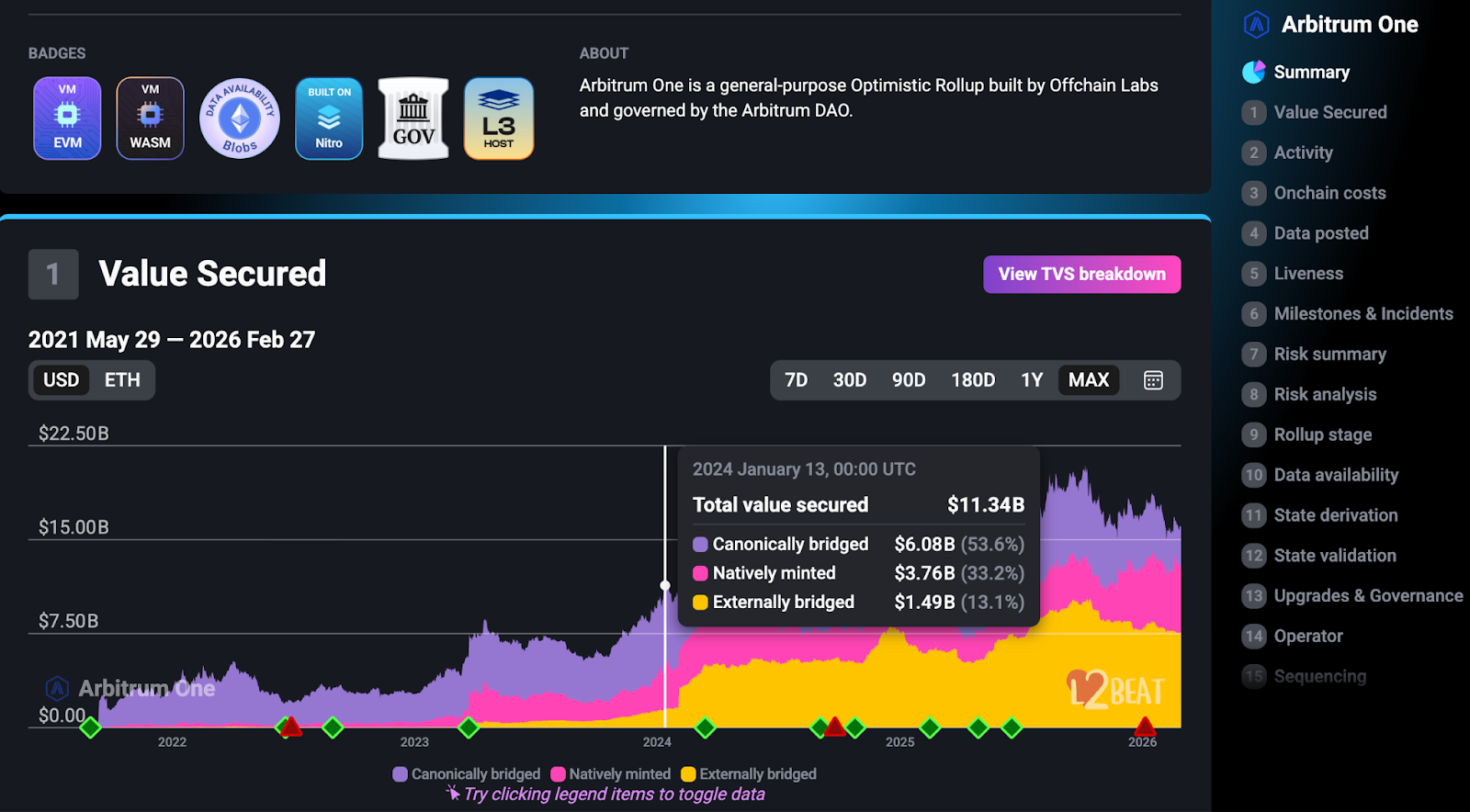
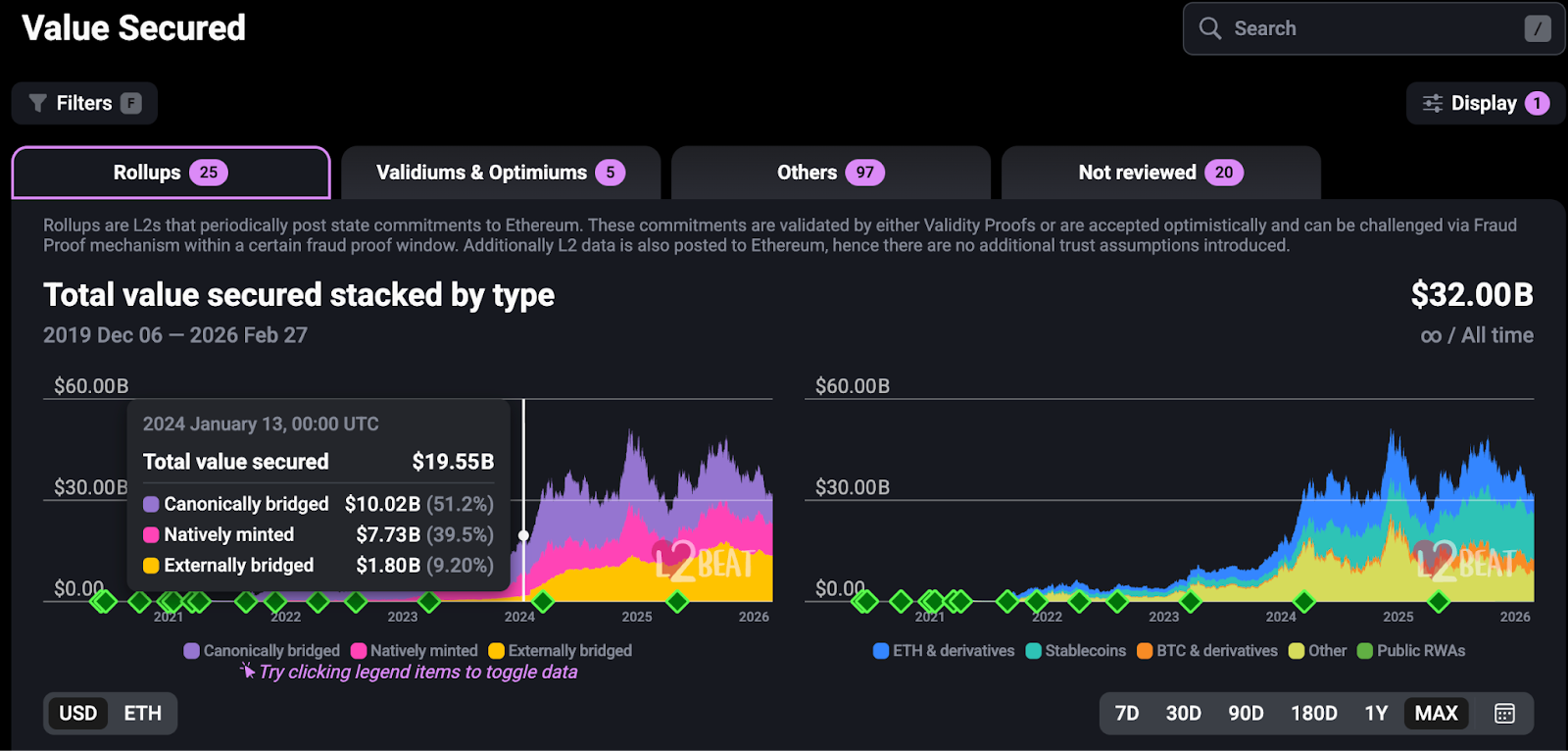
Rollups TVS among L2s from L2Beat
Price lingered at around that level for a couple of months before its gains were erased by 95.87% to its price today. It was only last February 23, 2026 that it registered its all-time low (ATL) at $0.08861.
Monthly token unlocks introduce an average of 95 million ARB into circulation or about 1.85% of its total supply. This further dilutes its price though the overall crypto industry has been bearish as of late.
On the bright side, its price is above 11.75% from its lowest mark. There are no guarantees that this will continue to improve however as macro-level factors remain uncertain.
Arbitrum's latest performance
March 20 to 26, 2026 saw ARB’s price action range between $0.0921 to $0.1012. On the other hand, its market cap fluctuated between $556.53 million to $611.28 million within the same period.
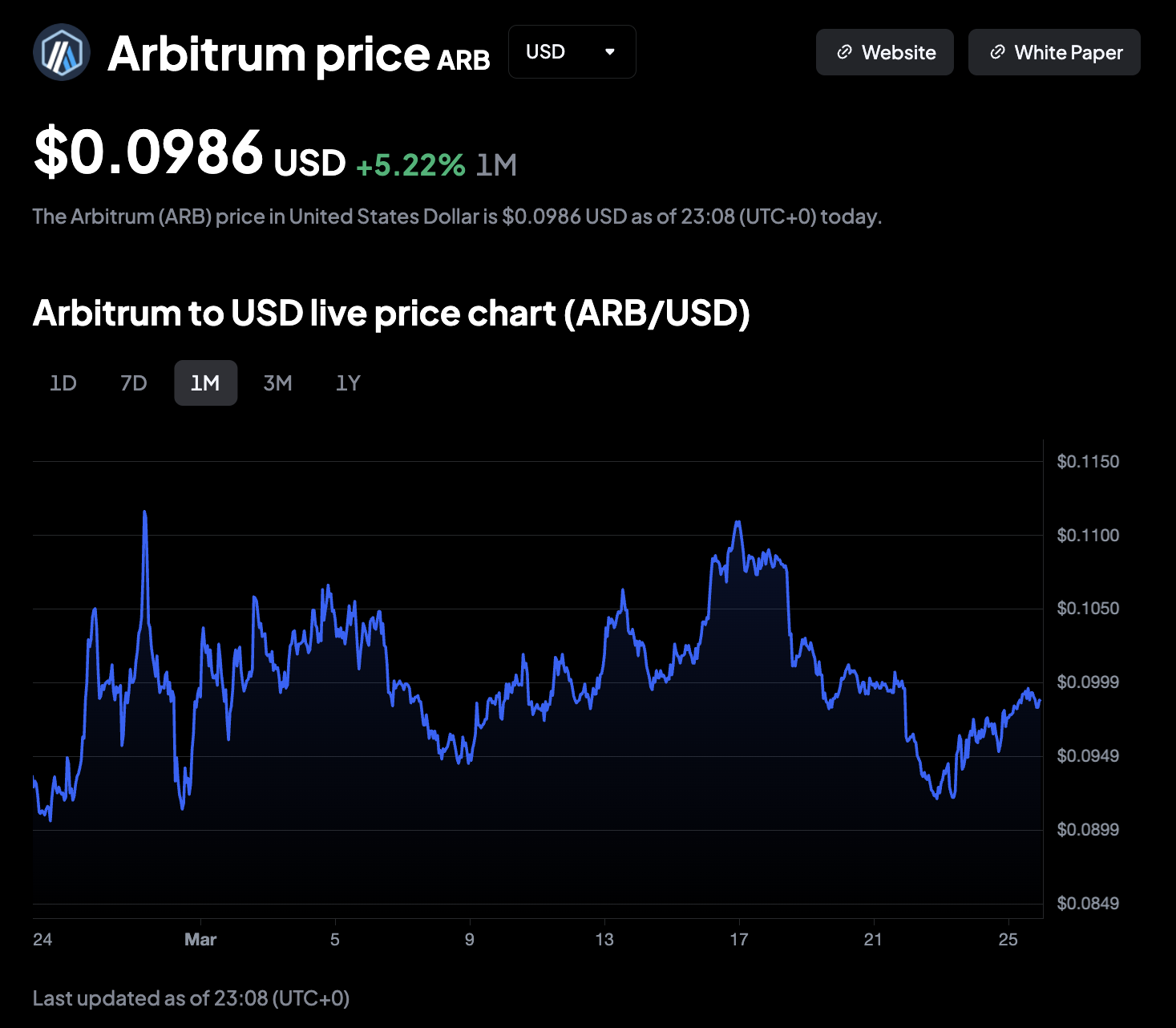
Arbitrum to USD live price chart on March 26, 2026, 07:09 UTC+8 from Toobit
It is trying to reclaim the psychological $0.100 price level after dropping to $0.0921 on March 22, 2026. The steady rise could continue especially if peace talks materialize in the ongoing unrest in the Middle East.
Current market snapshot (March 26, 2026, 07:09 UTC+8)
ARB bulls are battling to reclaim the uptrend with its price trading at $0.0946 on the ARB/USDT price chart. The last 24 hours have seen fluctuations in its price but is currently up 1.13%.
Around 6.04 billion ARB is currently in circulation with 10 billion ARB as its total supply. ARB’s market cap is up by 1.77% to $596.99 million in the last 24 hours.
Trading volume across all exchanges has decreased within the same period. It now sits at $54.2 million, down by 14.55%.
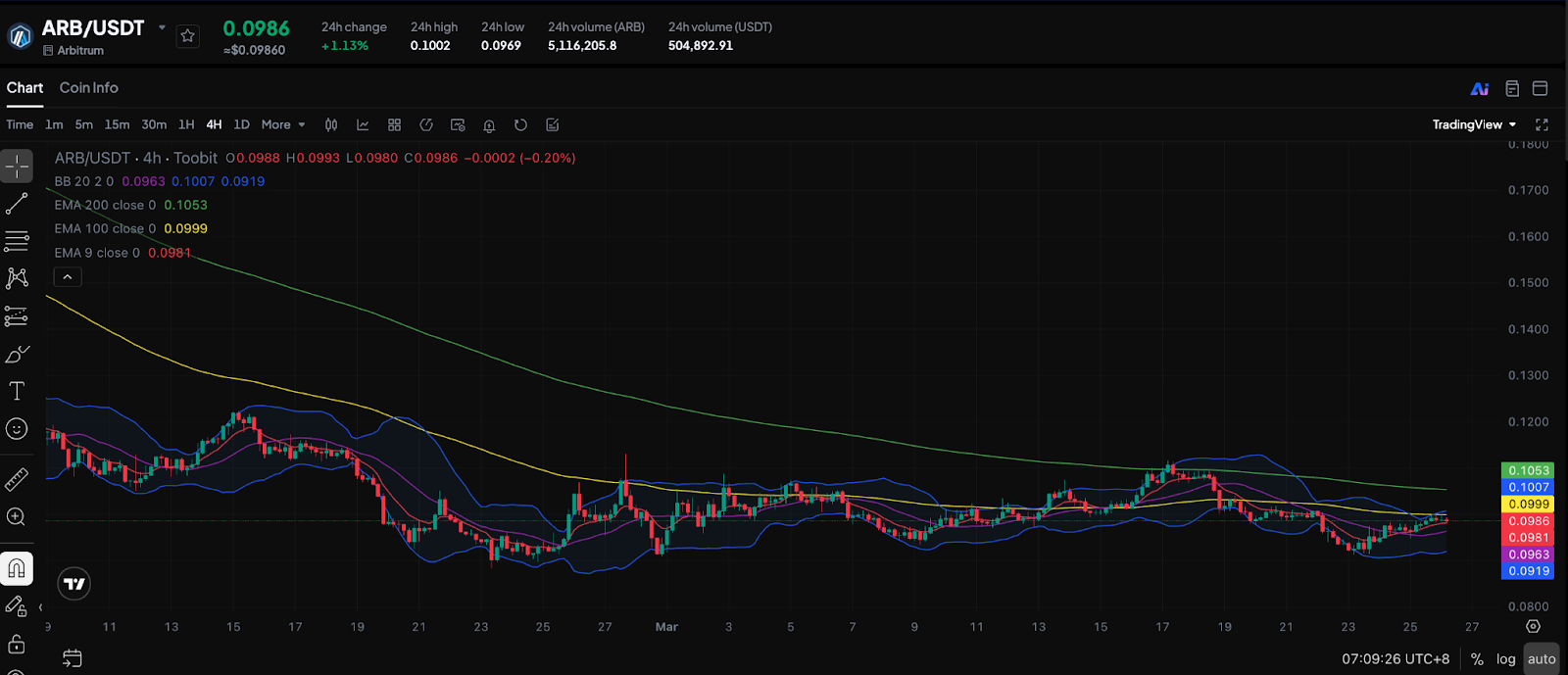
ARB/USDT 4-hour spot trading chart from Toobit
ARB’s price has been steadily moving upwards since March 23, 2026. This is in line with the announcement of a five-day pause in hostilities in the Middle East.
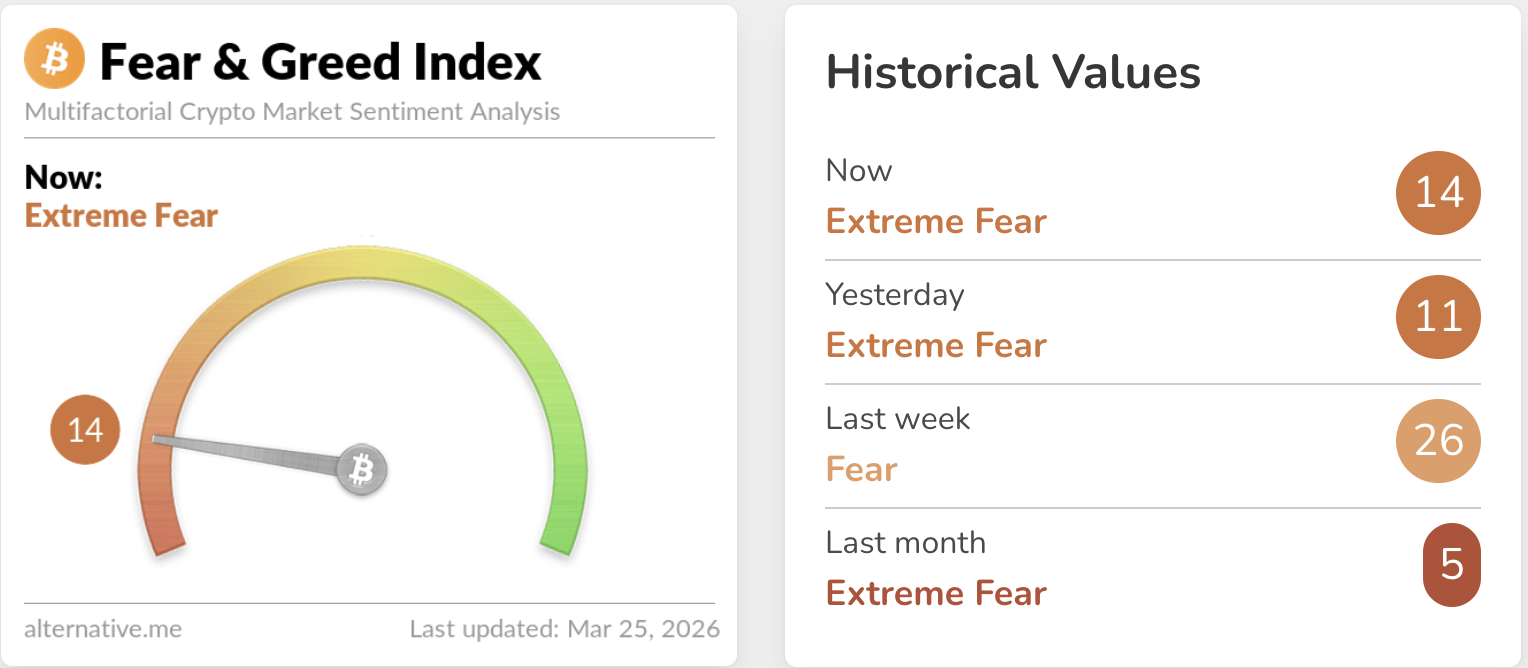
Crypto Fear and Greed Index from alternative.me
The Fear and Greed Index is currently at 14 (Extreme Fear). It may not specifically apply to ARB however it provides a general insight behind the token’s prolonged sideways trajectory.
On-chain and technical analysis
Support and resistance
ARB has been struggling with near term resistance at around the $0.1055 level since February 19, 2026. It has built near term support at about $0.915 and has been going sideways within this area.
This is also around the same level that its price wicked toward last October 2025 at $0.1055. With this major wick filled, ARB is likely to regain momentum in the coming days.
The next resistance level is around $0.1750 on the 4-hour time frame. Zooming out to the daily chart however, ARB has to next break past a possibly strong $0.2510 resistance level.
Momentum indicators
ARB’s Relative Strength Index (RSI) on the 4-hour time frame is at 55.81. It may dip slightly, before regaining momentum towards the 70 level with buyer exhaustion mounting.
Its daily Moving Average Convergence/Divergence (MACD) reveals a positive histogram reading of 0.0059. Its MACD blue line however appears to be peaking at 0.0022 over a signal of -0.0023.
Moving averages and volume
Price is below ARB’s 20-day SMA Middle Bollinger Band of $0.1210 on the daily time frame. It is currently challenging its 50-day moving average (MA) at $0.1034 but appears to be losing short-term momentum.
Both its 100-day and 200-day MAs are still quite a distance away at $0.1456 and $0.2360, respectively. It was back in October 2025 when ARB was hovering between all three MAs at the $0.465 level.
On March 22, 2026 however, volume began to pick up from its last recorded low of $32.53 million. Today’s $54.2 million volume output is about 67% above such reading.
On-chain cues
Dune records ARB’s on-chain data with weekly transactions at 15.8 million and 798.4k weekly active wallet addresses. Its DeFiLlama based reading has its Total Value Locked (TVL) at $2.01 billion.
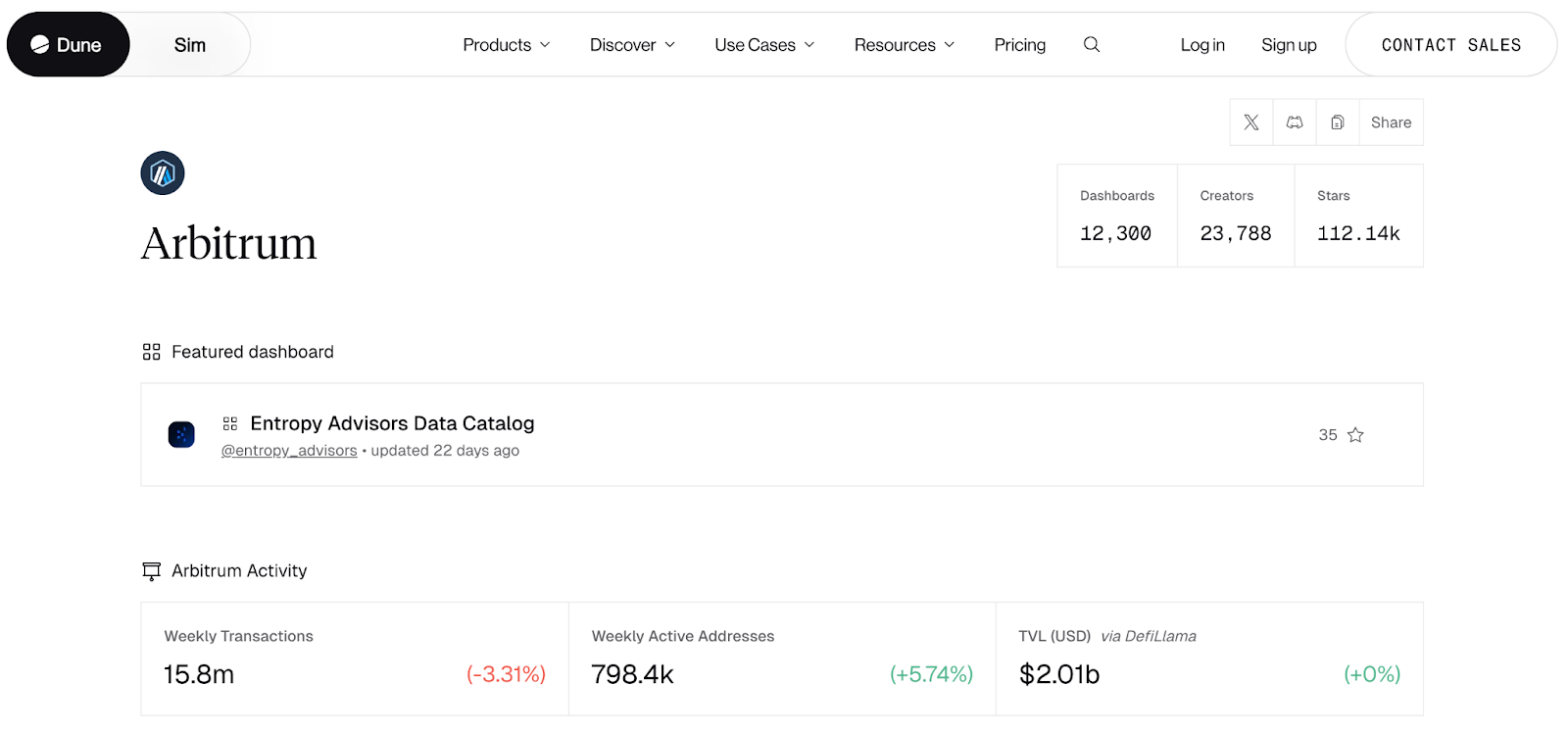
Arbitrum (on-chain) Activity from Dune
Weekly transactions are down 3.31% though it is countered by a 5.74% increase in weekly active addresses. TVL remains unchanged but based on its total asset holdings, Arbitrum is still very much in use among leading L2 projects.
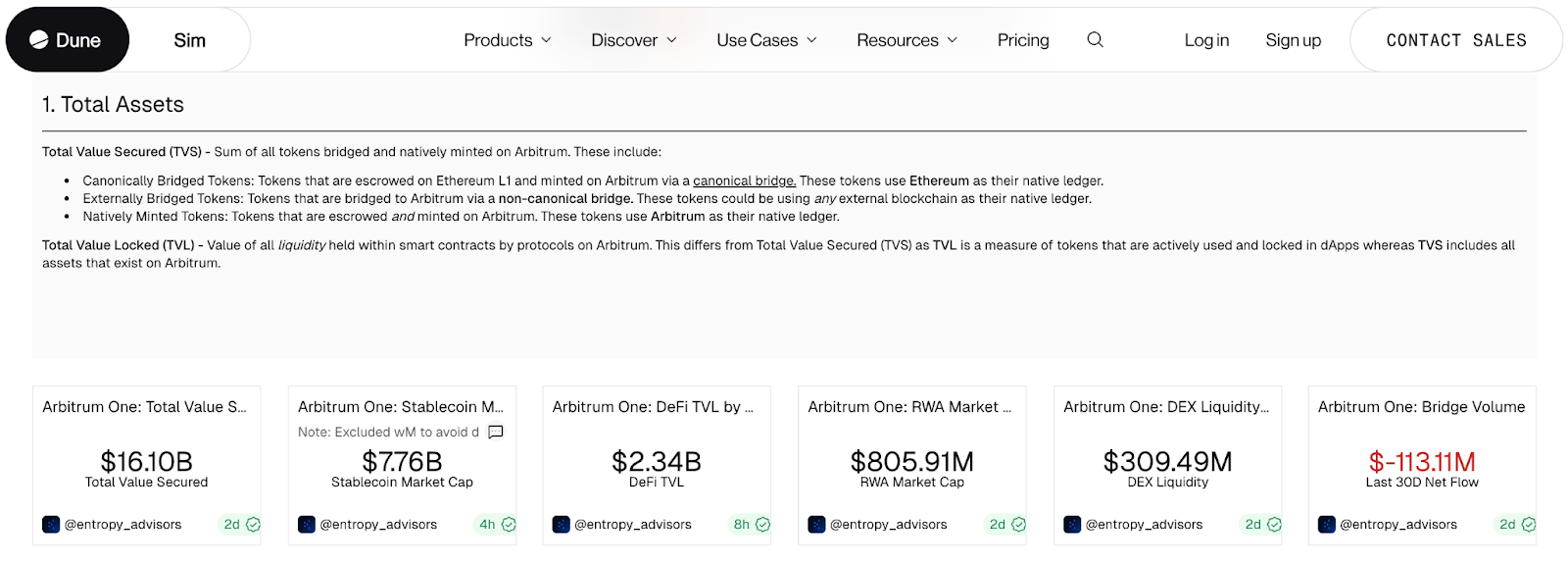
Arbitrum Total Assets from Dune
Arbitrum price prediction and outlook
As of March 26, 2026, ARB faces a tug-of-war between technical dominance and heavy supply pressure. Regular monthly unlocks of 95 million tokens with 39.6% of the 10 billion hard-cap still locked create a persistent price ceiling.
ARB remains inflationary in the short-to-medium term as it lacks aggressive deflationary mechanics combined with its token unlocks.
Bull Case ($0.35 to $0.85)
A rally could depend on the full Robinhood Chain rollout and ArbOS 51 Dia adoption. If the DAO introduces staking rewards and deflationary measures then it could accelerate buying pressure.
Base Case ($0.22 to $0.31)
ARB could continue tracking Ethereum’s performance while battling unlock fatigue. In this scenario, gains remain modest as the token struggles to break key resistance at $0.46.
Bear Case ($0.07 to $0.09)
The Fear and Greed Index has been at Extreme Fear levels for weeks now. Any broader downturn could re-test ARB’s ATL or go even lower.
Long-term utility is driven by allowing common programming language usage through Stylus and BoLD’s permissionless validation. Despite the recent slump, the bounce to $0.1069 shows resilient demand.
Arbitrum’s strategic shift toward Web3 gaming and institutional partnerships provides the fundamental strength needed to absorb supply inflation. If the $0.0944 support level holds, a steady recovery is likely.
This article is for informational purposes only and does not constitute financial advice. Always do your own research (DYOR) before making any decisions.
Key milestones for Arbitrum
1. Arbitrum One mainnet launch (August 31, 2021): It was the first Optimistic Rollup by Offchain Labs, supporting smart contracts on Ethereum.
2. Launch of Arbitrum Nova (August 2022): This second specialized chain utilizes AnyTrust technology storing transaction data off-chain through a Data Availability Committee (DAC).
3. Nitro upgrade (August 2022): Replaced the original architecture with a stack built on standard technologies resulting in a 7x increased speeds and reduced fees.
4. Transition to DAO governance (March 23, 2023): The ARB token launch handed governance power to ARB token holders establishing the Arbitrum Foundation and the Security Council.
5. Arbitrum Orbit unveiled (October 2023): Provided a framework for developers to create their own L3 chains and settle on Arbitrum One or Nova.
6. Stylus mainnet activation (September 2024): Introduced a second virtual machine alongside the Ethereum Virtual Machine (EVM), allowing smart contracts written using more common programming languages aside from Solidity.
7. BoLD permissionless validation (2025–2026): Stage 2 rollup maturity allows anyone to challenge fraudulent transactions instead of confining authority to a permissioned set of validators.
8. ArbOS 51 Dia upgrade (January 8, 2026): Aligned Arbitrum with Ethereum's Fusaka upgrade by introducing more efficient gas pricing models.
Community sentiment and ARB news
Checking ARB’s March 25, 2026 Sentiment Score on Messari yields a positive 0.0555. Sentiment Scores range from -1.0 being extremely negative and 1.0 as extremely positive.
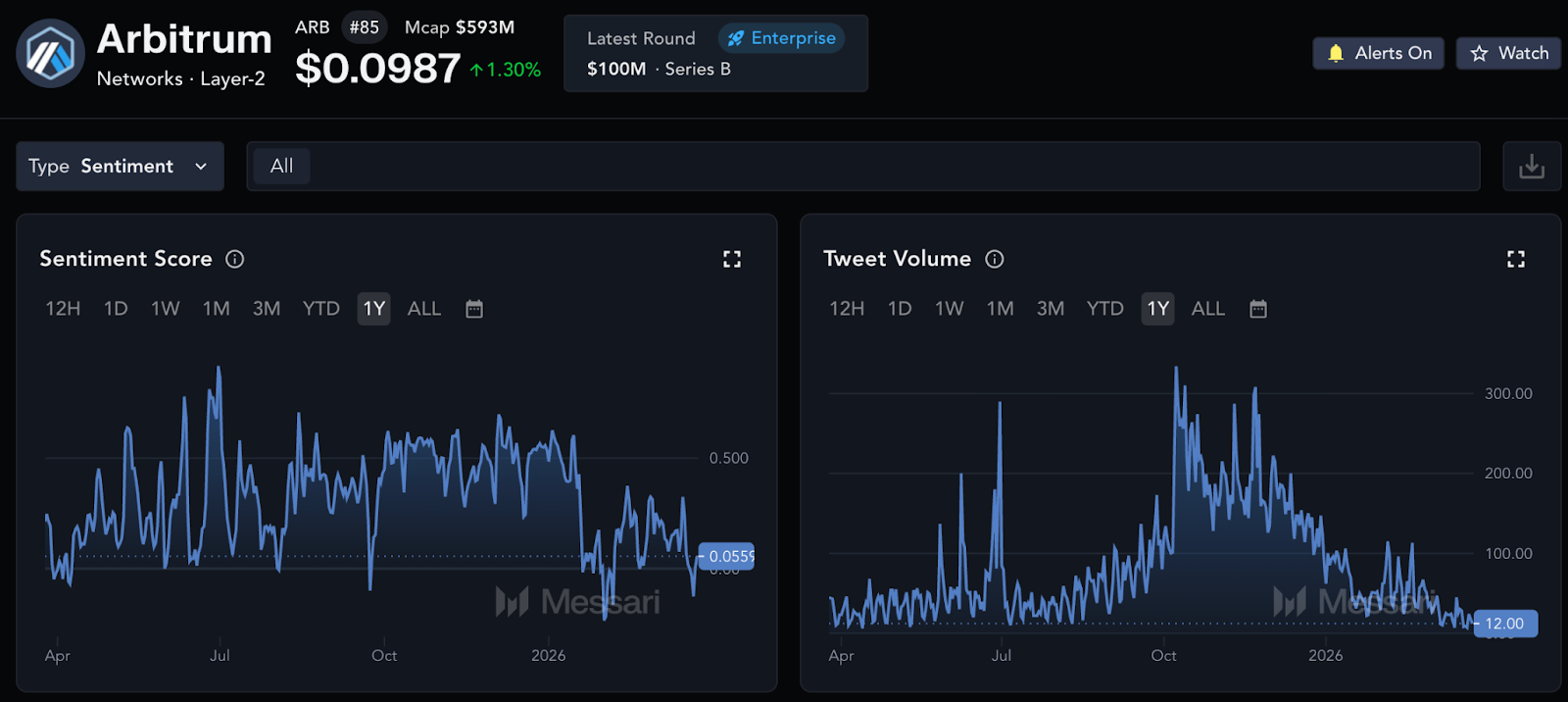
Arbitrum Sentiment Score and Tweet Volume charts from Messari
It generally maintained a positive sentiment score for a year, peaking at 0.917 on June 30, 2025, possibly due to partnership rumors with Robinhood and a 25% rise in active addresses.
Sentiment surrounding ARB however recently reached its lowest on February 1, 2026 at -0.234. This could be due to overall bearish sentiment in crypto instead of an isolated event.
ARB’s Tweet volume for March 25, 2026 was at 12. This is a far cry from the 334 it posted last October 8, 2025.
That spike was mainly due to the $10 million investment by Arbitrum Gaming Ventures in Web3 gaming companies. RWA tokenization also reached a valuation of around $1.1 billion on the network at this time.
ARB news
-
(March 25, 2026) Virtuals Protocol integration will bring a commerce layer for AI autonomous agents to transact natively on the Arbitrum network. It marks a solid deployment of a crypto-AI crossover in the emerging agentic economy.
-
(February 11, 2026) Built on Arbitrum, Robinhood Chain’s public testnet is unveiled by Robinhood. It plans to have a larger scale rollout later in 2026. Robinhood Chain will support tokenized stocks and other assets through the Robinhood crypto wallet with round-the-clock trading.
-
(December 12, 2025) Arbitrum-based Ostium protocol secures $24 million in funding. It was composed of a $20 million Series A and $4 million undisclosed strategic round. Ostium is a perpetuals protocol, boasting $25 billion in trading volume processed.
FAQs
What makes Arbitrum attractive for DeFi?
This is mainly due to its deep liquidity and high TVL. Its lower transaction costs and faster confirmations compared to the Ethereum mainnet make it ideal for on-chain financial activities.
Arbitrum’s EVM-compatibility allows Ethereum-based DeFi protocols to deploy with minimal changes which attract major applications, creating a more robust ecosystem.
How do optimistic rollups differ from zk-rollups?
Optimistic rollups assume off-chain transactions are valid, without publishing proofs of validity for transaction batches posted on-chain. It relies on a fraud-proving scheme to detect cases where transactions are not calculated correctly.
Anyone can challenge the results of a rollup transaction by computing a fraud proof during the challenge period after it is submitted on Ethereum. On the other hand, zk-rollups publish cryptographic proofs of validity for off-chain transactions.
What is the BoLD?
It is a sophisticated multi-round fraud-proof system which ensures that any fraudulent state is corrected on Ethereum. BoLD maintains the network's integrity through economic penalties for bad actors who attempt to submit invalid data.
How Does ARB Compare to Similar L2s Like Polygon (POL) and Optimism (OP)?
|
Feature |
ARB |
POL |
OP |
|
Main niche |
DeFi powerhouse |
Enterprise and gaming hub |
Ecosystem builder |
|
Technology |
Optimistic Rollup (multi-round fraud proofs) |
AggLayer + zk-based technology |
Optimistic Rollup (single-round fraud proofs) |
|
Token usage |
Governance only (fees paid in ETH) |
Gas fees + staking (fees paid in POL) |
Governance only (fees paid in ETH) |
|
Security model |
Inherits Ethereum security directly |
Hybrid model (transitioning toward zk security) |
Inherits Ethereum security directly |
|
Key advantage |
Deep liquidity and high TVL in L2 DeFi |
Strong mainstream partnerships |
“Superchain” interoperability vision |
What is Arbitrum’s L3 strategy?
L3 chains can optimize for specific use cases such as gaming or social applications. Projects do not need to compete for block space on a single L2.
Such layered approach improves scalability while keeping costs low and maintaining security through Ethereum at the base layer. This strategy combined with its multi-round fraud-proof mechanism positions its ecosystem to support mass adoption without sacrificing decentralization or security.
The bottom line
Arbitrum is undoubtedly among the premier Ethereum scaling solutions available today, blending technical maturity with massive liquidity. With around $16 billion in TVS, the network serves as a trusted hub for both institutional and DeFi assets.
This reliability is fueled by a consistent base of hundreds of thousands of Active Addresses. Its 6,000 TPS ensures the infrastructure can handle massive global activity.
Despite current market price pressures, continuous upgrades like Stylus and BoLD prepare Arbitrum for a new wave of crypto adoption.
Stay alert and track ARB price charts on Toobit for real-time insights.
How to start trading ARB on Toobit
Arbitrum is the engine for mainstream success. It has one of the deepest liquidity and TVL among the top L2 blockchains.
Ready to get into ARB?
Toobit has amazing access to charting tools to help you in your trading journey. Execute trades on its Spot and Futures pairs at competitive fees.
Start trading ARB/USDT today.


