
Preheader: Track the latest Aptos price, APT price USD levels, key technical indicators, and the on-chain signals that could shape Aptos’ market outlook in 2026.
When market infrastructure meets performance-driven tokenomics
Aptos (APT) enters 2026 with a more defined setup than it had a year ago. The roadmap is widening beyond raw throughput into two lanes: a performance-driven tokenomics reset and a broader infrastructure push across regulated assets, payments, and on-chain trading.
That first lane is now centered on Aptos’ tokenomics update, which ties supply mechanics more directly to network usage. Around it, the ecosystem has added more concrete infrastructure signals, including regulated APT futures, tokenized securities integrations, cross-border settlement expansion, and Decibel, a fully decentralized perpetuals venue built natively on Aptos.
The next sections outline what the chart must confirm, what would invalidate the move, and which milestones matter most as Aptos tries to turn infrastructure growth into sustained network activity.
What is Aptos (APT)?
Aptos is a Layer-1 (L1) blockchain built for fast, scalable on-chain applications. In plain terms, it is network infrastructure designed to support payments, trading, and tokenized asset activity with low-latency execution.
APT is the network’s native token. It is used to pay transaction fees and secure the network through staking. That gives APT a direct role in the activity moving across the chain.
Aptos is easiest to understand through 3 product lanes:
-
Payments and stablecoins: Aptos is building payment infrastructure and stablecoin-based settlement for cross-border transfers, treasury flows, and other money movement use cases.
-
Tokenized finance: The network is expanding into tokenized assets and other real-world assets (RWAs), which is why regulated integrations and asset wrappers matter to the APT story.
-
On-chain trading and automation: Aptos is also being built out for trading venues, settlement infrastructure, and machine-driven payment flows, including x402-related payment infrastructure.
In 2026, the Aptos story is less about speed on its own and more about whether that performance can support real payment activity, RWAs, and scalable on-chain execution.
APT price history and performance overview
APT price history
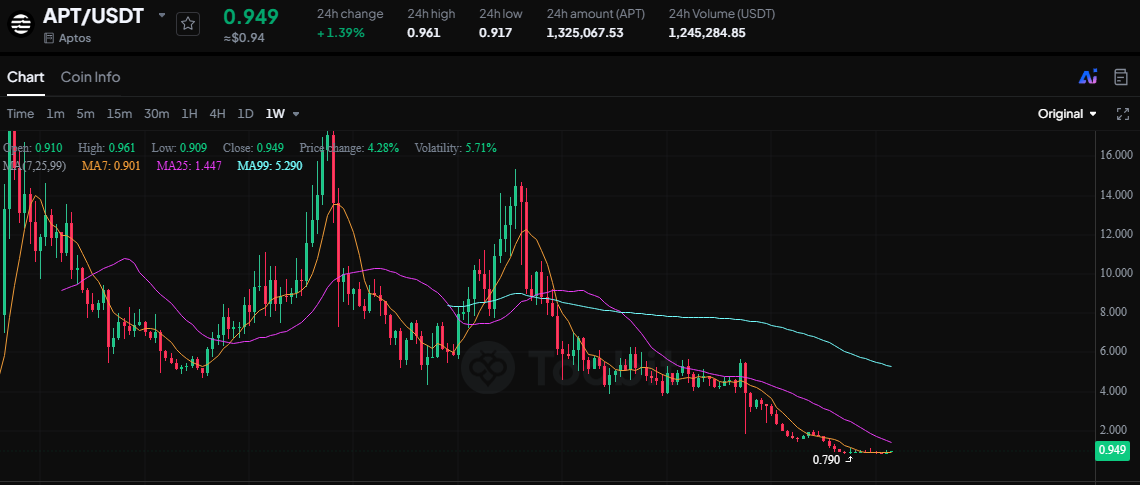
APT’s long-term spot chart has traded through a steep reset since its early-cycle peak. There was a move in 2023 that resulted in a new peak, with price now sitting close to the lower end of its historical range.
-
All-time high (ATH): around $19.84 (January 30, 2023)
-
All-time low (ATL): around $0.7943 (February 23, 2026)
APT price from Toobit, as of April 22, 2026, around 07:30 UTC.
APT’s latest performance
-
APT price: around $0.949
-
24h high: around $0.961
-
24h low: around $0.917
-
24h volume: around 1,325,067.53 APT (around $1.25 million in USDT)
At the time of writing, APT is trading near the middle of its recent short-term range. The implication is that price has stabilized locally, but the next move still needs stronger follow-through.
Current market snapshot (April 22, 2026, 07:30 UTC)
Risk appetite is still cautious.
Crypto Fear and Greed Index from Alternative.me, as of April 22, 2026.
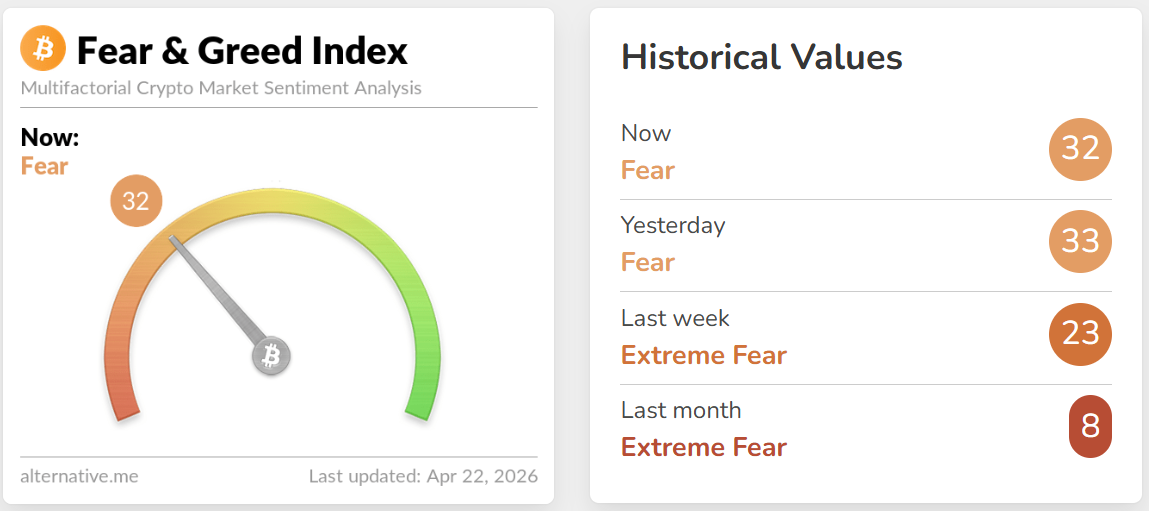
Fear & Greed Index prints 32 (Fear), which keeps the broader market mood defensive rather than supportive of a clean risk-on move. Breakouts still need stronger confirmation, and rebounds can fade quickly if conviction stays weak.
Yesterday’s reading was 33 (Fear). That is a clear improvement from last month’s 8 (Extreme Fear), but the broader tape is still far from confident.
APT can still rebound on coin-specific catalysts, but sustained upside usually needs a cleaner reclaim and a market more willing to take risk.
On-chain and technical analysis
Support and resistance
APT is trading near the lower end of its broader structure, with the latest 24-hour range sitting between $0.9169 and $0.9618. Price is still holding above the recent floor near $0.7897, but it remains below the first local ceiling and well below the heavier higher-timeframe break zone.
Near-term support sits at $0.7897.
Near-term resistance remains $0.9618. Above that, the more important higher-timeframe break level is the MA25 near $1.4463.
Momentum indicators
APT’s 14-period Relative Strength Index (RSI) is around 32.24, which keeps momentum weak and close to oversold territory rather than clearly repaired. That fits a market that has stabilized near a low base, but has not yet shown stronger upside follow-through.
APT RSI from TradingView, as of April 22, 2026, around 07:30 UTC.

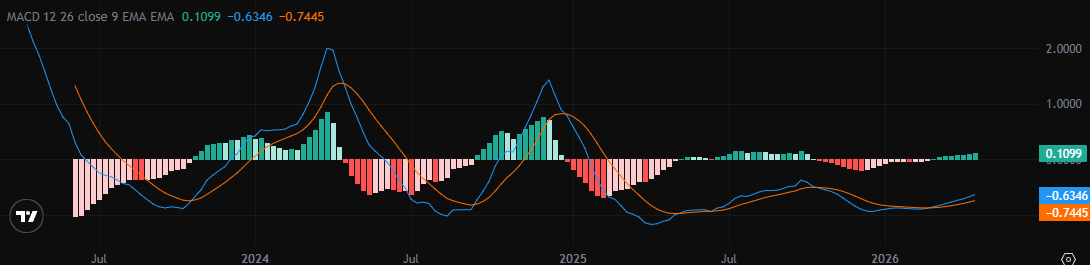
Moving Average Convergence Divergence (MACD) is still below zero, with MACD around -0.6346, the signal line around -0.7445, and the histogram around 0.1099. That suggests downside pressure has eased, but the move still looks more like a recovery attempt than a clean trend change.
APT MACD from TradingView, as of April 22, 2026, around 07:30 UTC.
Moving averages and volume
APT is now trading above the 7-day MA, which points to firmer short-term momentum, but it still remains below the 25-day MA at $1.4463 and far below the 99-day MA at $5.2880. The short-term picture has improved, but the heavier levels that would signal a more durable trend shift still have not been reclaimed.
APT volume from Toobit, as of April 22, 2026, around 07:30 UTC.

Volume also looks more consistent with stabilization than aggressive accumulation. The latest reading is around 31.018 million APT, which is roughly 69% below the 20-period volume average of around 100.416 million APT. The implication is that the move is stabilizing, but conviction still looks limited and participation is not yet strong enough to confirm a stronger accumulation phase.
On-chain cues
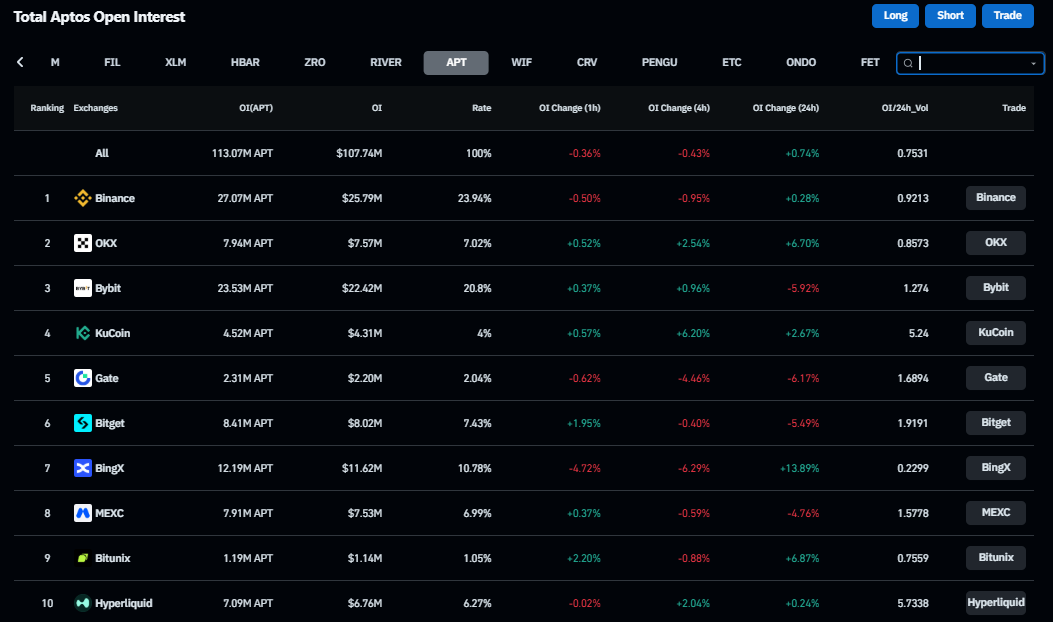
Derivatives positioning is still active, but it is not confirming a stronger move yet. For APT, that leaves the rebound looking low-conviction rather than fully supported.
Total open interest (OI) is around 113.07 million APT, or roughly $107.74 million. Short-term changes are mixed, with OI down around 0.36% (1-hour), down around 0.43% (4-hour), and up around 0.74% (24-hour). That divergence matters because it suggests positioning is not building in a clean trend. The market is still active, but conviction is uneven, which makes it harder to treat the latest rebound as a stronger extension.
APT OI from Coinglass, as of April 22, 2026, around 07:30 UTC.
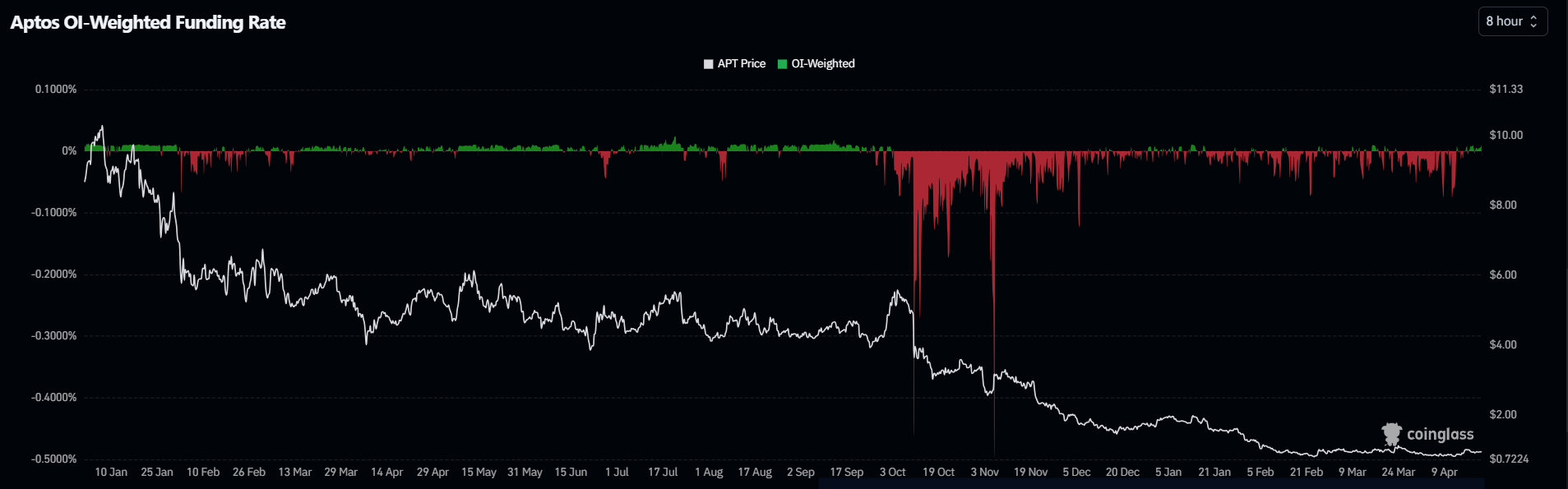
The OI-weighted funding rate (FR) still looks slightly negative overall, with only a modest lift toward neutral in the most recent prints. That leaves APT without the kind of crowded long positioning that usually confirms a stronger breakout.
APT OI-weighted funding rate from Coinglass, as of April 22, 2026, around 07:30 UTC.
What to watch next
-
First, APT needs to hold $0.7897. If that floor breaks, the repair attempt weakens quickly.
-
Next, a reclaim of $0.9618 would improve the short-term structure and shift attention toward the MA25 near $1.4463.
-
Confirmation matters after that. Volume needs to improve from current levels, while OI should start building more cleanly and OI-weighted funding should stay controlled.
APT price prediction and outlook
Base case
-
APT keeps stabilizing above $0.790 while price remains capped below $0.961 on spot.
-
Price is now holding above the recent base, but it still remains below the 25-day MA at $1.447 and far below the 99-day MA at $5.290. That keeps the move in repair mode rather than a stronger trend shift.
-
The setup stays intact if spot volume improves gradually and, on the perpetual, open interest remains mixed rather than breaking down sharply.
Bull case
-
APT reclaims $0.961 and starts holding above it on spot.
-
That would improve the short-term structure and strengthen the rebound. On the higher timeframe, the 25-day MA at $1.447 would become the next key test, while the 99-day MA at $5.290 would still remain the heavier cap.
-
The move looks more credible if spot volume starts building from current depressed levels and, on the perpetual, open interest expands while funding stays controlled.
Bear case
-
APT loses $0.790 and fails to reclaim it quickly on spot.
-
That would weaken the current repair attempt and keep the broader structure under pressure, with price falling back below the recent base while still remaining far from the heavier moving-average ceilings.
-
The downside read becomes more vulnerable if spot participation stays weak and, on the perpetual, open interest fails to build while funding remains soft.
A controversial viewpoint
APT’s harder risk may not be outright failure. Aptos can keep expanding across payments, tokenized assets, and on-chain trading while APT still fails to attract sustained token demand. In that outcome, the network becomes more useful, but the token is still treated as a secondary infrastructure asset rather than a clear market leader.
The key twist
-
The financial-infrastructure lane is tied to stablecoins, tokenized assets, and products such as Archax, PACT, and Juicyway. This gives Aptos a clearer role in payments and capital-market activity rather than a generic L1 narrative.
-
The execution-and-throughput lane is tied to Aptos’ broader push around trading and performance, including Decibel and the network’s newer tokenomics framing. Stronger activity across those lanes would make the market more likely to treat APT as a utilization-linked asset instead of a weak rebound token.
Key milestones for Aptos
-
February 24, 2022: Aptos completed a strategic funding round worth around $200 million.
-
July 25, 2022: Aptos completed a Series A round worth around $150 million. That brought disclosed 2022 fundraising to around $350 million and became an important part of the project’s early development story.
-
October 12, 2022: Aptos mainnet launched, moving the project from pre-launch development into a live L1 network with an initial supply of 1 billion APT.
-
October 2024: Native USDT launched on Aptos mainnet, marking a major step in the network’s push to become a stronger stablecoin and settlement layer.
-
January 30, 2025: Native USDC and Cross-Chain Transfer Protocol went live on Aptos, expanding the network’s stablecoin stack and improving cross-chain dollar flows.
-
August 21, 2025: Aave went live on Aptos in its first non-Ethereum Virtual Machine (EVM) deployment, giving the network a stronger large-cap decentralized finance anchor.
-
October 2, 2025: Aptos said the network had surpassed $1 billion in stablecoin market cap during 2025, reinforcing the chain’s stablecoin-led growth narrative.
-
February 18, 2026: Aptos published its tokenomics update, proposing lower staking emissions, higher gas fees, and a harder supply framework so APT mechanics would track network activity more closely.
-
February 22, 2026: Aptos integrated Juicyway for cross-border settlements, adding a payments use case tied to more than $3 billion in processed volume.
-
March 2026: Aptos added 2 regulated market milestones. Bitnomial launched a regulated APT futures product in the United States, while Archax brought more than 100 tokenized securities on-chain.
Community sentiment and APT news
APT chatter has stayed constructive lately as the token’s 2026 narrative tightens around higher network activity, stablecoin growth, and a broader financial infrastructure push.
Aptos weekly transactions snapshot from Token Relations, as of April 21, 2026.
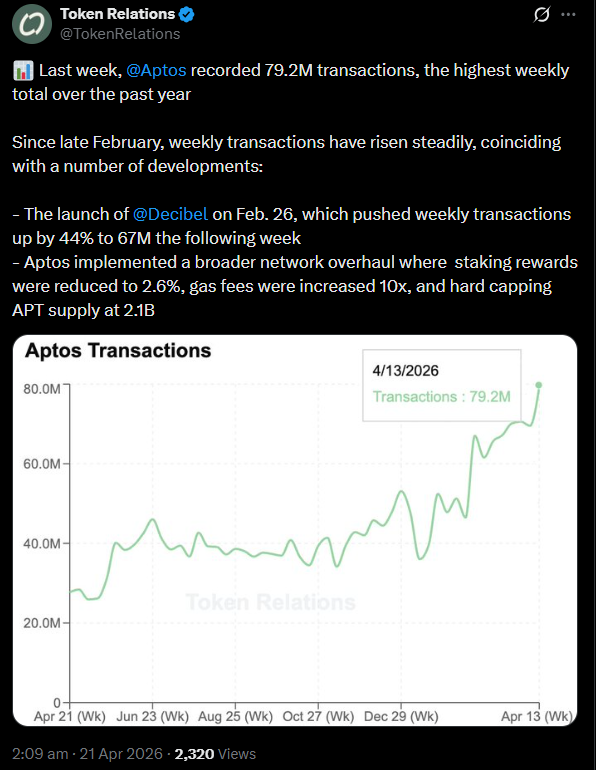
Token Relations reported that Aptos reached 79.2 million weekly transactions, the highest weekly total over the past year, and linked that rise to both the Decibel launch and the network’s newer tokenomics overhaul.
Community sentiment for APT from CoinMarketCap, as of April 22, 2026.
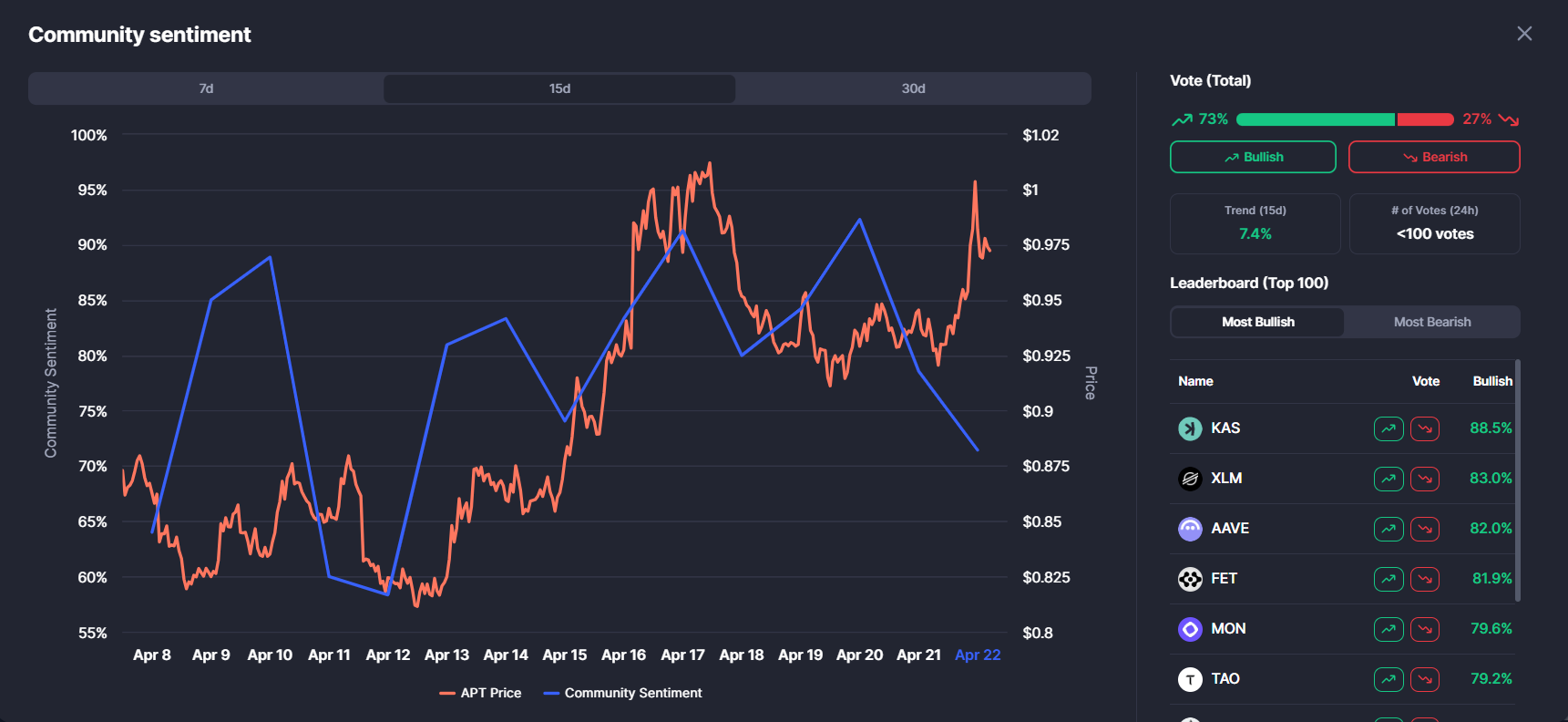
Community sentiment from CoinMarketCap also leans supportive. The latest read shows 73% bullish versus 27% bearish, with a 7.4% 15-day trend. That keeps the signal directionally constructive, but the vote count is still small, with fewer than 100 votes recorded in the last 24 hours.
The broader takeaway is that the market is paying attention to Aptos again, but it still wants cleaner follow-through before treating that constructive tone as stronger conviction.
FAQs
What is Aptos used for?
Aptos is a L1 blockchain built for payments, stablecoin settlement, tokenized assets, and scalable on-chain applications. Its broader goal is to support low-latency execution for financial activity such as transfers, trading, and other infrastructure-heavy use cases.
What is APT used for?
APT is the network’s native token. It is used for gas fees, staking, and governance. In practice, that means APT helps pay for activity on the chain, supports network security through staking, and plays a role in how protocol-level changes are approved over time.
How is Aptos different from other Layer 1 blockchains?
Aptos stands out through its Move-based architecture, parallel execution design, and stronger focus on execution quality for financial infrastructure. The more important difference in 2026, though, is not just raw speed. It is that Aptos is trying to turn that performance into real use across payments, stablecoins, tokenized finance, and on-chain trading.
Does Aptos support stablecoins and tokenized assets?
Yes. Stablecoins have become one of Aptos’ clearest growth areas, and the network has also pushed further into tokenized finance through integrations tied to regulated assets and on-chain credit. Aptos now has a more concrete role in settlement and market infrastructure rather than a generic L1 story.
Should I buy APT now?
That depends on your risk tolerance, time horizon, and how you view Aptos’ broader role in market infrastructure. The stronger case for watching APT is tied to what the network is building: payment rails, stablecoin settlement, tokenized assets, and on-chain trading infrastructure, with APT sitting at the center of fees, staking, and governance.
What makes that story more credible is that Aptos is no longer relying only on throughput claims. It now has a clearer product direction and more visible execution across financial use cases. What still needs proof is whether that progress can turn into sustained network activity, stronger participation, and more durable token demand.
The bottom line
APT enters 2026 in a stabilization phase. The setup is less about headlines and more about follow-through. Price has moved off the recent low, but it is still trading below key moving averages, momentum remains soft, and rallies are still being treated as tests until structure starts to repair.
The key trigger is stronger follow through, where improving activity starts to translate into firmer participation and a more durable upside move. The key risk is that Aptos keeps expanding across payments, tokenized assets, and on-chain trading while APT itself remains stuck as a low-conviction infrastructure token rather than a clear market leader.
This article is for informational purposes only and does not constitute financial advice. Always do your own research (DYOR) before making any decisions.
How to start trading Aptos (APT)
Aptos is building across payments, RWAs, and on-chain trading, and APT tends to stay relevant when market attention rotates toward high-throughput infrastructure. If you are ready to trade APT, Toobit provides a streamlined way to get started with spot and futures tools built for active execution.
Ready to trade APT? Toobit offers spot and futures trading with low fees, deep liquidity, and clean charting tools to help you plan entries and manage risk.
Start trading APT/USDT today.


