
Preheader: Track the latest Aave price, AAVE price USD levels, key technical indicators, and the protocol milestones that could shape Aave’s market outlook in 2026.
When DeFi lending meets institutional RWAs
Aave (AAVE) enters 2026 with a stronger setup than many decentralized finance (DeFi) blue chips. The roadmap is widening beyond “supply and borrow” into two lanes: an institutional real-world asset (RWA) track and a broader product push focused on usability and distribution.
Aave Horizon supports that institutional lane by focusing on borrowing stablecoins against tokenized assets for eligible participants. If tokenized Treasuries and other RWAs keep scaling, Aave is positioning itself as part of the lending rail that can serve that demand.
The next sections outline what the chart must confirm, what would invalidate the move, and which milestones matter most as Aave V4 moves toward a 2026 mainnet target.
What is Aave (AAVE)?
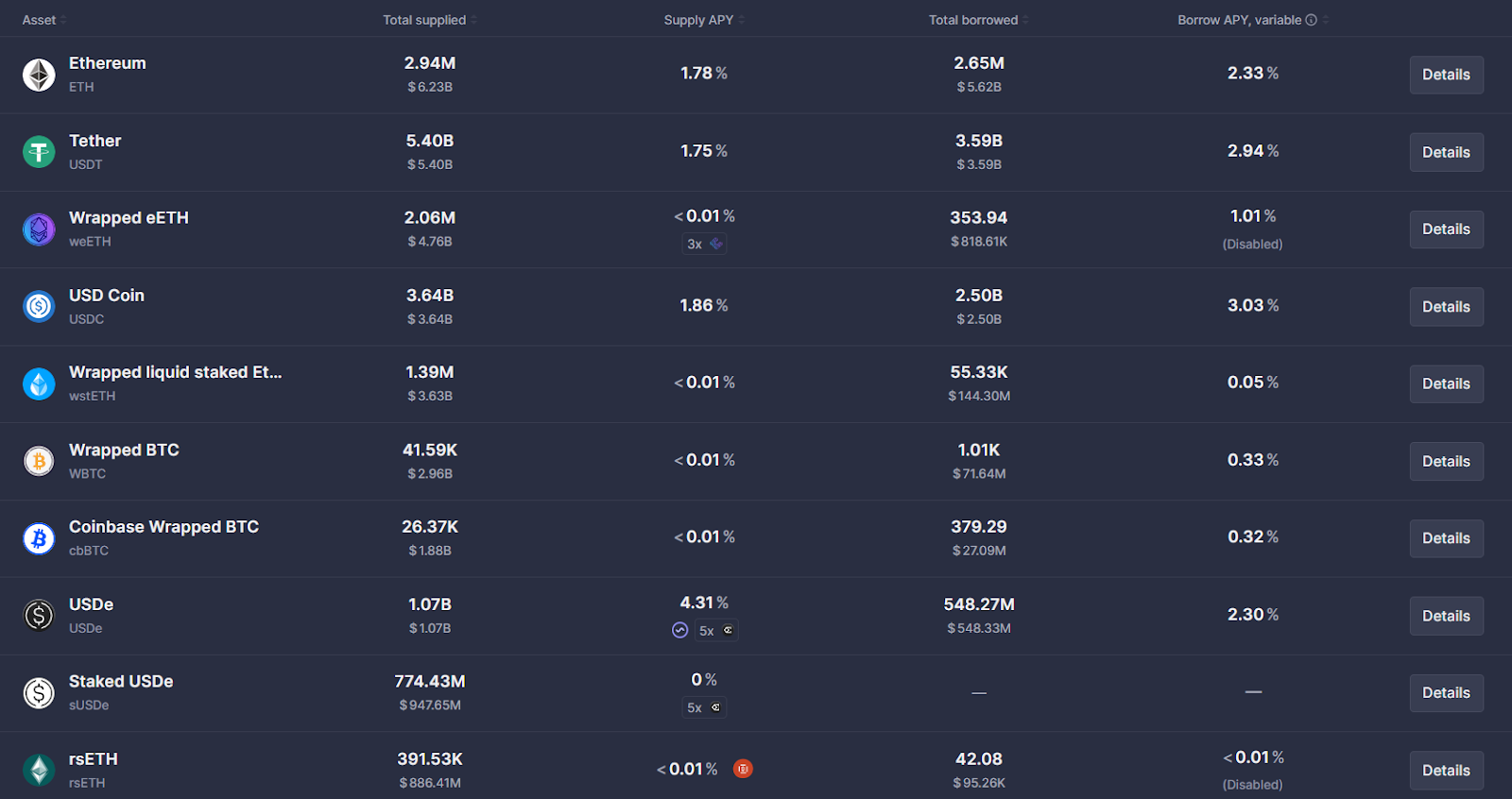
Aave is a decentralized, non-custodial liquidity protocol. In plain terms, it is a marketplace where users lend and borrow crypto through pooled liquidity.
Aave market interface (suppliers and borrowers in pooled liquidity) from Aave
-
Suppliers deposit assets into liquidity pools and earn interest.
-
Borrowers post collateral and borrow assets from those pools, typically overcollateralized to manage risk.
Aave is modular and governed through on-chain governance, with AAVE token holders voting on decisions such as supported assets, risk parameters (collateral settings, caps, and interest rate models), and major protocol upgrades across deployments.
Aave also has a native stablecoin called GHO (pronounced “go”), an overcollateralized stablecoin designed to target a U.S. dollar peg that users mint by supplying collateral within Aave.
A key economic detail is that interest paid by GHO minters is directed to the Aave treasury, positioning GHO as more than a feature and potentially supportive of long-term protocol sustainability.
GHO facilitators overview from Aave
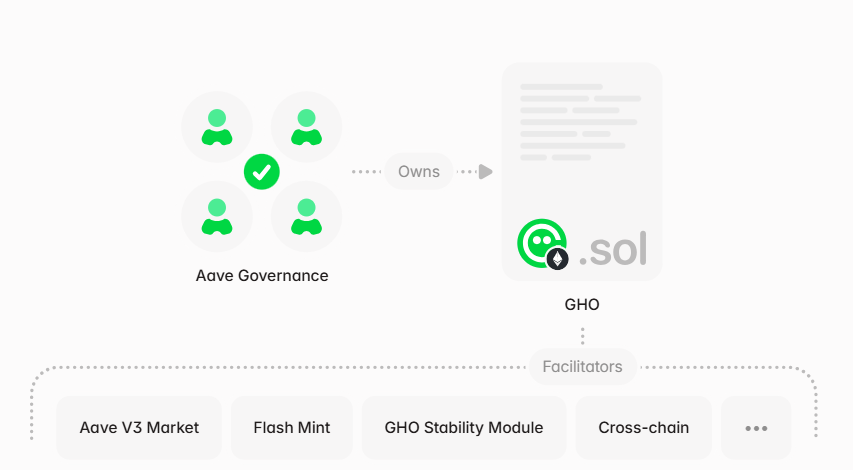
To support peg mechanics, the GHO Stability Module (GSM) enables swaps between GHO and governance-accepted stablecoins such as USDC, providing a risk-management toolset designed to help maintain stability during market stress.
AAVE price history and performance overview
AAVE price history
AAVE’s long-term chart has traded through clear cycles: sharp upside during risk-on periods, followed by long compression phases when liquidity tightens.
-
All-time high (ATH): $664.01 (May 2021)
-
All-time low (ATL): $26.02 (November 2020)
In simple terms, AAVE has already proven it can move fast. The key for 2026 is whether it can reclaim levels that turn rebounds into a sustained move.
AAVE’s latest performance
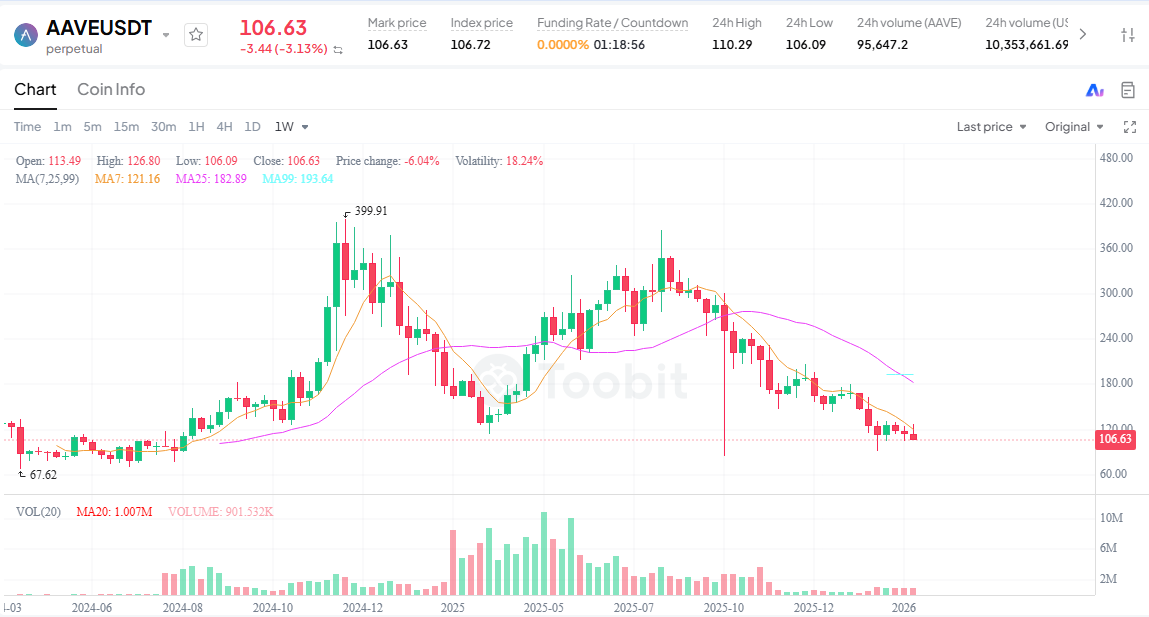
AAVE price from Toobit, as of March 18, 2026, 07:37 UTC
-
AAVE price: around $120.41
-
24h high: around $123.17
-
24h low: around $118.87
-
24h volume: around 5,748.76 AAVE (around $697,362.19)
At the time of writing, AAVE is trading around $120.41, which keeps it above the earlier rebound zone but still below the recent swing high near $124.85.
Current market snapshot for (March 18, 2026)
Aave Fear and Greed Index from CFGI.io (March 18, 2026)
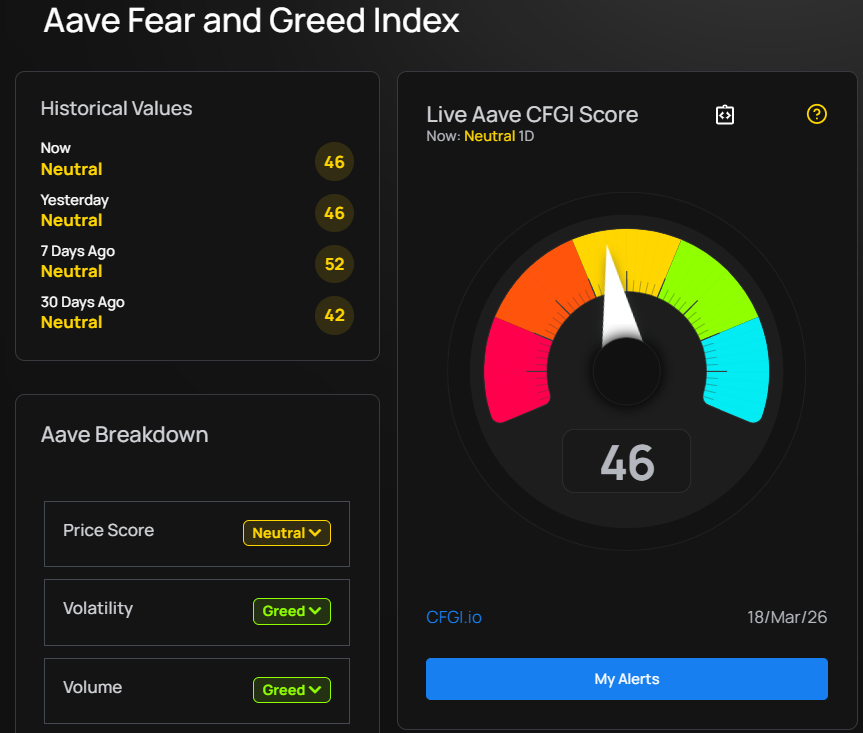
The Aave Fear and Greed Index score is 46 (Neutral), unchanged from yesterday (46). One week ago it was 52 (Neutral), while 30 days ago it sat at 42 (Neutral).
In other words, sentiment remains solidly in the neutral zone, modestly better than a month ago but still far from any strong greed territory. That fits the current chart setup: AAVE is stabilizing, but it still needs a clearer push through resistance to turn attention into a sustained move.
The broader macro backdrop also helps explain that caution. Rising geopolitical risk and firmer energy prices have kept overall risk sentiment fragile, which makes it harder for AAVE to shift from stabilization into a stronger breakout.
On-chain and technical analysis
Support and resistance
AAVE is trading in a tighter range than the earlier March reset, so the structure has shifted from breakdown risk to short-term consolidation.
The latest session range is defined by a 24-hour high of $123.17 and a 24-hour low of $118.87, with price last trading near $120.41. That keeps AAVE in the middle of the range, but still below the recent swing high near $124.85, which is the level that capped the latest upside push.
Near-term support sits at $118.87 to $120.00.
Near-term resistance remains $123.17, with the recent swing high near $124.85 still acting as the next upside reference.
Momentum indicators
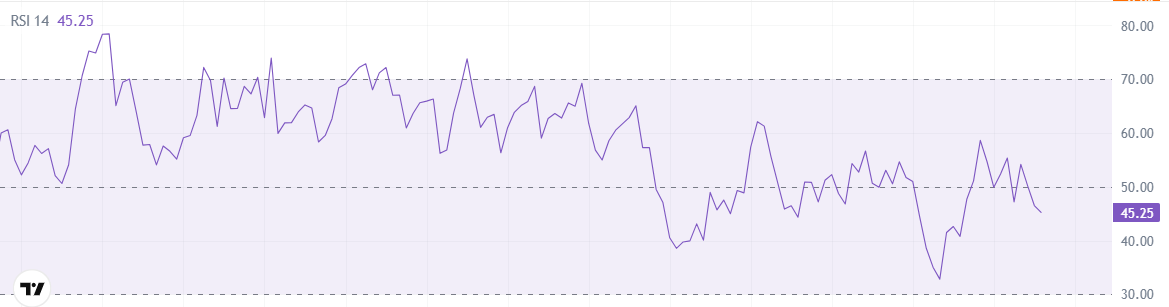
AAVE’s 14-period relative strength index (RSI) is around 45.25, which places it in neutral territory. That usually reflects a market that has cooled from the recent rebound but has not rolled into clear downside momentum.
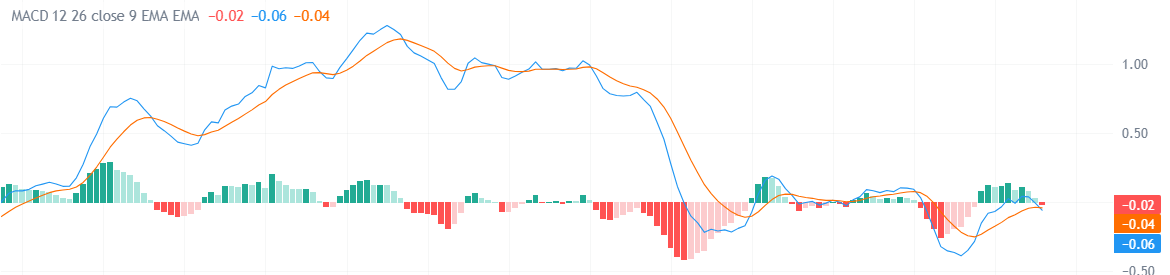
AAVE MACD from TradingView, as of March 18, 2026, 07:37 UTC
Moving average convergence divergence (MACD) is still slightly negative, with MACD around -0.06, the signal line around -0.04, and the histogram around -0.02. That suggests momentum has softened after the recent move higher, but the downside read is still mild rather than aggressive.
AAVE MACD from TradingView, as of March 18, 2026, 07:37 UTC
Moving averages and volume
AAVE is now trading close to its key moving averages (MAs) rather than well below them. Price is near MA(7) at $120.89 and MA(25) at $121.15, while still holding above MA(99) at $116.98. That is a different setup from the earlier defensive structure, because the chart is now testing whether short-term averages can turn from overhead resistance into support.
That also makes the latest range more important. AAVE has already bounced sharply from the earlier March low near $106.98 and pushed as high as $124.85, but the current price action shows that upside is slowing around the short-term averages instead of expanding cleanly through them.
In practical terms, this looks more like consolidation after a rebound than a fresh breakout.
Volume has also moderated after the stronger burst seen during the move into March 15 to March 16. That points to a market that is digesting gains rather than attracting aggressive follow-through buying at current levels.
On-chain cues
Derivatives positioning still looks active, but it is not one-way.
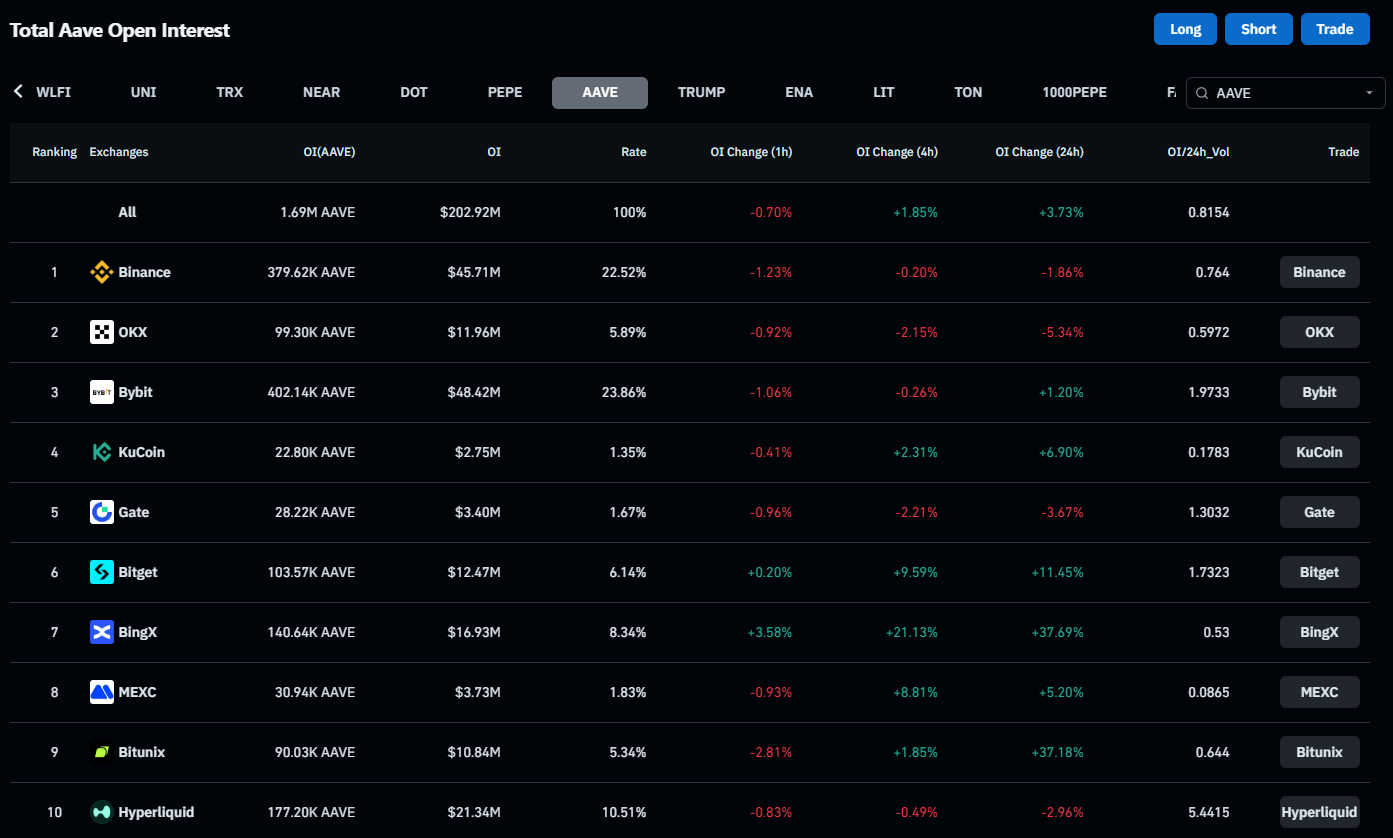
Total open interest (OI) is around 1.69 million AAVE (around $202.92 million). Short-term changes are mixed: down around 0.70% (1h), up around 1.85% (4h), and up around 3.73% (24h).
AAVE Open Interest from Coinglass, as of March 18, 2026, 07:37 UTC
Funding rate (FR) on the OI-weighted view remains close to flat, with the latest prints only slightly negative. For AAVE, that matters because price is no longer sitting at panic lows; it is consolidating near the middle of the range after a rebound.
AAVE OI weighted funding rate from Coinglass, as of March 18, 2026, 07:37 UTC
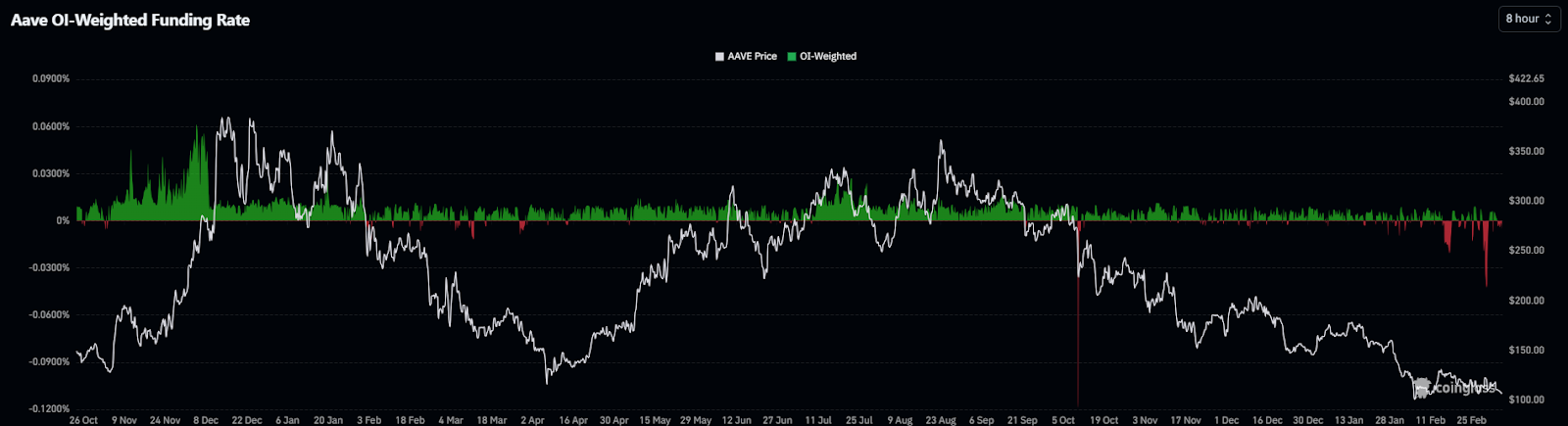
In this setup, a push back into $123.17 to $124.85 looks more constructive if OI continues building while FR stays controlled.
If FR stays flat but OI starts fading, the current rebound is more likely to remain range-bound than turn into a stronger extension.Taken together, the cleaner signal would be price holding above the $120 area while OI stays firm and the market starts pressing resistance again.
What to watch next
-
AAVE holds $118.87 to $120.00 and avoids slipping back below the range midpoint
-
AAVE reclaims $123.17 and starts pressing the recent $124.85 swing high
-
OI continues building instead of fading after the rebound
-
Spot participation improves if price retests the upper end of the range
AAVE price prediction and outlook
Base case
-
AAVE keeps consolidating around $120 while holding the rebound zone at $118.9 to $120.0.
-
Price stays range-bound below $123.17, with the chart holding its recent recovery but not yet breaking into a cleaner continuation move.
-
The setup remains constructive as long as AAVE keeps trading around MA(7) at $120.89 and MA(25) at $121.15, while staying above MA(99) at $116.98.
What would support the base case:
-
AAVE holds $118.9 to $120.0 and keeps printing higher lows
-
Price stays firm around MA(7) and MA(25)
-
OI stays stable or keeps building while FR remains controlled
Bull case
-
AAVE reclaims $123.17 and starts pressing into the recent swing high near $124.85.
-
The structure shifts from consolidation to continuation if price can hold above its short-term moving averages instead of fading back into the range.
-
A stronger breakout would look more credible if it comes with firmer participation rather than another light-volume push.
What would support the bull case:
-
Price holds above $123.17 after the breakout
-
AAVE starts clearing $124.85 with follow-through
-
OI rises with price while spot participation improves
Bear case
-
AAVE loses $118.9 to $120.0 and fails to reclaim it quickly, weakening the recent recovery structure.
-
Price slips back below MA(7) and MA(25), turning the current setup into another stalled range move.
The downside gets more vulnerable if momentum stays soft and participation does not return on rebounds.
What would confirm the bear case:
-
Clean loss of $118.9 to $120.0 with no fast reclaim
-
Price falls back below MA(7) and MA(25)
-
OI fades as price weakens
A controversial viewpoint
AAVE may stay structurally strong, but 2026 could still be a year where the token behaves more like “infrastructure equity” than a momentum asset. In that tape, milestones land, usage stays steady, and the market still refuses to pay up because capital rotates into faster narratives.
The more realistic risk is not a sharp breakdown. It is a slow grind where rallies keep getting sold, and price only responds when liquidity returns to large-cap DeFi as a group.
The key twist
-
The institutional lane is tied to Horizon, positioning Aave as a lending rail for eligible participants borrowing stablecoins against tokenized assets.
-
The upgrade lane is tied to Aave V4, framed as the next major architecture step with a 2026 mainnet target.
Key milestones for AAVE
-
October 25, 2017: Held an ICO at a $1.84 token price, raising $16.2 million
-
September 2018: Rebranded from ETHLend to Aave, shifting toward a pooled-liquidity model.
-
January 8, 2020: Launched Aave V1 on Ethereum, establishing pooled liquidity lending.
-
October 12, 2020: Completed an undisclosed round raising $25 million, backed by Blockchain Capital, Blockchain.com, and Standard Crypto.
-
December 3, 2020: Launched Aave V2 on Ethereum, improving protocol efficiency and user experience.
-
March 2022: Rolled out Aave V3, enabling broader multi-chain expansion and improved risk tooling.
-
August 1, 2022: Approved GHO via governance, adding a protocol-native stablecoin layer.
-
August 27, 2025: Launched Horizon, positioning an institutional track for borrowing stablecoins against tokenised assets.
-
November 19, 2025: Released Aave V4 on testnet, introducing the Hub-and-Spoke architecture, risk premiums for risk-adjusted rates, and a redesigned liquidation engine, with mainnet targeted for 2026.
-
February 25, 2026: Reached $1 trillion in all-time loan volume, marking a major adoption milestone.
Community sentiment and Aave news
Aave chatter has stayed active lately as the protocol’s 2026 narrative tightens around scale milestones, Aave V4, and expansion into new markets.
On social media, the tone is broadly constructive: some posts frame Aave as one of the stronger large-cap DeFi names because of its scale, security track record, and product roadmap, while governance and deployment discussions still add short-term noise.
A community post discussing Aave from X
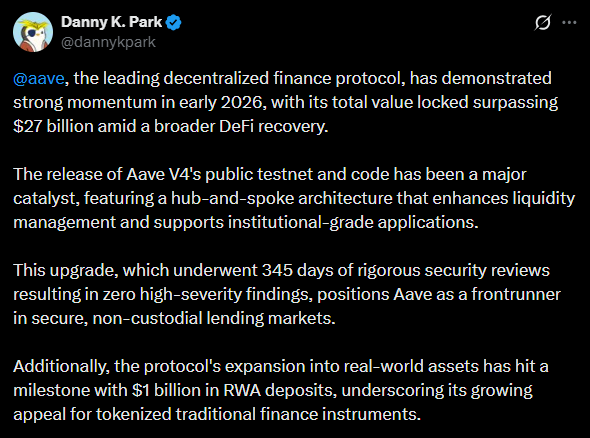
The tone is cautiously bullish, but patient. A common read is that Aave looks structurally strong after multiple cycles, but traders still want cleaner follow-through before treating this as a full trend shift.
Community sentiment from Coinmarketcap as of March 18, 2026, 07:37 UTC
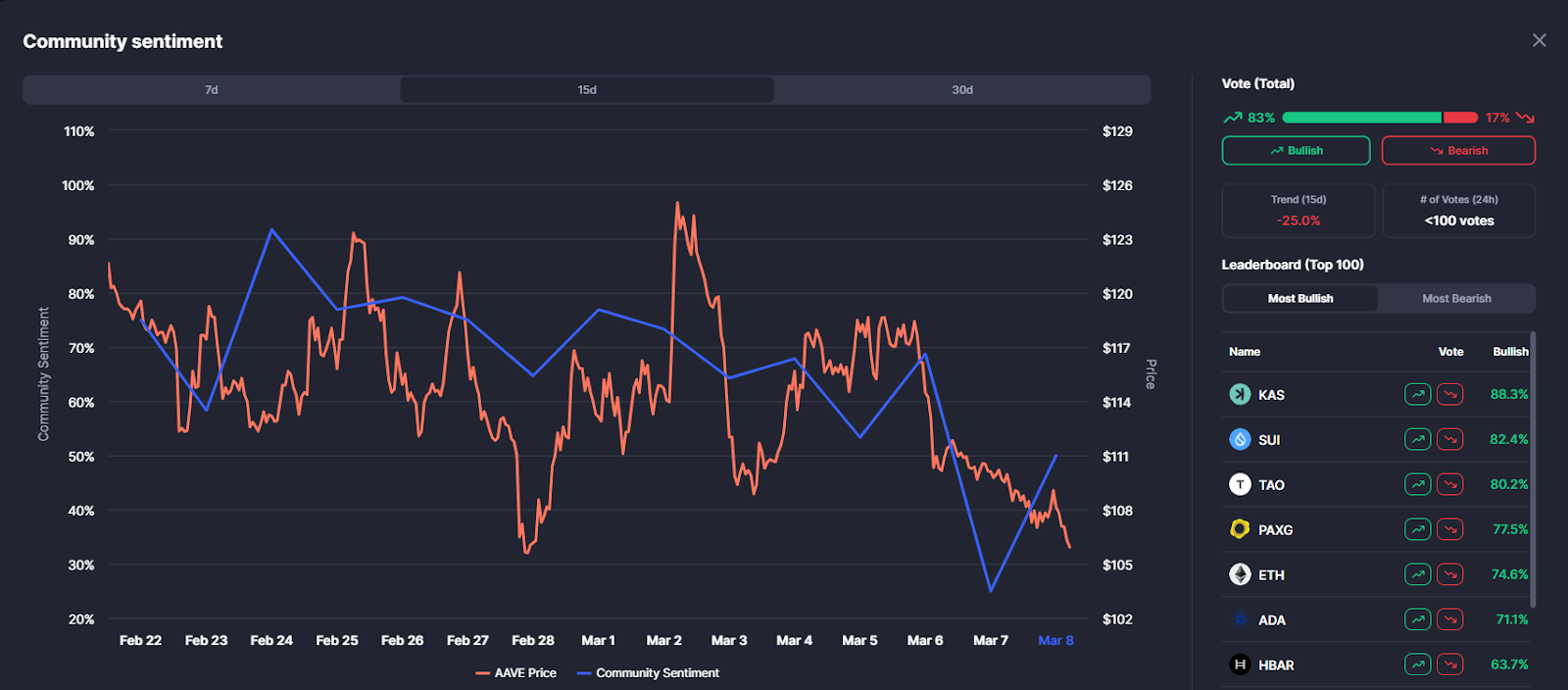
Sentiment from CoinMarketCap, as of March 18, 2026, 07:37 UTC, shows 83% bullish vs 17% bearish, with a -17.9% 15-day trend and <100 votes in the last 24 hours. That keeps the signal directionally supportive, but still light-sample and not strong enough on its own to confirm conviction.
Overall, sentiment is improving, but conviction still depends on price confirmation.
The bottom line
AAVE enters 2026 in a consolidation phase. The setup is less about headlines and more about follow-through. Price is still trading below key moving averages, momentum remains soft, and rallies are being treated as tests until structure starts to repair.
The key question is whether AAVE can turn stabilization into a sustained move by reclaiming resistance and holding support with consistent participation. If usage remains sticky and positioning stays healthy, AAVE tends to benefit because its longer-term relevance is tied to real protocol activity, not short-lived attention.
This article is for informational purposes only and does not constitute financial advice. Always do your own research (DYOR) before making any decisions.
How to start trading Aave (AAVE)
Aave sits at the center of DeFi narratives, and AAVE tends to react quickly when the market rotates back into large-cap DeFi or when major protocol milestones approach.
Ready to trade AAVE? Toobit offers spot and futures trading with low fees, deep liquidity, and clean charting tools to help you plan entries and manage risk.
Start trading AAVE now.


