
If you have noticed Worldcoin popping up again and again, it is not just because it is controversial. It is because the problem it targets is getting worse fast: Bots, fake accounts, and AI “users” are flooding the internet, and most platforms are not equipped to handle it.
Worldcoin, now branded as World, tries to solve that with a bundled stack: WLD (the token), World ID (proof you are a unique human), World Chain (human-first blockchain), and the World App (the wallet and app hub).
What is World?
World launched its token WLD on July 24, 2023. It was created by Tools for Humanity, founded by Sam Altman, Alex Blania, and Max Novendstern.
The core idea is called proof of personhood: You can prove you are a real, unique human online without handing over your name, phone number, or government ID. According to World's webpage, World's approach uses World ID plus cryptography (including zero-knowledge proofs) to confirm uniqueness while minimizing what needs to be revealed.
What is WLD's price now?
World (WLD) market snapshot
These figures move fast, so treat them as a timestamp.
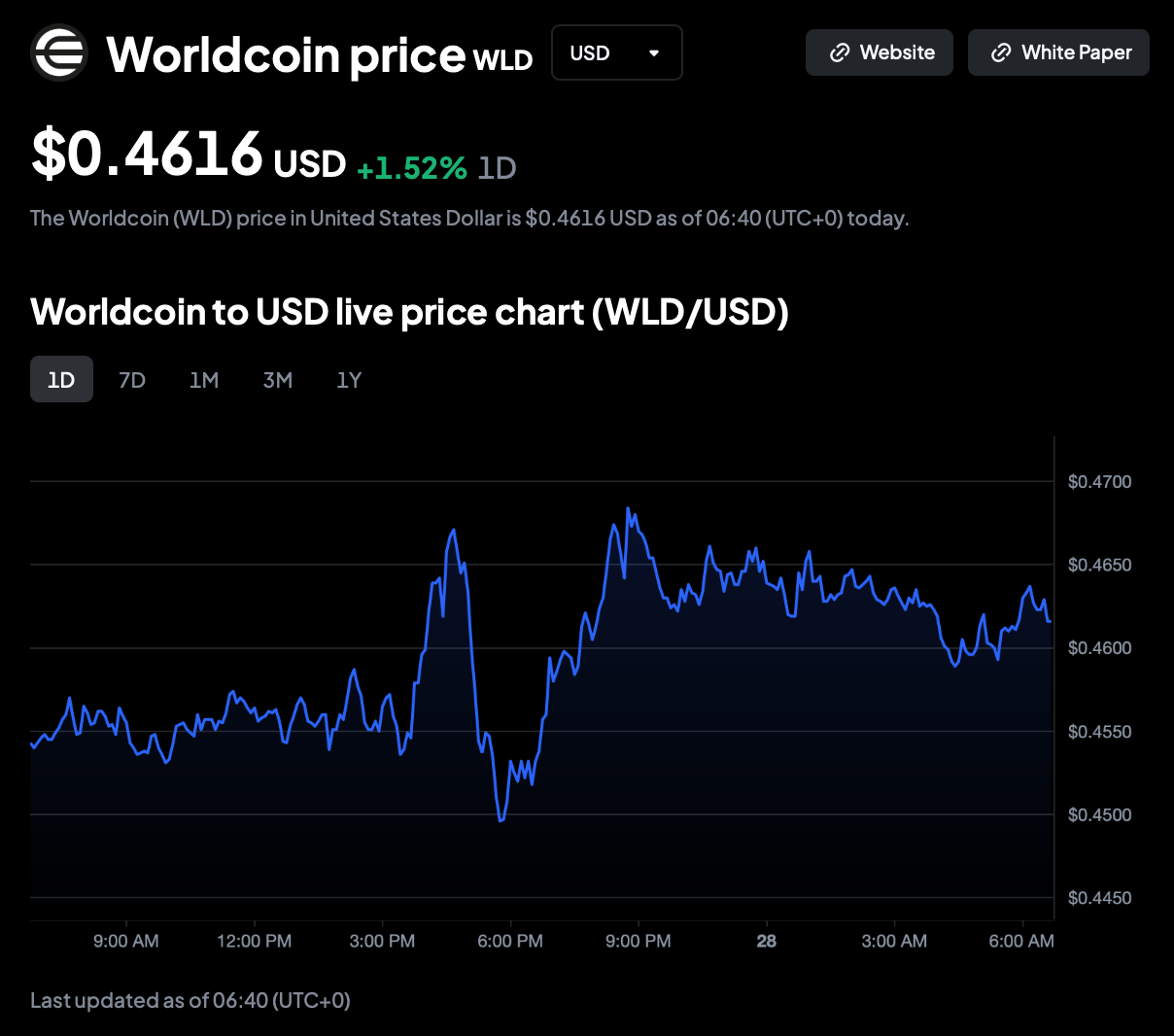
Figures from Toobit, accurate as of January 28, 2026, 06:40 UTC
As of January 28, 2026, WLD price is around $0.46, with a market cap near $1.27 billion. According to CoinMarketCap, the 24-hour trading volume is around $73.67 million and the circulating supply stands at around 2.77 billion WLD presently.
Supply-wise, the project launched with an initial cap of 10 billion WLD for the first 15 years, with any inflation only possible starting July 24, 2038, capped at 1.5% annually if governance ever turns it on.
Price history of WLD
For extremes, CoinGecko lists:
-
WLD all-time high (ATH): $11.74 on March 10, 2024
-
WLD all-time low (ATL): $0.4343 on January 25, 2026
WLD Tokenomics
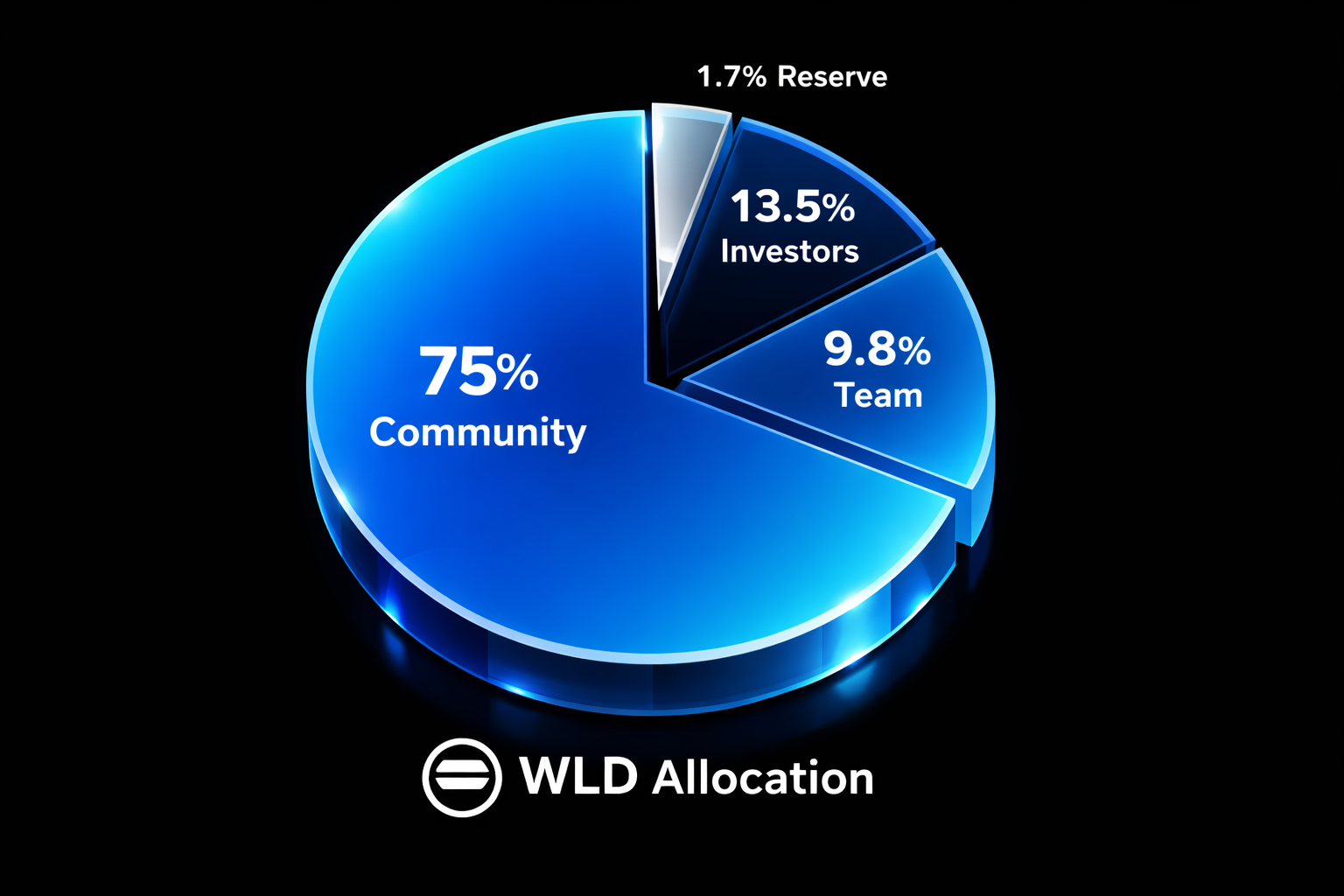
WLD token allocation breakdown by category
WLD's initial supply cap is 10 billion (first 15 years). The headline allocation at launch was:
-
75% allocated to the community
-
13.5% to early backers in Tools for Humanity
-
9.8% to the initial development team
-
1.7% reserved for Tools for Humanity
World also stated an aspirational goal to direct at least 60% of total WLD to users over time.
Major news and upgrades of WLD
-
Rebrand and network shift: Worldcoin rebranded to World and launched World Chain in October 2024, with migrations from the earlier venue toward World Chain.
-
Orb Mini: World introduced a smaller "Orb Mini" concept as part of expanding verification access.
-
Regulatory pressure: Multiple regulators have restricted or challenged biometric collection practices, including actions in Spain and Hong Kong, and court scrutiny in Kenya.
Where Worldcoin lives on
WLD is an ERC-20 token on Ethereum mainnet, but most real usage has moved onto World's own layer-2 (L2) called World Chain (built on the OP Stack). WLD also exists on Optimism from the earlier phase, but World’s Whitepaper positions World Chain as the main venue for access and use today.
Practical takeaway: When you deposit, withdraw, or send WLD, you must match the network (Ethereum vs. World Chain vs. Optimism). Network mismatch is how people learn expensive lessons.
The World ecosystem mapped to real utility
Now that you know where WLD lives, the more useful question is what the World ecosystem actually lets you do. World is built like a stack, and each layer is supposed to turn "verified human" into something practical you can use in apps, payments, and on-chain actions.
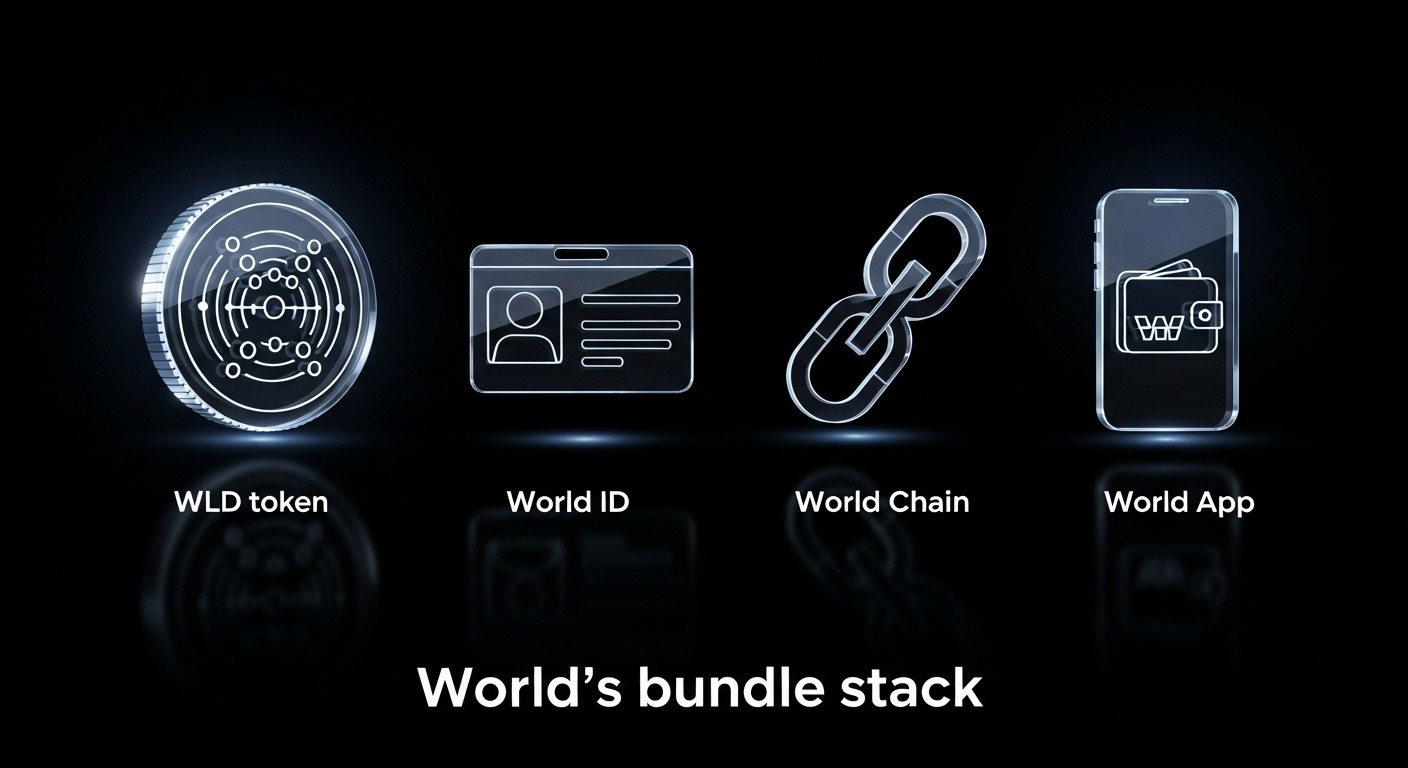
The key components of World's ecosystem: WLD token, World ID, World Chain, and World App.
World ID and the proof-of-human layer
World ID is the core product.
It is a privacy-preserving credential that lets apps verify you are a real, unique human without needing your name, email, or government ID. The key word is unique. This is the part that targets bots, duplicate accounts, and reward farming at scale.
Where the utility shows up
-
One-human-one-account access for sign-ups, voting, and gated features
-
Sybil resistance for apps that need to stop fake accounts from draining rewards
-
Human-only gating without forcing platforms to collect more personal data themselves
The Orb and why hardware is part of the pitch
The Orb exists because "prove you are human" is hard to do reliably with just software. World's whitepaper is explicit that custom biometric hardware is central to scaling proof of human. In plain English, the Orb is the cost of making uniqueness hard to fake.
Where the utility shows up
-
A verifiable on-ramp to a World ID that is hard to mass-produce or script
-
A pathway for proof-of-human that does not rely on government IDs
World has also introduced Orb Mini as a more portable verification device, aimed at increasing access and distribution.
World App and the mini app distribution engine
World App is not just a wallet; it is the main frontend that guides users through verification, stores World ID credentials, and lets users share proofs with third parties in a privacy-preserving way. It is also the distribution channel for mini apps that want to reach verified humans on mobile.
Where the utility shows up
-
A single place to manage World ID and use it across apps
-
A smoother path for non-technical users to actually interact with on-chain apps
-
A mobile-first ecosystem where mini apps can tap into verified human distribution
World Chain and the human-first network layer
World Chain is World's blockchain, which is built on an OP Stack L2 on Ethereum designed around a human-centric idea.
Here are the core benefits of World Chain, according to World's developer docs:
-
Free gas fees or gas stipend for verified humans
-
Sybil resistance for developers via World ID
-
Native mobile distribution to World App users through mini apps
-
Priority blockspace for humans (PBH)
Where the utility shows up
-
Lower friction for real users making small transactions
-
A more predictable on-chain experience for human-facing apps
-
A "builders get humans" pitch that is measurable, if it works
WLD and the incentive layer that ties it together
WLD is issued to align incentives around network growth, especially early on. The whitepaper frames it as the economic glue that helps bootstrap adoption while apps and network effects catch up.
World's whitepaper also notes that individuals claiming user tokens receive bridged WLD on World Chain, and that most WLD transactions are expected to happen there.
Where the utility shows up
-
Token distribution that rewards verified participation where laws allow
-
A value layer that can be used inside apps built on World Chain
-
A measurable link between ecosystem activity and token demand, if apps drive real usage
How to use Worldchain and World ID
Download World App only from the official app store listing and verify the publisher, then lock your phone down with a strong passcode.
If you want a World ID, use the in-app map to find a verification point and complete the Orb check in person, paying close attention to consent options. When you use "Sign in with World ID," you are usually approving a proof that you are verified, not handing over personal details.
If you move WLD to another wallet or an exchange, double-check the address, confirm the destination supports the same network you are sending on, and use the official WLD token on supported networks (Ethereum, World Chain, Optimism).
To learn more, you may refer to the World project documentation for more information.
What drives WLD price
-
Verification growth and real usage: More verified humans and more apps requiring World ID is the cleanest long-term driver.
-
Regulatory clarity or regulatory shock: Because biometrics are sensitive, headlines from regulators can swing sentiment quickly.
-
Supply dynamics and unlock expectations: WLD has a large total cap, and circulating supply grows over time. That dilution narrative can matter just as much as product news.
-
Broader market conditions: WLD trades like a higher-volatility asset. When risk appetite disappears, it usually does not get a personal exemption.
Common risks when using World
-
Biometric and privacy risk: Even with privacy engineering, biometrics raise hard questions about consent, data handling, and oversight. Regulators have repeatedly challenged the project on these points.
-
Jurisdiction restrictions and availability: World’s own documentation lists restrictions in certain territories (for example, New York is explicitly referenced), and availability can change.
-
Centralization and trust assumptions: A lot depends on how governance decentralizes over time and how much users trust the operational setup today.
-
User-level security risk: Scam apps, fake links, and bad network selections are the greatest hits of losing funds. World explicitly warns to watch out for fake apps and to verify correct token addresses.
Closing perspective
World is aiming at solving a real problem, where trust is rapidly eroding on an internet flooded with bots. The upside is a new building block for fair access and bot-resistant apps. The tradeoff is that the system’s strongest proof leans on sensitive biometrics, which guarantees scrutiny.
If you are exploring it, treat it like you would any high-risk digital asset project: Understand what you are opting into, verify every official source twice, and assume the rules can change as regulation and governance evolve.
How to start trading World (WLD)
World is built around proof-of-human utility in an AI-heavy internet. If you are ready to trade WLD, Toobit gives you a smooth, straightforward way to get started.
Common FAQs
What is Worldcoin (WLD) used for?
WLD is used inside the World ecosystem for user distributions (where eligible), network participation, and broader token utility tied to World Chain and World App activity.
What is World ID in simple words?
World ID is a credential that lets you prove you are a real, unique human to participating apps, without revealing your personal identity details.
How does the Orb verification work?
The Orb captures images, derives a unique iris code, splits it into cryptographic fragments, sends a package to your device, and deletes the images on the Orb according to World’s published flow.
Is Worldcoin multi-chain?
WLD is an ERC-20 on Ethereum, and it is also used on World Chain and Optimism via bridging. World’s whitepaper lists contract addresses for each.
What are the biggest risks with Worldcoin?
The big buckets are regulatory and privacy risk around biometrics, token supply, and dilution expectations, centralization and governance questions, and user security mistakes like scams or wrong-network transfers.
This article is for informational purposes only and does not constitute financial advice. Always do your own research (DYOR) before making any decisions.


