
If you have ever hesitated before clicking “Buy” or “Sell,” you have already felt the gap AI copy trading tries to close. Markets move fast. Humans hesitate. Algorithms do not.
Institutional firms use automation to trade faster. Now retail traders can access similar tools. AI copy trading allows users to allocate funds to automated systems that place and copy trades in real time, cutting hesitation and manual mistakes.
But how does it actually work? And is it as effortless as it sounds?
What is AI copy trading?
Traditional copy trading meant following a human trader. If that trader made money, you did too. If they made mistakes, you absorbed them as well.
AI copy trading removes the human signal provider and replaces it with automated systems. These systems analyze market data, generate trade signals, and execute positions based on programmed rules.
According to Wikipedia’s overview of algorithmic trading, automated systems now account for a significant portion of financial market activity. In traditional equities markets, algorithmic trading has dominated volumes for years.
In 2026, more platforms is shifting toward multi-model AI copy trading. Instead of relying on one algorithm, they combine several AI models into a single trading engine. The aim is to improve decision-making by using multiple data-processing systems rather than one strategy source.
Toobit entered this space in early December 2025 with the launch of its AI copy trading feature, built on what it describes as the first multi-model AI trading core.
The system integrates models such as DeepSeek, Claude, Gemini, ChatGPT, Grok, and Qwen into one framework designed to analyze data and execute trades automatically.
How does AI copy trading work?
At its core, AI copy trading has 3 layers:
-
Data ingestion and analysis
The system pulls in large volumes of market data in real time. This can include BTC/USDT live order books, price history, funding rates, open interest data from platforms, and broader market indicators. Some systems also scan sentiment data from public feeds.
-
Strategy generation
Based on that data, the AI builds rule-based or predictive models. These can include momentum strategies, mean-reversion setups, arbitrage detection, or volatility-based entries.
Some newer platforms use multi-model cores (just like how Toobit uses a multi-model AI trading core), meaning several AI engines work together rather than relying on a single algorithm. The idea is diversification at the model level.
-
Automatic replication
Users allocate capital to follow an AI strategy. When the system executes a trade, it mirrors that trade proportionally in the user’s account. This removes manual timing decisions.
Execution typically happens through spot or derivatives markets such as perpetual futures contracts.
Why is AI becoming central to trading?
AI is not a niche feature anymore. It is becoming infrastructure.
According to industry projections like MarketsandMarkets, the overall AI market is expected to expand to $2,407.02 billion by 2032, at a Compound Annual Growth Rate (CAGR) of over 30.6%.
In traditional finance, quantitative and algorithmic trading already dominate volumes. Crypto, known for 24/7 trading and high volatility, is a natural fit for automated systems.
The logic is simple: machines do not sleep, hesitate, or panic.
Advantages of Toobit’s AI copy trading
-
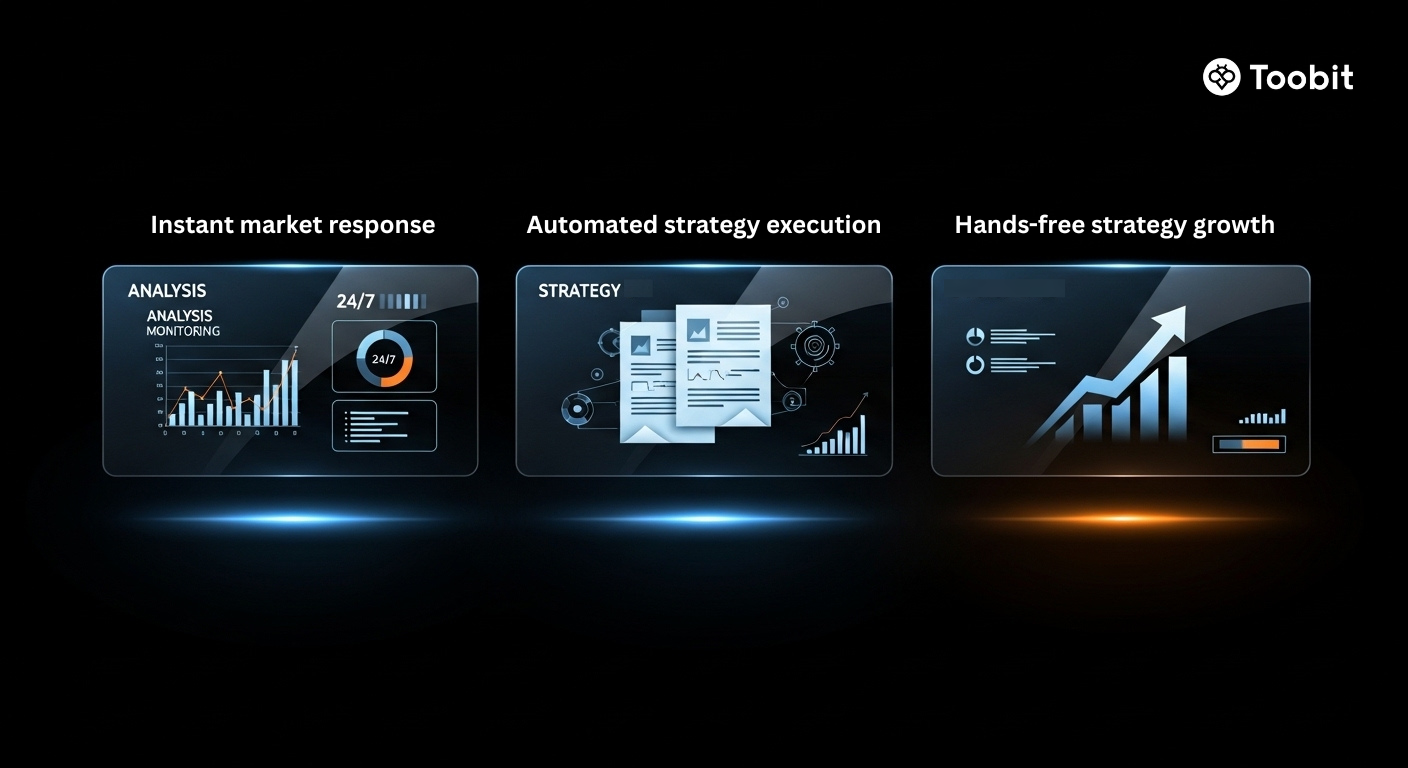
Instant market response: Toobit's AI Traders analyze market data in real time, allowing traders to react immediately to sudden price changes and volatility.
-
Automated strategy execution: The AI core executes trades automatically, reducing manual errors and ensuring consistent strategy implementation. You do not need advanced charting skills. Users can access structured strategies without building them from scratch.
- Hands-free strategy growth: Traders can follow and copy successful strategies while the system continuously optimizes performance in the background.
Is AI the future of trading?
Evidence suggests yes but with limits.
Algorithmic systems already dominate equity markets. Crypto adoption is catching up. As exchanges integrate multi-model AI engines and automated strategy replication, manual-only trading may become less common.
However, AI does not replace judgment entirely. It shifts the role of the trader from decision-maker to allocator and risk manager.
Is it time to outsource your FOMO?
As a trader, you may ask: "If everyone uses AI, who loses?" The answer is simple: those still trading manually.
AI copy trading is not a “cheat code”; it is a way to compete with the high-frequency firms that have dominated markets for years. With multi-model systems like Toobit’s, you essentially have a team of experts monitoring your portfolio while you focus on other things.
In 2026, you can either be the trader who knows how to use AI effectively or the one still asking, “What just happened?” after every 2am dip. The system is ready. Are you?
Unlock Toobit AI Copy Trading today and trade smarter, not harder.


