
March 2026 sits at an interesting point. If you are still using a 2021 playbook and expecting every asset to rise together, it may be time to reassess.
The market has shifted from broad speculation to a more structured environment with clearer distinctions between projects.
To a casual observer, activity can look quiet. Bitcoin dominance is around 59% and the Altcoin Season Index sits near the early-30s based on data from CoinMarketCap.
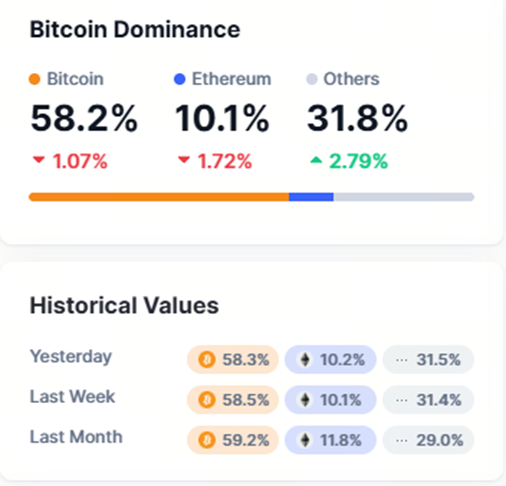
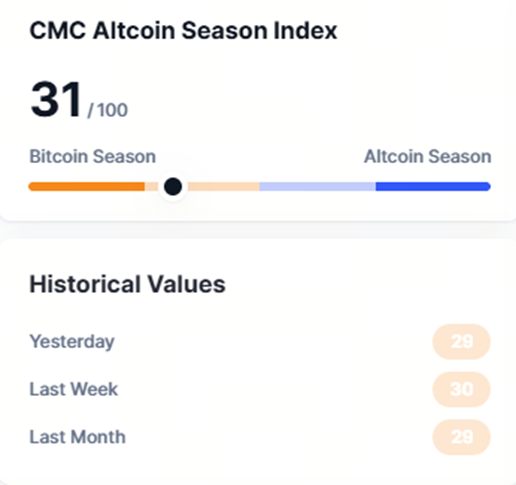
But this does not necessarily signal a broad downturn. Instead, liquidity has become selective, flowing mainly toward projects with sustained usage and clear purpose.
So where should attention go next? Let us review 5 altcoins to watch in March 2026.
Before we start: What makes an altcoin worth buying?
Instead of guessing price targets, we will look at signals that historically matter:
-
Active users and transaction growth
-
Developer activity
-
Revenue (yes, blockchains now earn revenue)
-
Real-world integrations
According to CoinGecko’s industry report, user activity correlates strongly with long-term token performance.
In other words: usage first, price later.
Solana (SOL): The consumer apps chain that is scaling through performance
Solana keeps doing the thing other chains talk about: handling large volumes cheaply.
According to DefiLlama DEX statistics, Solana frequently leads daily decentralized exchange (DEX) volume across all chains.
Why this matters: trading volume equals fees, and fees equal demand for blockspace.
Recent drivers:
-
On-chain trading and meme coin cycles
-
Decentralized physical infrastructure networks (DePIN networks) like Helium, Hivemapper
-
Mobile wallet adoption
Solana has also moved from testing phases into steady network use, supporting active decentralized finance (DeFi) trading and DePIN projects.
A key development is the rollout of Firedancer, an independent validator client built by Jump Crypto to improve performance and stability. The network also expanded its mobile ecosystem with the announced Seeker device, its second smartphone designed for on-chain applications.
Together, these updates aim to improve reliability and user access rather than rely only on external scaling layers.
Ondo Finance (ONDO): Tokenized treasury access
Ondo Finance focuses on bringing U.S. Treasury exposure on-chain. By offering tokenized government securities, it allows users to hold yield-bearing assets within blockchain wallets.
According to Yahoo Finance, as of late January 2026, Ondo holds over $2.5 billion in total value locked (TVL) in tokenized Treasuries and has begun offering tokenized equities.
The project reflects a broader trend: traditional financial assets moving onto blockchain infrastructure rather than purely speculative trading.
Sui (SUI): Parallel execution for apps
Sui focuses on running transactions in parallel using its object-based model and the Move programming language. This design supports applications such as gaming and social platforms that require frequent on-chain activity.
Network data also shows rising developer participation, with steady growth in monthly contributors.
The architecture aims to process complex applications efficiently while limiting state growth, positioning it as an alternative Layer 1 alongside larger networks.
Artificial Superintelligence Alliance (FET): AI network infrastructure
In 2026, "AI Crypto" is no longer a buzzword; it is an infrastructure necessity.
The Artificial Superintelligence Alliance combines Fetch.ai, Ocean Protocol, and SingularityNET to build shared infrastructure for AI services, including data exchange and automated agents.
As businesses experiment with autonomous software agents that can execute tasks and payments, the network aims to provide a token-based system for machine-to-machine interactions and coordination across platforms.
Chainlink (LINK): The data economy play
Blockchains cannot access outside data alone. Chainlink feeds them pricing, identity, and real-world events.
Without oracles, DeFi literally stops working.
According to Chainlink Proof-of-Reserve (PoR) documentation and integrations tracked by CoinMarketCap, the network secures tens of billions in value across protocols.
Recent trend:
Banks and asset managers testing tokenized assets require verifiable off-chain data, exactly what oracles provide.
This is not flashy, but infrastructure rarely is.
Are altcoins riskier than Bitcoin?
Yes, and that is the point. Bitcoin behaves like a macro asset. Altcoins behave like tech startups.
Based on our research, smaller crypto assets historically exhibit higher volatility but stronger adoption-driven cycles:
Higher risk, but also higher sensitivity to real usage growth.
This article is for informational purposes only and does not constitute financial advice. Always do your own research (DYOR) before making any decisions.
Final thoughts: Follow users, not narratives
Markets eventually reward activity.
If people transact → networks earn fees
If networks earn fees → tokens capture value
Also, the current cycle rewards consistency and planning rather than chasing short-term momentum. Instead of reacting to every move, it helps to identify projects with sustained activity and build positions carefully.


