
February 2026 has a way of sharpening focus. Altcoins remain active, but smart capital is asking a harder question: which ones are actually worth holding right now?
A quick reality check from CoinMarketCap shows the Altcoin Season Index still sitting in the 20 to 30 range, a sign that Bitcoin dominance continues to shape sentiment.
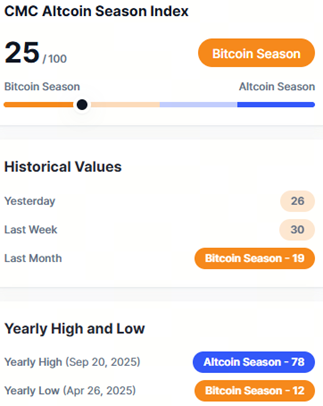
In this environment, success is less about chasing hype and more about understanding utility, momentum, and long-term narratives.
So as liquidity tightens, which altcoins are actually worth the risk in February 2026?
Solana proves that speed can scale with structure
Let us get the obvious one out of the way.
Solana (SOL) has quietly kept itself in the conversation among high-performance blockchains. As of early 2026, SOL has reclaimed notable attention due to network resilience and usage metrics, even while broader markets remained sideways.
The launch of multiple Spot Solana exchange-traded funds (ETFs) also gave institutional players the regulated access they needed to jump in.
Analysts point to structural support that shows relative strength amid modest volatility, implying builders and markets are re-engaging.
The key story this month is the Alpenglow upgrade, which prepares the network for AI Agents: autonomous programs that can trade and settle transactions without human intervention.
Solana is no longer just a retail playground; it has become a high-throughput settlement layer for the next generation of automated finance.
Beyond simple chains, its ecosystem now supports decentralized finance (DeFi), non-fungible-tokens (NFTs), and even emerging AI-linked applications. As the broader market digests macro risk, SOL remains one of the few altcoins maintaining structural momentum.
Bottom line: if you want an altcoin with real application utility, not just hype, SOL is a base layer worth owning.
Sui pairs native speed with growing institutional interest
If you have been following Layer-1 innovation, Sui (SUI) is a name that would not sit still.
Originally developed by ex-Meta engineers, Sui uses an object-centric data model that achieves massive parallel transaction processing, a design that aims to eliminate bottlenecks before they start.
According to ecosystem trackers, Sui’s Total Value Locked (TVL) climbed past $2 billion in 2025.
There is also another angle: Sui filings for institutional exposure, including multiple ETF applications, are pending; a development that could meaningfully broaden market access.
In a macro phase where institutional buckets matter more than retail hype, SUI’s structural appeal makes it a top pick for 2026.
Polygon is building blockchain infrastructure with a clear purpose
Not every altcoin needs to be a valley-breaking L1.
Polygon (POL) is the scaling highway for Ethereum: its AggLayer and Zero-Knowledge Ethereum Virtual Machine (zk-EVM) solutions continue to draw significant traffic and positioning from major projects. As of early 2026, POL trades far below its previous all-time high (ATH), a discount that many analysts now label undervalued on a fundamental basis.
Its architecture caters to real demand: cheaper transactions, seamless Layer-2 scaling, and infrastructure that plays nicely with the broader Ethereum ecosystem.
Polygon is not about moonshots; it is about utility that already has traction. In markets this complex, that can matter more than narrative momentum alone.
Cardano combines patience with long-term vision for blockchain
Cardano’s (ADA) story is one of deliberate engineering over flash.
Critics have long labeled ADA slow on price performance, but that narrative misses the point: Cardano is built around research-driven, iterative progress.
As of early 2026, the network’s decentralized governance, known as the Voltaire era, is in full swing, positioning Cardano as a Proof-of-Stake (PoS) network governed by stakeholders rather than unaccountable validators.
Here is the twist: while Cardano has lagged in price action historically, its approach to scaling and governance remains one of the strongest playbooks for long-term sustainability. That gets lost in the noise when traders chase quarterly memes, but it is exactly what matters during multi-year cycles.
ADA’s price discount arguably provides a margin of safety for patient capital, and with growing interest from institutions in research-focused PoS blockchains, it is more than just a bet on narrative.
Internet Computer drives web-scale innovation across blockchain applications
You might see Internet Computer (ICP) and think, “Another L1? Yawn.” But that undersells what it actually is.
ICP is not just a blockchain, it is a full web environment where smart contracts execute at near-web speeds. Its architecture gives developers a chance to rebuild cloud-native apps directly on chain; that is a utility edge few others can claim.
Price action has not been uniform and that is part of what makes ICP interesting. At current levels, many long-term data indicators show that network development and fundamental usage continue to improve, even while price lags.
That disconnect between technical progress and token price can create opportunity for risk-aware traders willing to think longer term.
Okay, but is it the Alt season yet?
Here is where things get circular.
The data still shows Bitcoin dominance and a subdued Altcoin Season Index, meaning we are not yet in a broad alt rally. That does not mean altcoins are dead, it means entry timing and selection matter more than ever.
A smart February 2026 alt strategy does not chase the most hyped token. It focuses on ecosystems with real use cases, ongoing adoption, and solid technical foundations.
That is exactly the lens used above, and it is the kind of disciplined approach that separates thoughtful traders from trend followers.
This article is for informational purposes only and does not constitute financial advice. Always do your own research (DYOR) before making any decisions.
Final thought
Altcoins are never free of risk; regulatory uncertainty, market structure, and volatility remain real. But the projects above show that utility, innovation, and credible progress still win out when the noise fades.
As always, DYOR and make decisions based on your risk tolerance and time horizon. But if you are sizing up altcoins in February 2026, these five deserve more than a passing glance.
How to buy crypto on Toobit
Toobit is a fast-growing crypto exchange, built to make your trading journey super smooth. It's secure and easy to use, whether you're new or experienced. Plus, you can buy crypto, giving you instant access to tons of digital assets.
First, you'll need to fund your Toobit Account, which begins by creating your account on Toobit. Registration is a 2-minute process and can be done with either email or even your Telegram account.
Navigate to the "Buy Crypto" section. From there, you can select the desired crypto and choose a payment method. Toobit offers various options, including credit card purchases through partnerships with third-party providers like Simplex and Advcash.
The platform will guide you through the remaining steps, which may involve entering payment details, confirming the transaction, and potentially completing additional verification steps.
Once the transaction is completed, return to Toobit and check your "Spot Account" to view the newly credited assets.
Congratulations, you now know how to purchase crypto on Toobit!


