
Bitcoin (BTC) miners are back in focus, and not for the reason bulls usually like.
Public mining companies have sold record amounts of BTC in 2026 as margin pressure bites harder and balance-sheet discipline replaces the old hold-forever playbook.
According to TheEnergyMag, major public miners sold more than 32,000 BTC in Q1 2026, already topping total net sales across all of 2025 and setting a new industry record.
Separate on-chain data cited by CryptoQuant shows miner reserves have fallen by about 61,000 BTC from cycle highs, underscoring just how aggressive the distribution has become.
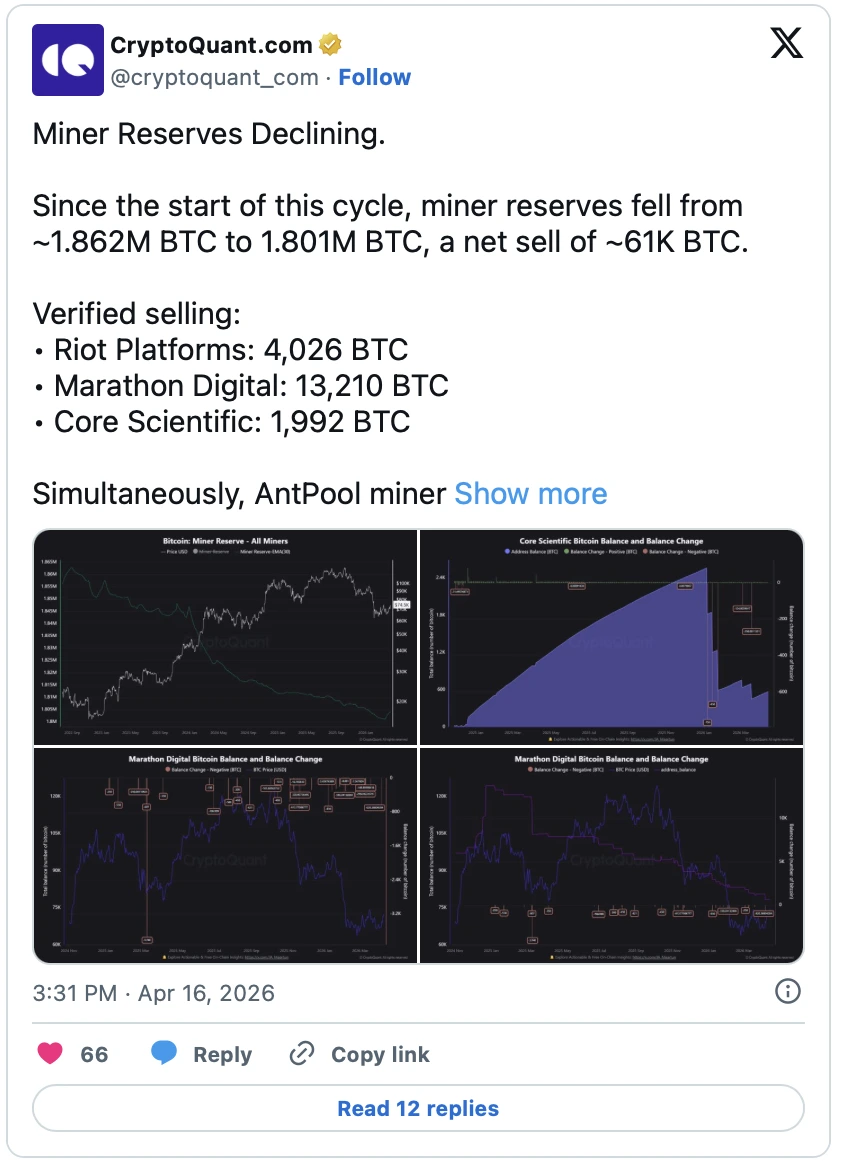
Screenshot of CryptoQuant's data from the official X page. Source: X
This matters because the selling is not happening in a vacuum. Bitcoin is trading around $74,742 on April 17, 2026, while hashprice, one of the clearest gauges of miner revenue, dropped to around $33.25 per PH (peta hash)/s/day, according to Hashrate Index. That is better than the early-March lows, but still a tough operating backdrop for large parts of the fleet.
Profitability in the mining industry calls for drastic measures
The pressure point is simple.
After the 2024 halving cut block rewards to 3.125 BTC, Bitcoin miners had to work with less coin output just as network competition stayed intense. CoinShares reported hashprice falling from roughly $63/PH/s/day in July 2025 to around $28 to $30 by early March 2026, marking a fresh post-halving low. Its report also noted that around 15% to 20% of the global mining fleet may now be unprofitable, especially older machines and higher-cost operators.
Yes, miners are selling. But in many cases, this selling reflects operational pressure, and miners use that earned capital to build a new and broader business model for their next phase of growth.
The biggest sales are coming from balance-sheet strategy
MARA Holdings, a digital asset and cryptocurrency mining company, made the clearest statement of intent. On March 26, it announced it had sold 15,133 BTC for approximately $1.1 billion, with proceeds earmarked for repurchasing convertible notes and for general corporate purposes.
Similarly, Riot Platforms, another major Bitcoin mining company, disclosed in its Q1 2026 production and operations update that it sold 3,778 BTC for $289.5 million at an average net price of $76,626 per coin, while still holding 15,680 BTC at quarter-end. Riot has also been pushing harder into data center infrastructure, including its AMD lease at Rockdale and its broader buildout plans at Corsicana.
What stands out is the shift in mindset. From sitting on mined BTC to using it as capital to fund strategy, Bitcoin has become a balance-sheet tool for the listed miners.
This is where the AI pivot enters the picture
The mining sector is splitting into two.
One group is still focused mainly on mining efficiency, power contracts, and fleet upgrades. The other is increasingly chasing higher-value revenue streams tied to AI and HPC infrastructure.
Publicly listed miners have announced more than $70 billion in AI and HPC deals, and argued that equity markets are rewarding miners with that exposure more generously than pure-play mining names.
That helps explain why it is too simplistic to call every sale a capitulation signal.
In some cases, coins are being sold because miners need cash. In others, they are being sold because management thinks redeploying capital into infrastructure, debt reduction, or hosting revenue offers a better return than simply sitting on BTC.
So is this a warning sign for Bitcoin?
Yes and no.
It is a warning sign for mining margins. The economics are clearly under strain, and the old model of mine, hold, and wait for higher prices is not working as cleanly in 2026. With Bitcoin near $74,742 and hashprice still depressed versus 2025 levels, weaker operators are under real pressure.
But it is not automatically a warning sign for Bitcoin’s long-term structure. Bitcoin’s network remains near zettahash(ZH)-era levels, with Hashrate Index showing a 7-day simple moving average (SMA) around 969 EH (exa hash)/s on April 13, after the network first crossed the 1 ZH/s milestone in 2025.
That tells you the network is still highly competitive and deeply industrialized, even as profitability gets squeezed. Additionally, it exposes which operators can survive this phase and which ones were built for a much easier environment.
The bottom line
The recent Bitcoin dumping by miners is real, but it is not just panic selling.
What we are seeing is a harsher reset. Hashprice has collapsed from 2025 highs, public miners have sold record amounts of BTC, and treasury policy has become more pragmatic.
-
MARA is using sales to repair its balance sheet.
-
Riot is using them to fund expansion.
-
Across the sector, BTC is increasingly being treated as deployable capital, not a trophy asset.
That makes this episode important, but not necessarily bearish in the way the headline suggests.
It is a loud signal that the mining business model has changed. The miners that come through this stretch strongest will likely be the ones with cheap power, efficient fleets, and a business model that does not rely on hoping the next BTC rally fixes everything.
This article is for informational purposes only and does not constitute financial advice. Always do your own research (DYOR) before making any decisions.
How to buy Bitcoin on Toobit
If this article inspired you to start trading Bitcoin, you can simply create an account on Toobit, complete your account verification, and go to Buy crypto.
Choose Bitcoin, select a payment method, and confirm the purchase. Your assets will appear in Spot Account once the transaction settles.
Congratulations, you’re all set to start your Bitcoin journey on Toobit.


