
Here’s the uncomfortable truth about 2026: there is no “one right” crypto to hold anymore. The market has grown up, fragmented, and learned how to punish lazy narratives. That’s especially so after the whiplash of late 2025.
Bitcoin (BTC), Ethereum (ETH), and Solana (SOL) aren’t competing for the same role; they’re competing for capital allocation. Holding BTC feels very different from holding ETH, which feels very different from holding SOL. And that’s the point.
If 2025 was about survival after excess, 2026 is about choosing what kind of risk you’re actually comfortable with.
Bitcoin: The asset you hold when you don’t want surprises
Bitcoin in 2026 isn’t trying to impress you. It doesn’t ship features, chase trends, or care about vibes. It exists to do one thing well: not break.
The BTC price today is less about speculation and more about positioning. Bitcoin has settled into its role as crypto’s macro asset. At the time of writing, BTC price is trading a little above $91,000.
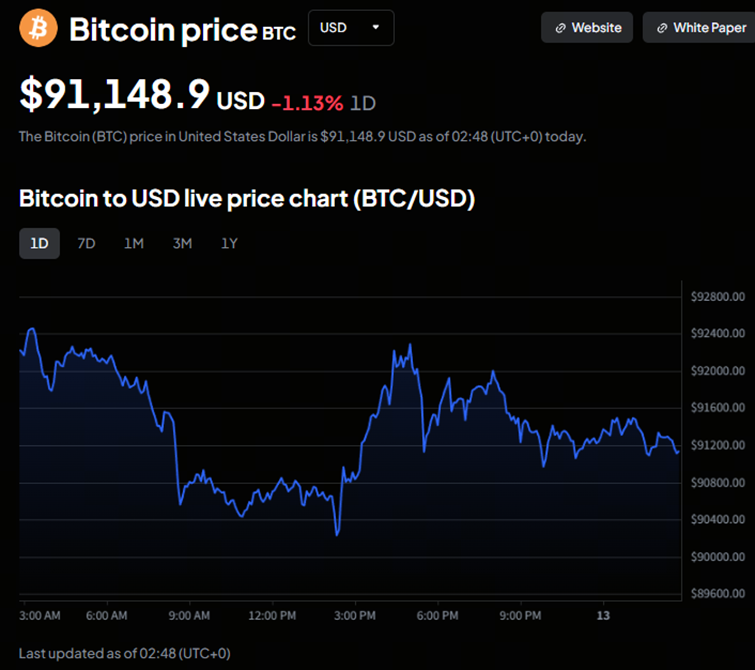
The BTC/USDT pair now trades more like a hybrid between gold and a high-volatility macro hedge. Look at the BTC rainbow chart and you see a market that still moves in cycles, but with fewer extremes.
That matters for risk. Bitcoin’s adoption curve is no longer retail-led. Spot exchange-traded funds (ETFs), corporate treasuries, and long-term holders now drive a large share of demand.
That’s why BTC/USDT current price action often looks boring, until it isn’t. When macro conditions shift, Bitcoin tends to move first and drag the rest of the market with it.
BTC price prediction models for 2026 are less about moon targets and more about regime shifts. Is inflation sticky? Does liquidity return? Bitcoin reacts before altcoins do. If your goal is capital preservation with upside optionality, BTC price charts still make the strongest case.
Risk profile: Low relative risk, lower upside, highest conviction
Narrative: Digital reserve asset
Who it’s for: Anyone who wants to sleep at night
What does the BTC rainbow chart tell you?
The BTC rainbow chart shows Bitcoin sitting in the middle valuation bands as of mid-January 2026, not in bubble territory and not in capitulation. At around $91,000, the price of BTC is in the “Basically a Fire Sale” range.
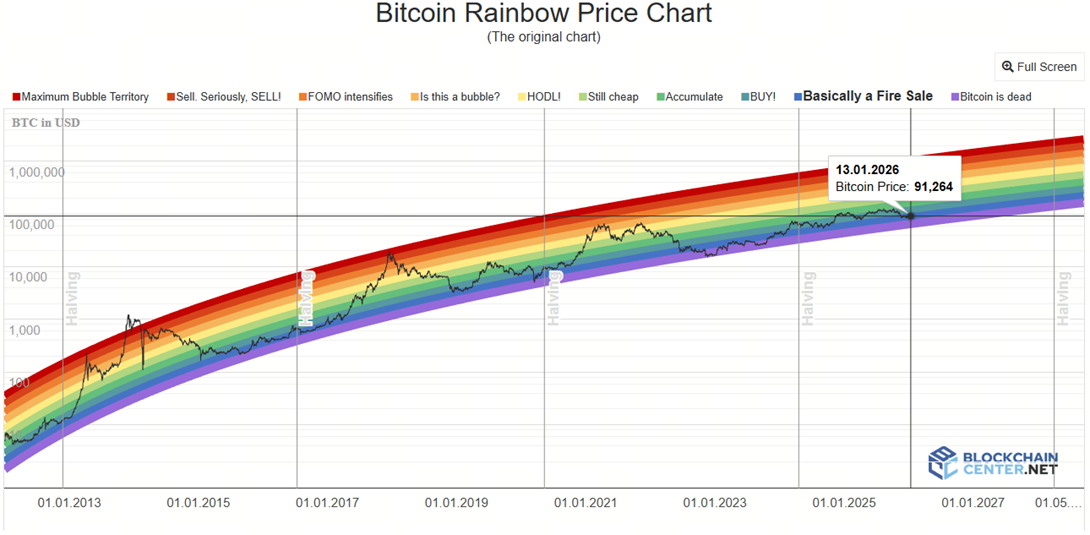
Compared to past cycles, volatility looks muted. Bitcoin is moving within its long-term growth curve, not blowing past it. That points to maturity: slower percentage gains, higher absolute prices.
The BTC rainbow chart is saying Bitcoin in early 2026 looks structurally healthy, fairly valued, and far from euphoric. It’s not a screaming buy, not a screaming sell. It’s behaving like a grown-up asset settling into its role.
Ethereum: Still the backbone, still complicated
Ethereum enters 2026 pulled in two directions. On one side, it remains the core settlement layer and the backbone of decentralized finance (DeFi).
On the other, it’s competing with its own Layer 2 ecosystem, which now handles most transactions while pushing fees and revenue away from the base layer.
At the same time, Ethereum is trying to sell Wall Street on the idea of ETH as an “internet bond.”
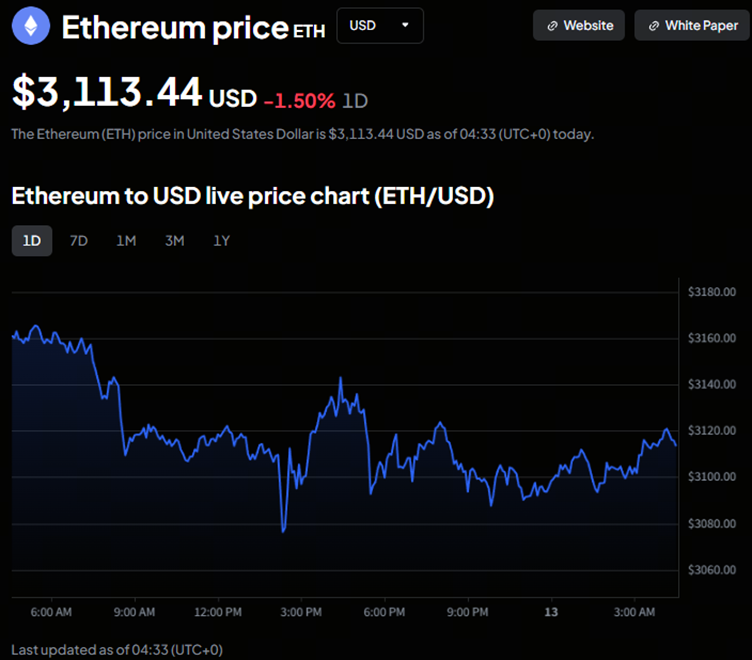
The Ethereum price today reflects a network in transition. ETH price now is driven less by hype cycles and more by usage: DeFi settlement, stablecoin rails, tokenization, and increasingly, institutional infrastructure. ETH/USDT trades like a productivity asset: when on-chain activity rises, ETH tends to follow.
Ethereum price prediction debates often miss the point. ETH isn’t trying to be scarce in the same way Bitcoin is. Its value comes from being useful. ETH price charts tend to lag BTC early in cycles and outperform later, once risk appetite returns and capital rotates toward applications.
At the time of writing, ETH price now is trading around $3,110.
In 2026, Ethereum’s bet is clear: it wants to be the neutral settlement layer for digital finance. Rollups handle scale. ETH handles trust. That’s not flashy, but it’s durable.
Still, ETH carries execution risk. Upgrades take time. Governance is messy. And competition is real. ETH cryptocurrency price reflects that tension: strong fundamentals, uneven market confidence.
Risk profile: Medium risk, medium-to-high upside
Narrative: Financial settlement layer
Who it’s for: Investors who believe usage beats hype
Solana: Speed, payments, and AI agents everywhere
The SOL price in 2026 reflects a chain that stopped apologizing for the past and started shipping. Payments, consumer apps, and AI agents all gravitate toward speed and low fees, and that’s Solana’s edge.
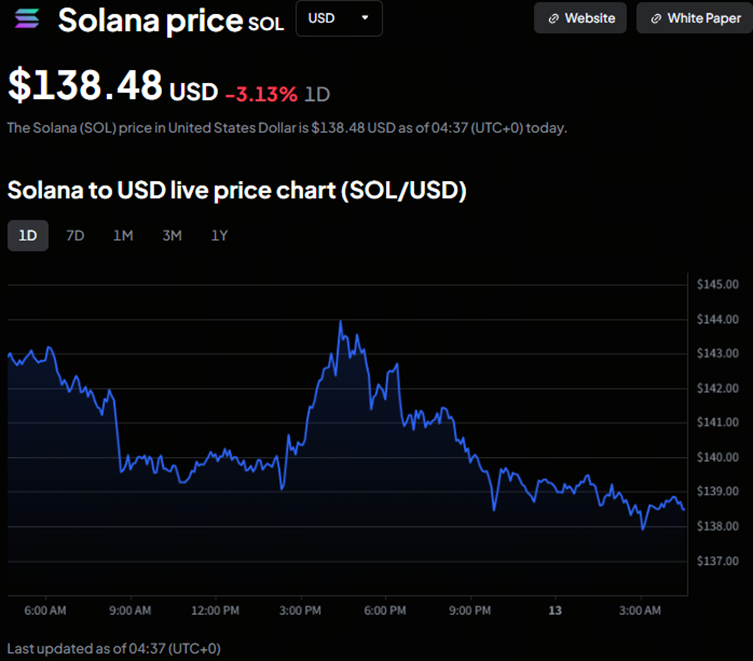
How much is SOL worth now depends almost entirely on adoption momentum. SOL price charts tend to move fast, overshoot, correct hard, and then repeat. That volatility is the cost of ambition. SOL token price reacts instantly to network usage, meme cycles, and new product launches.
At the time of writing, price of SOL is trading just below $140.
Solana price prediction models are wild for a reason: outcomes diverge sharply. If consumer crypto breaks out (payments, social apps, AI-driven bots), Solana stands to benefit disproportionately. If the market shifts to defensive, SOL usually feels it first.
How much is a SOL worth long term? That hinges on whether Solana becomes a mainstream transaction layer or remains a high-performance niche. Either way, it’s not subtle.
Risk profile: High risk, high upside
Narrative: Consumer and AI execution layer
Who it’s for: Traders comfortable with volatility
Should you hold BTC, ETH, or SOL in 2026?
That’s the wrong question.
The better one is: what role do you want crypto to play in your portfolio in 2026?
-
Bitcoin anchors risk.
-
Ethereum monetizes activity.
-
Solana amplifies growth.
BTC price charts tell you where the market stands. ETH price charts tell you how much is being built. SOL price charts tell you how much risk people are willing to take.
By 2026, the tourists have mostly cleared out and the professionals are setting the tone. In a market that no longer rewards blind conviction, allocation beats maximalism. Choose accordingly.
This article is for informational purposes only and does not constitute financial advice. Always do your own research (DYOR) before making any decisions.
How to buy crypto on Toobit
Toobit is a fast-growing crypto exchange, built to make your trading journey super smooth. It's secure and easy to use, whether you're new or experienced. Plus, you can buy crypto, giving you instant access to tons of digital assets.
First, you'll need to fund your Toobit Account, which begins by creating your account on Toobit. Registration is a 2-minute process and can be done with either email or even your Telegram account.
Navigate to the "Buy Crypto" section. From there, you can select the desired crypto and choose a payment method. Toobit offers various options, including credit card purchases through partnerships with third-party providers like Simplex and Advcash.
The platform will guide you through the remaining steps, which may involve entering payment details, confirming the transaction, and potentially completing additional verification steps.
Once the transaction is completed, return to Toobit and check your "Spot Account" to view the newly credited assets.
Congratulations, you now know how to purchase crypto on Toobit!


