
By late October 2025, the market had finally started to recover, and Bitcoin (BTC) was holding steady around $112,000. Everyone was watching one person: Fed Chair Jerome Powell.
Then things flipped. The Fed announced a 25-basis-point rate cut, which sounded like good news at first. But Powell’s tone turned hawkish, signaling that more cuts weren’t on the table.
And so, early this week, the cryptocurrency market, led by Bitcoin, experienced a sharp collective plunge. The price of Bitcoin dropped below the critical $110,000 mark, and markets collectively reeled.
What followed was a chain reaction. Closed to $600 million in leveraged positions were liquidated, wiping out around 130,000 traders in hours. It wasn’t a random crash; it was a sharp reminder that in crypto, even good news can hit like a sledgehammer.
In short: the Fed said “cut,” the market heard “pause,” and risk assets, including crypto, responded accordingly.
Why did nearly $600 million in liquidations happen?
The irony of the whole thing is hard to miss. In theory, an interest rate cut should be good for risk assets like crypto; cheaper borrowing usually pushes money out of safe havens and into higher-return bets. The 25-basis-point cut was exactly what traders had been waiting for.
But the real damage didn’t come from the move itself, it came from what Powell said after which dampened the market's risk appetite. That’s what made it a true “hawkish cut.”
He made it clear this wasn’t the start of an easy-money cycle, just a one-time adjustment. The market got the cut it wanted but not the promise of more to come. That shift in tone was enough to spook institutional investors and spark the sell-off that followed.
The market downturn led to nearly $600 million in leveraged contract liquidations across the entire crypto network in a short period. The crash exposed a hard truth about the current market: too much leverage and not enough real liquidity.
As prices fell, overleveraged traders were wiped out, triggering a wave of forced sell-offs.
Each liquidation added more selling pressure, dragging prices even lower. In a market this thin, it doesn’t take much for a dip to turn into a full-blown slide.
How did Bitcoin respond?
Bitcoin took a hit, dropping below the critical $110,000 mark amid the liquidations.
On the BTC price charts, you’ll now find jagged swings and hesitation around that mark.
But here's the kicker: despite the drop, Bitcoin’s fundamentals remain intact. It still holds deep liquidity, global familiarity, and institutional trust. So while the price of BTC fell and investors took a beat to regroup, the BTC price prediction for many remains sound, just on a slightly longer timeline.
At the time of writing, BTC price is trading slightly below $110,000.
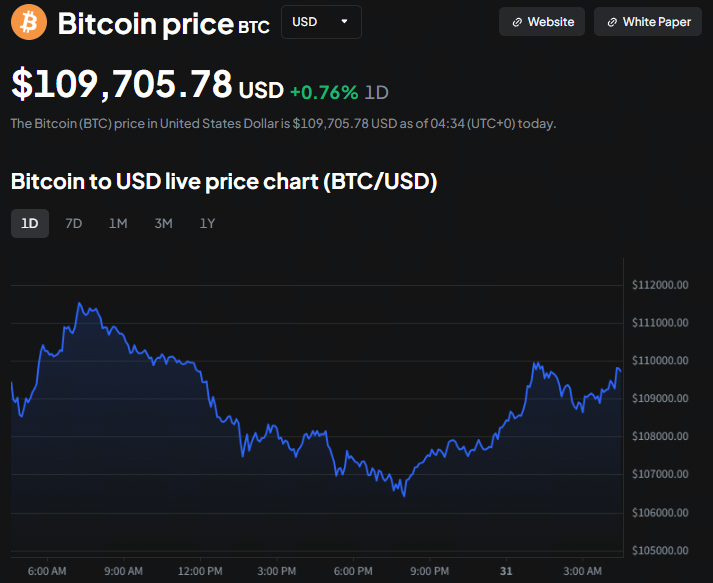
Investor sentiment turned cautious. The crash exposed the cracks, but Bitcoin still stands as a relatively safer crypto bet compared to its peers.
So... what can be learned?
-
Leverage kills at scale. The $600 million liquidation wasn’t a tech bug; it was systemic exposure to bad timing and high debt.
-
Macro matters. The Fed cut? Fine. The Fed said it might not cut again? That rattled a lot of risk-assets, including crypto.
-
Liquidity vs. hype. Bitcoin’s depth helped it survive better than most. Tokens built mainly on buzz took bigger hits.
-
Sentiment shifts fast. One hawkish line from the Fed and an avalanche of liquidations later, and we’re back to asking: what does risk even mean now?
Final thought
This week showed a clear reality: crypto is still unpredictable, and institutional moves, macro shifts, and leverage risks can have a big impact in a very short time.
The incident highlighted that crypto is now tied to the global financial system, with its performance influenced by central bank decisions and shifts in risk appetite. At the same time, the market’s high leverage still makes it feel like the Wild West.
If you’re holding or trading right now, the question isn’t just “What’s next?” The more useful one is “How resilient is your position if the next curveball hits?”


