
BTC dominance climbed to 61.3 percent, the highest reading since November 2025. The Fear and Greed Index has clawed its way out of April’s deep red and is sitting near the upper end of the neutral band. Total crypto market cap is back to roughly 2.69 trillion dollars. None of this looks like a blow off top. It looks like a market that finally got the macro backdrop it was waiting for.
What Bitcoin ETFs are telling us
Spot Bitcoin ETFs in the US have now booked four straight days of net inflows totaling about 1.65 billion dollars. That is the cleanest signal of institutional intent we have seen since late 2025.
May 5 alone pulled in 467.3 million dollars. BlackRock’s IBIT did the heavy lifting at 251.4 million, with Fidelity's FBTC adding 133.2 million, ARKB at 92.3 million, and Bitwise BITB at 14.6 million. The only outflows came from Grayscale’s GBTC at 18.4 million and VanEck’s HODL at 5.8 million, which is the same structural rotation away from legacy fee tiers we have been watching all cycle.
Stretch the lens to the four day window and IBIT picked up roughly 890 million dollars on its own. FBTC added 557 million. Total spot Bitcoin ETF AUM now sits at 108.98 billion dollars, equal to about 6.67 percent of Bitcoin’s entire market cap. That is no longer a niche allocation bucket. That is structural demand.
Traditional markets lit up across the board
The headline driver was Axios reporting that the White House is closing in on a one page, 14 point memorandum of understanding with Iran. Two US officials and two other sources briefed on the negotiations told the outlet the framework would end the war and reopen the door for nuclear talks. Markets did not wait for confirmation.
Equities
The Nasdaq Composite jumped 2.0 percent to a fresh record close. The S&P 500 climbed 1.46 percent, posting its first close above 7,300, also a record. The Dow Jones Industrial Average added roughly 600 points, up 1.24 percent. AMD soared 19 percent on a massive AI capex guide, Super Micro popped 25 percent, and the entire Magnificent Seven moved higher.
Energy
WTI crude crashed 7 percent to 95.15 dollars a barrel. Brent dropped 7.8 percent and briefly traded under 100 dollars before settling at 101.27. Just last week, Brent had crossed 126. The geopolitical premium is unwinding fast.
Rates and safe havens
The 10 year US Treasury yield slipped to 4.35 percent from 4.43 percent. The Dollar Index eased 0.4 percent to 98.02. Gold caught a haven bid and rallied 3 percent to 4,708 dollars an ounce, with silver up roughly 5 percent. Gold and bitcoin both moving higher on the same day is rare. It usually means the same group of buyers is rebuilding risk and hedge exposure at the same time.
Macro policy updates that actually matter
Three policy threads are setting the tone for the rest of May.
CLARITY Act targets July 4
White House digital assets adviser Patrick Witt told CoinDesk's Consensus Miami audience that the administration is aiming for July 4 House passage of the Digital Asset Market CLARITY Act. The Senate Banking Committee markup is now scheduled for the week of May 11, with four working Senate weeks in June for floor passage.
The mechanic is unlocked. Senators Thom Tillis and Angela Alsobrooks closed the stablecoin yield compromise, banning bank deposit equivalent yield while preserving rewards tied to spending, transactions, staking, and governance tokens. Polymarket odds for CLARITY reaching the President's desk by year end have jumped from roughly 43 percent to 69 percent since the compromise dropped.
There is a real time pressure point here. Ripple CEO Brad Garlinghouse publicly warned at Consensus that the bill has roughly two weeks to advance before midterm primaries swallow legislative bandwidth. If it slips past the cycle, formal market structure rules likely defer toward 2027.
Kevin Warsh advances toward the Fed
The Senate Banking Committee voted 13 to 11 to advance Kevin Warsh as the nominee to replace Jerome Powell as Federal Reserve chair. The point for markets is not who wins the floor vote. It is the regime question. How the next chair frames inflation versus growth risk, the sequence of any 2026 cuts, and how independent the institution looks heading into a contested election cycle. Crypto reacts through liquidity, ETF demand, and dollar pricing. All three bend on this appointment.
CFTC moves to codify Phantom-style wallet rules
CFTC Chair Michael Selig said the agency wants to formalize the March 17 Phantom Technologies no action letter very soon, converting one off staff relief into a rule that draws a clear line between neutral non custodial software and platforms that control customer assets. Read across is medium term constructive for self custody wallets, DeFi front ends, and compliant interface providers.
Industry highlights
The forward narrative is getting crowded, but three threads stood out today.
CoinGecko drops its CEX and DEX trading activity report 2026
CoinGecko just published its CEX & DEX Trading Activity Report 2026, and it is the most useful long form release of the week. Five takeaways set the scene for the rest of the year.
CEXs processed nearly 80 trillion dollars in spot and perps volume across 2025. DEXs' spot share doubled from 6.9 percent in January 2024 to 13.6 percent in January 2026, with a peak of 24.5 percent in June 2025 during the Binance Alpha 2.0 routing era.
Perps DEX share grew five times over to 10.2 percent. Hyperliquid was the only DEX to crack the top ten perps venues, posting 1.59 trillion dollars in cumulative volume from August 2025 to January 2026.
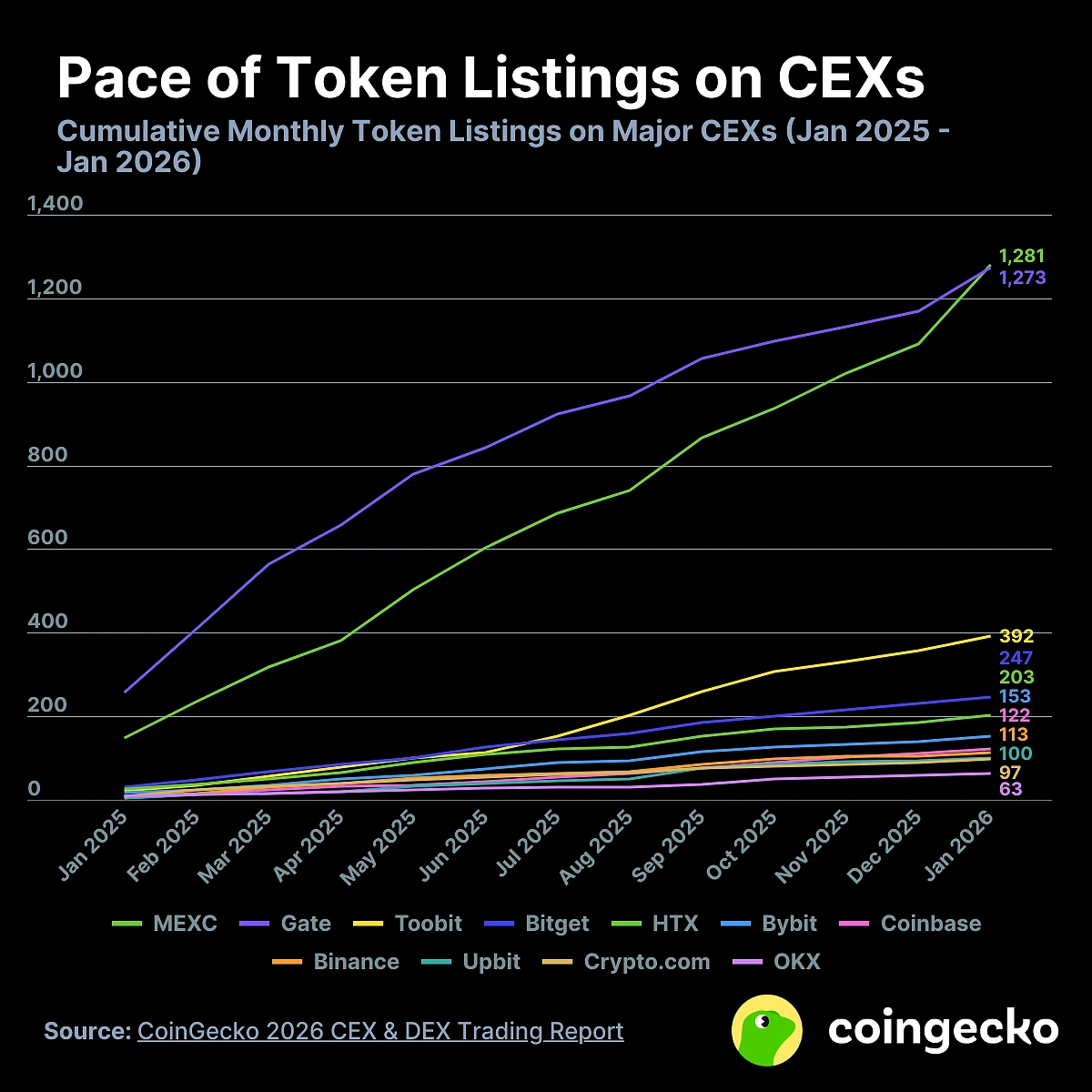
On the listings side, MEXC and Gate led the major CEX field with about 100 listings per month. Toobit followed third with 392 cumulative listings, averaging roughly 30 per month. That puts Toobit notably ahead of Upbit, Crypto.com, and OKX, all of which kept their listing pace at or below 100 over the same period. The chart cleanly captures the venue strategy split between conservative gatekeepers and growth oriented exchanges.
PancakeSwap and Uniswap broke into the top ten spot exchanges by cumulative volume, finishing ahead of Bitget, OKX, Coinbase, and Upbit. The DEX maturation arc is no longer theoretical.
Security cost the industry over 2.4 billion dollars in the trailing thirteen months, with 71 percent of CEX losses tied to the February 2025 Bybit hack. Compromised private keys via social engineering and UI phishing remained the dominant attack vector. Oracle and internal mechanism manipulation hit Bitget, Binance, and Hyperliquid.
The takeaway. Flow keeps rewarding venues that combine deep liquidity, broad listing surface, and credible security infrastructure. That is the lane that will define the next twelve months.
Altcoin rotation prints its first real sign of life
A subtle but important breadth tell quietly flipped today. About 12.6 percent of Binance listed altcoins reclaimed their 200 day simple moving average, up from 2.3 percent earlier in the cycle. TOTAL3, the index that strips out BTC and ETH, climbed 17 percent off its February 6 low to a two month high near 765 billion dollars. The 90 day AltSeason Index jumped to 28.6, the fastest recovery in months.
This is not altseason yet. The threshold for that label is 75 plus, and we are nowhere near it. But for the first time in months, breadth is improving alongside BTC instead of fighting it. Binance altcoin volume share against BTC and ETH futures climbed from 31 percent in March to 49 percent on May 6. Capital is starting to test the edges.
Solana keeps the consumer app crown
Solana finished the session at 88.45 dollars, up 3.4 percent on 4.92 billion dollars of daily volume. SOL outpaced both BTC at plus 0.6 percent and ETH at minus 0.5 percent on the same tape. The 90 to 94 dollar supply zone is still the structural ceiling, but the network has retained the consumer app momentum that ETH's L2 stack has yet to fully replicate.
Western Union also confirmed it is launching its native stablecoin USDPT on Solana. Layering tradfi settlement infrastructure on top of a network that already routes the majority of retail driven on chain flow is exactly the kind of legitimacy bid that drove Solana's first ETF approvals.
How to trade this setup
Bitcoin is still the OG. Whether you are stacking sats, hedging through options, or running leverage on the breakout, the playbook stays the same. Respect the level. Size for volatility. Treat every retest of 80K as a signal, not a guarantee.
If you are mapping the 78K to 85K range right now, Toobit covers spot, futures, and the rest of the toolkit you need to trade through it.
Alpha watch
The selective bid tape
In the absence of a full rotation, narrative driven assets are doing the heavy lifting today.
Zcash gained 29 percent in the past 24 hours, now up roughly 80 percent since April 3, pressing the 800 dollar pivot zone last seen in 2018 and 2025. Toncoin added 23 percent. Filecoin climbed 16 percent. The underperformers tell their own story. Ethereum slipped 0.4 percent. Algorand dropped 0.5 percent. Basic Attention Token shed 4.6 percent. The rotation is real, but it is selective rather than breadth led.
Stablecoin supply quietly turning
USDT market cap rose 5.9 billion dollars over the last 60 days. That is a clean reversal of the roughly 2 billion dollar monthly bleed that defined Q1 2026. This is the kind of liquidity backdrop that historically precedes broader risk on participation, and one of the cleaner reasons the rally has held into Iran deal headlines instead of fading on profit taking.
Treasury accumulation on the equity side
BitMine crossed 5,180,131 ETH held on balance sheet, equal to roughly 4.29 percent of total ETH supply. The company posted a third consecutive week of more than 100,000 ETH in purchases. Treasury style equity vehicles are emerging as a structural bid for ETH, similar to how Strategy has acted for BTC. Slower in absolute terms, but persistent.
Prediction markets keep pricing the same story
Polymarket tracked odds keep migrating toward the same base case. The probability of WTI hitting 120 dollars dropped from 74 percent to roughly 60 percent. The implied probability of BTC reaching 84,000 dollars as the next major move ticked higher. Two separate markets pricing the same scenario, cooling oil plus stronger BTC, is the most practical sentiment proxy traders have right now.
Concluding note
May 7 is closing with a clear split. Macro is easing. ETF flows are real. Equities are at fresh records. And BTC is consolidating right under its 200 day moving average around 83K. But altcoins are confirming selectively, RSI is overheated near 70, and the Iran framework still needs Tehran's sign off inside the 48 hour window the US set on May 5.
If BTC holds 80K with ETF inflows extending into a fifth or sixth day, the next zone is 83K to 85K, where the 200 day moving average and the Q1 supply cluster overlap. The cleaner structural target sits at 88K to 93K. If price slips back under 80K, expect another round trip between 78K and 82K while the market waits on Senate Banking markup, the Iran MoU, and the next FOMC signal.
The remaining sessions of this week call for discipline. Respect short term overheat. Watch whether the policy narrative converts from headline into positioning. And remember the lesson buried in the CoinGecko data. The cycle is rewarding venues with deeper liquidity, broader listing surface, and credible security infrastructure. That is exactly the lane Toobit has been building into.


