
In 2026, tokenized commodities are no longer a novelty tucked inside the wider real-world asset (RWA) story.
They are now a measurable market segment with billions in on-chain value, and gold still sits firmly at the center of it. At the time of writing, RWA.xyz puts tokenized commodities at about $7.62 billion in market cap, with Tether Gold (XAUT) and Pax Gold (PAXG) together accounting for roughly 75% of that market.
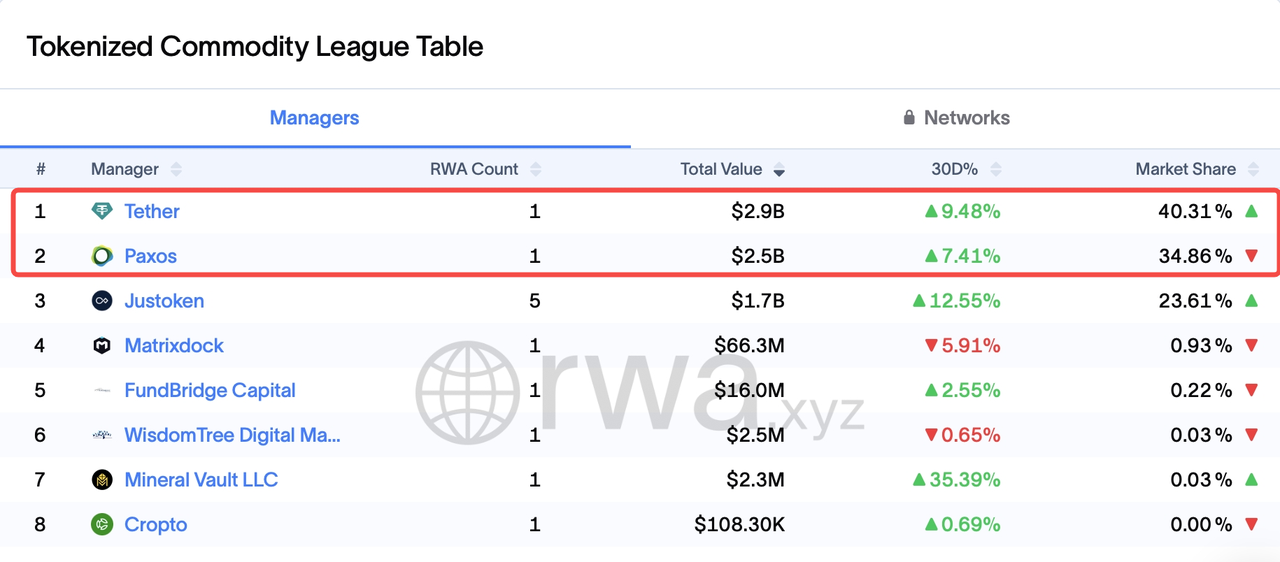
Tokenized commodity table with top 8 managers. Source: RWA.xyz
This matters because gold proved there is real demand for blockchain-based exposure to a familiar physical asset if the wrapper is credible, liquid, and available around the clock.
The World Gold Council notes that total gold demand in 2025 exceeded 5,000 tonnes for the first time, while global gold exchange-traded fund (ETF) holdings grew by 801 tonnes and bar and coin buying reached a 12-year high.
But the more interesting question now is not whether tokenized gold works.
It is whether tokenized energy and agriculture can do something harder: turn real-world production, delivery, and supply-chain value into assets that people actually want to hold, move, finance, and price onchain.
Gold is the benchmark for tokenized assets
Tokenized gold helped shift the conversation from narrative-driven tokens to assets with clearer real-world backing.
That first wave helped bring tokenized commodities from a niche category into a market that now sits above $7 billion. It also pushed commodities into the list of major tokenized asset categories that have already crossed the $1 billion threshold in onchain value.
Still, gold's dominance also reveals the sector's main limitation. With nearly three quarters of the category still concentrated on 2 gold-backed tokens, the real test is finding out whether tokenization can work for messier, more operational assets.
Can energy "operationalize" tokenization?
If gold showed that commodities can be tokenized, energy is starting to show how tokenization can be operationalized.
RWA.xyz lists JMWH at about $861 million in asset value, with each token tied to one real megawatt-hour of energy backed by contractual generation capacity. Those tokens are assigned through signed energy agreements and burned once the power is delivered and used.
That structure makes energy tokenization feel less like a digital wrapper and more like a working layer for tracking, settlement, and real-world execution.
However, there is a catch. While JMWH is large on paper, it remains semi-private and thinly traded, which limits access and shows that the model is further along on infrastructure than on market depth.
The power trade is no longer speculative
There is another reason energy stands out. It is one of the few commodity categories where tokenization can improve how the asset is used, not just how it is packaged.
Bloomberg reported that Ant Digital is working to bring more than $8 billion in energy assets onto blockchain rails, after previously financing three clean energy projects with roughly 300 million yuan, or about $42 million.
Additionally, there are new platforms that allow producers and consumers to trade energy directly, such as Powerledger.
A peer-to-peer (P2P) energy trading company, Powerledger's own documentation describes its software as a system for tracking, tracing, and trading clean energy and environmental commodities.
The Australian Trade and Investment Commission similarly affirmed the Australia-based company's move as the world's first renewable energy blockchain trading platform to make energy markets more efficient.
That is the kind of signal markets tend to notice. Not because it means tokenized energy is suddenly retail-ready, but because it suggests large firms see blockchain-based infrastructure as useful for funding, tracking, and distributing real-world power assets.
Why agriculture may be the sleeper category
If energy is the infrastructure play, agriculture may be the more practical one.
RWA.xyz lists JSOY_OIL at roughly $430.8 million in asset value, with each token representing 1 metric ton of soybean oil, designed to support transactions, barter, and credit access in the agricultural ecosystem.
That makes the takeaway pretty simple: tokenized agriculture is no longer just a future-facing concept. It is already being used to plug real commodities into trade, credit, and settlement flows.
What about lithium?
Lithium is the high-conviction narrative asset in this conversation, but it is also the least mature in terms of visible, investable tokenized market structure.
There are legitimate reasons for interest. The wider critical minerals buildout is still active in 2026, and the U.S. embassy in Singapore's fact sheet on the 2026 Critical Minerals Ministerial highlights substantial financing and policy attention around strategic battery materials.
However, the current public evidence for lithium tokenization looks more like ecosystem development and coordination-layer experimentation than a market with the same kind of proven, liquid footprint gold already has.
Some of that activity is showing up in ecosystem posts and infrastructure updates around Avail Nexus integrations, but it has not yet reached the same level of broad, verifiable market maturity as tokenized gold, or even emerging examples in energy and agriculture.
Honestly, lithium's time is not here yet. And that makes its story stronger when it evolves into a fully formed tokenized commodity segment later on.
Regulation is making the story easier to believe
That is why the policy backdrop matters.
Lithium may still be early, but the broader tokenized commodity story is getting easier to take seriously as regulation becomes less murky. Markets Media reported that U.S. policymakers are exploring narrower paths for tokenized assets to develop within clearer boundaries, rather than treating tokenization like a free pass around existing rules.
Meanwhile, hubs like Singapore are already focused on the infrastructure layer, not just the hype layer. That does not make every tokenized commodity market-ready overnight, but it signals that there will be infrastructure support when the time comes for other commodities to scale.
The bottom line
The next chapter will be decided by execution, not excitement.
The tokenized commodity markets that last will be the ones that can translate real-world value into liquid, usable on-chain exposure at scale. That is what the next phase of energy, agriculture, and eventually lithium needs.
That is when tokenization stops being a market theme and becomes market structure.
How to buy tokenized TradFi on Toobit
To buy crypto on Toobit, create an account, complete verification, and go to Buy Crypto. Choose a token, select a payment method, and confirm the purchase. Your assets will appear in Spot Account once the transaction settles.
Congratulations, you now know how to purchase crypto on Toobit!


