
Digital assets promised speed. Instead, users got fees, congestion, and the occasional meltdown during non-fungible token (NFT) mints.
But for years, Ethereum dominated, though high gas fees often frustrated users. Then came Solana, a blockchain built to process transactions much faster.
But is it actually different, or just marketing wrapped in technical jargon?
What is Solana?
Solana (SOL) is a high-performance blockchain designed for decentralized applications (dApps), payments, and trading, with a very specific obsession: speed at scale without layer-2 bandages.
Most blockchains solve congestion by splitting activity across rollups, sidechains, or optimistic promises about the future. Solana instead redesigned how time works inside a blockchain.
Launched in 2020, the network has experienced several outages and restarts but continues to operate and grow.
As of early 2026, it remains among the top 10 largest cryptocurrencies by market value, supporting a broad ecosystem that includes decentralized finance (DeFi) services, NFTs, and consumer applications, according to CoinMarketCap.
How is SOL related to Solana?
SOL is the native token of the Solana network.
Think of Solana as the system and SOL as the fuel that keeps it running.
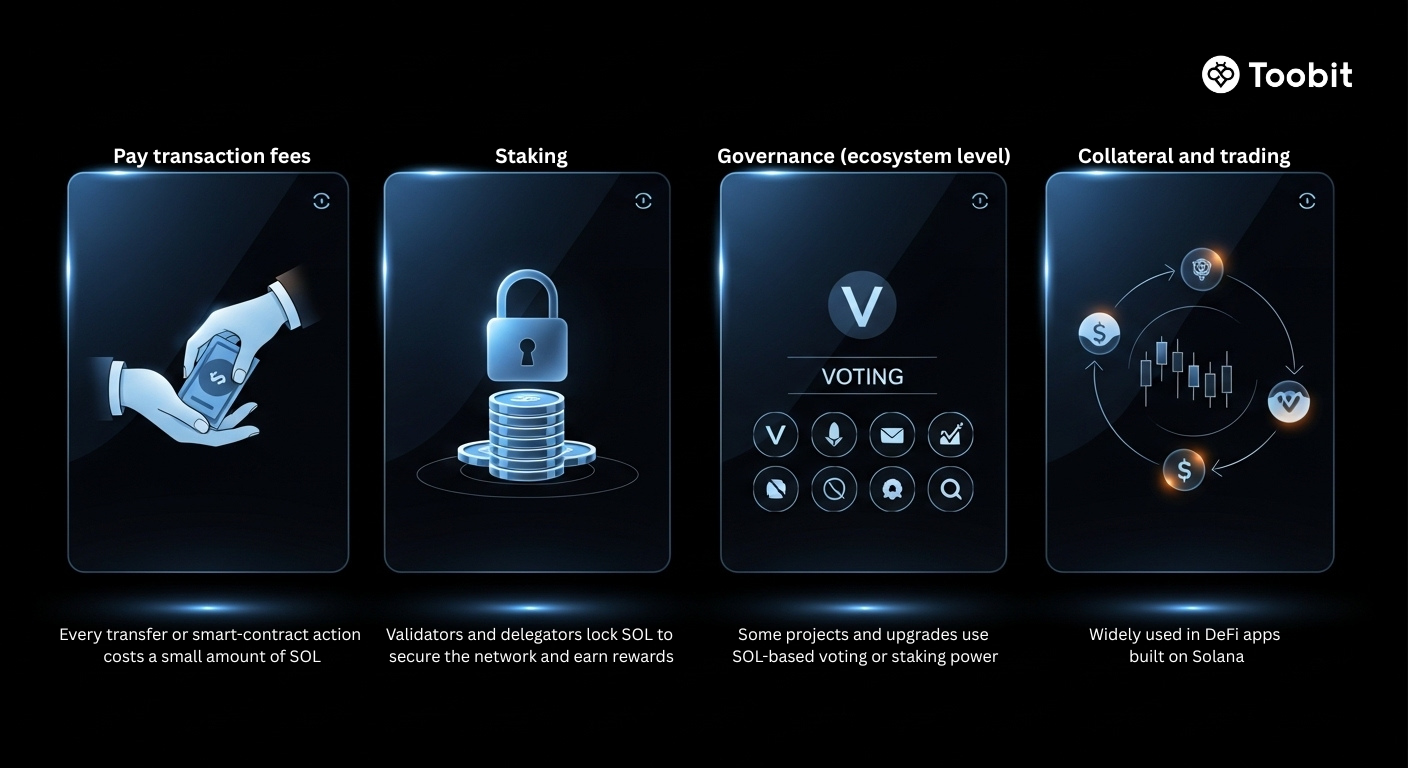
Here is what SOL is used for.
Source: Toobit
Who founded Solana?
The project was created in 2017 by:
Anatoly Yakovenko, former Qualcomm engineer
Alongside co-founders Greg Fitzgerald and Raj Gokal (systems + product backgrounds)
Yakovenko’s work in distributed systems shaped the design. He focused on how nodes agree on time, a major source of delay in many blockchains.
By introducing a verifiable timestamp system, the network could process transactions more efficiently and scale toward tens of thousands of transactions per second (TPS) under optimal conditions.
Basically, instead of validators constantly agreeing on order (slow), Solana timestamps history cryptographically (fast).
This idea became Proof-of-History (PoH).
So what is PoH?
PoH generates a cryptographic timeline: a cryptographic timestamp system that proves when events occur. It uses a verifiable delay function to create a sequence of hashes that cannot be reordered.
Think of it as a tamper-proof stopwatch everyone trusts.
Because validators do not debate ordering anymore since they already know the order of transactions, they can process many of them at the same time instead of waiting for each block to be confirmed.
Solana then combines PoH with Proof-of-Stake (PoS) consensus.
Result: fast agreement + fast execution.
How does Solana work?
Most blockchains must agree on transaction order before processing. Solana records order first, then processes transactions, which reduces waiting time.
Traditional chains do this:
-
Nodes talk
-
They argue
-
They agree
-
Then they process
Solana flips it:
-
Timestamp first
-
Process later
That timestamping system is PoH.
Key use cases of Solana
Solana is not just “Ethereum but cheaper.” It supports more than token trading; its speed and low fees allow different types of applications to run on-chain.
High-frequency trading and DeFi
Low fees (~$0.00025 average per transaction) make strategies like arbitrage actually possible again.
Consumer apps and payments
Because transactions finalize in seconds, Solana can support Web2-style apps:
-
On-chain games
-
Social networks
-
Micropayments
NFTs and digital assets
According to activity data on dappradar, Solana hosts major NFT ecosystems because minting costs cents instead of lunch money.
Tokenized real-world assets (RWAs)
Fast settlement enables tokenized stocks, RWAs, and stablecoin transfers where speed actually matters.
Decentralized Physical Infrastructure Networks (DePIN)
Networks like Helium (wireless coverage) and Hivemapper (mapping) use Solana to coordinate real-world devices and record activity on-chain at low cost.
Solana mobile
The Saga phone launched in 2023, followed by the announced Seeker device. These phones include a secure Seed Vault for private keys and a built-in dApp store for blockchain applications.
Advantages of Solana
Fast confirmation times
Blocks are produced roughly every 400 milliseconds, and transactions typically finalize within a few seconds, allowing applications to respond quickly.
Low fees
Average transaction costs are often around a fraction of a cent (commonly cited near $0.00025, though it varies with network activity).
Single-layer design
No rollups
No bridges (in theory)
No fragmented liquidity
The user experience feels closer to a normal app.
Developer flexibility
Parallel execution allows complex programs like games, exchanges, orderbooks to exist fully on-chain instead of half off-chain.
Limitations of Solana
Past outages
The network experienced several downtime events in earlier years.
“Why does Solana go down sometimes?” Good question.
Because high throughput requires high hardware requirements. Validators need powerful machines, which reduce decentralization compared to smaller nodes on slower chains.
Stability has improved recently, but reliability is still closely watched.
Complexity risk
Parallel execution is powerful but hard to program safely. Bugs become expensive fast.
Centralization concerns
Running a validator requires powerful hardware and bandwidth, which can limit who can participate.
How to buy Solana on Toobit
Buying Solana is more accessible than ever, thanks to the growing number of cryptocurrency platforms. One such platform is Toobit, a rapidly expanding cryptocurrency exchange that allows users to buy Solana easily and securely.
-
Sign up on Toobit: Create an account and complete the verification process. This helps secure your account and unlocks full features.
-
Deposit funds: Use various payment methods, including bank transfers and credit cards.
-
Buy Solana: Navigate to the trading section, select SOL, and place an order at the current market price or set a limit order.
Toobit’s intuitive interface and strong security features make it an excellent choice for both beginners and experienced traders.
Is Solana actually the future?
Here is the honest answer: it depends on what “future” means.
If the future is settlement security above all else, slower chains still win.
If the future is apps normal people actually use daily, Solana’s design makes more sense.
Solana is not without trade-offs, but it focuses on speed and throughput more than most networks today. Its design, especially the timestamp system and performance-focused engineering, sets it apart from many scaling approaches on other chains.
As with any digital asset network, higher performance also brings risk, so users should understand the trade-offs before using it.


